 William BensonVIEW PROFILE →
Inside the Mutiny That Nearly Toppled Niger's Military Government From Within
Hundreds of soldiers attacked the airbase, the state broadcaster, and the presidential palace itself, before loyalist forces, with help from Russia and Algeria, fought their way back in control.
Hundreds of soldiers attacked the airbase, the state broadcaster, and the presidential palace itself, before loyalist forces, with help from Russia and Algeria, fought their way back in control.
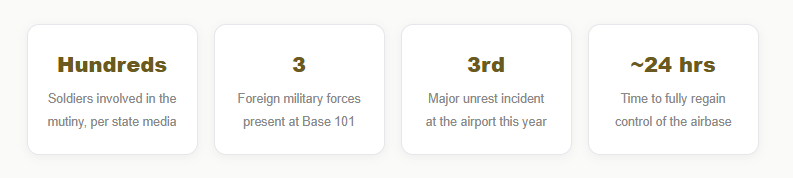
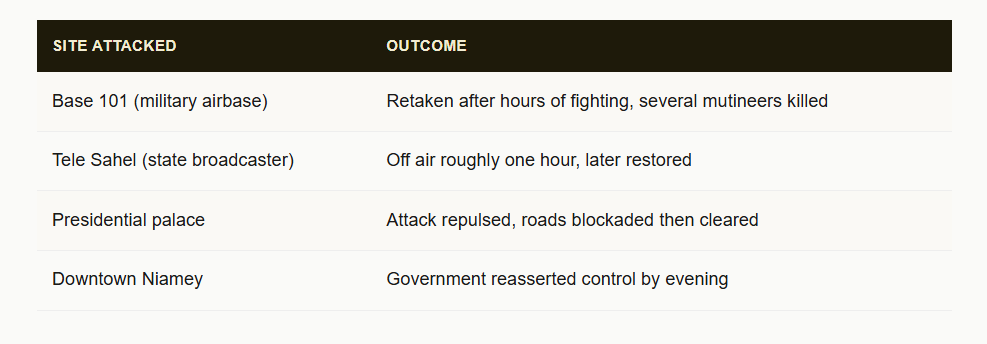
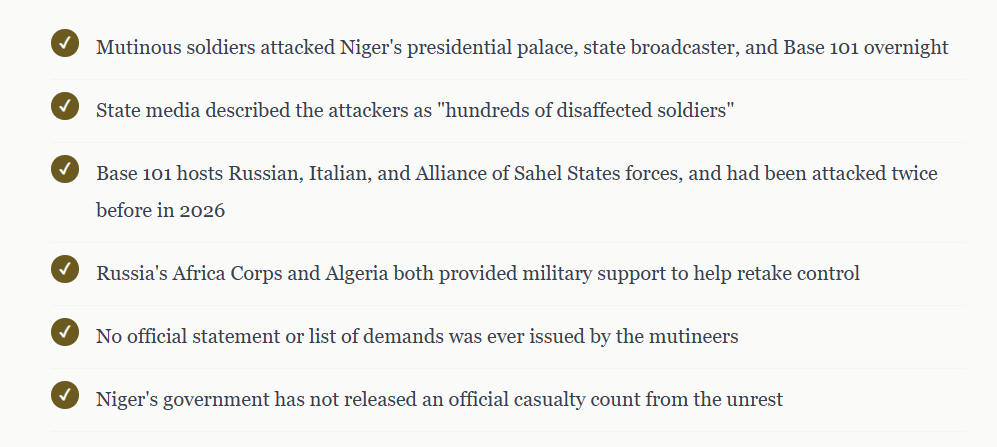
Just after midnight, the quiet of Niamey shattered. Gunfire first, then explosions rolling across the darkened skyline of Niger's capital, the kind of sound that makes residents reach for their phones instead of going back to sleep. By dawn, soldiers had blocked roads leading to the presidential palace, seized the national television station off the air, and laid siege to a military airbase that houses foreign troops from three different countries. This wasn't a foreign invasion or a jihadist assault, the kind of threat Niger has grown grimly accustomed to. This was Niger's own soldiers, turning their weapons on the government they serve. What unfolded over that weekend in late August 2026 became the most serious internal challenge Niger's ruling military junta has faced since it seized power in a coup three years earlier. Here's the full account of what happened, who was involved, and what it reveals about just how fragile the country's grip on stability actually is. How the Night Unfolded The violence began shortly after midnight on a Saturday, with sustained gunfire and explosions reported across multiple locations in Niamey almost simultaneously. Soldiers blocked access roads to the presidential palace and stormed the offices of Tele Sahel, the state broadcaster, which went dark for just over an hour before regaining transmission. Niger's Defence Minister, General Salifou Mody, later confirmed that a group of mutinous soldiers had taken fellow troops hostage inside a barracks before opening fire on what officials described only as several "sensitive sites" across the capital. Among the locations hit hardest was Base 101, a military airbase sitting inside the same complex as Niamey's international airport. The base isn't just any military installation, it currently serves as headquarters for Russia's Africa Corps operations in Niger and hosts the command structure for the joint counter-terrorism force belonging to the Alliance of Sahel States, the regional bloc uniting Niger with Mali and Burkina Faso. Italian forces are also stationed at the same complex, making it one of the most strategically sensitive sites in the entire country.
A Base That's Been Targeted Before
What makes this attack particularly striking is that it wasn't the first time Base 101 had come under assault in 2026 alone. The same facility had already been targeted twice earlier in the year, once in January by the regional Islamic State affiliate, and again in June by fighters linked to the regional al Qaeda branch. That pattern, three serious attacks on a single military complex within eight months, underscores just how persistently unstable the security situation around Niamey's airport has become, even before accounting for the added danger of an internal mutiny rather than an external jihadist strike.
Bana Wagana Ibrahim, a member of Niger's Bureau of the Consultative Council and a deputy in the Alliance of Sahel States parliament, addressed the situation directly on social media as the crisis unfolded, describing it as yet another attack on Base 101 and stating that Niger's defense and security forces had once again brought the situation under control.
"Another cowardly attack on Base 101, and once again our defence and security forces ensured the situation was brought under control." — Bana Wagana Ibrahim, Niger's Bureau of the Consultative Council
Outside Help Arrives Fast
Within hours of the fighting breaking out, Niger's government moved to bring in outside support, a telling sign of just how seriously officials were treating the threat. Russia's ambassador to Niger, Viktor Voropaev, confirmed in an interview with Russian state news agency TASS that Africa Corps, the Kremlin-controlled paramilitary force stationed at Base 101, had received an official request for assistance in neutralizing the mutineers.
Algeria also stepped in to help, with Niger's presidential office confirming that Algiers dispatched four fighter jets, a transport aircraft, and a refueling tanker to Niger the day after the fighting began. That kind of rapid, multinational military support arriving within roughly 24 hours illustrates how quickly this internal mutiny escalated from a domestic security matter into something drawing in regional and international military partners.
What the Mutineers Actually Wanted, Nobody Fully Knows
Perhaps the strangest detail in the entire episode is how little clarity exists about the mutineers' actual objectives. According to reporting citing a diplomat familiar with the situation, no official communication was ever issued by the rebelling soldiers explaining their demands or goals. That silence stands in contrast to more conventional coup attempts, where organizers typically make some public statement, however brief, laying out their grievances or intentions.
A source cited by the Financial Times indicated that the mutineers had managed to seize control of the airport itself along with Turkish-operated drones stationed there, as well as the state broadcaster and national radio, at least for a period during the fighting. Without any official statement from the rebels themselves, outside observers have been left largely piecing together motive from context: deep, longstanding frustration within Niger's armed forces over repeated battlefield losses in the ongoing fight against jihadist insurgents linked to both al Qaeda and the Islamic State.
Why army frustration has been building for years
Niger's military has absorbed years of difficult, often costly engagements against West Africa's al Qaeda and Islamic State affiliates, with the country consistently ranking among the deadliest fronts in the broader Sahel insurgency. Repeated battlefield setbacks, combined with the pressures of operating under a military government that itself came to power through a coup, have created exactly the kind of internal strain security analysts say can eventually boil over into open mutiny.
How the Government Regained Control
By late morning on Saturday, Niger's Ministry of Defence announced that armed forces were progressively retaking the sites hit during the overnight assault, although security sources cautioned at the time that mutineers remained present at the airport and that the overall situation was still far from resolved. According to accounts from Niger's state media, members of the Presidential Guard, working alongside Russian forces stationed in the country, recaptured the airbase by evening, with some mutineers reportedly killed in the process.
The following day, three separate security sources confirmed to Reuters that government forces had successfully retaken the airbase after what had amounted to hours of sustained fighting. By Sunday, residents described the capital as calm, with military aircraft circling overhead and authorities dismantling roadblocks that had been thrown up across the city during the height of the unrest. State television aired footage that it said showed surrendering mutineers, though outside news organizations were unable to independently verify those claims.
What remains uncertain
Niger's government has not issued an official casualty count from the mutiny, despite state media reports describing dozens of rebel soldiers as either killed or arrested during the fighting. Multiple civilians were also reported injured during the overnight violence, though independent verification of exact figures remains limited given restricted access and the fog surrounding fast-moving unrest of this kind.
Three Years of Instability Since the 2023 Coup
To understand why this particular mutiny matters so much, it helps to place it inside the broader arc of Niger's recent political history. The country's current military rulers, organized under what's known as the National Council for the Safeguard of the Homeland, seized power in a coup back in 2023, ousting the country's elected president and promising, as juntas typically do, to restore order and security. Three years on, that promise remains largely unfulfilled.
This weekend's mutiny marks yet another blow to a military leadership that has struggled consistently to deliver the stability it used to justify its own seizure of power in the first place. Coming on top of ongoing jihadist violence, economic strain from years of international sanctions following the coup, and now open rebellion from within its own ranks, the episode raises serious questions about how securely Niger's current government actually holds the reins of power, even three years into its rule.
Why the silence from the mutineers matters
In most coup attempts or organized mutinies, a public statement of grievances or demands typically follows fairly quickly, it's part of how rebelling factions try to build legitimacy or rally further support. The complete absence of any such statement here has left analysts and diplomats working with limited information about what specifically triggered this particular uprising, whether it was a narrow grievance within a specific unit or a broader expression of dissatisfaction across the wider armed forces.
What Comes Next for Niger
With the immediate fighting over and government forces back in control of the key sites targeted during the mutiny, attention now shifts to how Niger's military leadership responds in the aftermath. Questions remain about how the government will handle those captured, whether any structural changes will follow within the armed forces to address the underlying frustrations that apparently drove the mutiny, and how Niger's foreign partners, particularly Russia, whose Africa Corps forces played a direct role in suppressing the uprising, will factor into the country's security posture going forward.
What's clear is that this episode adds yet another layer of uncertainty to a country already navigating a punishing combination of insurgent violence, economic isolation, and internal political fragility. For a government that came to power promising order, a mutiny reaching the doorstep of the presidential palace itself is about as direct a challenge to that promise as it gets.