 William BensonVIEW PROFILE →
The Strange Case of Starlink in India: Every Green Light, and Still No Launch
Licenses cleared. Pricing published. Partnerships signed with both Airtel and Jio. Elon Musk himself keeps posting about it. And yet, four years after this whole saga kicked off, not a single Indian household can actually order the thing.
Licenses cleared. Pricing published. Partnerships signed with both Airtel and Jio. Elon Musk himself keeps posting about it. And yet, four years after this whole saga kicked off, not a single Indian household can actually order the thing.
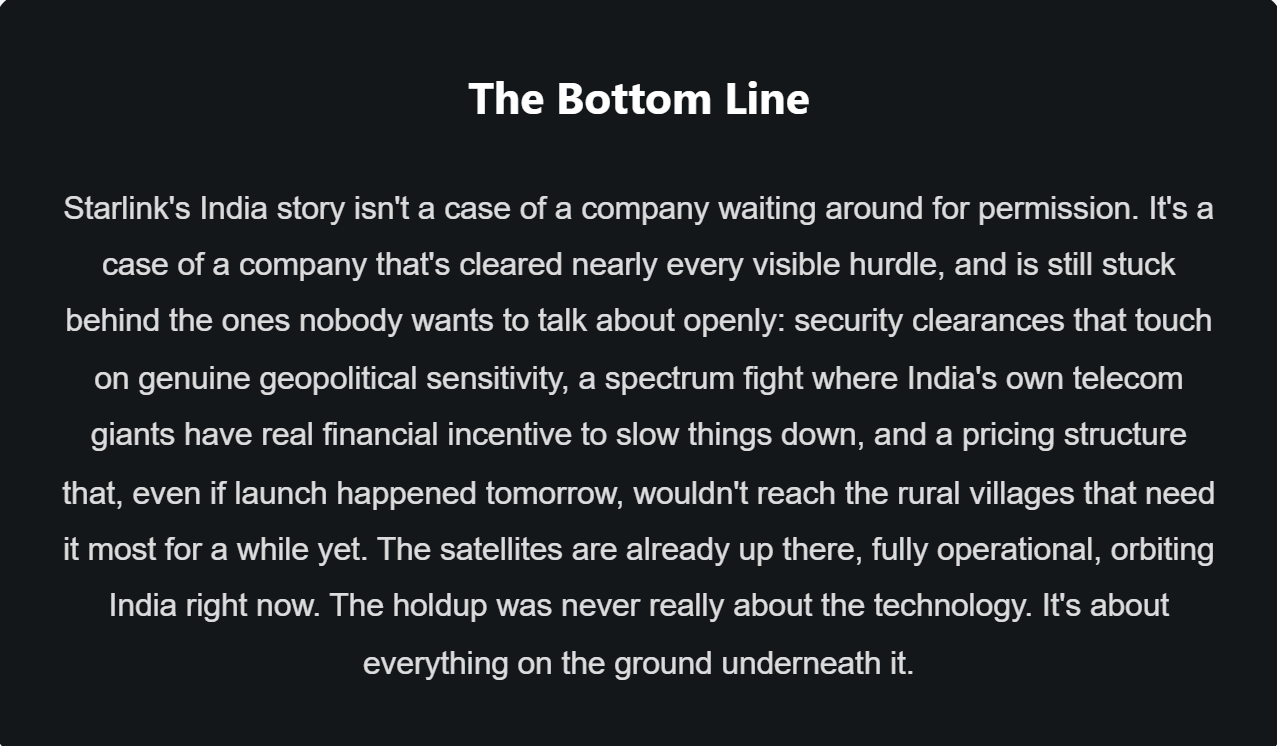
Here's a genuinely weird situation happening in the world's second-biggest internet market right now. Starlink has a license from India's telecom ministry. It has authorization from India's space regulator. It has signed partnerships with both of the country's biggest telecom players, who are normally bitter rivals fighting over every last customer. It even accidentally leaked its own India pricing on its website last December. By almost every visible metric, the hard part is done. And yet, as of late August 2026, you still cannot walk into a store, open an app, or visit a website and actually buy a Starlink connection in India. Something doesn't add up here, and once you dig into it, the real story turns out to be a lot more interesting than a simple "coming soon."
How This Whole Saga Even Started
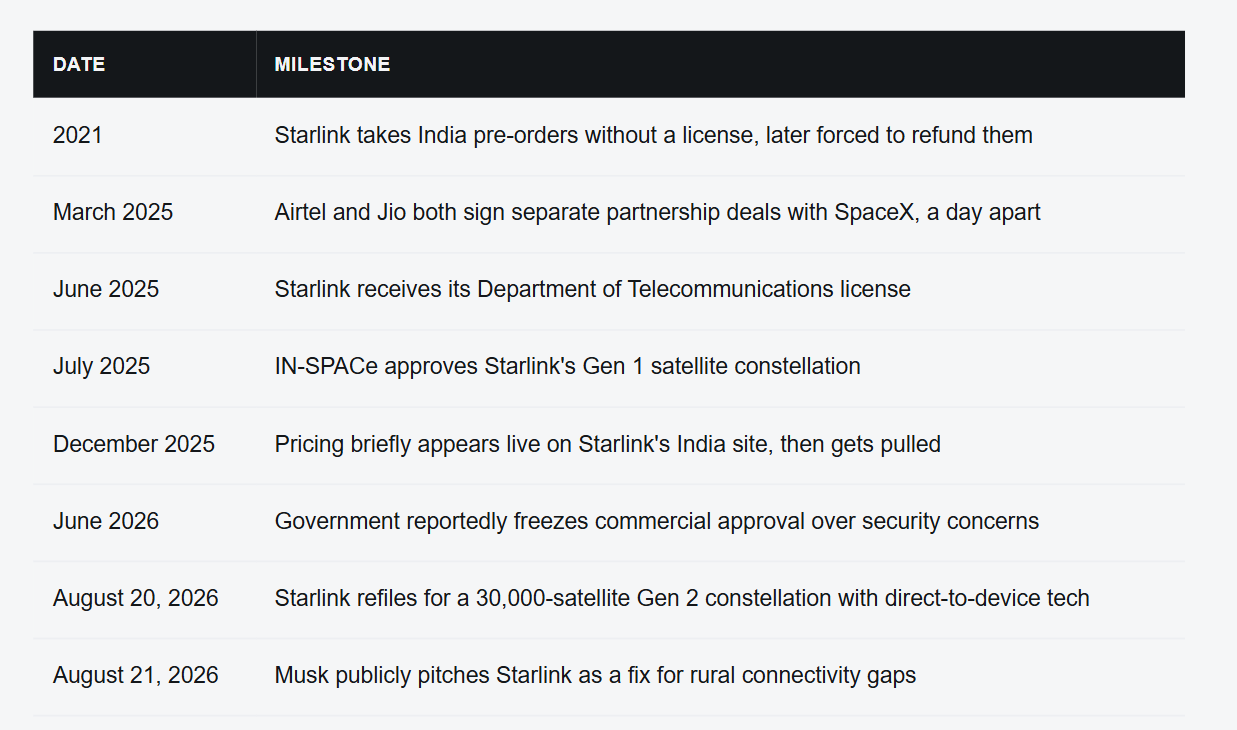
Elon Musk's satellite internet company first started circling India back in 2021, applying for pre-orders before it had any license to actually operate there, a move that got SpaceX publicly reprimanded by the Indian government and forced the company to refund every single deposit. That early stumble set the tone for what became a genuinely drawn-out, multi-year regulatory dance, one that's still not finished five years later.
The turning point everyone points to came in March 2025, when Bharti Airtel, India's second-largest telecom operator, announced a partnership to bring Starlink's service to the country, contingent entirely on regulatory approval. What made that moment notable wasn't just the deal itself, it was the timing. It landed just weeks after Prime Minister Narendra Modi met with President Trump in Washington, discussing space and technology cooperation between the two countries, and only a day before Reliance Jio, Airtel's biggest rival and the market leader by a wide margin, announced its own near-identical agreement with SpaceX. Watching Mukesh Ambani's Jio and Sunil Mittal's Airtel, two companies that spend most of their time trying to poach each other's customers, both rush to sign deals with the same foreign satellite company in the space of 24 hours told you exactly how much was riding on this for everyone involved.
When your two fiercest domestic rivals both scramble to strike near-identical deals with you within a single day of each other, that's not a coincidence. That's two companies who've each independently concluded they can't afford to be the one left standing outside the tent.
The Boxes That Actually Got Checked
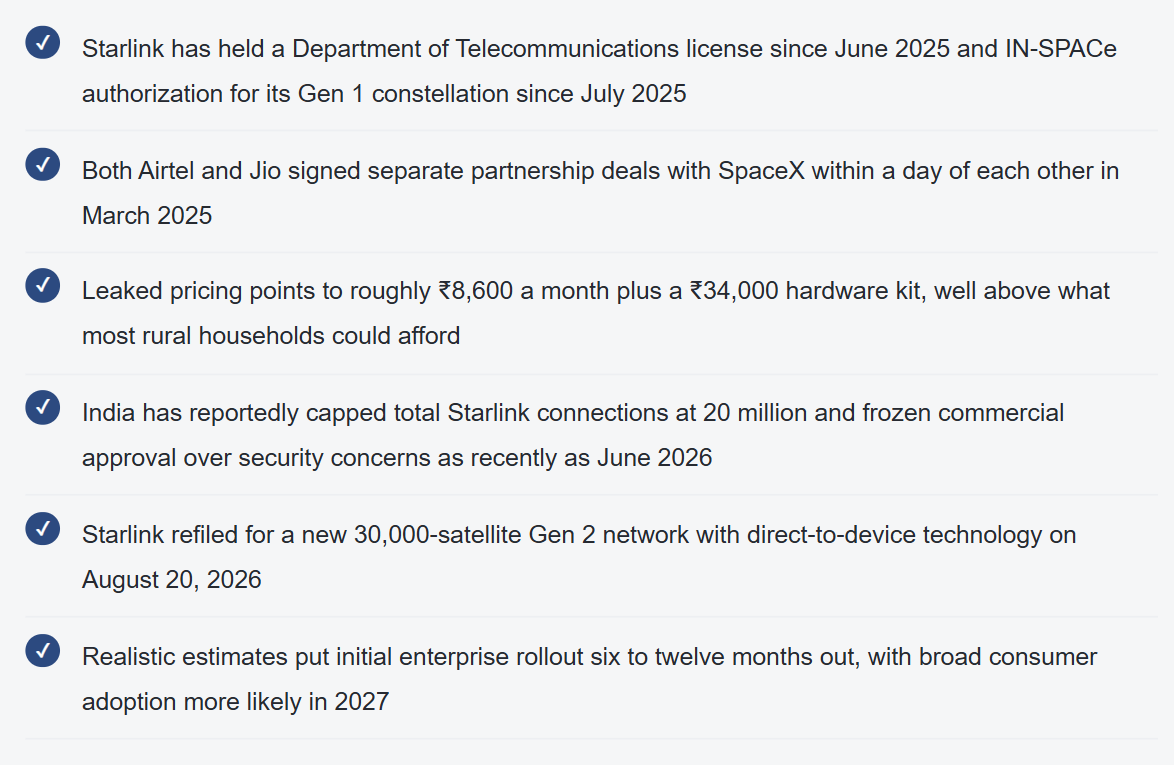
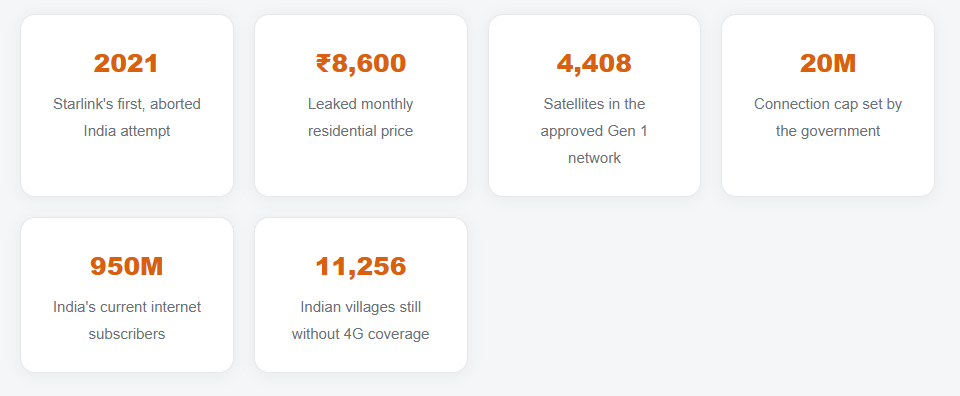
To be fair to Starlink, and to be clear about how far this has actually progressed, the regulatory wins here are real and substantial, not just paperwork theater. In June 2025, Starlink received its license from India's Department of Telecommunications, becoming the third company after Eutelsat OneWeb and Jio's own satellite venture to clear that particular hurdle. A month later, in July 2025, India's space regulator, the Indian National Space Promotion and Authorisation Centre, better known as IN-SPACe, granted Starlink authorization for its first-generation constellation, a network of 4,408 satellites orbiting between 540 and 570 kilometers above Earth, capable of delivering roughly 600 gigabits per second of throughput across the country.
Then came the pricing leak. In December 2025, eagle-eyed users spotted that Starlink's India website had briefly gone live with real numbers: a residential plan priced at roughly 8,600 rupees a month, plus a one-time hardware kit costing about 34,000 rupees, complete with promises of unlimited data, a 30-day trial, and 99.9% uptime. Starlink's own team called it a "config glitch," insisting the numbers were dummy test data and not final pricing, but the fact that a fully built, ready-to-publish pricing page existed at all told everyone the company genuinely believed launch was close at that point.
Meet the Third Wheel in This Story: OneWeb
While Starlink and Jio's own satellite venture were fighting through regulatory queues, one company quietly slipped ahead of both of them. Eutelsat OneWeb, in which Airtel's parent group is actually a major investor, already secured the key approvals it needed to begin offering satellite communication services in India, putting it in a genuinely awkward first-mover position relative to a Starlink partnership the same Airtel group was simultaneously pursuing. It's a small but telling detail: even the Indian telecom giant putting its name behind Starlink was hedging its bets with a completely separate satellite provider the whole time.

So What's Actually Holding This Up in 2026?
This is where the story stops being a straightforward regulatory checklist and starts getting genuinely tangled. Three separate, overlapping issues are keeping Starlink parked on the runway even now, and none of them have a clean, fast resolution in sight.
1. The Security Question Nobody's Fully Answering
Reports throughout 2026 have pointed to a specific, sensitive concern inside the Indian government: worries about how Starlink terminals have reportedly been used in active conflict zones elsewhere in the world, and whether Indian authorities would have adequate oversight and control if the same hardware were operating inside Indian borders. That concern reportedly led India to freeze approvals for Starlink's commercial operations as recently as June 2026, even after the earlier licenses had already been granted. It's the kind of national-security friction that doesn't resolve on a predictable timeline, because it isn't really a technical or commercial question at all.
2. The Spectrum Fight That Splits the Whole Industry
Underneath the security debate sits an even messier fight over money and market fairness. India's telecom regulator has been wrestling with whether satellite spectrum should be allocated administratively, essentially assigned by the government based on set criteria, or auctioned off to the highest bidder the way traditional mobile spectrum has been. Reliance Jio, sitting on the country's largest terrestrial mobile network, has pushed hard for an auction model, arguing that handing satellite players cheaper, administratively assigned spectrum would be unfair to companies that paid enormous sums for traditional airwaves. Complicating things further, the government has floated a roughly 4% spectrum usage fee tied to adjusted gross revenue, on top of an 8% license authorization fee, a combination that could push Starlink's realistic monthly pricing in India above 4,200 rupees, considerably steeper than what the company charges in a comparable market like Bhutan.
The connection cap almost nobody talks about
Buried in the regulatory framework is a detail that could matter enormously once service actually starts: the Indian government has reportedly capped the total number of Starlink connections in the country at 20 million. On paper, that's a huge number. Against a market of nearly 1.4 billion people and roughly 950 million existing internet subscribers, it's actually a pretty tight ceiling, one apparently designed specifically to protect the market share of India's existing telecom giants rather than let satellite internet scale freely.
3. The August 2026 Twist: Starlink Reapplies From Scratch
Just as things seemed stalled, Starlink threw a curveball. On August 20, 2026, the company submitted a fresh application to IN-SPACe, this time for an entirely different, far more ambitious network: a Generation 2 constellation of nearly 30,000 satellites, operating at lower altitudes between 340 and 615 kilometers, and crucially, including direct-to-device technology that would let ordinary smartphones connect straight to satellites without needing any specialized dish or hardware at all. It's worth noting Starlink had actually tried this before. An earlier Gen 2 application had already been rejected by IN-SPACe over technical non-compliance with Indian frequency-band requirements, which is exactly why this refiled version exists.
The very next day, Musk posted on X, arguing that Starlink "would help the least served in India, especially in rural areas," a comment that landed pointedly the day after the new filing and read, to most observers, less like a spontaneous thought and more like carefully timed public pressure aimed at regulators still sitting on the existing approvals. Whether or not that reading is fair to Musk, the sequencing was hard to miss.

Why This Actually Matters for Ordinary Indians
Strip away the corporate maneuvering, and the underlying case for Starlink in India is genuinely compelling. As of May 2026, more than 11,000 villages across the country still had no 4G coverage whatsoever, and the gap between urban and rural internet access remains stark despite India's overall internet subscriber base climbing past 950 million people. Laying fiber or building new cell towers into remote, mountainous, or sparsely populated regions is expensive and slow in a way that beaming a signal down from orbit simply isn't. That's the pitch Musk keeps making, and on its face, it's not wrong.
The catch is that the leaked pricing, even before any additional spectrum fees get layered on, already puts Starlink well outside what most rural Indian households could realistically afford. A monthly bill north of 8,000 rupees, on top of a hardware kit costing more than 30,000 rupees upfront, is a genuinely steep ask in a country where a meaningful share of the population most in need of this exact service also has the least disposable income to pay for it.
Industry analysts have flagged this tension directly: satellite internet in India is shaping up to launch as a premium, urban-adjacent product first, with its most compelling use case, actually reaching the underserved countryside, sitting furthest down the affordability curve.
What Realistically Happens From Here
Industry watchers who track this space closely have offered a fairly consistent read heading into the back half of 2026: initial commercial and enterprise-focused rollouts are plausible within the next six to twelve months if the outstanding approvals move forward, but genuine consumer-scale adoption is a longer runway, likely stretching into 2027, as operators still need to build out distribution networks, install satellite gateways, and bring equipment costs down from where they currently sit. In other words, even in the most optimistic realistic scenario, "Starlink is finally live in India" and "Starlink is actually accessible to the rural households that need it most" are probably two different milestones, arriving years apart from each other.