 William BensonVIEW PROFILE →
"Lake of America": Inside Trump's Wildest Executive Order Yet and Canada's Perfect Comeback
A two-story sign, a Santa Claus insult, and geese memes with blond hair. Welcome to the strangest chapter yet in the US-Canada trade war.
A two-story sign, a Santa Claus insult, and geese memes with blond hair. Welcome to the strangest chapter yet in the US-Canada trade war.
Some political headlines make you do a double take, and this is one of them. On a Thursday afternoon in the Oval Office, flanked by giant maps with one of the Great Lakes freshly relabeled, President Trump signed an executive order renaming Lake Ontario "Lake America." It sounds almost too strange to be real. It is real, it's tangled up in a genuinely serious trade war with one of America's oldest allies, and Canada's response, a two-story sign planted right on the shoreline, has already become the moment everyone's talking about. What Actually Happened in the Oval Office On Thursday, August 27, 2026, Trump signed an executive order directing the Interior Department to officially rename Lake Ontario "Lake America" across US federal maps and databases. He'd been floating the idea for days on social media as tensions with Canada escalated, and when the moment finally came, he didn't hold back on the theatrics. Flanked by large maps of the Great Lakes, one titled "Making the Great Lakes Even Greater" with the new "Lake America" label already stamped over Lake Ontario, Trump declared the change "effective immediately." "I've been thinking about this for a long time," Trump told reporters. "We have a gulf and we have a lake. Now, all we need is an ocean. So, maybe we'll have to change the name of the Atlantic and/or the Pacific." The order itself leans on a geographic technicality for justification, arguing that because the "deepest parts of the Lake's waters" sit within US territory, America "claims most of the Lake's volume." It's the same legal playbook Trump used last year to rename the Gulf of Mexico the "Gulf of America," and the order actually gives federal agencies 30 days to implement the change, despite Trump's insistence it was already official on the spot.
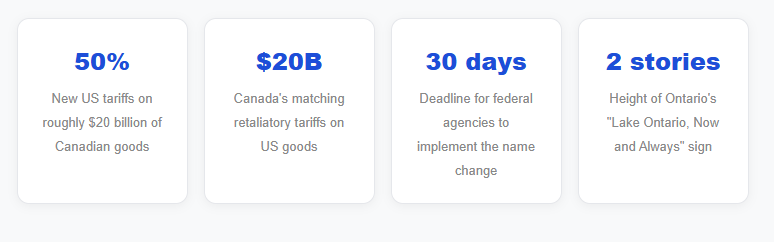
None of this happened in a vacuum, and understanding the trade dispute underneath it is genuinely important. Trade talks between Washington and Ottawa collapsed last Friday evening, and Trump responded over the weekend by imposing 50 percent tariffs on roughly $20 billion worth of Canadian goods. Canada answered almost immediately with "dollar for dollar" retaliatory tariffs of up to 50 percent on American imports, originally set to take effect September 8, though Canada trimmed some of those measures targeting seafood and fish products midweek specifically "to protect against broader economic harms."
The practical fallout is landing on real products people actually buy. Canada's retaliatory list includes steel, dairy products, appliances, and farm equipment, exactly the kind of goods that show up in grocery bills and big-ticket purchases alike. Canadian Prime Minister Mark Carney acknowledged directly that the new round of tariffs "could still raise costs and reduce choices for consumers," even as Trump dismissed concerns that the dispute might worsen affordability problems already squeezing American households.
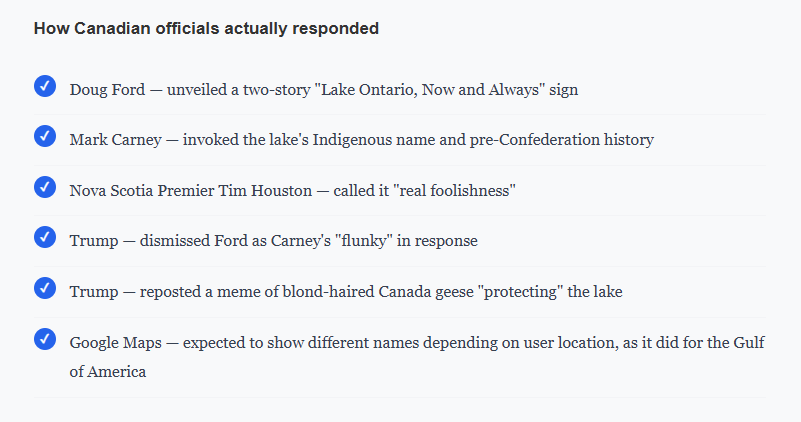
Canada's Response: Ridicule, Not Outrage Here's where the story takes its most memorable turn. Rather than firing back with anger, Canadian leaders largely chose mockery, and Ontario Premier Doug Ford delivered the moment that's now dominating headlines on both sides of the border. On Saturday, wearing a Team Canada soccer jersey, Ford unveiled a genuinely massive sign near Grimsby, Ontario, a 24-by-12-foot billboard reading "Lake Ontario. Now and Always," its top standing roughly 18 feet off the ground, about two stories high, with the message repeated in French for good measure. Prime Minister Mark Carney took a more historically grounded approach, invoking the lake's Indigenous roots directly. "Canadians also know that naming reality means calling it Lake Ontario, then, now and always," Carney wrote, noting the name predates both Canadian Confederation and the US Declaration of Independence. The name actually traces back to the Huron Indigenous word "oniatarí:io," meaning "lake of shining waters," and the Canadian province of Ontario, founded in 1867, took its own name directly from the lake.
Trump's Fired-Back Insults Got Personal Fast
The exchange didn't stay lighthearted for long. Trump dismissed Ford's comments as "bluster," calling him Carney's "flunky" and, in a notably personal jab, describing him as the "less charismatic, intelligent, and overall unimpressive brother" of the late Toronto Mayor Rob Ford. Trump kept the momentum going through the weekend, reposting a meme depicting Canada geese with Trump-style blond hair, rifles in wing, standing guard to "protect" the newly christened Lake America.
It's a pattern Trump has leaned on repeatedly in this dispute: using maps as a political weapon. A "Gulf of America" map sat displayed beside the Resolute Desk in the Oval Office for a stretch after that earlier renaming, and Trump has separately posted images depicting Canada as though it were already absorbed into the United States as a 51st state.
Can Trump Actually Force This Name Change to Stick?
This is the part worth understanding clearly, because it shapes everything else about this story. The president has genuine, real authority over how the US federal government refers to geographic landmarks domestically, the same power he used to rename the Gulf of Mexico last year. What he cannot do is force Canada, or any other country, or international mapping bodies, to adopt the new name. After the Gulf of Mexico renaming, Mexican officials flatly rejected it and kept using the original name, and Google ultimately split the difference, showing "Gulf of America" to US-based map users while Mexican users continued seeing "Gulf of Mexico."
That same split-screen outcome is almost certainly coming for Lake Ontario. Expect US government documents, federal maps, and likely US-based Google Maps users to eventually show "Lake America," while Canadian maps, Canadian government documents, and basically the entire rest of the world keep calling it exactly what it's been called for centuries.
Part of a Bigger, Longer Pattern With Canada To understand why this particular jab landed the way it did, it helps to zoom out. Trump has been needling Canada consistently since returning to the White House, repeatedly floating the idea that America's northern neighbor, a country with which the US once maintained genuinely warm relations, should instead just become the 51st state. That framing has resurfaced constantly throughout the current trade dispute, and it's exactly why Canadian officials treated the "Lake America" order less as a serious geographic proposal and more as the latest chapter in an ongoing pattern of provocation. It's also worth noting the political texture back home. Not every Republican has been thrilled with the escalating trade fight. Maine Senator Susan Collins, currently in a tight reelection race, called the Canada tariffs "a mistake" earlier in the week, a reminder that the economic fallout from this dispute is landing unevenly across the US political map, particularly in border states and states with deep economic ties to Canadian trade. A Few Honest Questions People Are Actually Asking Will Lake Ontario's name actually change on my map app? If you're in the US, quite possibly, similar to what happened with the Gulf of Mexico rename. If you're in Canada or most of the rest of the world, almost certainly not, since Trump's authority only extends to how the US federal government refers to the lake. Will these tariffs actually raise prices for regular people? Yes, on both sides of the border. Carney has directly acknowledged Canada's retaliatory tariffs could raise costs and limit consumer choices, and US tariffs on Canadian goods like steel and dairy typically get passed along to consumers in the form of higher prices too. Is this dispute likely to get resolved soon? There's no clear indication of that as of this writing. Talks broke down entirely last Friday, both countries have implemented retaliatory tariffs, and Trump has explicitly threatened further escalation if Canada doesn't back down, suggesting this fight has real room to continue. Why This Moment Captured So Much Attention Strip away the trade policy and the tariff percentages, and what's really driving this story's viral spread is the sheer, almost cartoonish contrast at its center: a serious economic dispute between two major trading partners, expressed through a lake's name and a two-story roadside sign. That combination, real economic stakes wrapped in genuinely absurd political theater, is exactly the kind of moment that cuts through the usual news cycle noise and gets shared, mocked, and memed across both countries simultaneously. Whatever happens with the actual tariffs, and however the map labeling eventually shakes out, Doug Ford's billboard-sized rebuttal has already secured its place as one of the more memorable moments of this entire trade standoff, proof that sometimes the sharpest political response isn't outrage. It's just putting up a bigger sign. A note on this coverage This dispute remains actively developing as of late August 2026, with Canada's retaliatory tariffs set to take effect September 8 and no clear resolution in sight. Details here reflect reporting from NBC News, CNN, ABC News, NPR, PBS, and the Associated Press as of August 29-30, 2026, and specifics may continue to shift.