 William BensonVIEW PROFILE →
Liftoff: NASA's Roman Space Telescope Just Left Earth to Hunt Dark Energy
A million miles from home, a telescope 100 times sharper than Hubble's field of view is about to start mapping the universe like never before.
A million miles from home, a telescope 100 times sharper than Hubble's field of view is about to start mapping the universe like never before.
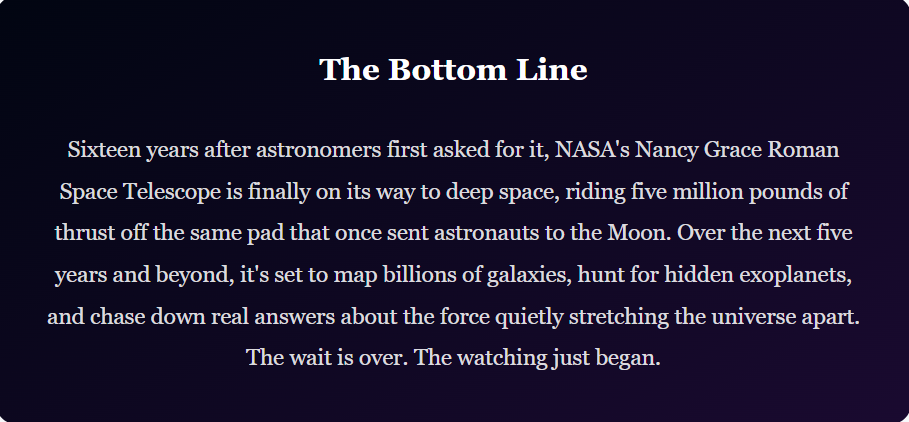
At 7:26 a.m. Eastern on Sunday morning, three fire-breathing boosters ripped off the pad at Kennedy Space Center and sent one of NASA's most ambitious science missions in a generation on its way to deep space. Sixteen years after astronomers first asked for it, the Nancy Grace Roman Space Telescope is finally airborne, and it's headed somewhere no camera has ever mapped quite this way before.
If you've been half-following the headlines about "the next Hubble" for the last few years, here's the moment that name finally means something. Roman isn't a replacement for Hubble or James Webb. It's something closer to their wide-angle cousin, built to do a job neither of those legendary observatories can pull off: survey enormous swaths of sky, fast, and catch everything from runaway black holes to planets orbiting stars trillions of miles away.

A Perfect Morning for a Sixteen-Year Wait
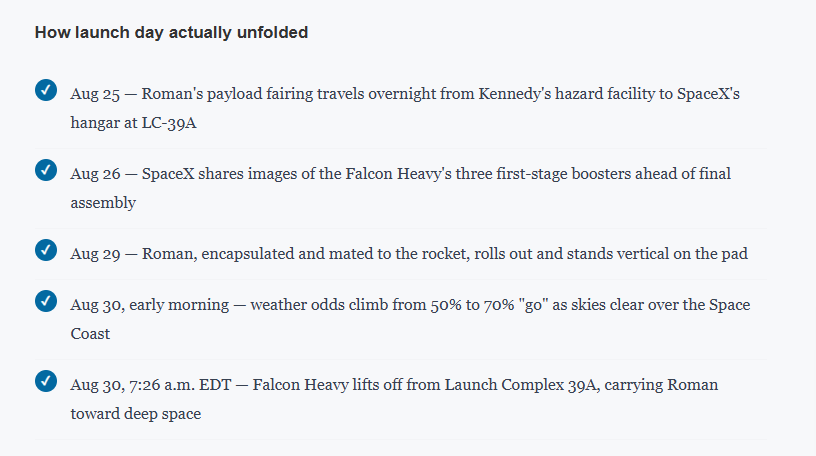
Launch day didn't start with certainty. As recently as Saturday, cloudy weather over Florida's Space Coast had pushed the U.S. Space Force's 45th Weather Squadron's launch probability down to just 50 percent. By Sunday morning, though, the skies cooperated, clearing enough to push the "go" call up to 70 percent, and eventually, all the way to liftoff.
Roman lifted off from Launch Complex 39A, the same historic pad that sent Apollo 11 to the Moon and dozens of Space Shuttle missions into orbit, riding on top of a SpaceX Falcon Heavy. That rocket's three first-stage boosters, essentially three modified Falcon 9s strapped together, combined to generate more than five million pounds of thrust at liftoff, enough to push the telescope rapidly through the atmosphere and set it on a course toward one of the most scientifically valuable parking spots in the solar system.
Where Exactly Is This Thing Going?
Roman isn't headed for low Earth orbit like the International Space Station, or even the roughly 340-mile-high perch Hubble calls home. Its destination is Sun-Earth Lagrange Point 2, a gravitationally stable spot located nearly a million miles from Earth, in the opposite direction from the Sun. It's the same neighborhood James Webb Space Telescope has called home since 2022, chosen for the same reason: at L2, a spacecraft can keep the Sun, Earth, and Moon all behind it, giving its instruments an unobstructed, consistently cold view of deep space without needing constant course corrections to stay in position.
Once it settles into that halo orbit, likely sometime in the coming months, Roman will begin a mission designed to last at least five years, and quite possibly much longer, based on how well its predecessor missions have historically outlived their planned lifespans.
Roman's Wide-Field Instrument is a 300.8-megapixel camera capable of capturing images as sharp as Hubble's, but across a field of view roughly 100 times larger, meaning a single Roman image can cover in one shot what would take Hubble around a hundred separate pointings to map.
What Roman Is Actually Built to Find
Two enormous scientific questions sit at the center of this mission, and they couldn't be more different in scale. The first is almost impossibly big: what is dark energy, the mysterious force that appears to be accelerating the expansion of the entire universe? Roman will spend years tracking the light from billions of galaxies, using subtle patterns in that light to help cosmologists test competing theories about dark energy's nature, and by extension, the ultimate fate of the cosmos itself.
The second question is almost the opposite in scale: are there planets, potentially even Earth-sized ones, orbiting stars far beyond our solar system? Roman will hunt for them using a technique called gravitational microlensing, watching for the tiny, temporary brightening that happens when a distant star's light bends around a foreground planet's gravity. It's a method that's especially good at catching planets that other techniques tend to miss, including ones orbiting far from their host stars, more like Jupiter and Saturn than Mercury or Venus.
Alongside those two flagship goals, Roman carries a secondary instrument, the Coronagraph, a technology demonstration designed to block out a star's overwhelming glare well enough to directly photograph the faint planets orbiting around it, a notoriously difficult feat that could inform the design of future planet-hunting telescopes for years to come.
A Name Sixteen Years in the Making
Roman's story didn't start on a launch pad. It began in 2010, when the National Research Council's once-a-decade astronomy priorities survey first recommended building it, under the far less catchy name Wide-Field Infrared Survey Telescope, or WFIRST. It later took on the name it carries today in honor of Dr. Nancy Grace Roman, NASA's first chief of astronomy and the driving force behind the agency's earliest space-based observatories, a legacy that earned her the affectionate nickname "the mother of Hubble" among colleagues.
Fittingly, Roman's primary mirror is exactly the same size as Hubble's, 2.4 meters wide, though the two telescopes serve very different purposes. Where Hubble was built to zoom in tight on individual objects with extraordinary detail, Roman was built to zoom out, scanning huge sections of sky quickly enough to catch rare, fleeting cosmic events that a narrower field of view would almost certainly miss entirely.
Questions People Are Actually Asking
Is Roman meant to replace Hubble or James Webb? No. All three are designed to complement each other rather than compete. Hubble and Webb excel at detailed, close-up observations of specific targets. Roman's specialty is breadth, surveying massive areas of sky rapidly, which makes it exceptionally good at finding rare events and objects that narrower-view telescopes would likely never spot at all.
How long until Roman starts sending back data? After launch, Roman still has to complete its roughly month-long journey to Lagrange Point 2, followed by a commissioning period where engineers test and calibrate its instruments. Based on comparable missions like James Webb, that process typically takes several months before the telescope begins full science operations.
Why does the launch site matter? Launch Complex 39A carries genuine historical weight in American spaceflight — it's the same pad that launched Apollo 11 to the Moon in 1969 and supported the majority of NASA's Space Shuttle missions, making it a fitting starting point for a telescope built to push the boundaries of what astronomers can observe.
Why This Launch Actually Matters
It's easy for a space launch to blur into the general noise of "another rocket went up." This one is worth separating from that noise. Roman represents one of NASA's flagship-class missions, the same tier of ambition and cost that produced Hubble and James Webb, and it's arriving at a moment when both dark energy and exoplanet science have matured enough to know exactly what kind of data would move each field forward the most. This telescope was purpose-built to generate precisely that data, at a scale no previous mission could manage.
What happens next unfolds slowly, by design. Roman will spend the coming weeks coasting toward L2, followed by months of instrument calibration before its cameras start doing real science. But the hardest, least forgiving part, the sixteen-year journey from a decadal survey recommendation to a working spacecraft screaming off a launch pad on five million pounds of thrust, is now, as of this morning, finally done.
A note on this reporting
Details in this piece reflect NASA's official mission pages, live launch coverage from NASA and Space.com, and Wikipedia's mission summary, current as of the August 30, 2026 launch. Post-launch milestones, including arrival at L2 and the start of science operations, will be updated by NASA in the weeks and months ahead.