 William BensonVIEW PROFILE →
Not Jihadists This Time: Niger's Junta Just Survived a Mutiny From Its Own Soldiers
Hundreds of disaffected troops opened fire on the presidency and a military airbase in Niamey. What that says about the state of Niger's army is bigger than the attack itself.
Hundreds of disaffected troops opened fire on the presidency and a military airbase in Niamey. What that says about the state of Niger's army is bigger than the attack itself.
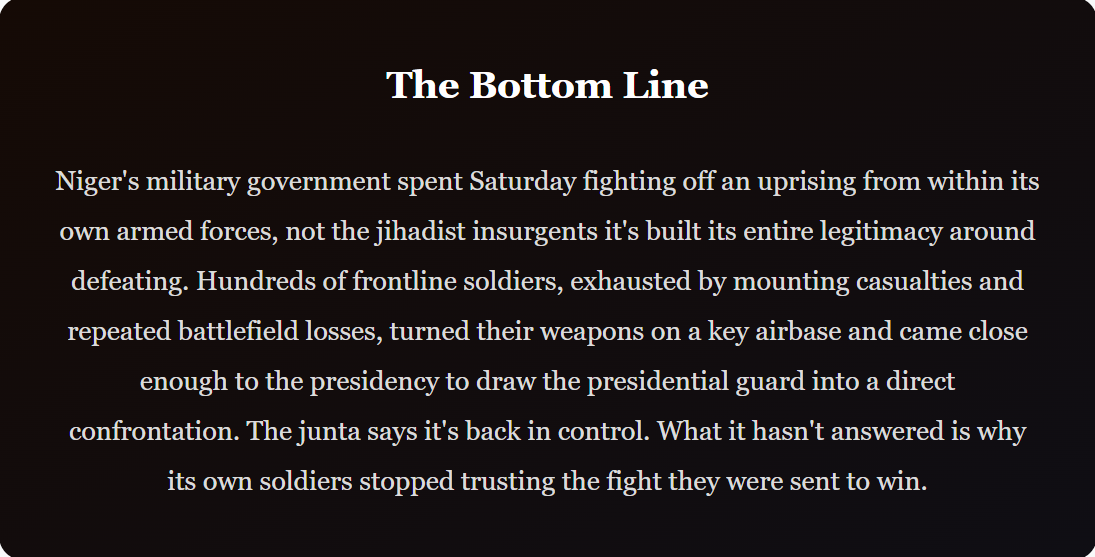
For a few tense hours before dawn broke over Niamey on Saturday, nobody outside Niger's inner security circle actually knew who was shooting, or why. Explosions rattled the capital. Gunfire echoed near the presidential palace and the international airport. The first assumption, given the country's recent history, was that West Africa's jihadist insurgents had struck again. They hadn't. This time, the threat came from inside the barracks. What unfolded was a mutiny, soldiers turning their weapons against their own command structure, and it landed as one of the clearest signals yet that Niger's military government is under pressure from a direction it can't simply fight its way out of.
How Saturday Actually Unfolded
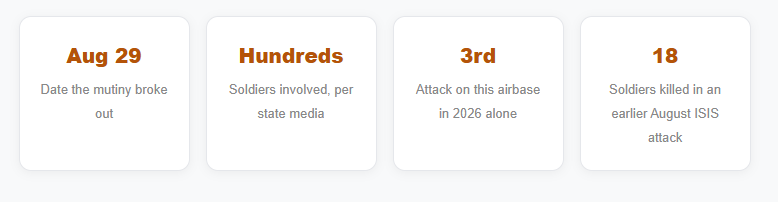
The trouble started overnight at Base 101, a military installation sitting next to Niamey's Diori Hamani International Airport, a site that also hosts the headquarters of the joint Niger-Burkina Faso-Mali military force, and, notably, stations both Russian and Italian forces. According to Niger's Defence Minister General Salifou Mody, a group of soldiers there broke military regulations, attempted to detain fellow soldiers, and opened fire on what officials described as "sensitive sites" across the city.
Sustained gunfire and explosions rang out for hours. Separately, security sources told AFP that "insurgents from within the armed forces" tried to force their way into the presidential palace itself, only to be repelled by the presidential guard. State broadcasting was temporarily disrupted during the chaos, and a major road leading into Niamey was closed as security forces moved to contain the situation. Confusion reigned for much of the day: initial reports genuinely couldn't confirm whether this was a jihadist assault or an internal military revolt, a distinction that took hours of official statements to resolve.

Who Was Actually Involved
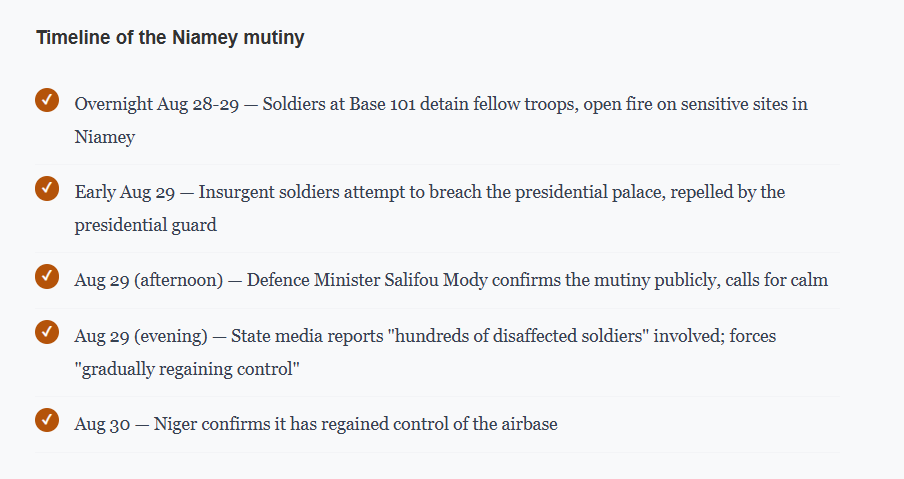
This wasn't an isolated cell acting alone. Reuters reporting indicated the mutineers' operation drew soldiers based in Niamey itself alongside troops from Ouallam, Téra, and Dosso, localities where Niger's army has taken particularly heavy casualties fighting jihadist groups in recent months. That detail matters, because it points toward the mutiny's underlying cause: not a coordinated coup attempt against Tiani specifically, but what analysts and security sources describe as mounting frustration within frontline units exhausted by repeated battlefield losses.
The whereabouts of Niger's military ruler, Abdourahamane Tiani, who seized power in a 2023 coup, weren't immediately confirmed during the height of Saturday's unrest, adding another layer of uncertainty to an already chaotic day for a government that has spent more than two years consolidating its grip on power.
This marks at least the third attack on the Base 101 airbase complex in 2026 alone, following separate assaults earlier in the year by the regional Islamic State affiliate in January and the regional al Qaeda affiliate in June, before Saturday's mutiny came from within the ranks itself.
A Government Fighting a War on Two Fronts
To understand why soldiers might turn against their own command structure, you have to understand the position Niger's military has actually been in. Since Tiani's coup in 2023, the government has severed longstanding security ties with Western partners, particularly France and the United States, and pivoted instead toward Russia, deepening cooperation with Russia's Africa Corps while formally breaking with the regional ECOWAS bloc.
That pivot hasn't solved the country's core security problem. Niger's armed forces, even with Russian support, have remained overstretched across multiple fronts battling West Africa's al Qaeda and Islamic State affiliates in the Sahel, and the human cost has been steep. Earlier in August alone, a separate Islamic State assault killed eighteen soldiers, part of a pattern of mass-casualty attacks against Niger's military that has intensified over the past year. Before the 2023 coup, Niger had actually been considered the West's last reliable regional partner in the fight against Sahel jihadist groups, a role the junta has since abandoned in favor of self-reliance that frontline soldiers appear increasingly unconvinced is working.
Why This Matters Beyond Niger's Borders
Niger isn't an isolated case in the region. It sits alongside Burkina Faso and Mali as one of three neighboring Sahel countries currently under military rule following a string of coups, all three struggling with the same core problem: insurgent violence that keeps escalating despite years of military governance specifically justified, in each case, as a more effective response to exactly this kind of insecurity. A mutiny inside Niger's own armed forces undercuts that core justification directly, suggesting the junta's approach hasn't actually stabilized the security situation enough to keep its own soldiers confident in the chain of command.
The strategic sensitivity of the target adds another layer. Base 101 doesn't just serve Niger's air force, it hosts the operational headquarters for the joint Niger-Burkina Faso-Mali military alliance these three juntas have built specifically to coordinate regional security independent of Western involvement. An attack, from any direction, on that particular site strikes at the physical infrastructure underpinning the Sahel's entire post-coup security arrangement.
Questions People Are Actually Asking
Was this an attempted coup against Tiani specifically? Officials have characterized it as a mutiny rather than a coup attempt, soldiers breaking discipline and attacking specific sites rather than a coordinated effort to seize the presidency itself, though the attempted breach near the presidential palace complicates a fully clean distinction between the two.
Is the security situation in Niamey stable now? Niger's government confirmed on August 30 that it had regained control of the airbase, and state media described calm largely returning to the capital, though sporadic gunfire was still reported even after the main confrontation ended. A confirmed casualty count from the mutiny itself had not been released as of this writing.
Why would soldiers mutiny against a government they helped install? Reporting points to mounting frustration within frontline army units over repeated battlefield losses and mass casualties fighting jihadist groups, rather than an ideological break with the junta's broader direction. Soldiers from hard-hit frontline localities like Ouallam, Téra, and Dosso were specifically identified among the mutineers.
What This Actually Tells Us
Strip away the initial confusion over who was attacking whom, and Saturday's events in Niamey point to something more structurally significant than a single contained incident. Niger's military government built its legitimacy on the promise that a junta, unconstrained by the political compromises of the ousted civilian government, could fight the country's jihadist insurgency more effectively. Two and a half years later, the insurgency hasn't meaningfully receded, casualties among frontline troops keep mounting, and now the very soldiers that promise depended on have turned their weapons on the base sitting right next to the seat of power.
Whether this specific mutiny stays a contained, one-off incident or becomes the first visible crack in a wider pattern of military discontent is the question security analysts across the Sahel will be watching closely in the weeks ahead. For a government that has staked everything on the claim that military rule delivers stability, an uprising from inside its own ranks is a difficult story to control.
A note on this reporting
Details in this piece reflect statements from Niger's Defence Ministry and reporting from Reuters, Africanews, AFP, and regional outlets current as of August 30, 2026. Casualty figures and the full scope of those involved in the mutiny had not been officially confirmed as of this writing and may be updated as more information becomes available.