 William BensonVIEW PROFILE →
The Creator Platform Math Nobody Talks About, and Why AVALW Refuses to Play That Game
Every platform out there solves one piece of the puzzle and leaves you to pay, in money or in time, for everything it doesn't cover. This one didn't want to play that game.
Every platform out there solves one piece of the puzzle and leaves you to pay, in money or in time, for everything it doesn't cover. This one didn't want to play that game.
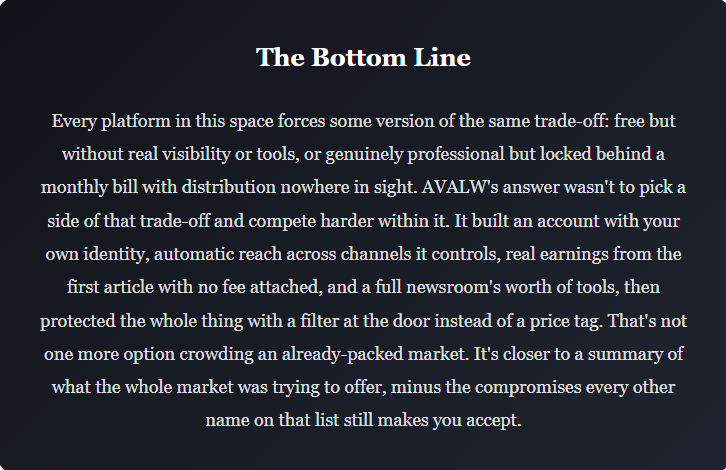
Ask any serious online writer how many tools they're actually juggling right now, and you'll rarely hear "just one." It's usually three, sometimes four: a newsletter platform for the words, a separate payment processor for the money, maybe a Discord for community, and a spreadsheet somewhere trying to hold the whole operation together. Nobody plans it that way. It just happens, one gap at a time, because every platform on the market solves exactly one piece of the puzzle and quietly leaves you to handle the rest. AVALW's entire pitch starts from a genuinely different place: what if one account just did all of it, and did it free, from the very first article you publish? The Pattern Every Creator Eventually Notices Look closely at the crowded field of publishing platforms and a strange consistency emerges. One gives you a decent free editor, then quietly keeps a cut of whatever you actually earn. Another builds you a real audience, but only inside its own walled garden, under its own branding, on its own terms. A third stacks you with genuinely powerful tools and then asks for real money, sometimes a lot of it, before you've made a single dollar back. Nobody's necessarily being dishonest about this. It's just how the market shook out. AVALW was built to break that pattern rather than optimize within it, bundling publishing, distribution, and monetization into a single account that costs nothing to start.
Your Own Corner of the Internet, Not a Rented Room
The difference shows up the second you sign up. AVALW hands you a real subdomain in the format name.avalw.com, a genuine public site that search engines actually index, carrying your name and your work, not buried inside somebody else's app. That alone isn't unheard of elsewhere, so it's worth being specific about how the comparison actually plays out. Medium gives you a profile at medium.com/@you, and a free subdomain only if you request one, but a custom domain there requires a paid membership, and either way your work still lives entirely inside Medium's brand. Substack offers a free yourname.substack.com subdomain too, fair enough, but attaching your own custom domain costs a flat $50 there, a separate purchase layered on top.
Then there's the other end of the spectrum. Sign up for a free Wix or WordPress.com site and you'll find the platform's own advertising sitting on your pages, which means even your "free" plan is quietly monetizing your readers for someone else's benefit, not yours. AVALW's subdomain skips all of that entirely: clean, ad-free unless you choose otherwise, indexed from day one, and every single article you publish adds to a running, public archive that functions as a real portfolio if you're a creator, a standing body of work if you're a journalist, or a searchable public record if you're a company putting out official communications.
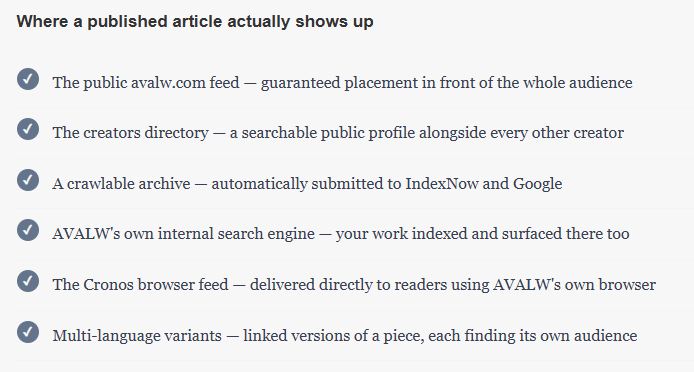
Getting Found Without Having to Chase It Yourself Here's where the comparison gets genuinely interesting, because distribution is the part most platforms quietly leave entirely in your hands. Substack and beehiiv do offer recommendation networks, letting newsletters cross-promote each other, which helps, but mostly just moves subscribers between creators who already have some. Ghost, WordPress.com, Wix, and Squarespace mostly just hand you the tools and wish you luck finding an audience on your own. AVALW takes a fundamentally different approach: every article that clears editorial approval gets automatically placed across a set of channels the platform itself owns and operates, meaning your work can reach people who've never even heard of you before, not just readers trading subscriptions among each other.
What "Free" Actually Costs on Every Other Platform
This is the part worth slowing down for, because the fine print across the industry adds up fast. Substack keeps 10 percent of subscription revenue, before payment processing fees even get deducted. Patreon's standard plan for new creators takes the same 10 percent cut, also before processing costs. beehiiv locks its actual monetization tools, the ad network, paid subscriptions, digital products, behind plans starting around $43 a month and climbing toward $96. Ghost runs anywhere from $18 to $239 a month, and even its "free" self-hosted option really just means you're paying for a server and need the technical chops to keep it running yourself. Squarespace doesn't offer a genuinely permanent free tier at all.
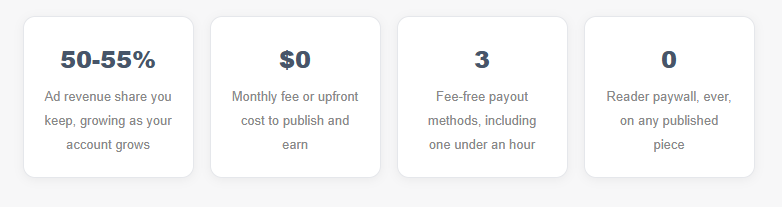
AVALW asks for none of that. No monthly subscription, nothing due upfront, and earning starts immediately from the ads running on your published work, with the platform sharing that revenue rather than charging you a fee to access it in the first place.
The revenue split itself is straightforward and grows over time: you keep 50 percent of ad revenue starting with your very first article, and that climbs permanently to 55 percent once you've connected your social channels, reached 500 subscribers, and published 30 pieces. No monthly bill, no paywall standing between your work and the people reading it.
Two Ways to Actually Get Paid, Neither One Blocking Your Readers
Beyond ad revenue, there's a second income stream built specifically not to create friction for the audience: readers can voluntarily tip a piece that genuinely moved them, in small preset amounts. It's not a mandatory subscription, and it's nothing like a paywall. That distinction matters more than it might seem, especially set against Medium, which locks its members-only content behind a roughly $5-a-month reader paywall by default.
When it's actually time to withdraw earnings, the options are refreshingly clear-cut: IBAN bank transfer across Europe and most of the world, no fee, two to three business days; direct account transfer for the US, UK, and Canada, also fee-free, three to five business days; or stablecoin payment on supported networks, the fastest route, landing in under an hour. And crucially, the reader on the other end never needs a crypto wallet or any technical know-how to support your work, exactly the barrier that's kept platforms like Mirror and Paragraph stuck in a small, niche corner of the internet.
A Full Newsroom Instead of a La Carte Tools Most platforms sell their real capabilities off one subscription tier at a time. AVALW just hands them all over at once. The dashboard shows readers gathered, confirmed ad clicks, published articles, and subscribers, alongside a seven, fourteen, and thirty-day traffic trend and a running list of your top-performing pieces. The built-in editor lets you compose a title, intro, body, cover image, and category, then publish in one motion. A dedicated statistics section goes deeper still, tracking where traffic actually comes from and how readers behave on individual pieces, replacing guesswork with something closer to an actual editorial strategy. On top of that sits a weekly report, delivered automatically every Friday: readers gained, the week-over-week change, ad earnings, articles published, new subscribers, and your single best-performing story, wrapped in a downloadable PDF that lands in your inbox without you lifting a finger to compile it. Then there's the stuff genuinely absent from most individual creator accounts entirely: Premieres, which let you schedule a major piece as a real event with a live countdown and simultaneous release to your whole audience; peer review, where other members verify your facts and sources with their name and photo attached to the piece, exactly like a real newsroom's editorial process; a built-in editorial guide covering headlines, structure, sourcing, and credibility; and badges that have to be earned through actual activity, not purchased. Built for More Than Just One Kind of Creator The platform also recognizes that "creator" isn't one single job description. Four distinct account types exist, Creator, Journalist, Company, and Academic, each with its own fitting profile setup and badge set. A company account specifically gets a canonical link and original-source credit on any syndicated content, a detail that keeps search engines correctly crediting the actual source rather than whoever republished it. Add in genuine email subscriber tools, full transparency on ad earnings down to a country-by-country breakdown, and live, ticketed support built directly into the platform, and the picture that emerges looks less like a blogging tool and more like actual infrastructure. Rewards You Can Actually Hold in Your Hands Perhaps the clearest way AVALW breaks from how every other platform operates shows up in its rewards system. At real audience milestones, what you get back isn't a digital badge or a pixel on a profile page, it's a physical object, produced specifically from your account's actual activity. Hit 100,000 subscribers and you receive a hand-bound printed volume of your complete published work, signed and numbered as a genuinely unique copy. Reach a million, and your most-read piece gets engraved in metal, framed in wood, paired with network-wide promotion and event invitations. Hit ten million, and it's a numbered trophy, a permanent spot in the platform's gallery, a lifelong bump to your revenue share, a seat in the editorial structure, and an annual prize carrying your own name, awarded each year to a new creator coming up behind you. Nothing here is purchased or handed out for show. It's produced directly from the result of the work itself. The Filter That Changes Everything About How This Actually Works Here's the detail that separates AVALW from essentially every platform mentioned so far. Medium, Substack, WordPress.com, Wix, Blogger, Patreon, all of them let anyone in, no questions asked. AVALW doesn't. Access runs through invitation and editorial approval, a deliberate choice built around quality over sheer volume. For a reader, that means an AVALW article has already cleared a real filter, closer to the experience of reading a trusted outlet than scrolling an open platform where anyone can post anything. For a creator, it means your byline sits next to names that actually mean something, rather than disappearing into an anonymous, endless content stream. And here's the part that makes the whole model genuinely unusual: that filter at the entrance comes with no invoice attached. Once you're in, the full newsroom-grade toolkit is handed over immediately, free, not dangled as some distant reward for eventually becoming successful first. You don't have to prove yourself important before getting a professional's tools. You get them on day one and grow into them from there. A Few Honest Questions People Are Actually Asking Is AVALW actually free, or is there a catch somewhere? There's no monthly fee and nothing required upfront to publish or start earning. The platform makes its own money by sharing ad revenue with creators rather than charging a subscription, which is a genuinely different business model than most of its competitors. How is this different from just using Substack or Medium? The core differences are curated access at the entrance, built-in distribution across channels AVALW itself controls rather than requiring you to build an audience from scratch, and a full toolkit, analytics, premieres, peer review, physical rewards, bundled into every account instead of gated behind separate paid tiers. What happens if my application isn't approved right away? Because entry is invitation and approval-based rather than open to anyone instantly, the process is intentionally more selective than a typical sign-up flow, which is the deliberate trade-off behind keeping the overall quality bar high across the platform. Who This Actually Makes Sense For Strip away the feature list and the comparison charts, and the real question is simple: who benefits from having identity, distribution, monetization, and a full editorial toolkit bundled into one free account instead of stitched together across three or four separate services? Pretty much anyone serious about writing consistently, an independent creator tired of juggling logins, a journalist who wants a durable, portable body of work outside a single employer, or a company that wants an independent public voice it doesn't have to rent from someone else's platform. The honest pitch here isn't that AVALW beats Substack at newsletters, or beats Patreon at memberships, or beats Medium at reach. It's that it doesn't need to win any single one of those categories, because it never asked you to choose between them in the first place. A note on this comparison Pricing, revenue-share terms, and feature details for AVALW and the platforms mentioned here reflect publicly stated policies as of August 2026. Platform pricing and terms change regularly industry-wide, so confirming current specifics directly with each service before making a decision is always the safer move.