 William BensonVIEW PROFILE →
While Congress Stalled, the SEC Moved: Inside Regulation Crypto Assets
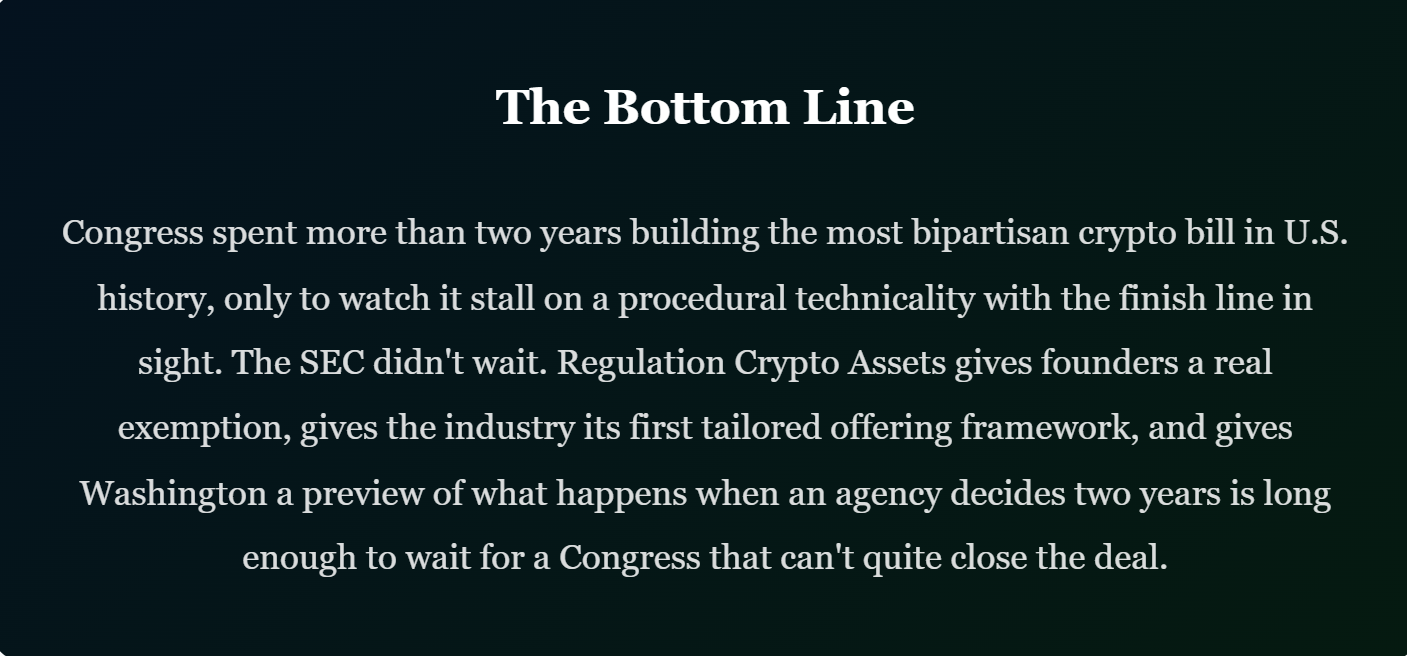
Two years of stalled legislation, one surprise announcement, and the most significant crypto rulemaking in SEC history , here's what actually happened, and what it means for the industry.
Two years of stalled legislation, one surprise announcement, and the most significant crypto rulemaking in SEC history — here's what actually happened, and what it means for the industry.
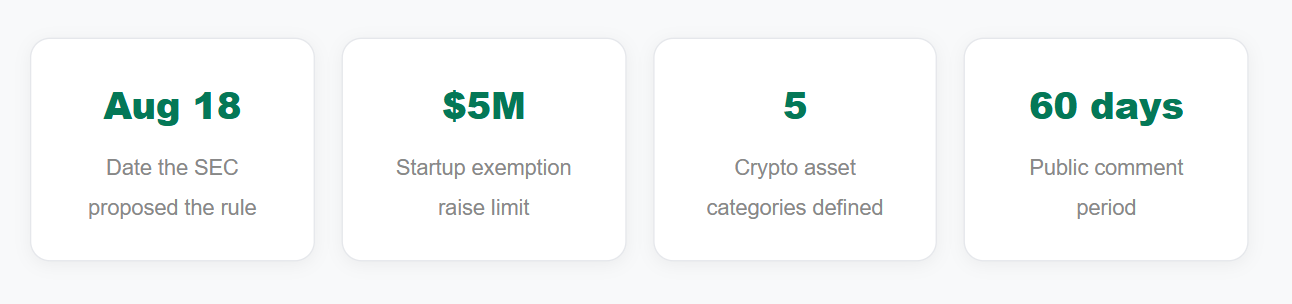
For more than two years, the crypto industry's biggest question in Washington wasn't whether regulation was coming. It was which branch of government would get there first. On August 18, 2026, that question got answered in a single, mostly unplanned afternoon — and it wasn't Congress that crossed the finish line. The Securities and Exchange Commission had, according to multiple reports, actually cancelled a meeting days earlier where this same proposal was expected to be introduced. Then, with no warning, it came back and did it anyway. What emerged is called Regulation Crypto Assets, and it's the closest thing the crypto industry has ever gotten to a rulebook written specifically for it, rather than borrowed from decades-old securities law never designed with blockchains in mind.
The Bill That Kept Almost Passing
To understand why the SEC's move mattered, it helps to understand what Congress had been trying, and repeatedly failing, to do. The Digital Asset Market Clarity Act, better known as the CLARITY Act, had been the industry's preferred vehicle for a real answer to a deceptively simple question: when exactly is a digital asset a security, and when is it something else?
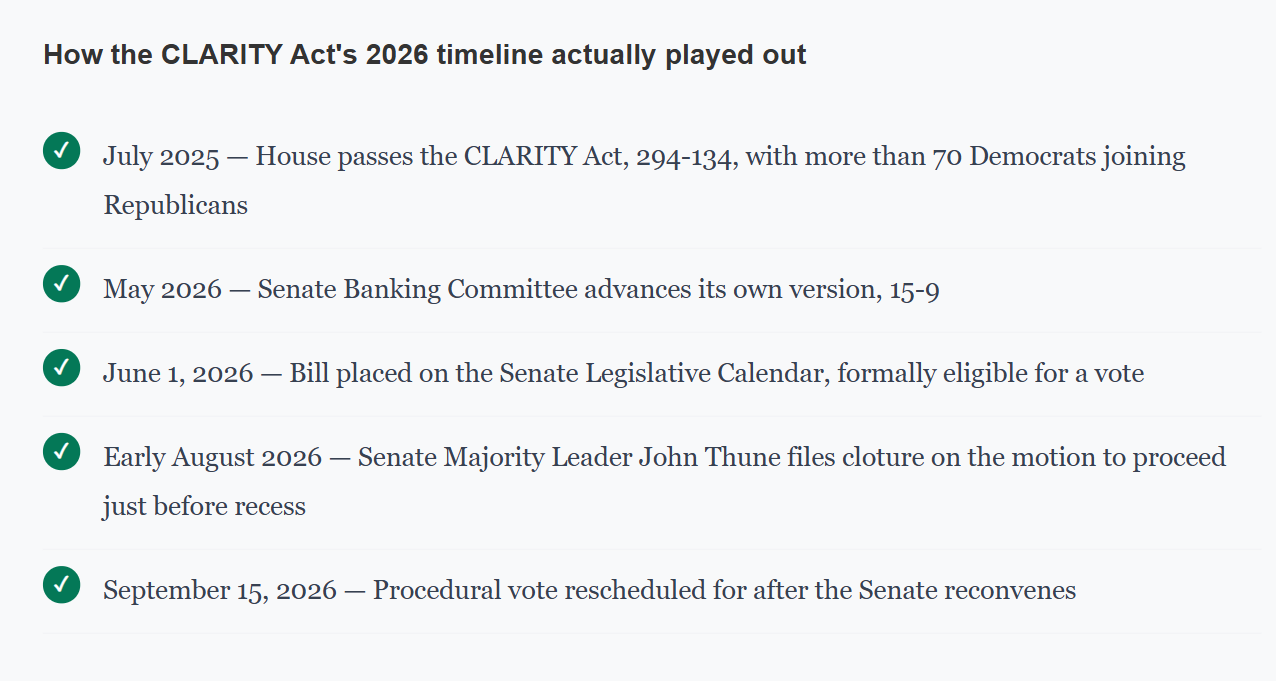
By the numbers, the bill looked closer to passage than any crypto legislation in U.S. history. The House passed it in July 2025 by a wide, genuinely bipartisan 294-to-134 margin. The Senate Banking Committee advanced its own version 15-to-9 in May 2026. It landed on the Senate's legislative calendar in June. And then it sat there.
What stalled it wasn't the substance of market structure at all. It was, as one industry outlet put it bluntly, a problem of political structure rather than policy. Democrats pushed for stronger ethics language limiting how sitting officials and their families could profit from crypto ventures, an issue that took on particular weight given the president's own family's crypto holdings. Republicans pushed for the certainty markets were asking for. Neither side could close the gap fast enough, and prediction markets tracking the odds of the bill's 2026 passage reportedly collapsed from a peak near 82 percent in the spring to under 30 percent by late July.
Then the SEC Stopped Waiting
Regulation Crypto Assets didn't come out of nowhere. It builds directly on interpretive guidance the Commission issued back in March 2026, a release that first sorted crypto assets into five working categories: digital securities, digital commodities, digital collectibles, digital tools, and stablecoins, and explained how federal securities law applies, or doesn't, to each one. That March release was itself the product of SEC Chairman Paul Atkins' "Project Crypto" initiative, which had been signaling since late 2025 that the Commission intended to build a crypto-specific framework with or without Congress.
August's proposal is where that framework actually takes shape. It's organized into five subparts covering everything from new disclosure forms built specifically for crypto offerings to two headline exemptions that have drawn the most attention from founders and investors alike.
The "startup exemption" at the centre of the proposal would let a crypto issuer raise up to $5 million over a four-year period without registering the offering under the Securities Act, a considerably lighter path than the one most public offerings have historically had to take.
What the Rule Actually Changes
Beyond the startup exemption, the proposal introduces a safe harbor provision: if an issuer satisfies specific conditions, a crypto asset would be treated as falling outside the "investment contract" definition that has, for years, been the main lever the SEC used to bring enforcement actions against token issuers under the long-standing Howey test. The proposal would also preempt state-level securities registration requirements for offerings made under its exemptions, addressing a long-standing industry complaint about having to navigate fifty separate state regimes on top of federal rules.
The SEC's own stated goals for the rule are notable for what they reveal about the agency's read on the last several years: reducing the incentive for crypto projects to incorporate and operate offshore, and expanding the range of investment opportunities available to U.S. investors under clearer, more consistent protections rather than the case-by-case enforcement approach that has defined crypto regulation since the early 2020s.
An Unusually Warm Industry Reaction
The proposal landed at a White House event just one day earlier where President Trump had gathered crypto industry leaders and regulators, including representatives from Coinbase, Kraken, and Robinhood, alongside the heads of the SEC and CFTC, to publicly press Congress to pass the CLARITY Act. Industry reaction to the SEC's own rule, once it appeared the next day, leaned notably positive. The Digital Chamber's chief executive praised the Commission's willingness to keep engaging with the industry directly, a marked shift in tone from years of adversarial enforcement-driven regulation.
That said, Regulation Crypto Assets and the CLARITY Act aren't interchangeable, and industry lawyers have been careful to note the difference. The SEC's rule addresses only the offering side of the crypto asset lifecycle, how tokens can be sold to raise capital. Questions of trading venues, custody requirements, and exchange regulation remain open, and are reportedly on the Commission's separate 2026 rulemaking agenda rather than resolved by this proposal.
Questions People Are Actually Asking
Does this mean crypto regulation in the U.S. is now settled? No. Regulation Crypto Assets is still a proposed rule, open for public comment for 60 days following its publication in the Federal Register, meaning it could still change materially before, or if, it's finalized. It also only covers offerings, not trading or custody.
Why does it matter that this came from the SEC instead of Congress? Durability. Interpretive guidance and agency rules can be revised or rescinded by a future SEC under different leadership without requiring a single vote in Congress. A statute passed by Congress, like the CLARITY Act would be, is far harder to unwind. Industry analysts have flagged this distinction directly: only a law survives a change in administration; agency rules can shift with the next Chair.
Is the CLARITY Act dead now that the SEC has acted? Not necessarily, but its momentum has clearly slowed. The bill's procedural vote was pushed to mid-September, and with the 2026 midterm campaign compressing the Senate's remaining working days, several industry trackers now consider enactment before 2027 increasingly unlikely.
What This Actually Means Going Forward
Strip away the political drama and what's left is a genuinely significant moment: the SEC building, on its own initiative, the kind of tailored regulatory framework the crypto industry has been asking Congress for since roughly 2021. It's not a substitute for legislation, agency rules can be undone in ways statutes can't, and it leaves major parts of the crypto ecosystem, trading and custody chief among them, still governed by the old, awkward fit of pre-blockchain securities law.
But for founders trying to raise capital for a crypto project in the U.S. right now, the practical reality just shifted in a real way. A clearer, considerably lighter path exists where a genuinely uncertain one stood a month earlier. Whether Congress eventually catches up with its own version, or whether Regulation Crypto Assets becomes the de facto rulebook by default, is now the question the rest of 2026 will likely answer.
A note on this reporting
Figures and timeline details in this piece reflect the SEC's official press releases and proposing release, Federal Register filings, and reporting from Reuters, Euronews, CoinDesk, and legal analysis from Sidley Austin and Morrison Foerster, current as of late August 2026. Legislative and rulemaking timelines are subject to change as the comment period and Senate calendar proceed.