 William BensonVIEW PROFILE →
Why Almost Every State Law Trying to Keep Kids Off Social Media Keeps Getting Blocked
More than 20 states want your teenager to prove their age and get your permission before they can open a social media app. Big Tech is suing to stop almost every single one. Here's who's actually winning.
More than 20 states want your teenager to prove their age and get your permission before they can open a social media app. Big Tech is suing to stop almost every single one. Here's who's actually winning.
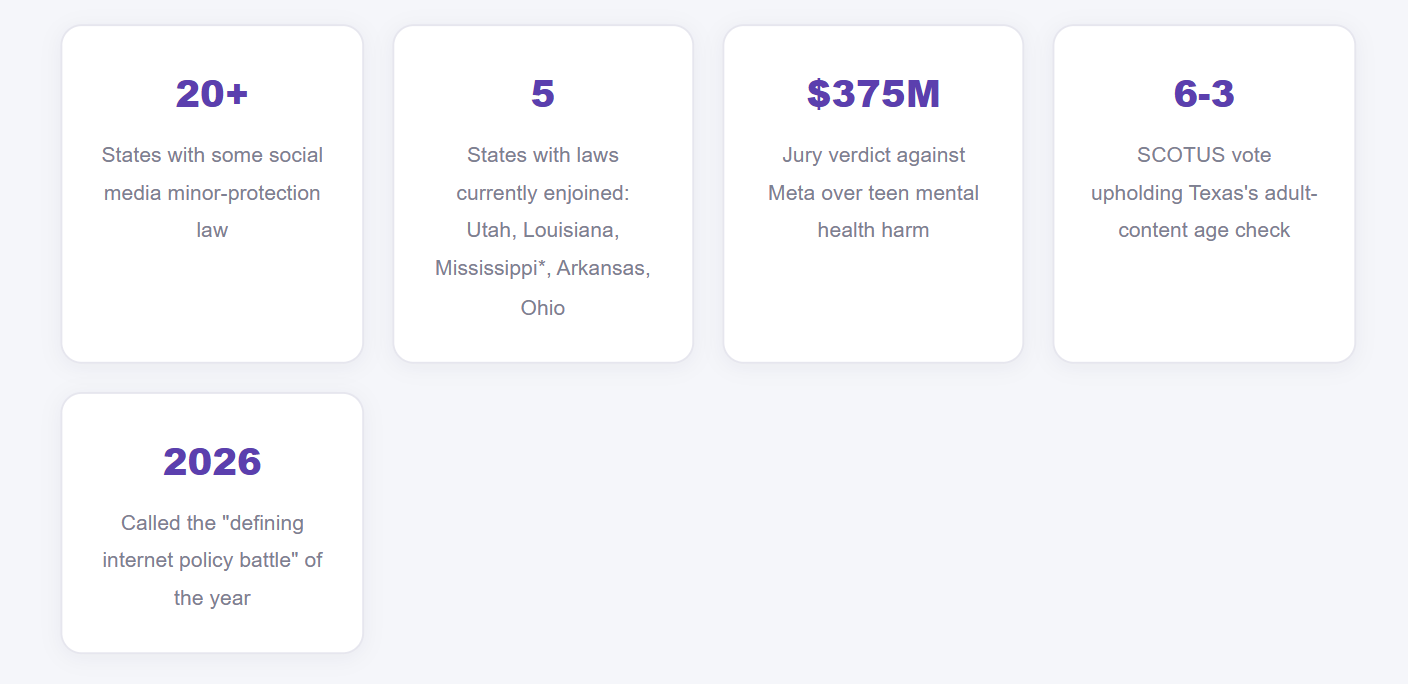
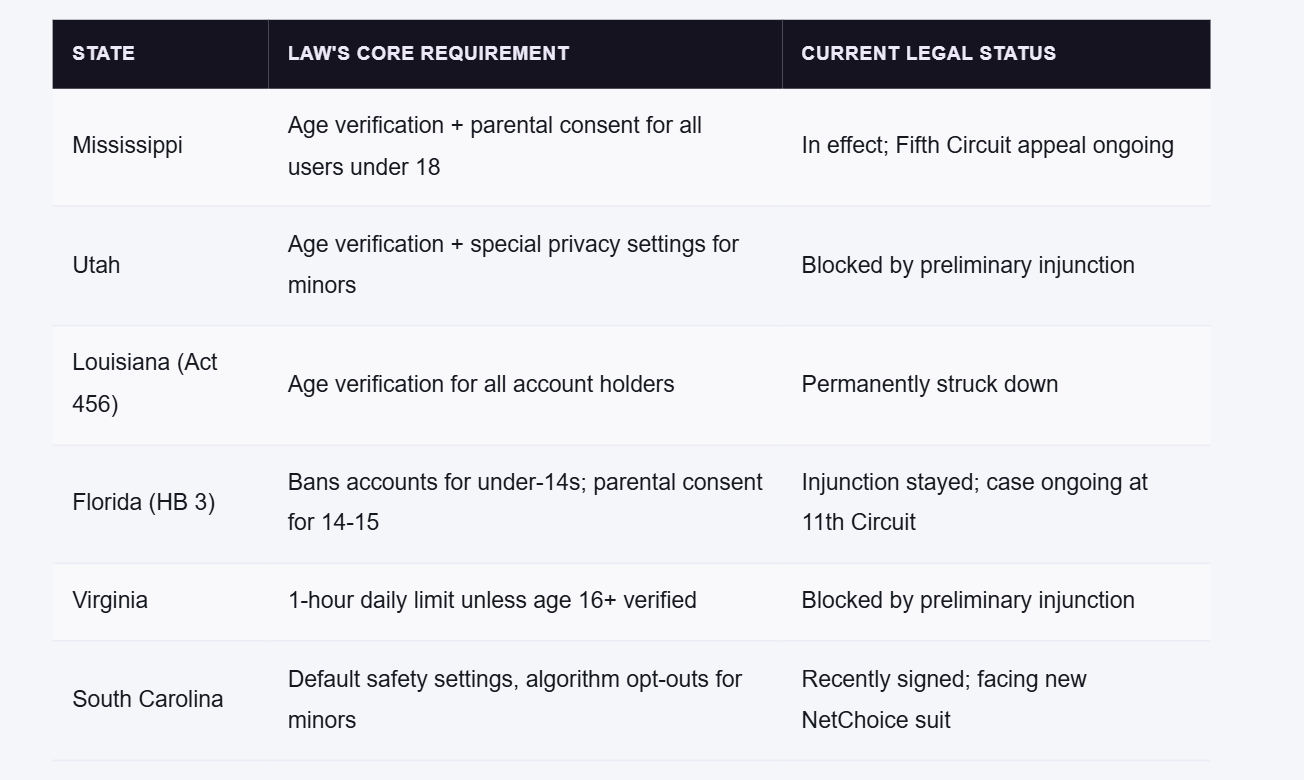
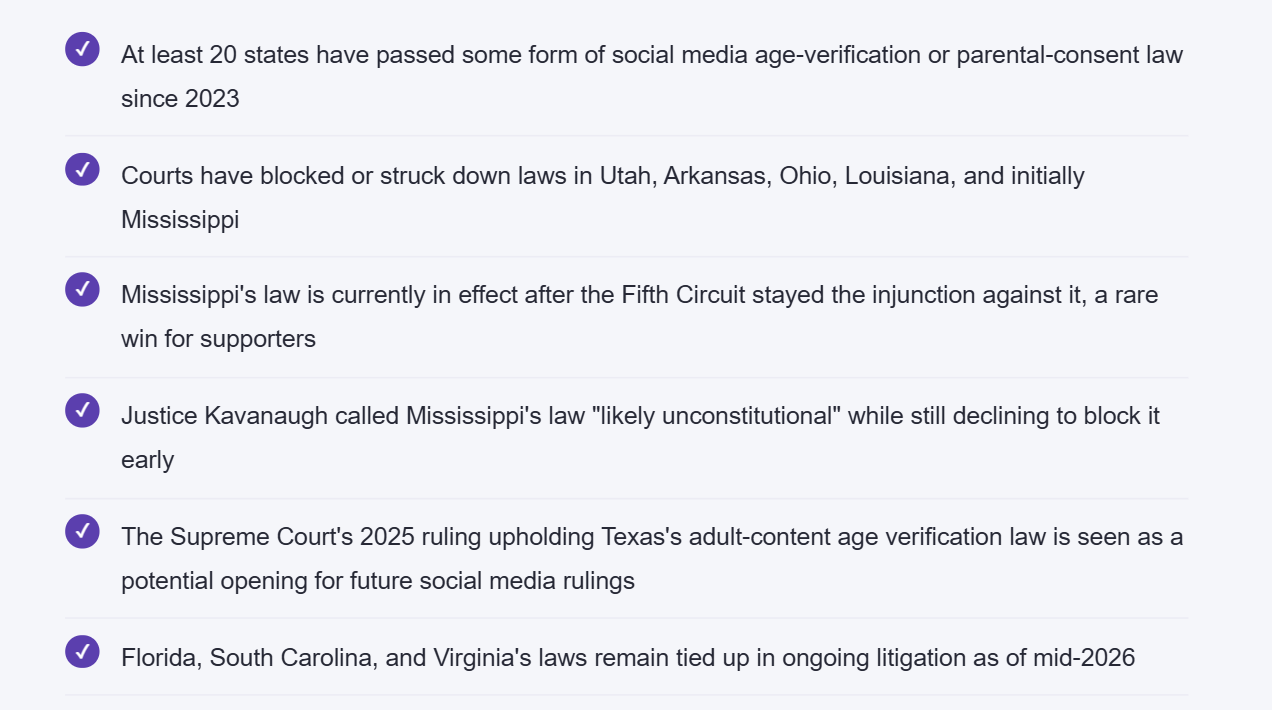
Picture this: a state legislature spends months debating a bill, holds hearings with worried parents and grieving families, passes it with bipartisan votes, and the governor signs it into law with cameras rolling. Then, sometimes within days, a lawyer for a tech industry group walks into federal court, and a judge puts the whole thing on ice before a single teenager ever has to verify their age. That exact sequence has now played out more than a dozen times across the country, and it's turning into one of the messiest, most consequential legal fights happening in America right now, one that touches nearly every parent, teenager, and tech company in the country. What These Laws Are Actually Trying to Do Since 2023, at least 20 states have passed some version of a law aimed at how kids use social media, according to the Age Verification Providers Association, and the approaches vary more than you'd expect. Some, like Mississippi's Walker Montgomery Protecting Children Online Act, require platforms to verify every user's age and get parental consent before anyone under 18 can create an account. Others, like Florida's HB 3, go further and flat-out ban kids under 14 from having accounts at all, with 14- and 15-year-olds needing parental sign-off. Virginia took a different angle entirely, capping minors at one hour of social media use per platform per day unless they can prove they're 16 or older. A newer wave of state laws skips age verification altogether and instead targets platform design, things like turning off addictive recommendation algorithms by default for minors, or forcing apps to let teens silence notifications overnight. South Carolina, Maryland, Nebraska, Vermont, and California have all passed versions of these "age-appropriate design code" laws, which regulate how a platform behaves rather than who's allowed to sign up in the first place. States have the power to enforce parental prohibitions, but it does not follow that the state has the power to prevent children from hearing or saying anything without their parents' prior consent. Here's the Thing: Courts Keep Blocking Almost All of Them If you've been half-following this news cycle, you might assume most of these laws are already in effect. They're not. NetChoice, the tech industry trade group representing Meta, Google, TikTok, Snap, and X, has become something like the undefeated boxer of internet law, filing First Amendment challenges against nearly every one of these laws and winning the overwhelming majority of them, at least at the injunction stage. Federal courts have blocked or paused laws in Utah, Arkansas, Ohio, and Virginia. A Louisiana court went even further and permanently struck down that state's Act 456 entirely. Texas's App Store Accountability Act got hit with an injunction in December 2025, just days before it was set to take effect. The legal argument that keeps working for NetChoice traces back to a 2011 Supreme Court case called Brown v. Entertainment Merchants Association, which struck down a California law restricting violent video game sales to minors. That case established that kids have their own First Amendment right to receive information, and that states can't just assume they can regulate what minors see or say online without running into serious constitutional trouble. NetChoice has leaned hard on that precedent in state after state, arguing these laws function as "prior restraints" on protected speech.

Then Mississippi Broke the Streak
Here's where the story gets genuinely interesting. Mississippi's age-verification law, the one challenged in NetChoice v. Fitch, actually got blocked by a district court just like the others. But then something unusual happened: the Fifth Circuit Court of Appeals stayed that injunction, letting the law take effect while the appeal played out. NetChoice rushed an emergency request to the Supreme Court asking the justices to step in and block it again. In a move that surprised a lot of legal observers, the Supreme Court said no, and Mississippi's law has been in effect ever since, even while everyone acknowledges the underlying legal question hasn't actually been settled.
Justice Brett Kavanaugh wrote a notable concurring opinion on that decision, one that's been quoted constantly since. He said NetChoice had "demonstrated that it is likely to succeed on the merits" of its case, essentially agreeing the law is probably unconstitutional, but he still voted against blocking it early, citing the balance of harms while the case works its way through the system. That's a genuinely strange spot for a law to sit in: a Supreme Court justice on record saying it'll probably lose, while the law stays fully enforced in the meantime.
The porn case that's quietly reshaping this whole fight
A year before the Mississippi decision, the Supreme Court handed down Free Speech Coalition v. Paxton, upholding a Texas law requiring age verification for websites hosting sexually explicit content. The Court ruled that checking someone's age before letting them see adult content only "incidentally" burdens adult users' free speech rights, a notably more relaxed standard than courts have traditionally applied. Legal analysts widely see that ruling as the crack in the dam, one that could eventually let similar age-verification logic bleed into the social media fight too, even though social media obviously covers far more than just explicit content.
The Case for These Laws, Stripped of the Legal Jargon
Strip away the court filings and the argument from state lawmakers is pretty simple: social media companies have built products specifically engineered to maximize how long kids stay glued to their screens, and there's a mounting pile of evidence, including massive jury verdicts against companies like Meta, showing real harm to teenagers' mental health along the way. Supporters point to genuine, well-documented dangers, predators using platforms to target kids, sextortion schemes, and algorithm-driven content that can spiral a vulnerable teenager toward genuinely dark places. From that lens, requiring a parent's sign-off before a 13-year-old opens a TikTok account doesn't feel radical, it feels like the same basic parental gatekeeping that already exists for R-rated movies or a driver's license.
The Case Against Them, Also Stripped of the Jargon
Opponents, and it's not just Big Tech making this argument, digital privacy groups like the Electronic Frontier Foundation make it too, say the actual mechanics of these laws create a much bigger problem than the one they're trying to solve. To verify anyone's age accurately, a platform generally needs to collect some form of ID or biometric data from every single user, adults included, which critics argue builds exactly the kind of centralized identity-verification infrastructure that's historically been a privacy nightmare waiting to happen. As one industry group put it bluntly in court filings, there's no age-verification system that isn't also a de-anonymization system. Beyond privacy, opponents argue these laws often sweep up completely harmless activity, a 15-year-old wanting to follow the news, join an educational community, or just talk to friends, alongside whatever harmful content the law was actually trying to target.
So Who's Actually Winning?
Legal experts are pretty candid that nobody really knows yet, and that uncertainty might stick around for a while. Eric Goldman, a law professor at Santa Clara University who tracks internet law closely, put it plainly: getting real answers out of the Supreme Court on exactly how far states can go here "is going to take us years, if not decades, to resolve." Meanwhile, Rin Alajaji from the Electronic Frontier Foundation has pushed back on reading too much into the Texas porn-verification case, calling it a "red herring" since it only covers a narrow slice of explicit content, not the much broader question of banning minors from general-purpose social platforms entirely.
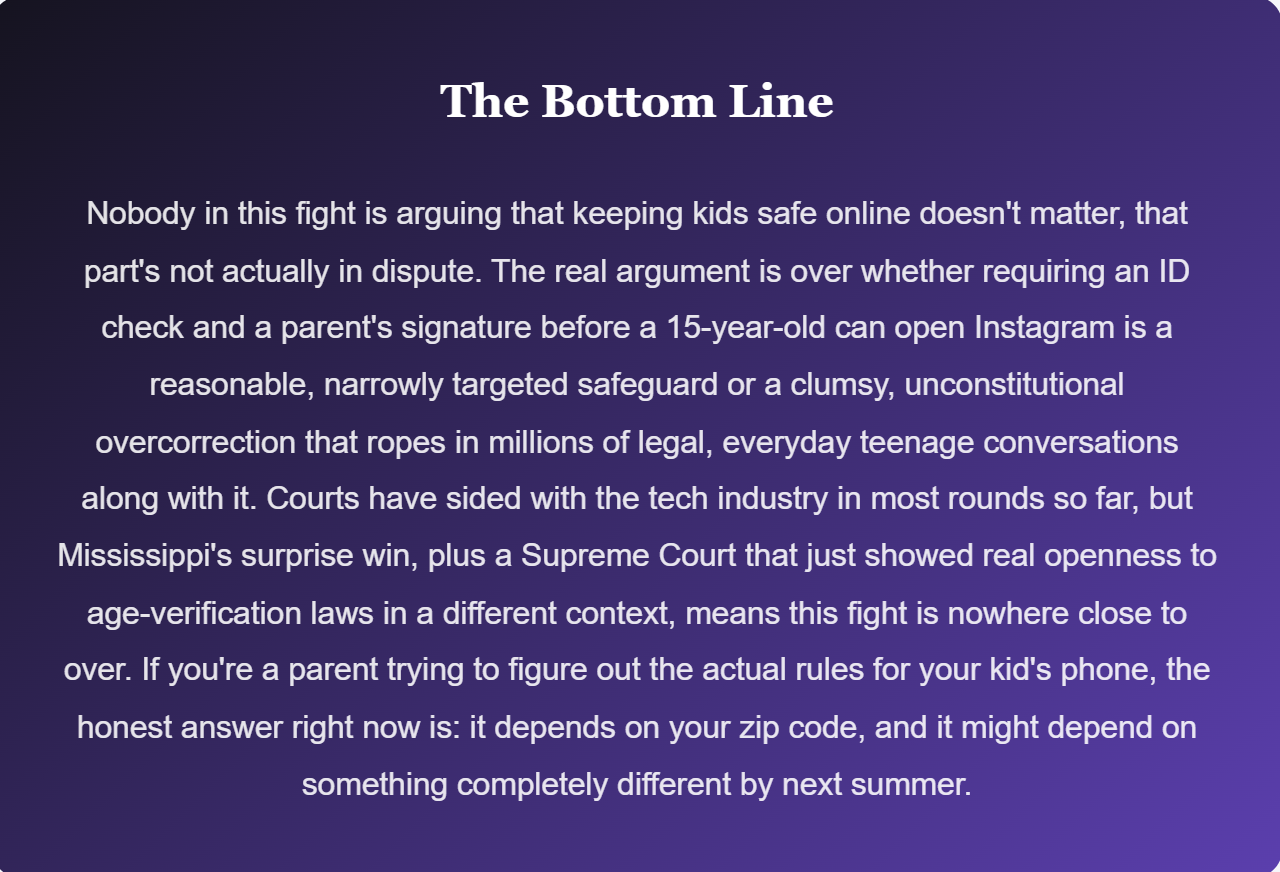
What's genuinely notable is that this fight has become one of the rare issues with real bipartisan energy behind it, red states and blue states alike keep passing these laws even as courts keep striking them down, which tells you lawmakers on both sides see real political value, and real constituent demand, in being seen as doing something about kids and social media, regardless of how the legal fights shake out.
What this actually means for your family right now
Here's the practical, unglamorous truth: what rules apply to your kid's social media accounts depends heavily on which state you live in, and that patchwork could keep shifting for years. If you're in Mississippi, age verification and parental consent are currently the law of the land for social platforms. If you're in Utah, Louisiana, or Virginia, the law your legislature passed is currently frozen and not being enforced. That means the most reliable move for parents right now isn't waiting on Congress or the courts to sort this out, it's using the parental control tools most platforms already offer voluntarily, and having the actual conversation with your kid about what they're seeing and who they're talking to, regardless of what any state law does or doesn't require this year.