 William BensonVIEW PROFILE →
A Prime Minister, a Mini Moke, and a Relationship 27 Years in the Making
Two days, one historic award, and a relationship that traces back to before Timor-Leste even existed as a country.
Two days, one historic award, and a relationship that traces back to before Timor-Leste even existed as a country.
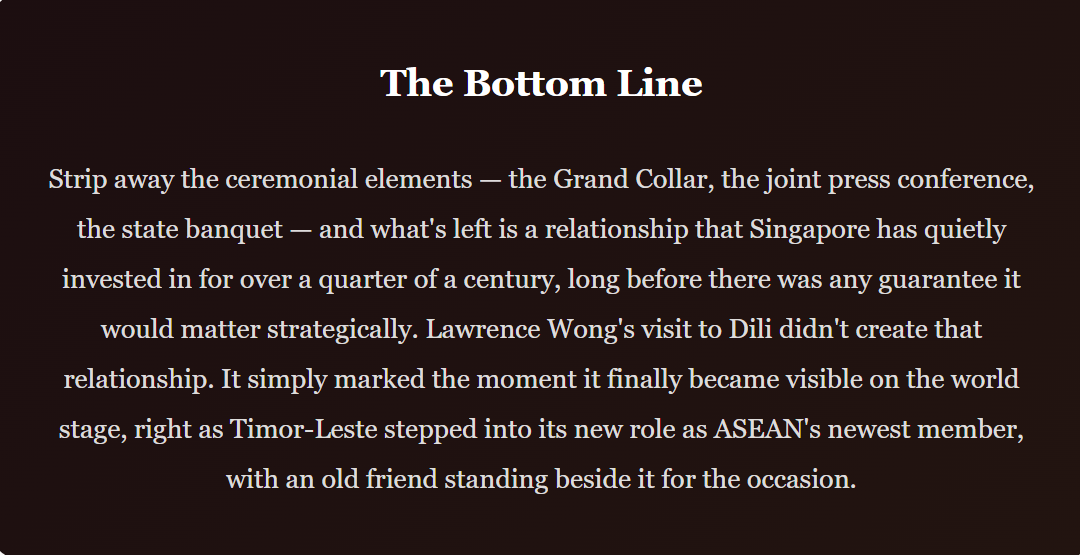
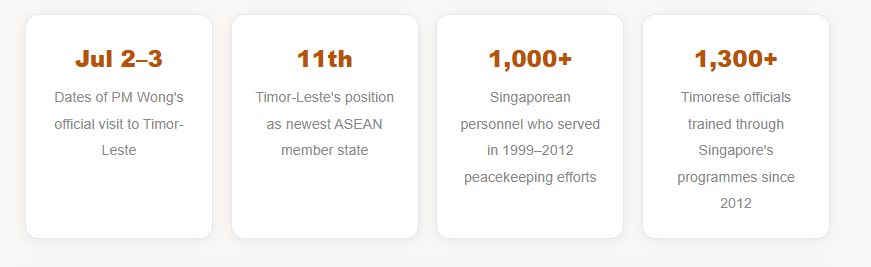
There's a particular kind of significance that comes with being the first — the first Singapore Prime Minister to ever set foot in Timor-Leste as its official guest. When Lawrence Wong landed in Dili in early July, he wasn't just checking a country off a diplomatic itinerary. He was closing a loop on a relationship that started decades before either country's current government existed in its present form, back when Timor-Leste wasn't even an independent nation yet. A Visit 27 Years in the Making Prime Minister Wong's official visit ran from July 2 to 3, and it carried weight well beyond the usual diplomatic photo-ops. As he put it himself at the joint press conference alongside Timor-Leste's Prime Minister Xanana Gusmão, the trip was significant for three overlapping reasons at once: it was his personal first visit to the country, the first-ever visit by any Singaporean Prime Minister, and it landed during Timor-Leste's very first year as a full member of ASEAN. That last detail matters more than it might first appear. Timor-Leste spent roughly fourteen years working toward ASEAN membership before finally being admitted as the bloc's 11th member state. A visit from Singapore, one of the region's most established economies and a long-time advocate for Timor-Leste's inclusion, sent a clear signal that the newest member wasn't going to be left to find its footing alone.
What Actually Happened During the Two-Day Visit
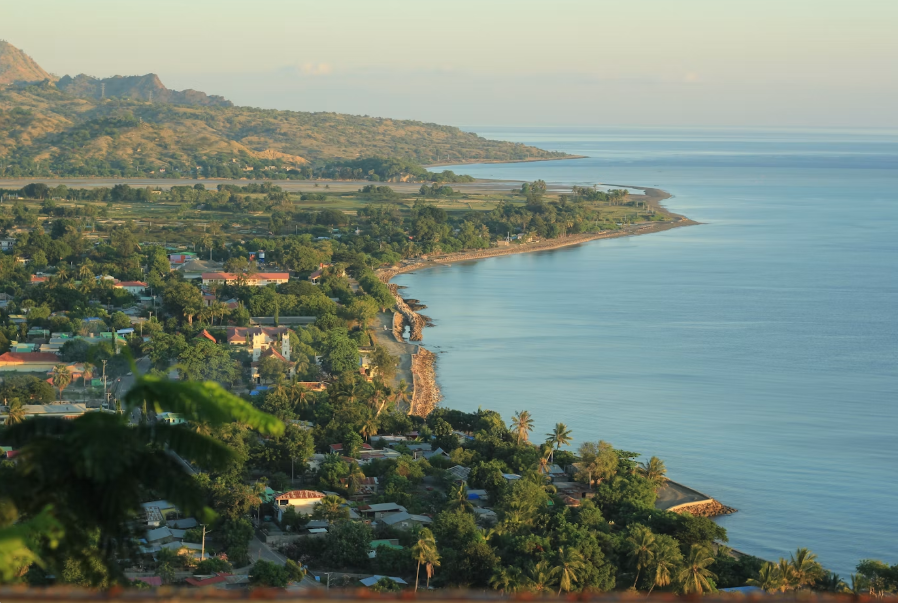
The visit followed the kind of carefully choreographed sequence typical of a state-level trip, but with a few genuinely warm, personal touches woven in. Wong arrived at Dili's Presidente Nicolau Lobato International Airport in the late afternoon, where he was welcomed by both Timor-Leste's President, Dr José Ramos-Horta, and Prime Minister Gusmão. From there, the three leaders reportedly rode together in Ramos-Horta's own Mini Moke — a small detail that said as much about the closeness of the relationship as anything on the formal agenda.
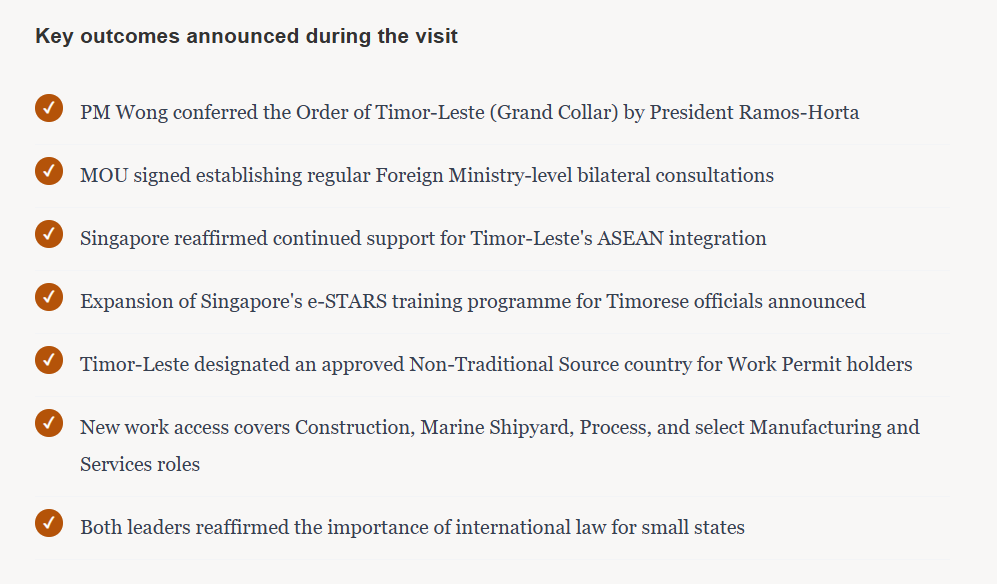
The following day brought the ceremonial centerpiece of the trip: President Ramos-Horta conferred the Order of Timor-Leste, specifically its Grand Collar, on Prime Minister Wong. It's the highest honor the Timorese state can bestow, and it was awarded specifically in recognition of Singapore's long-running support for the country's development and its path into ASEAN. Wong and Gusmão then held substantive talks, witnessed the signing of a new Memorandum of Understanding, and gave a joint press conference before Gusmão hosted a state banquet lunch. Wong also set aside time to meet members of the overseas Singaporean community living in Dili — a smaller, more personal stop, but one that's become a fairly standard feature of how Singapore's leaders conduct these visits.
"Singapore is privileged to be able to partner Timor-Leste on its nation-building journey," Wong told reporters, noting that the relationship began even before Timor-Leste's independence was formally restored.
Why Singapore Has Been Involved Since Before Independence Even Happened
To understand why this visit carried the weight it did, it helps to go back to 1999. That year, as Timor-Leste was moving through the chaos and violence surrounding its vote for independence from Indonesia, Singapore became one of the first countries to contribute personnel to the International Force East Timor, the multinational peacekeeping mission tasked with restoring order. Over the following thirteen years, more than a thousand Singaporeans, spanning medical teams and combat peacekeepers alike, served in humanitarian and peacekeeping roles in the country.
That early involvement set the tone for everything that followed. Once Timor-Leste's independence was formally restored in 2002, Singapore shifted its support toward longer-term capacity building rather than security assistance, running training and human-resource development programmes across sectors including education, health, agriculture, and infrastructure. More than 1,300 Timorese officials have gone through Singapore's Cooperation Programme since 2012 alone, a pipeline of technical and administrative training that's continued quietly for well over a decade with relatively little international attention.
The formal diplomatic relationship deepened further and further in recent years. Singapore opened a resident Embassy in Dili in April 2024, and appointed its first resident Ambassador to the country just months before Wong's visit. Each of those steps, on their own, might look like a routine diplomatic upgrade. Taken together, they trace a clear and deliberate trajectory toward exactly the kind of high-level visit that finally happened in July.
What the New Bilateral Consultations MOU Actually Does
The centerpiece agreement signed during the visit, the Memorandum of Understanding on the Establishment of Bilateral Consultations, sounds bureaucratic on paper but carries genuine practical weight. In plain terms, it commits both countries' Foreign Ministries to a regular, structured consultation mechanism — a scheduled forum for discussing not just day-to-day bilateral issues, but broader regional, international, and strategic developments as well.
That structure matters because it moves the relationship beyond one-off high-level visits and toward something more institutionalized. Rather than depending on the initiative of whichever leaders happen to be in office at a given moment, a formal consultation mechanism creates a standing channel that persists across changes in government on either side. For a small, young state like Timor-Leste still building out its diplomatic institutions, having that kind of predictable, ongoing dialogue with a more established regional partner is a meaningful form of support in its own right, separate from any specific aid programme or investment.
The Work Permit Announcement That Matters More Than It Sounds
Buried among the ceremonial elements of the visit was an announcement with real economic weight for ordinary Timorese workers: Singapore designated Timor-Leste as an approved Non-Traditional Source country for Work Permit holders, effective from the second half of 2027. In practical terms, that means Singaporean companies will be able to hire workers from Timor-Leste under Work Permits in the construction, marine shipyard, and process sectors, along with selected roles in manufacturing and services.
For context, Singapore maintains a specific, government-controlled list of countries from which its Work Permit scheme can draw labor, and adding a new country to that list isn't a routine administrative update — it's a deliberate policy choice that opens a genuine new labor migration and remittance channel between the two economies. For a small country like Timor-Leste, still developing its formal labor market, that kind of access to Singapore's economy represents one of the more concretely useful outcomes of the entire visit, arguably more significant in day-to-day terms than the ceremonial elements that got most of the headline attention.
What This Means for Timor-Leste's Broader ASEAN Integration
Singapore wasn't the only regional player to make a point of visiting Dili around this period. Malaysian Prime Minister Anwar Ibrahim made his own first official visit to Timor-Leste in September 2025, the first by a Malaysian leader in over two decades, specifically framed around supporting the country's ASEAN accession process. Taken together with Wong's visit less than a year later, a pattern starts to emerge: established ASEAN members appear to be making a coordinated, if informal, effort to personally welcome Timor-Leste into the bloc rather than simply processing its membership on paper.
That matters for a genuinely practical reason. ASEAN membership brings Timor-Leste into a dense web of regional agreements, summits, and working groups that the country's relatively small diplomatic corps will need real capacity to navigate. High-level visits like this one aren't just symbolic gestures — they're opportunities to build the personal relationships and institutional habits that make participation in a body like ASEAN actually functional, rather than merely nominal.
A Few Straightforward Questions
Why is this visit described as historic if Singapore and Timor-Leste already had diplomatic relations? Because despite decades of cooperation dating back to 1999, no sitting Singaporean Prime Minister had ever physically visited the country before. Diplomatic relations and embassy-level engagement had existed for years, but a head-of-government visit is a different, higher tier of bilateral signaling.
What is the Order of Timor-Leste? It's the highest state honor Timor-Leste can award, conferred by the President in recognition of exceptional contributions to the country. The Grand Collar specifically is its highest grade, and it's typically reserved for heads of state or government rather than lower-level officials.
Does this visit change anything for ordinary citizens of either country? The Work Permit designation is the most concrete near-term change, opening a new formal labor migration pathway for Timorese workers starting in the second half of 2027. The broader diplomatic and training outcomes are more institutional in nature and will likely play out gradually rather than producing an immediate, visible shift.
Is Singapore Timor-Leste's most significant ASEAN partner? It's one of several countries that have prioritized supporting Timor-Leste's integration, alongside Malaysia and Indonesia in particular. Singapore's relationship stands out for its length and consistency, tracing back to 1999, rather than for being uniquely dominant among Timor-Leste's regional partnerships.
Worth keeping in mind
Details of bilateral agreements and implementation timelines, including the 2027 Work Permit designation, can be adjusted or refined as both governments work through the practical details. Treat specific dates and figures here as reflecting the announcements made at the time of the visit, and check official statements from Singapore's Ministry of Foreign Affairs or Prime Minister's Office for the latest updates.