 William BensonVIEW PROFILE →
Inside the Ethereum Treasury Boom: How BitMine and SharpLink Turned Corporate Balance Sheets Into Staking Machines
Two public companies now hold more Ethereum than most countries hold gold reserves. Neither is slowing down, even after a brutal quarter.
Two public companies now hold more Ethereum than most countries hold gold reserves. Neither is slowing down, even after a brutal quarter.
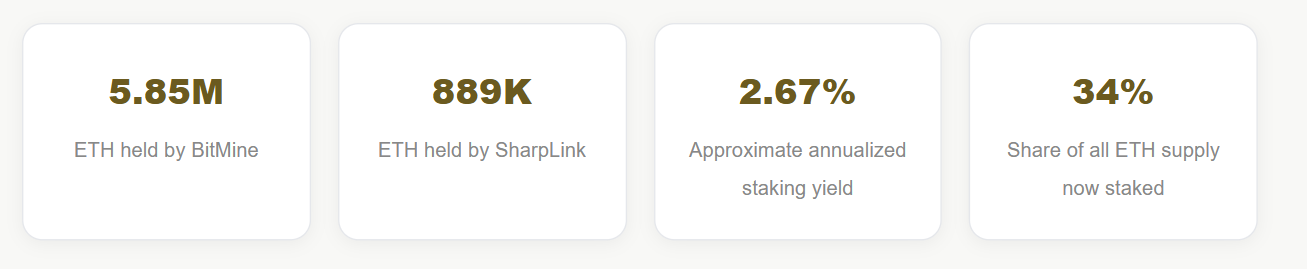
There's a particular kind of corporate strategy that sounds almost too simple to work: buy an asset, lock it up, and let the underlying network pay you for holding it still. That's the pitch behind Ethereum treasury companies, a still-young corner of public markets where firms have raised billions of dollars specifically to accumulate Ethereum and put it to work earning yield, rather than letting it sit passively on a balance sheet the way a gold reserve might. Over the past year, two companies in particular have taken that idea further than almost anyone expected. BitMine Immersion Technologies now holds 5.85 million ETH, worth roughly $14.9 billion when combined with its other crypto, cash, and equity holdings as of late August. SharpLink Gaming, running a considerably smaller but still enormous version of the same playbook, holds nearly 900,000 ETH. Together, these two companies alone control a genuinely significant slice of Ethereum's entire circulating supply, and they've built their entire investment case around a single structural difference between Ethereum and Bitcoin that doesn't get nearly as much mainstream attention as it deserves. Why Ethereum treasuries aren't just "Bitcoin's MicroStrategy, but different coin" It's tempting to describe this trend as a copy-paste of the strategy Michael Saylor's company, Strategy, pioneered with Bitcoin, buy the asset, hold it on the balance sheet, let public market investors get exposure to it through the stock. That comparison captures part of the story, but it misses the detail that actually makes Ethereum treasury companies structurally distinct: staking. Bitcoin has no native mechanism for generating yield simply by holding it. Ethereum does. Since the network's shift to proof-of-stake, ETH holders can lock up their tokens to help validate transactions and secure the network, earning a steady yield in return, currently in the range of 2.6 to 2.7 percent annualized. For a company holding millions of tokens, that yield isn't a rounding error. It's real, recurring revenue generated simply by holding the asset productively rather than letting it sit idle.
Why staking matters more than the yield percentage suggests
A 2.6% annual yield sounds modest on its own. Applied to billions of dollars in holdings, it becomes a genuinely material, recurring revenue stream, one that Bitcoin treasury companies simply have no equivalent mechanism to generate. That difference is the entire structural argument for why ETH treasury vehicles can, in theory, justify trading at a premium to the value of their underlying holdings.
Meet the two companies leading the category
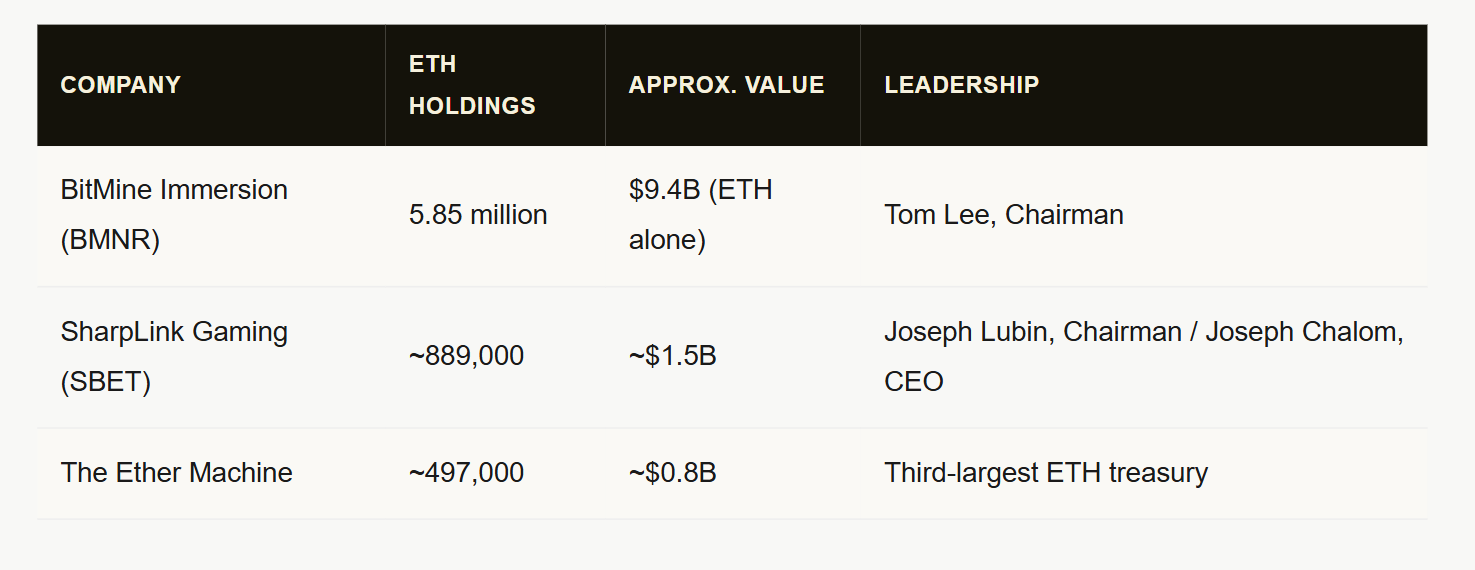
BitMine Immersion Technologies, led by Fundstrat co-founder Tom Lee as chairman, entered the Ethereum treasury business in mid-2025, pivoting from its original focus on Bitcoin mining infrastructure. The company secured an initial $250 million private investment round backed by a genuinely notable list of crypto-native investors, including Founders Fund, Pantera Capital, FalconX, Kraken, Galaxy Digital, and DCG, and has since become, by a wide margin, the largest corporate holder of Ethereum in the world, controlling close to 5 percent of the entire circulating supply.
SharpLink Gaming took a more unusual path to get here. The company, formerly focused on sports betting marketing, pivoted entirely toward Ethereum accumulation in mid-2025 under the leadership of chairman Joseph Lubin, one of Ethereum's original co-founders and the chief executive of Consensys, one of the network's most influential development companies. Under CEO Joseph Chalom, SharpLink has methodically built the second-largest corporate ETH position globally, and its stock was added to the Russell 2000 and Russell 3000 indexes effective June 29, 2026, a milestone that meaningfully broadened the pool of institutional investors able to hold the stock.
"We have successfully transformed into an institutional-grade Ethereum treasury platform. Our goal is straightforward: to responsibly enhance ETH per share and optimize our treasury's productivity over time."
— Joseph Chalom, CEO, SharpLink Gaming
The uncomfortable part: both companies just posted big losses
None of this has been a smooth, one-directional success story lately, and it's worth being direct about that. Ethereum's spot price fell roughly 23 percent during the second quarter of 2026, and that decline hit both companies' financial statements hard. SharpLink reported a net loss of $394.3 million for the quarter, driven primarily by $321 million in unrealized losses on its crypto holdings and an additional $76.1 million in impairments tied to its liquid staking positions. BitMine, while not disclosing an identical loss figure, has also sat on billions of dollars in unrealized losses at various points as ETH's price has fluctuated through 2026.
What's notable is how both companies have responded to that pressure: not by slowing down, but by continuing to accumulate. SharpLink added another 39,319 ETH, worth roughly $91 million, in a transaction detected by on-chain analytics platform Lookonchain on August 21, extending a pattern of steady, methodical purchases the company has maintained for well over a year. BitMine similarly continued adding to its position through the same stretch, with Tom Lee publicly framing recent price weakness as an overdue buying opportunity rather than a reason for caution.
Why staking revenue matters even during a losing quarter
Buried inside SharpLink's otherwise rough quarter is the detail that makes the entire treasury model worth taking seriously as more than speculative price exposure: the company generated $11.2 million in staking revenue during the same period it posted a $394 million net loss. That revenue doesn't erase the unrealized losses, but it does something a simple buy-and-hold Bitcoin strategy structurally cannot do, produce recurring, asset-backed income regardless of which direction the token's price happens to be moving that quarter. Analysts have pointed to BitMine's staking income specifically as a mechanism that helps "fill" operational funding gaps and can support share buyback programs even during periods of price weakness.
The risk that could undercut the entire model
Here's where the story gets genuinely uncertain, and worth watching closely if you're following this space. Ethereum's staking rate has climbed rapidly, crossing 30 percent of total supply in February 2026 and reaching approximately 34 percent by August, with more than 36 million ETH now staked across the network. That growth is, in one sense, a sign of a healthy, actively secured network. It's also creating pressure that has led to a proposal targeting validator rewards directly, one that could cut treasury companies' staking revenue substantially if implemented.
What's actually at stake with this proposal
According to analysis from The Block, if the proposed changes to validator reward structures move forward, staking revenue at current participation levels could be cut roughly in half, with the impact worsening further as the staked ratio climbs toward 50 percent of supply. For companies like BitMine and SharpLink, whose investment case leans heavily on staking yield as the structural differentiator from Bitcoin treasuries, a cut of that size would directly undercut the argument that justifies paying a premium for ETH treasury stock over simply holding staked ETH independently.
That risk sits at the center of an honest assessment of this entire sector. The bull case for Ethereum treasury companies rests specifically on the idea that staking yield makes them meaningfully different from, and arguably more attractive than, Bitcoin treasury vehicles. If that yield gets substantially reduced through a network-level change to validator economics, the case for paying any premium over simply holding the underlying staked asset directly becomes considerably harder to make.
This article is for informational purposes and does not constitute financial or investment advice. Cryptocurrency holdings, staking yields, and the companies discussed here carry significant price and regulatory risk, and figures cited reflect publicly reported data as of August 2026, which may have since changed.
What this reveals about where institutional crypto is heading
Whatever happens with the specific validator reward proposal, the broader shift these companies represent is unlikely to reverse entirely. Institutional interest in productive, yield-bearing crypto exposure, as opposed to simple price speculation, has been building steadily across the industry, visible not just in corporate treasuries but in the growing presence of staking-enabled ETFs and, notably, JPMorgan's own moves into tokenized fund products built on similar yield-generating logic.
That broader institutional embrace of staking as a legitimate yield mechanism, rather than a niche crypto-native curiosity, is arguably the more durable story here, even if the specific fortunes of BitMine and SharpLink's stock prices continue to swing with Ethereum's often-volatile spot price. The treasury company model these two firms have built out over the past year has, for better or worse, become the most visible public proving ground for whether "productive crypto holdings" can function as a genuine, sustainable corporate finance strategy, rather than just a leveraged bet on where token prices go next.
The question every investor in this space is now weighing
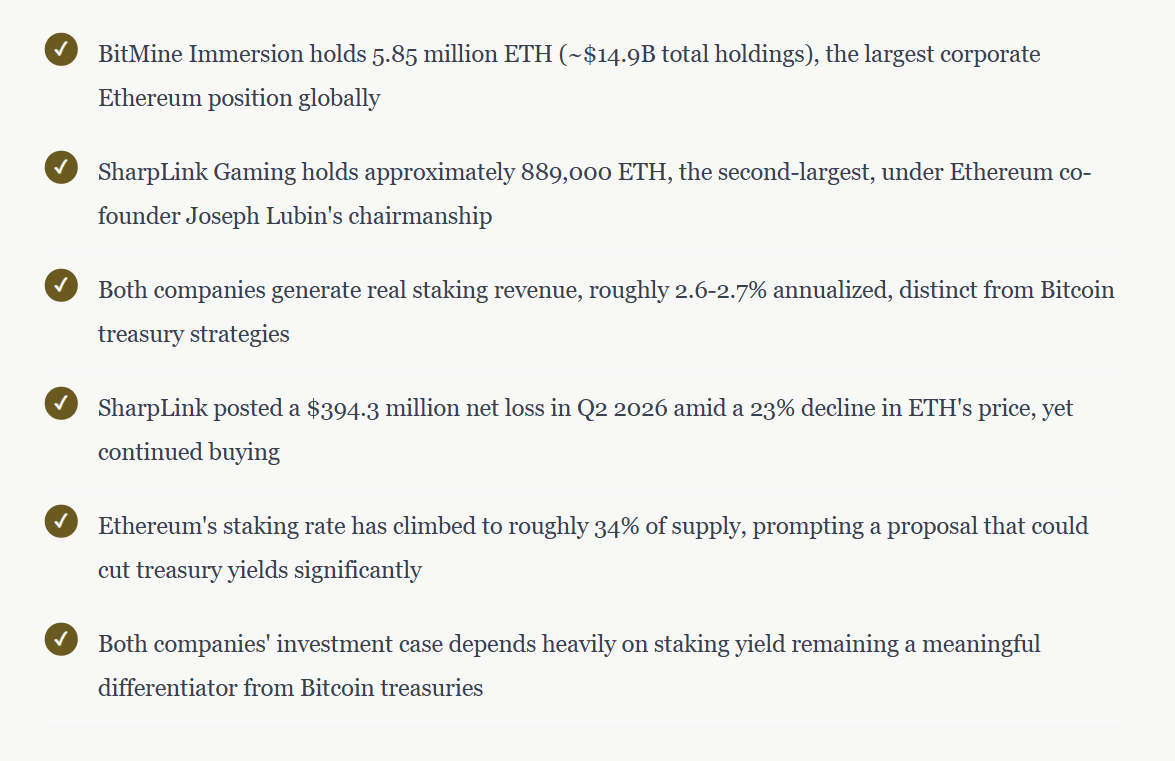
Strip away the specific tickers, and the core question facing Ethereum treasury companies is really about durability: is staking yield a stable, structural advantage that justifies treating ETH treasuries as fundamentally different from Bitcoin treasuries, or is it a temporary edge that network-level governance changes could erode significantly, the moment enough of the supply gets staked to make the current reward structure unsustainable? Neither BitMine nor SharpLink has slowed its accumulation while that question remains unresolved, a bet that the staking model holds up, or that Ethereum's price appreciation alone will justify the strategy even if yields compress.
For now, both companies continue to report their staking income alongside their unrealized losses each quarter, a combination that captures the genuine duality of this entire sector: a real, working yield mechanism that Bitcoin simply doesn't have, layered on top of an asset whose price can still move violently enough to erase hundreds of millions of dollars in a single quarter.