 William BensonVIEW PROFILE →
The World Economy Looks Fractured in 2026. So Why Is the Wealth Gap Still Shrinking?
Central banks haven't been this divided in years. And yet, underneath all that noise, poorer nations are catching up to rich ones faster than most people realize.
Central banks haven't been this divided in years. And yet, underneath all that noise, poorer nations are catching up to rich ones faster than most people realize.
Turn on any financial news channel this month and the story sounds like fragmentation, not unity. The Federal Reserve is split. The European Central Bank is hiking again. The Bank of Japan is normalizing decades of ultra-loose policy. Every major central bank appears to be pulling in a different direction, and headlines keep calling it "divergence." But zoom out from interest rate decisions to the bigger, slower-moving picture, how fast countries are actually getting richer relative to each other, and a genuinely different, more optimistic story is quietly still playing out: the long economic convergence between poor and rich nations hasn't stopped. If anything, in places like China, India, and Indonesia, it's still running ahead of schedule. Two Different Stories Wearing the Same Headline Part of the confusion here comes from a genuine collision of timeframes. Short-term monetary policy, the kind that moves markets day to day, really has fractured in 2026. On July 29, the Federal Reserve held its policy rate at 3.50 to 3.75 percent on a divided 9-3 vote, with three regional presidents publicly dissenting in favor of a hike as inflation ran above target for a fifth consecutive year. The Bank of England held steady at 3.75 percent through the summer, its own policy committee split between holding and raising. The European Central Bank, having paused its cutting cycle once inflation neared its 2 percent target, is now openly debating hikes. The Bank of Japan, meanwhile, is raising rates to levels unseen since 1995. That's genuine, well-documented divergence, and it's largely being driven by a shared external shock landing differently in different places: renewed energy price pressure tied to Middle East conflict, hitting import-dependent economies like the UK and eurozone harder than energy-independent ones. But monetary policy divergence measures something narrower than most people assume, it's about the next twelve months of interest rates, not about which economies are actually closing the gap in wealth and living standards over the next decade. Those are two different clocks, running on two different timescales, and 2026 happens to be a year where they're telling visibly different stories.
The Convergence Story Nobody's Shouting About
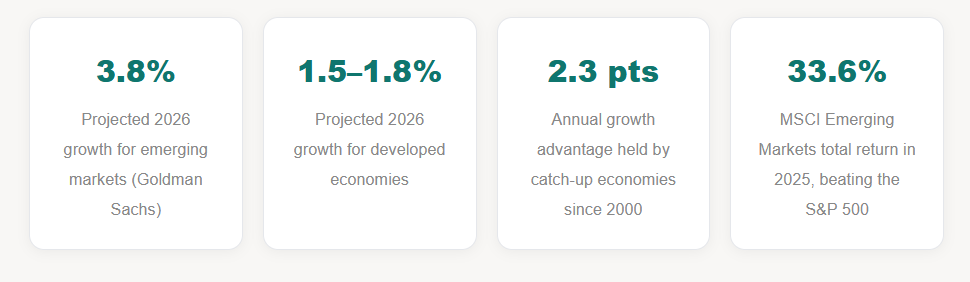
Here's the part that rarely makes the front page: Goldman Sachs research published in 2026 found that, when countries are weighted by population rather than treated as equal data points, economic convergence between rich and poor nations is very much still holding. Since the year 2000, countries starting at roughly 50 percent of US GDP per capita have grown about 2.3 percentage points faster per year than developed economies, a persistent catch-up effect large enough to meaningfully close the income gap over time rather than merely narrow it at the margins.
East Asia tells the clearest version of this story. GDP per capita across East Asian emerging markets now sits nearly ten times higher than it was in 1980, even though it remains well below levels in the US and Western Europe. China, India, Indonesia, and Bangladesh, four of the most populous nations on Earth, have been the primary engines of that narrowing gap, and their scale is precisely why population-weighted analysis matters here. A dozen small economies stagnating doesn't meaningfully change the global convergence picture. Four billion-person economies continuing to catch up absolutely does.

Why Rich Economies Are Actually Slowing Down
The convergence story isn't purely about emerging markets sprinting, it's also about developed economies genuinely losing speed, which narrows the gap from both directions at once. Aging populations, chronic underinvestment, tightening immigration policy, and rising protectionism are all weighing on the potential output of the US, the eurozone, and Japan simultaneously. Forecasters expect developed market growth to ease from around 1.7 percent in 2025 to roughly 1.5 percent in 2026, a modest but structurally significant deceleration that shows little sign of reversing on its own.
There's a partial counterforce worth naming honestly: AI-driven investment is providing a real offset in several advanced economies, with the prospect of meaningful productivity gains and modest disinflationary effects over the medium term. But even accounting for that boost, the underlying demographic and structural headwinds facing rich nations are substantial enough that most forecasters still expect the growth gap between rich and developing economies to persist, and in some projections, to widen further in the years ahead.
The disparity in growth rates between emerging and advanced economies is widening, not narrowing, according to multiple 2026 outlooks, with emerging markets expected to drive a significant share of total global GDP growth for the remainder of the decade.
The Uneven Middle: Not Every Emerging Market Is Converging Equally
It would be misleading to describe this as a uniform, guaranteed trend across every developing nation. The World Bank's own 2026 outlook is notably more cautious, projecting overall global growth slowing to 2.5 percent this year as Middle East conflict drives sharp energy price increases, with emerging and developing economies facing their weakest per capita income growth since the pandemic in aggregate. China faces its own intensifying structural headwinds, an aging population, underconsumption, and deflationary pressure, that complicate its role as the traditional engine of EM growth. Latin America continues to wrestle with fiscal fragility and persistent inflation.
Argentina offers a genuinely striking counterexample of how quickly a single economy's trajectory can shift. After a punishing two-year adjustment program combining fiscal consolidation, the elimination of central bank monetary financing, and a managed exchange-rate regime, the country posted its first primary fiscal surplus in over a decade in 2024, 1.8 percent of GDP, and entered 2026 with meaningfully restored macroeconomic stability after years of chronic imbalance. It's a reminder that convergence isn't a passive, automatic process. It happens, when it happens, through specific, often painful policy choices, not simply the passage of time.
A Few Honest Questions People Are Actually Asking
If central banks are so divided, doesn't that undermine the convergence story? Not directly. Short-term rate divergence reflects how different economies are absorbing the current energy shock, a cyclical, near-term dynamic. Long-run convergence is driven by structural growth differentials, productivity, demographics, investment, that operate on a much longer timeline and aren't necessarily disrupted by a single year of policy fragmentation.
Is convergence happening everywhere, or just in a few large countries? Largely the latter, and that distinction matters. Convergence at the global, population-weighted level is heavily driven by a handful of very large economies, China, India, Indonesia, Bangladesh, catching up. Smaller developing economies show a far more mixed, uneven picture, and some are falling further behind rather than closing the gap.
Could the current energy shock actually reverse convergence? It's a real risk worth watching. If elevated energy prices persist and disproportionately hurt import-dependent developing economies, that could slow or temporarily interrupt catch-up growth in specific regions, even as the larger structural trend continues elsewhere.
What This Actually Means Going Forward
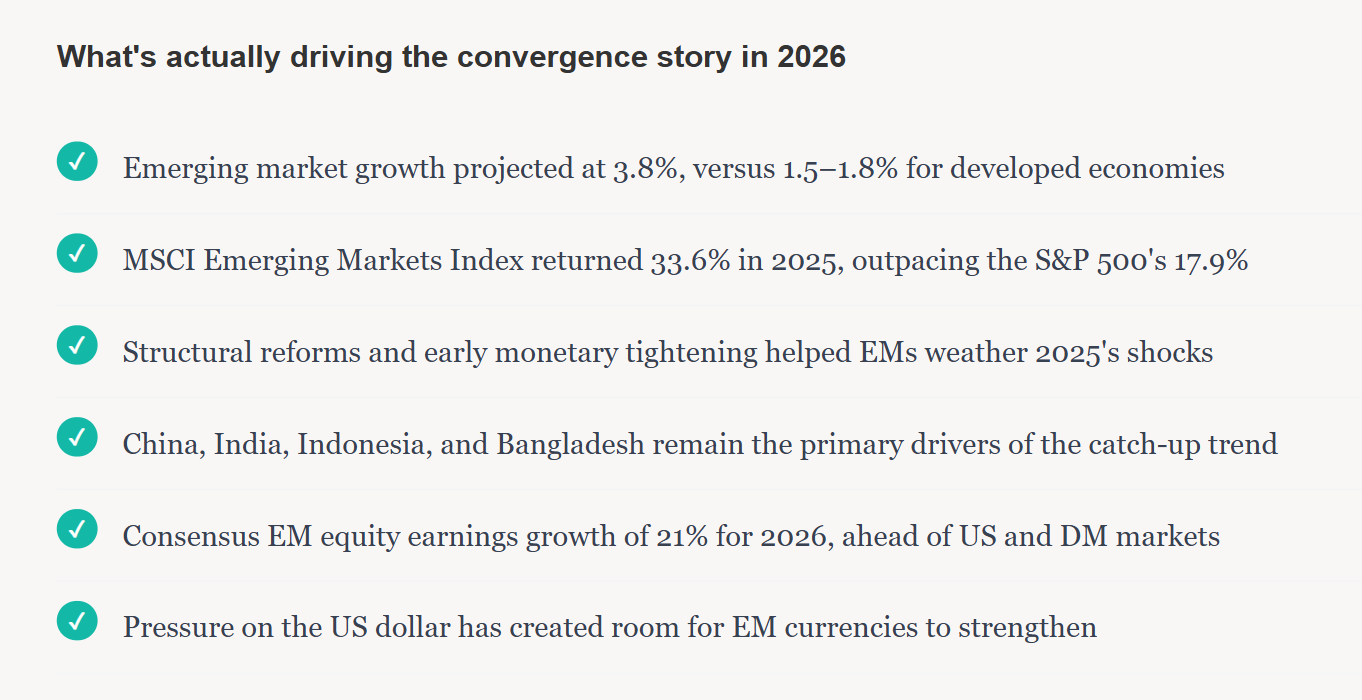
The honest takeaway for 2026 isn't a single, tidy headline, it's that two real trends are running simultaneously without necessarily contradicting each other. Short-term monetary policy has fractured more visibly than at any point since the pandemic, and that fracture is genuinely driven by an uneven energy shock rather than a temporary anomaly. At the same time, the decades-long structural story of large developing economies closing the income gap with rich nations remains, by the best available population-weighted evidence, largely intact, and in some projections, is actually widening the growth advantage emerging markets hold this year.
The mistake worth avoiding is treating one of these trends as proof the other doesn't exist. A world where the Fed, the ECB, and the Bank of Japan are all pulling in different directions on interest rates is entirely compatible with a world where India, China, and Indonesia keep growing meaningfully faster than the US, the eurozone, and Japan on a multi-year view. Convergence was never a story about central banks agreeing with each other. It's a story about which economies are actually building wealth faster, and on that measure, 2026's answer looks remarkably similar to the answer of the past two decades.
A note on the data
Growth projections and convergence figures in this piece are drawn from multiple 2026 sources, including Goldman Sachs, the IMF, the World Bank, and Lazard Asset Management, which can differ meaningfully in methodology and assumptions. Treat these as a directional picture of a genuinely complex, evolving global economy rather than a single settled consensus.