 William BensonVIEW PROFILE →
A Routine Landing, a Hovering Helicopter, and the Crash at Carlisle Airport That's Left a Community Searching for Answers
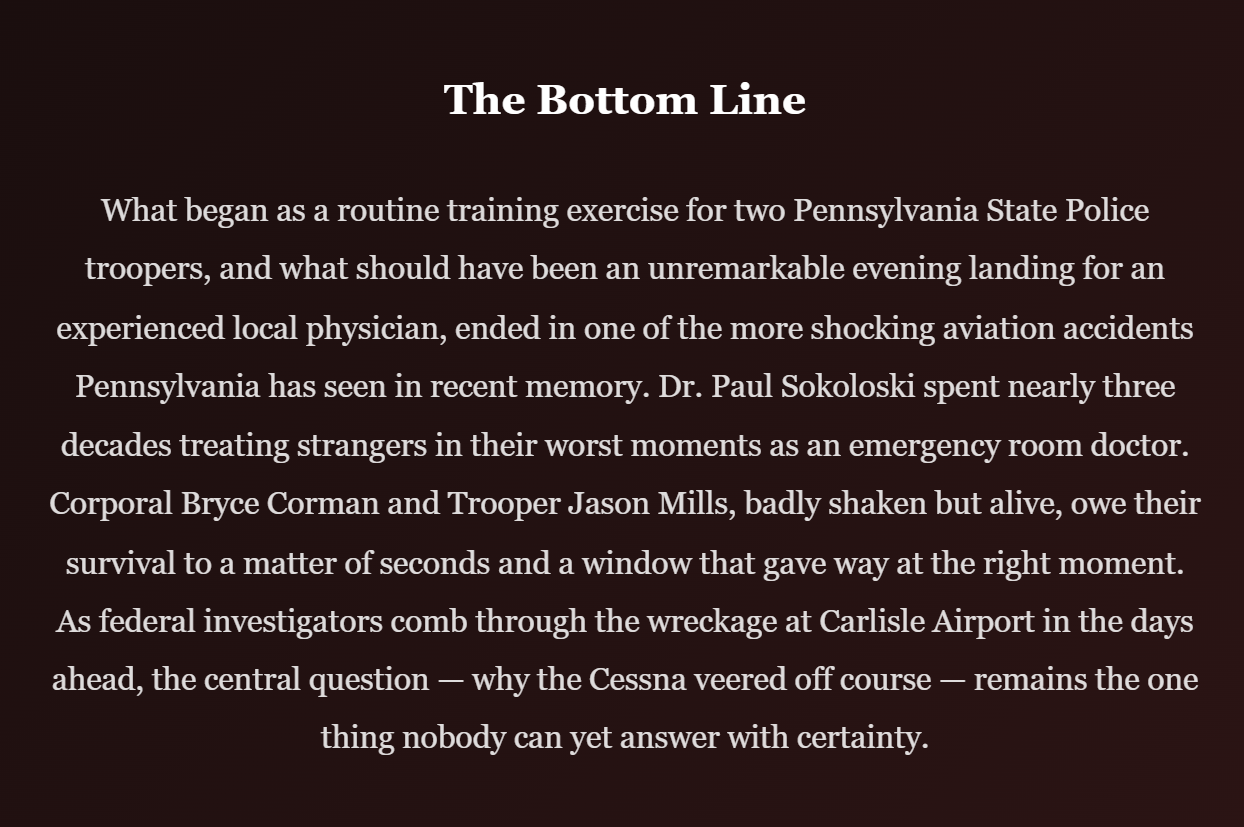
It was a few minutes before seven in the evening on a quiet Wednesday when a small two-seat airplane, coming in to land at a regional airport in central Pennsylvania, drifted off course by just enough to change everything. Within seconds, that plane had struck the tail of a hovering State Police helicopter, and by the time the wreckage stopped moving, one man was dead and two troopers were fighting to get out of a helicopter that had rolled onto its side.
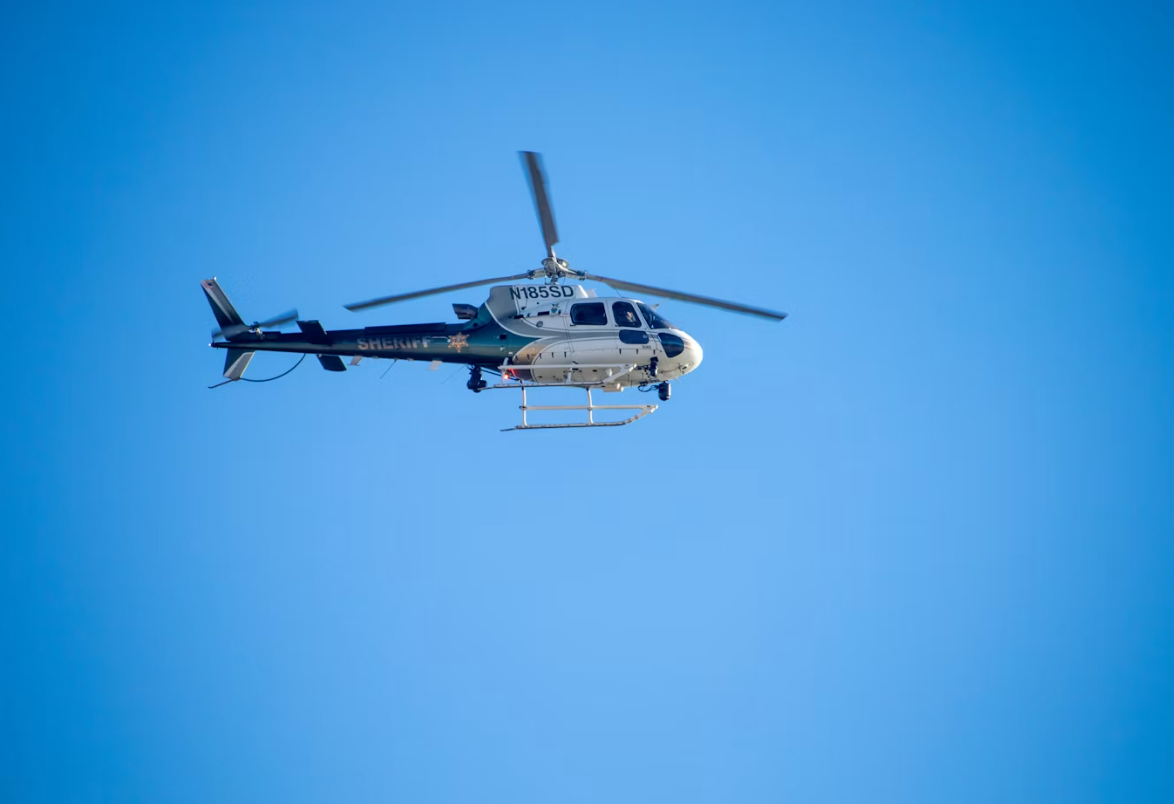
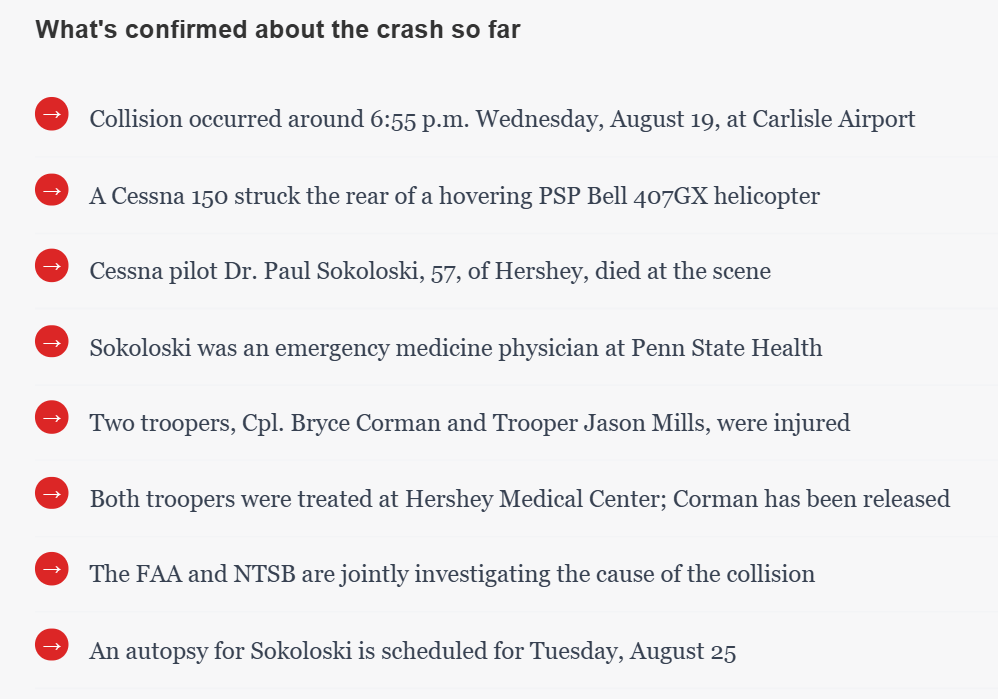
What Actually Happened at Carlisle Airport The crash unfolded at Carlisle Airport in South Middleton Township, Cumberland County, at roughly 6:55 p.m. on Wednesday, August 19. According to Pennsylvania State Police, a Cessna 150 — a small, two-seat single-engine airplane commonly used for training and short recreational flights — was on approach to land when it veered unexpectedly off the north side of the runway. Instead of touching down safely, it struck the rear of a Pennsylvania State Police Bell 407GX helicopter that was hovering several feet above a grassy patch just off the runway, where a crew was in the middle of a routine training exercise. State Police Acting Commissioner Lt. Col. George Bivens laid out the sequence during a late-night briefing alongside Governor Josh Shapiro. He explained that the helicopter crew, flying out of the Harrisburg-based aviation unit, would have had almost no chance of spotting the incoming aircraft, since it approached from directly behind them. The Cessna first clipped the helicopter's tail rotor before crashing into the main rotor assembly, an impact Bivens described bluntly as a violent one.
Once the two aircraft made contact, both went down hard. The Cessna broke apart into several pieces a short distance from where the collision occurred. The helicopter fared just as badly — it lost its rotor blades and tail boom, flipped, and came to rest on its side with part of the cabin resting on its roof. Investigators say the entire sequence, from first contact to both aircraft hitting the ground, likely took only a few seconds.
Who Was Dr. Paul Sokoloski
The pilot of the Cessna has been identified by the Cumberland County Coroner's Office as Paul William Sokoloski, 57, of Hershey, Pennsylvania. He was the plane's sole occupant and was pronounced dead at the scene.
Away from the cockpit, Sokoloski was known in the Hershey area as an emergency room physician with Penn State Health, where he had reportedly practiced emergency medicine since the late 1990s — a career spanning more than two decades of treating patients during some of the most difficult moments of their lives. Penn State Health confirmed his passing in a statement, saying the health system was focused on supporting his family and the colleagues who had worked alongside him for years.
According to FAA records, Sokoloski wasn't a casual weekend flyer. He held licenses covering single-engine, multi-engine, and commercial aircraft, which suggests a pilot with a serious amount of flight experience behind him — making the circumstances of Wednesday's crash all the more puzzling to those who knew him. Investigators have not yet offered a public explanation for why the plane veered off course during what should have been a routine landing.
"The pilots would not have been able to even see that airplane approaching them," Lt. Col. Bivens told reporters, describing a collision that came from directly behind the hovering helicopter and gave its crew no warning at all.
How the Two Troopers Survived
Inside the helicopter were Corporal Bryce Corman and Trooper Jason Mills, both members of an aviation unit that Governor Shapiro later described as an elite, highly trained team essential to the department's operations. Both men were initially trapped in the wreckage after the aircraft rolled onto its side.
Despite his own injuries, Corman managed to force open a window and pull himself free, then went back for Mills and helped him escape as well — all while there were concerns the damaged helicopter could catch fire. Both troopers were airlifted to Penn State Health Milton S. Hershey Medical Center for treatment.
Dr. Ashley Ludwig, the trauma medical director at Hershey Medical Center, told reporters that both troopers arrived as Level 1 trauma patients but were ultimately found to have relatively minor injuries given the severity of the crash. One trooper was expected to be released the same night, while the other was kept for observation. Governor Shapiro later confirmed that Corman had since been released from the hospital, while Mills remained hospitalized in stable condition. Speaking outside the medical center, Shapiro called the surviving troopers heroes and said the outcome could easily have been far worse.
Why the Investigation Will Take Time
Both the Federal Aviation Administration and the National Transportation Safety Board have opened investigations into the crash, working alongside Pennsylvania State Police. That's standard procedure any time a collision involves an aircraft, but it also means the public shouldn't expect a fast, definitive answer about what actually caused the Cessna to veer off course.
NTSB investigations into general aviation accidents typically take months, sometimes well over a year, before a final report is published. Investigators will look at everything from mechanical issues and weather conditions at the time of the crash to radio communication, airport visibility, and the pilot's health and recent flight history. Given that Sokoloski was an experienced, multi-licensed pilot, the eventual findings are likely to draw significant attention from the aviation community, not just from those who knew him personally.
A Few Questions People Are Actually Asking
Was Carlisle Airport closed after the crash?
Yes, at least temporarily. Emergency crews and investigators secured the area around the runway and the grassy strip where the helicopter had been hovering, and access was restricted while the FAA and NTSB documented the scene.
Did the helicopter crew do anything wrong?
Nothing reported so far suggests the helicopter crew was at fault. Officials have been clear that the Cessna approached from an angle the hovering crew couldn't have seen, and the incident is being treated, at least initially, as something that went wrong with the plane's approach rather than with the helicopter's positioning.
Is this connected to any other recent Pennsylvania State Police helicopter incidents?
Local reporting has noted that the crash leaves the department with a smaller active helicopter fleet than before, since PSP maintained only a handful of helicopters to begin with. That's a resourcing detail worth watching, but it isn't evidence of any pattern connecting this crash to prior incidents.
This is a developing story Investigations by the FAA and NTSB are ongoing, and official findings about what caused the Cessna to veer off course have not yet been released. Details in early reporting — including timelines and witness accounts — may be refined as investigators complete their work. Treat anything not yet confirmed by state police, the coroner's office, or federal investigators as preliminary.