 William BensonVIEW PROFILE →
A Week After Tragedy Struck Berlin Pride, Europe Answered With Its Biggest Crowds in Years
A week after an attack tried to turn a celebration into a tragedy, cities across the UK and mainland Europe answered with their biggest crowds in years.
A week after an attack tried to turn a celebration into a tragedy, cities across the UK and mainland Europe answered with their biggest crowds in years.
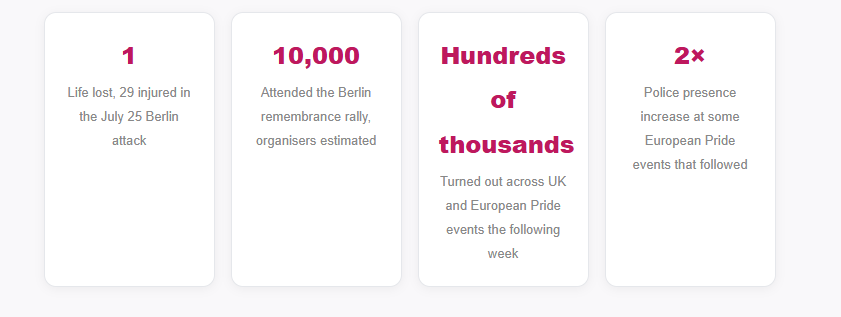
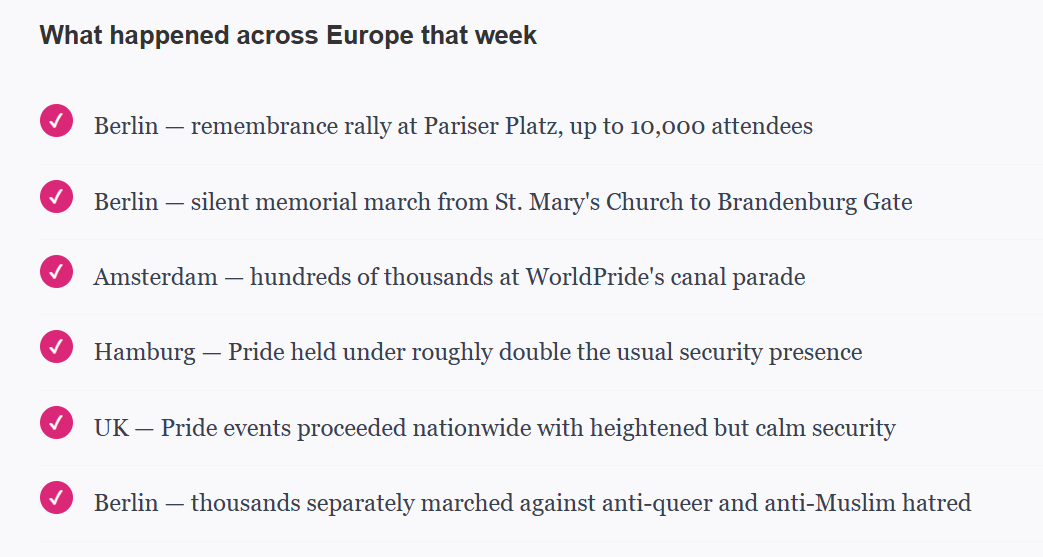
Seven days after a van tore through a crowd of dancers at Berlin's Pride festival, a very different scene unfolded across the continent. Instead of empty streets and cancelled events, hundreds of thousands of people turned out for Pride marches in the UK and mainland Europe, many of them wearing dark colours in quiet tribute, many of them there specifically because of what had happened, not despite it. It's the kind of response that's hard to script and even harder to fake, and it says something real about how a community chooses to answer fear. What Happened in Berlin On the evening of July 25, 2026, a 21-year-old German-born man of Lebanese descent drove a van into a crowd of pedestrians at the closing party of Berlin's Christopher Street Day festival in Tiergarten, one of the city's largest urban parks. One woman was killed and 29 people were injured, several critically, before the attacker fled on foot and allegedly continued the assault with a bladed weapon. He was shot dead by police the following day during an attempted arrest in the Spandau district. Germany's interior minister, Alexander Dobrindt, described the attack as pointing clearly toward Islamist terrorism, and Berlin's mayor, Kai Wegner, called it an assault on the city's "free and cosmopolitan society." The response inside Berlin itself was immediate. A remembrance rally at Pariser Platz, registered for an expected 600 people, drew as many as 10,000 according to organisers, with police estimating a still-substantial 5,000. A silent memorial march traced a route from St. Mary's Church to the Brandenburg Gate. And notably, Muslim community organisations in Berlin were among the first to publicly condemn the attack, with imams from local mosques establishing direct contact with the Pride organisers in the attack's immediate aftermath, a detail that mattered as the city worked to prevent the tragedy from being weaponised into broader hostility toward its Muslim residents.
The Week That Followed: Europe Didn't Stay Home
What happened over the following week was, by most accounts, unexpected in scale. Rather than a chilling effect on attendance, Pride events across the UK and mainland Europe drew crowds that organisers described as among the largest in years. In Amsterdam, hundreds of thousands of people lined the city's canals for the flagship boat parade of WorldPride, a fitting host city given it marked 25 years since the Netherlands became the first country in the world to legally recognise same-sex marriage. The event's chosen theme for the season: simply, "Unity."
In Hamburg, security was roughly doubled compared to the previous year's event, under the motto "Queer in solidarity. Take a stand — for a future without fear." Among the dozens of parade trucks was one specifically representing Berlin's Pride organisation, its participants dressed in dark clothing as a visible mark of respect for the victims of the attack just days earlier, a quiet, deliberate gesture carried into a celebration that could easily have been cancelled instead.

Why People Chose to Show Up Anyway
The reasoning behind the turnout, echoed across statements from organisers and attendees alike, tended to circle back to one idea: that staying away was exactly the outcome the attack was designed to produce. Julia Miosga, a board member of Berlin's Pride organisation, made a point of pushing back against attempts to use the tragedy to incite hatred against Muslims or people of particular backgrounds, insisting the attack shouldn't be allowed to divide communities that had, in the attack's aftermath, largely stood together.
Writing for Humanists UK in the days after, one gay writer described grappling directly with what the attack meant for a community that had, for years, felt increasingly safe marching openly. He recalled the day of the Berlin attack as one of genuine joy beforehand, hundreds of thousands of people dancing behind eighty parade floats under a festival motto that translated to "blessing instead of hate," before violence turned that same evening into tragedy. His conclusion, shared by many who marched the following week, was that fear achieving its goal would be its own kind of loss, separate from and beyond the attack itself.
Across statement after statement in the days that followed, organisers and attendees returned to a consistent theme: that visibility itself, showing up, marching, being seen, was the most direct answer available to an attack aimed specifically at making people afraid to do exactly that.
Security, Grief, and Celebration All at Once
None of this happened without visible caution. Organisers across multiple cities acknowledged openly that security had been meaningfully increased, a departure from the more relaxed atmosphere Pride events in Western Europe had generally enjoyed in recent years. The tension between wanting events to feel joyful and open, the entire point of Pride as a celebration, and needing real, heightened protection in the immediate wake of a deadly attack, was something organisers navigated publicly rather than pretending away.
That tension showed up in small, telling details: the darkly dressed marchers on Berlin's truck at Hamburg's parade, the doubled police presence, the way several statements from Pride organisations paired words of celebration with explicit acknowledgment of grief. It wasn't a simple story of defiant joy overriding fear. It was closer to both things being true simultaneously, genuine celebration and genuine caution, carried side by side through the same streets.
A Few Honest Questions People Are Actually Asking
Were UK Pride events specifically targeted or at heightened risk? There was no indication of a specific, credible threat against UK events tied to the Berlin attack. Increased security reflected a general, precautionary response following the incident, consistent with how public events across Europe typically respond after an attack elsewhere on the continent.
Has the attacker's background led to a broader backlash against Muslim communities in Germany? Some rise in Islamophobic rhetoric was reported in the days following the attack, prompting a separate march through central Berlin specifically protesting both anti-queer hatred and Islamophobia together, a response organisers framed as refusing to let the tragedy divide two communities rather than pit them against each other.
Is this the first time a Pride event in Europe has faced a deadly attack? No. Attacks and violence targeting LGBTQ+ gatherings have occurred in various forms across Europe and elsewhere in recent years, though the Berlin attack's scale and its target, one of the continent's largest and most established Pride celebrations, made it a particularly significant moment for the wider community.
What This Moment Actually Reveals
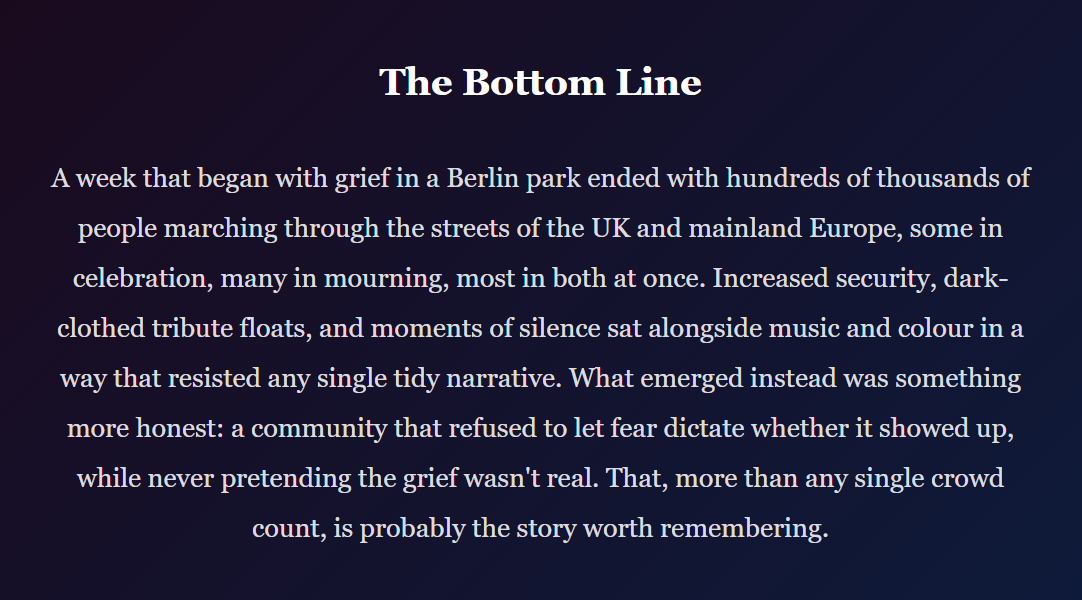
It would be easy, and not entirely wrong, to read the scale of these follow-up marches as a story about resilience. But the fuller picture is a little more complicated and, in some ways, more meaningful than a simple story of defiance. The turnout wasn't purely about refusing to be intimidated, it was also genuine, unhidden grief, expressed through darkened clothing on a parade float and moments of silence woven into otherwise celebratory events. People didn't show up despite the sadness. They brought it with them, and marched anyway.
That combination, joy and grief occupying the same street at the same time, is arguably closer to the truth of how communities actually process an attack like this than either a purely triumphant or purely fearful narrative would suggest. Berlin's Pride organisers, Amsterdam's WorldPride crowds, and the marchers who turned out in cities across the UK weren't performing resilience for an audience. They were doing what Pride, at its core, has always been built to do: showing up publicly, together, especially when it would be easier not to.
A note on this reporting
Details in this piece reflect public reporting and official statements as of August 2026. Attendance figures for large public gatherings vary between organiser and police estimates, and this article notes both where available rather than treating either as the single definitive count.