William BensonVIEW PROFILE →
Astronomers Just Found the Earliest "Black Hole Star" Ever Seen , And It Might Rewrite How the Universe's First Giants Were Born
It glows a hundred billion times brighter than an ordinary star, sits near the very dawn of the universe, and might finally explain a mystery that's puzzled astronomers for years.
It glows a hundred billion times brighter than an ordinary star, sits near the very dawn of the universe, and might finally explain a mystery that's puzzled astronomers for years.
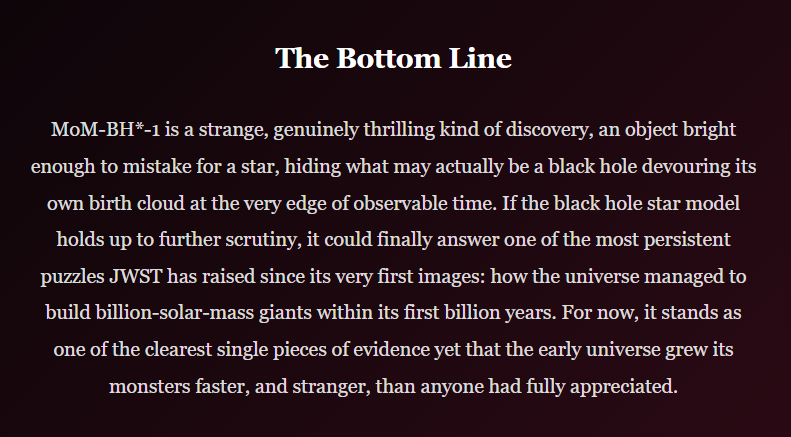
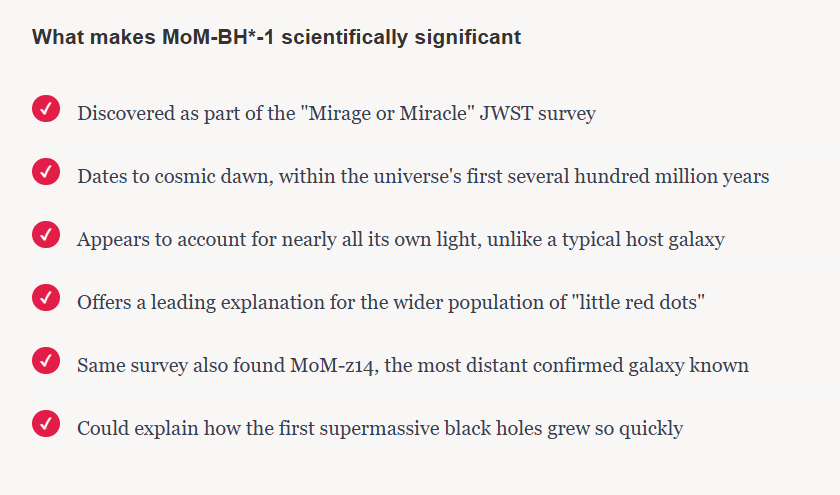
For years, the James Webb Space Telescope has been quietly breaking a rule astronomers thought was fairly solid: young galaxies aren't supposed to have monstrously massive black holes at their centers, not this early, not this fast. Every time JWST peered deeper into the early universe, it kept finding black holes that seemed to have grown up far too quickly for anyone's models to explain. This month, a team of astronomers may have finally caught one of the culprits red-handed, and it isn't quite what anyone expected. What Exactly Did JWST Find On August 12, 2026, a team led by astronomer Rohan Naidu at the University of Hawai'i published a paper in the journal Nature describing an object unlike anything catalogued before: a compact, extraordinarily bright source from the very early universe that the team nicknamed MoM-BH*-1. The name is a nod to the "Mirage or Miracle" survey that found it, and what makes the object remarkable isn't just its age, it's what it appears to actually be. Rather than an ordinary young galaxy or a typical growing black hole, the evidence points to something astronomers had never directly confirmed before: a black hole encased inside a dense, glowing cocoon of gas, together forming an object that radiates almost like a single, impossibly bright star. The object sits at a staggering distance, dating back to only a few hundred million years after the Big Bang, placing it firmly within what astronomers call "cosmic dawn," the earliest chapter of the universe's history. At that distance, MoM-BH*-1 outshines an ordinary star by roughly a hundred billion times, an almost incomprehensible figure for something so early in cosmic time.

The "Little Red Dot" Mystery That's Been Bugging Astronomers Since 2022
To understand why this discovery matters, it helps to rewind to shortly after JWST began operating. Almost immediately, the telescope's deep images of the distant universe started turning up strange, compact, extremely red sources that didn't fit neatly into any existing category. Astronomers quickly nicknamed them "little red dots," and they turned out to be remarkably common, appearing on average once in every deep JWST image taken of the early universe. Their unusual brightness, color, and sheer number challenged standard expectations for both young galaxies and ordinary black holes feeding on surrounding matter.
What nobody could confirm, until now, was what was actually powering them. MoM-BH*-1 offers the clearest single example yet, appearing to account for nearly all of the object's observed light itself, leaving little room for separate starlight from a surrounding host galaxy. That's a crucial distinction. It suggests the black hole and its gas cocoon aren't just one bright feature inside a galaxy, they're effectively the entire visible object.
A Black Hole Wearing a Star as a Disguise
Here's the part that sounds almost like science fiction but is grounded in genuine physics. The leading explanation for MoM-BH*-1 isn't a star at all in the traditional sense, it's a black hole sitting inside an unusually thick, dense envelope of gas. Instead of shining through nuclear fusion the way a normal star does, the object is theorized to be powered by the black hole itself, feeding voraciously on the surrounding gas cloud while that same cloud traps and re-radiates the resulting energy, producing a glow that looks, from a great distance, remarkably like an ordinary star.
Researchers have started calling this theoretical configuration a "black hole star," and MoM-BH*-1 is being described as the first relatively clean observational example of one. The gas cocoon isn't incidental to the discovery, it may be the entire mechanism explaining one of astrophysics' most stubborn puzzles: how a black hole seed could grow to a billion times the mass of our Sun within the universe's first billion years, a pace standard models of black hole growth struggle badly to explain.
Why This (Maybe) Solves an Impossible Problem
The deeper puzzle here has been sitting unresolved since JWST's earliest observations. Under standard physics, a black hole can only pull in and consume matter so quickly, a natural speed limit called the Eddington limit, before the radiation from all that infalling material pushes back and chokes off further growth. Yet JWST kept finding black holes with a billion solar masses or more, sitting in a universe barely a billion years old, far too young for that gradual, limited growth process to account for them.
A dense gas cocoon that both feeds a black hole at extreme rates and simultaneously traps the radiation that would normally choke off that growth offers, in the words of the research team, a theoretically attractive pathway that finally lines up observation with theory.
Mirage or Miracle? Why Scientists Are Still Being Careful
True to the survey's own slightly tongue-in-cheek name, the researchers behind this discovery are notably cautious about overselling it. MoM-BH*-1 is a compelling, well-argued case, not an unquestioned certainty. Astrophysics doesn't get the luxury of controlled laboratory experiments, everything here is inferred from faint radiation that has traveled across billions of light-years, filtered through the particular instruments and models used to interpret it. Competing explanations for other similarly extreme early black holes exist too, including separate JWST findings describing rapid, so-called "super-Eddington" accretion, where a smaller black hole briefly and dramatically exceeds normal growth limits without necessarily needing a full gas cocoon.
What makes MoM-BH*-1 stand out among these competing ideas is how directly its data seems to fit the black hole star model specifically, rather than requiring a more exotic or temporary explanation. Further spectroscopy is already scheduled to test the theory more rigorously, essentially checking whether the object keeps behaving the way the black hole star model predicts under closer scrutiny.
A Few Honest Questions People Are Actually Asking
Is this actually a new type of object, or just a black hole we're seeing differently? Both, in a sense. The black hole itself isn't a new category of object, but the specific gas-cocoon configuration making it appear almost stellar, if confirmed, would represent a genuinely new observed phase of early black hole growth.
Could there be more of these out there? Almost certainly. Given how common "little red dots" are across JWST's deep images, researchers suspect black hole stars, or something closely related to them, may be a fairly standard, if brief, phase many early supermassive black holes pass through.
Does this discovery change anything for life on Earth or our own solar system? Not directly or practically. Its significance is purely about understanding how the universe's earliest structures formed, a foundational question in cosmology rather than one with any immediate effect closer to home.
What Happens Next
The team behind MoM-BH*-1 has already secured additional JWST spectroscopy time to probe the object further, aiming to nail down exactly how thick its gas cocoon is, how fast the black hole inside it is actually growing, and whether the same signature shows up consistently across other little red dots already catalogued in JWST's archives. If the black hole star model holds up under that closer look, it would mark a genuine turning point, finally connecting a decades-old theoretical prediction to a real, directly observed object.
Either way, the discovery is a useful reminder of what makes this era of astronomy genuinely thrilling. JWST wasn't specifically built to hunt for black hole stars, they weren't even a confirmed category of object when the telescope launched. It found one anyway, simply by looking closer and more carefully at the earliest light in the universe than any instrument ever had before.
A note on the science
The black hole star interpretation of MoM-BH*-1 is the leading explanation supported by the August 2026 Nature paper, but as with most frontier astrophysics findings, it remains subject to further observation and peer scrutiny. Treat it as the strongest current evidence, not a fully settled conclusion.