 William BensonVIEW PROFILE →
Australia Charges Dual Citizen Who Joined Ukraine's Army, Then Allegedly Passed Intelligence to Russia
A years-long operation involving Australia's federal police and its domestic spy agency ended with a quiet arrest in a suburban Brisbane street.
A years-long operation involving Australia's federal police and its domestic spy agency ended with a quiet arrest in a suburban Brisbane street.
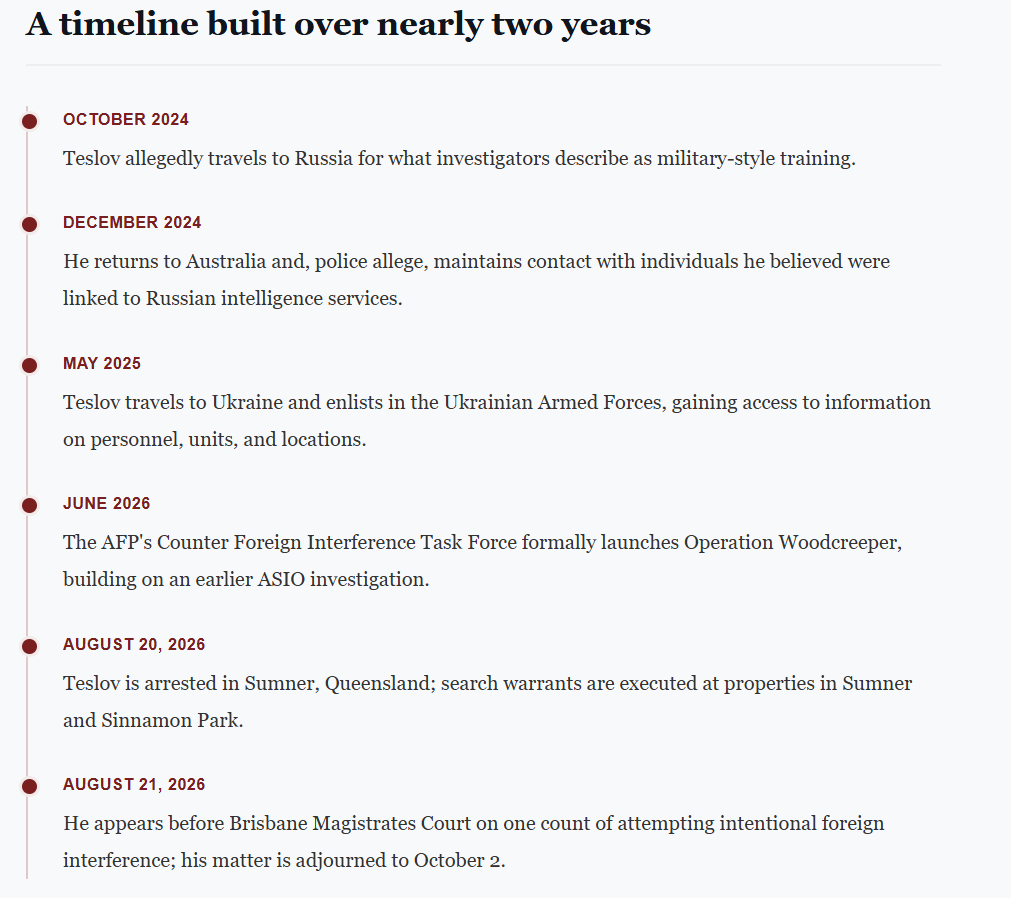
There's a particular kind of story that sounds almost too strange to be a genuine national security case rather than the plot of a spy thriller: a young man travels to a war zone, joins the very army fighting the country he holds citizenship in, and then, according to investigators, spends months quietly feeding what he learns back to the other side. That, in essence, is what Australian authorities allege happened over the course of nearly two years, and on Thursday it ended with handcuffs in a quiet street in Brisbane's western suburbs. The man at the center of the case is Vladimir Teslov, a 27-year-old with both Russian and Australian citizenship, arrested by the Australian Federal Police at a home in Sumner, Queensland. He now faces a single charge of attempting to engage in intentional foreign interference, an offense that carries a maximum penalty of twenty years in prison under Australian law. He did not apply for bail when he appeared before Brisbane Magistrates Court, and his case has been adjourned for mention in October. What investigators say actually happened According to the Australian Federal Police, the case traces back to October 2024, when Teslov is alleged to have traveled to Russia for what investigators described as military-style training. He returned to Australia in December of that year, and from that point on, police allege, he maintained contact with individuals he believed were connected to Russian intelligence services, a detail investigators say forms the connective thread running through everything that followed. The next chapter of the alleged timeline is the part that has drawn the most attention. In May 2025, Teslov traveled to Ukraine and enlisted in the Ukrainian Armed Forces. Through that enlistment, police allege, he gained genuine access to sensitive operational details: information relating to Ukrainian military personnel, specific units, and their locations. It's exactly the kind of granular, ground-level intelligence that would be effectively impossible for an outside intelligence service to obtain without a source physically embedded within the military itself.
Understanding the charge itself
"Foreign interference" is a specific and relatively modern category of offense in Australian law, distinct from traditional espionage charges, though the two frequently overlap in practice. It was introduced as part of a 2018 overhaul of Australia's national security legislation, designed specifically to capture covert, deceptive, or threatening conduct carried out on behalf of a foreign government or its intelligence services, whether or not classified state secrets are technically involved.
Why "foreign interference" rather than "espionage"
Espionage charges typically require proof that classified government information was compromised. Foreign interference charges cast a wider net, covering conduct carried out covertly on behalf of a foreign intelligence service that undermines Australia's national interests or, as in this case, potentially endangers people connected to Australia's strategic partners, even when the information involved wasn't classified Australian material.
That distinction matters here because the information Teslov allegedly gathered wasn't Australian state secrets; it was operational detail about a foreign military, obtained by way of his own enlistment in that military. The foreign interference framework is precisely what allows Australian prosecutors to pursue a case built on exactly that kind of conduct, treating the alleged transfer of information to Russian-linked contacts as a threat to Australia's broader national interest and its relationships with international partners, rather than requiring a direct link to classified Australian material.
Part of a broader, ongoing pattern
Thursday's arrest didn't happen in isolation. Australian authorities describe it as the eighth charge laid in connection with espionage or foreign interference offenses in recent years, a figure that reflects a marked escalation in prosecutions since Russia's invasion of Ukraine began in 2022. The most prominent earlier case involved a married couple, Kira and Igor Korolev, both Russian-born Australian citizens, arrested in 2024 after Kira, who worked as an Australian Defence Force information systems technician, was accused alongside her husband of attempting to access and transmit defense material to Russian authorities. Their charges were upgraded in June 2026 to conspiracy to commit espionage, an offense that could carry a life sentence.
Australia's domestic spy agency, ASIO, has been notably candid about the scale of the threat it believes it's tracking. Director-General Mike Burgess has previously said his organization forced out a "hive of spies" operating in Australia, and more recently confirmed that ASIO was investigating several pro-Russian social media influencers believed to be acting on directives that could be traced back to the Kremlin. Taken together, these cases paint a picture of sustained, multi-pronged Russian intelligence interest in Australia, spanning military technicians, dual citizens with battlefield access, and even online influence operations.
Why Australia, specifically
It's a reasonable question: why would Russian intelligence services invest resources in recruiting sources within Australia, a country geographically distant from the Ukraine conflict itself? The answer connects to Australia's role as one of Ukraine's more committed international backers. Since the invasion began, Australia has committed well over $1.5 billion in military, economic, and humanitarian support to Kyiv, alongside imposing hundreds of sanctions targeting Russian individuals and entities. That level of engagement, combined with Australia's membership in the Five Eyes intelligence-sharing alliance alongside the United States, United Kingdom, Canada, and New Zealand, makes the country a genuinely valuable target for intelligence services trying to understand Western support structures for Ukraine from the inside.
Russia's response, and what wasn't said
In a statement to reporters following news of the charges, Russia's embassy in Canberra offered a notably measured response, saying it had learned of the case through media reports rather than through any official channel. The embassy said no formal requests or notifications had been received from Australian authorities, and that it was using available channels to establish the circumstances of the case, language that neither confirms nor denies any connection to the individuals Teslov allegedly believed he was communicating with.
Vladimir Teslov has been charged but not convicted. The allegations in this article reflect claims made by the Australian Federal Police and prosecutors, which will need to be proven in court. He has not entered a plea, and his case remains before Brisbane Magistrates Court.
What Commissioner Barrett didn't allege
One detail worth noting for context: Commissioner Barrett was explicit that investigators found "nothing to suggest there was or is any threat to Australia" itself arising from this case. That distinction is significant. The alleged harm here centers specifically on the safety of Ukrainian military personnel, information about their positions and units potentially reaching people connected to the opposing side, rather than any suggestion that Australian national security or domestic infrastructure was compromised. It's a narrower, though still serious, category of alleged harm than some previous cases involving direct access to Australian defense systems.
Barrett also offered limited personal detail about Teslov himself, describing him as unemployed and confirming he had never worked for the Australian government or any of its agencies, information that rules out one common concern in cases like this, namely whether an insider had used privileged government access to gather intelligence. Investigators seized a number of electronic devices during the searches at Sumner and Sinnamon Park, which will undergo what the AFP described as extensive forensic examination in the coming weeks, a process likely to shape much of the evidence presented if the case proceeds to trial.
What happens from here
With no bail application made and the matter adjourned to October 2, the immediate next steps in the case are largely procedural: forensic examination of the seized electronic devices, further preparation by prosecutors, and eventually a decision on how the matter will proceed, whether toward a defended trial or some other resolution. Foreign interference cases of this profile tend to move slowly through Australia's court system, partly because of the sensitivity of underlying evidence and partly because of the international dimension involved, which can complicate the gathering and presentation of material connected to events that occurred, at least in part, on foreign soil.
For Australia's national security apparatus, the case is likely to reinforce an argument officials have been making with increasing frequency: that the war in Ukraine has generated intelligence pressure that extends well beyond Eastern Europe, reaching into the lives of ordinary dual citizens thousands of kilometers from the front line. Whether Teslov's case ultimately results in a conviction will be determined in court. What it has already demonstrated, regardless of the outcome, is how directly a distant war can pull an Australian citizen into its orbit, and how seriously Australian authorities now say they intend to treat the consequences.






