 William BensonVIEW PROFILE →
Beyond the Feed: Inside Mark Zuckerberg's High-Stakes Bet on Open-Source AI and Smart Glasses
A company that spent twenty years perfecting the art of holding your attention inside an app is now betting its future on a device that doesn't have a screen at all, and on giving away, for free, the exact technology most of its rivals are charging a subscription for.
A company that spent twenty years perfecting the art of holding your attention inside an app is now betting its future on a device that doesn't have a screen at all, and on giving away, for free, the exact technology most of its rivals are charging a subscription for.
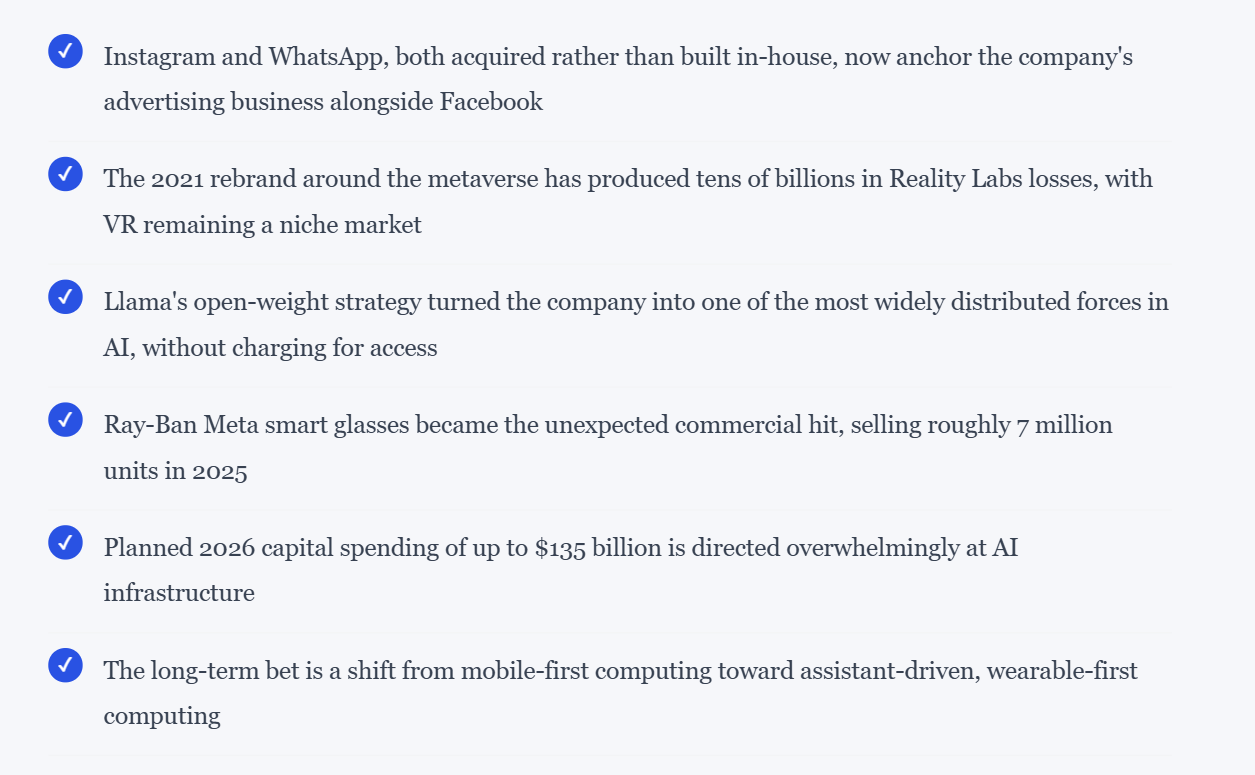
The founding story has been told so many times it's practically folklore at this point: a Harvard sophomore builds a way for classmates to rate each other's photos, drops out, and within a decade turns it into the largest social network on the planet. What tends to get skipped over is how much of what followed was really about acquisition and adaptation rather than pure invention. Two of the platforms now doing the heaviest lifting for the company's advertising business, Instagram and WhatsApp, weren't built in-house at all. They were bought early, for sums that looked wildly overpriced at the time and look, in hindsight, like some of the shrewdest technology acquisitions of the last two decades. That instinct, buy or build whatever the next platform shift demands rather than assume the current one lasts forever, is the thread connecting a company that renamed itself Meta in 2021 around a costly and so far commercially disappointing metaverse bet, then pivoted hard, and far more successfully, into open-source artificial intelligence and camera-equipped eyewear. It's a strange, occasionally reckless-looking strategy from the outside. It's also the same one that let a photo-sharing app acquisition and a messaging app nobody thought was worth the price tag become two of the four pillars now propping up a company worth well over a trillion dollars. The acquisitions nobody thought would work Buying Instagram for roughly a billion dollars in 2012, when the app had barely a dozen employees and no meaningful revenue, drew real skepticism at the time. Acquiring WhatsApp two years later for a figure north of nineteen billion dollars looked, to plenty of outside observers, like an even bigger gamble on a messaging app that wasn't running ads at all. Both bets ultimately paid off by removing potential competitors before they could challenge the core business, and by giving the company two more enormous, sticky audiences it could eventually fold into the same advertising engine. Between the core platforms today, the company now reaches an almost unfathomable share of the connected world.
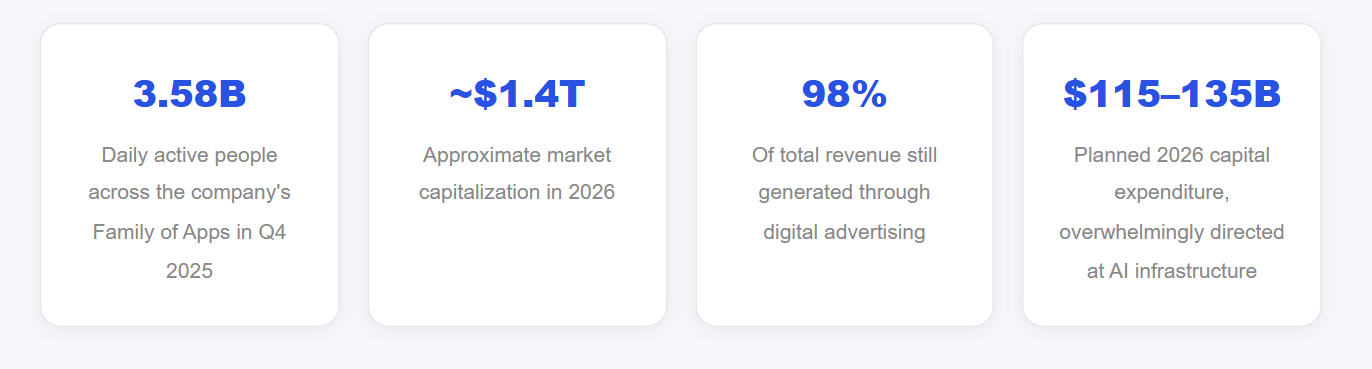
That advertising dependency is exactly what made the last several years so uncomfortable. Apple's privacy changes made it dramatically harder to track users across apps for ad targeting, and TikTok's rise pulled younger attention away from Instagram and Facebook faster than either platform could initially respond to. The company's answer to both problems turned out to be the same one: pour resources into AI, both to rebuild ad targeting on a foundation that doesn't depend on cross-app tracking, and to build something genuinely new that TikTok and its rivals couldn't easily copy.
Giving away the model everyone else is charging for
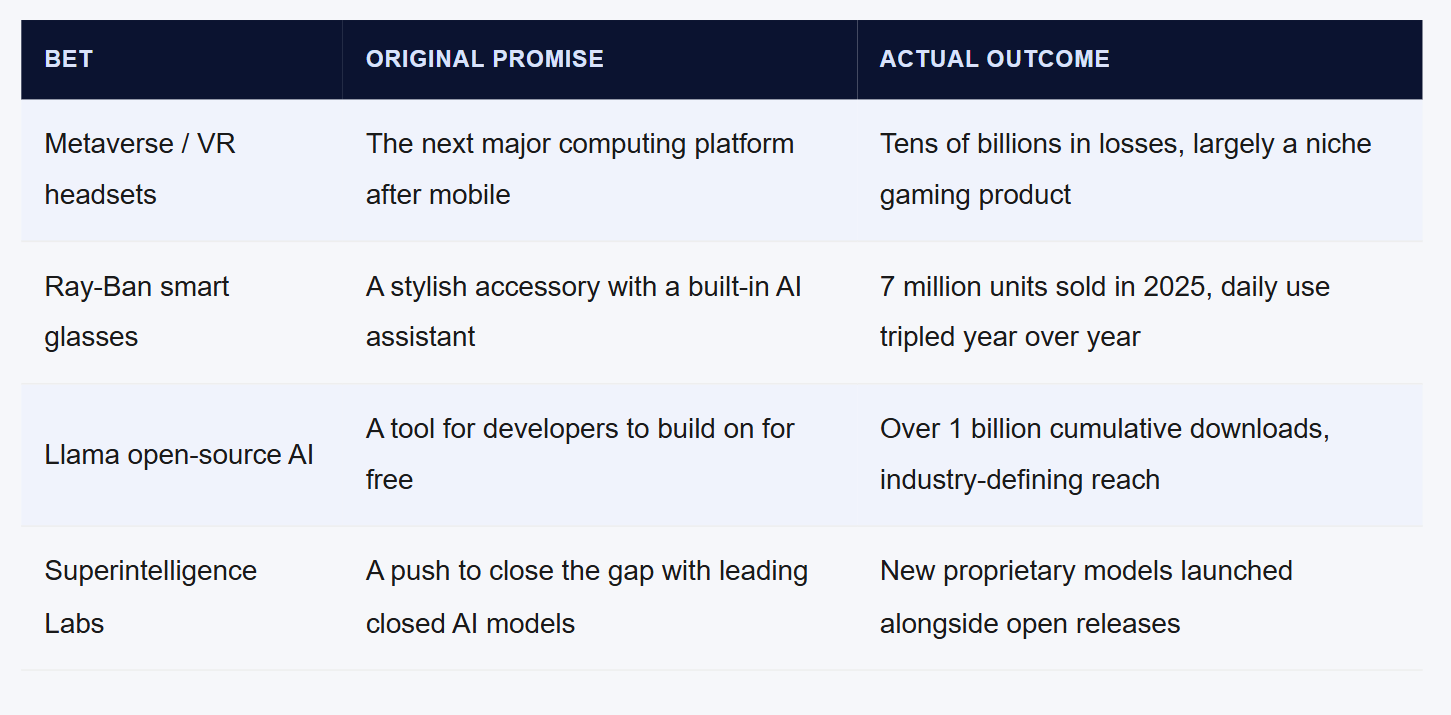
The company's most consequential strategic decision of the last few years wasn't a product launch, it was a choice about distribution. Rather than keeping its large language models locked behind a paid API the way most major AI labs do, the company released its Llama model family as open-weight, allowing outside developers to download, modify, and build on it largely for free. That single decision turned a comparatively new entrant in AI into the most widely distributed open-weight model family in the industry, with cumulative downloads passing the billion mark by early 2025.
Why giving it away was the actual strategy
The logic isn't charity. Open-sourcing the model commoditizes the proprietary alternatives rivals are trying to sell subscriptions around, while positioning the company's own version as the default choice for any developer or startup building on top of AI rather than paying a competitor for access. It also means every improvement outside developers make to the open model indirectly benefits the company that released it, a kind of crowdsourced research and development the largest closed-model labs don't get access to. The approach has recently evolved, with newer, more capable proprietary models emerging alongside the open releases as the company races to keep pace with faster-moving rivals.
The ambition is for American open-source AI models to become the global standard, particularly as competition intensifies with rival efforts emerging from China.
— Reflecting comments Meta's leadership has made publicly through 2026

The surprise hit nobody saw coming
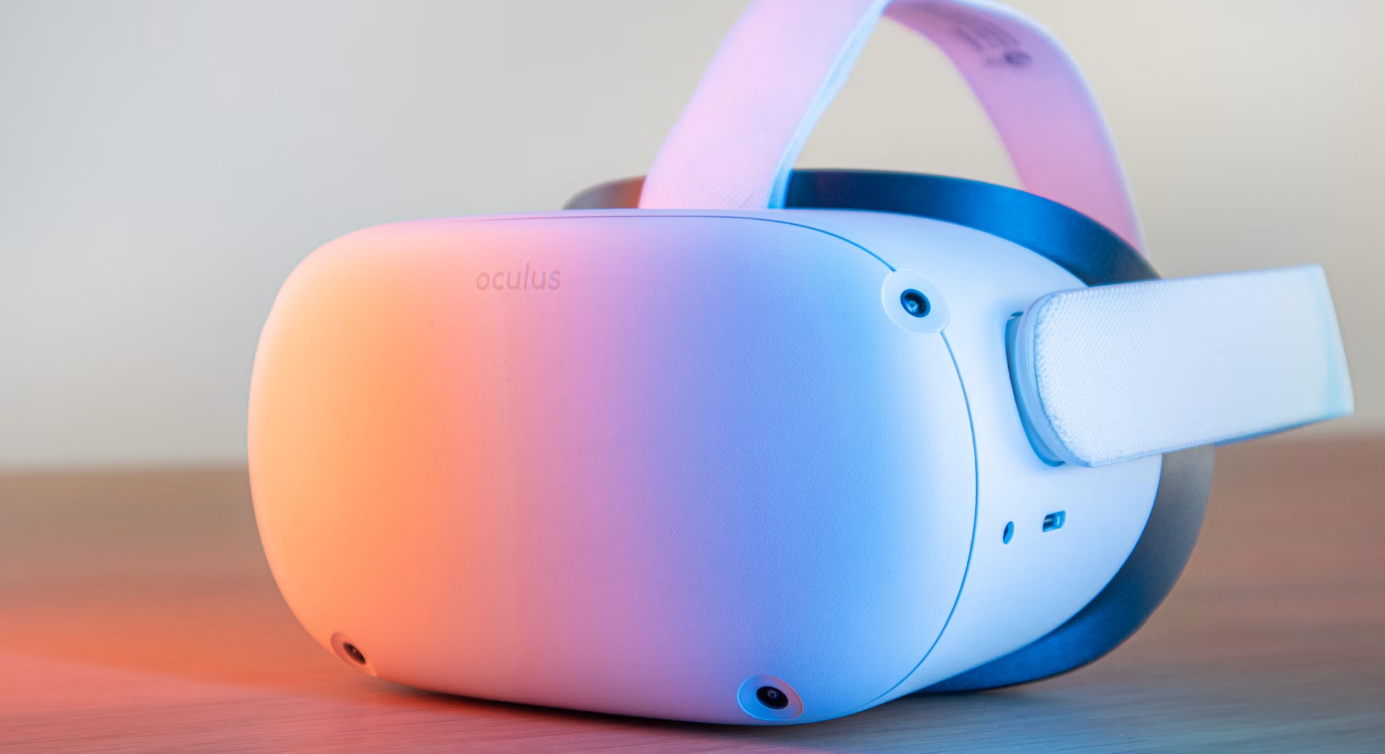
Reality Labs, the division built to chase the metaverse vision that gave the company its new name in 2021, has lost tens of billions of dollars since its creation, with the virtual reality headsets at the center of that vision remaining a mostly niche product for gamers rather than the mainstream computing platform once promised. What actually broke through commercially wasn't a headset at all. It was a pair of camera-equipped, voice-activated glasses, developed in partnership with Ray-Ban's parent company, that sold roughly seven million units in 2025 alone, a dramatic jump from a combined two million across the two years before that.
The glasses matter for a reason that goes beyond a single hit product. Every pair sold is a hardware channel for the company's AI assistant that doesn't route through a phone's app store at all, quietly reducing dependence on Apple's and Google's mobile platforms, something the company has reportedly wanted for the better part of a decade. As AI models get small and efficient enough to run directly on lightweight hardware, the entire industry may be inching toward what some analysts describe as a shift from mobile-first computing to wearable-first computing, and the company's glasses are currently the furthest along any major tech player has gotten toward proving that shift is commercially real.
The number that explains the urgency
Planned 2026 capital spending of up to $135 billion, almost entirely funneled into AI infrastructure and data centers, is a direct response to competitive pressure. Falling behind on model quality risks losing developers to open alternatives from other labs, while falling behind on infrastructure risks not being able to serve the assistant features now embedded across every one of the company's apps and devices.
What the next chapter is actually betting on
The company has brought in senior outside AI talent to lead a newly formed superintelligence research effort, signaling that leadership sees the current moment as an all-in race rather than a comfortable position to defend. New proprietary models are emerging to sit alongside the open Llama family, aimed at powering a more capable assistant across every app the company runs, from direct messaging to shopping recommendations to the smart glasses now selling in the millions. The through-line across advertising, open AI, and wearable hardware is a bet that the next major computing interface won't be a screen you scroll, but an assistant you simply talk to, embedded in something you're already wearing.
None of this guarantees the wearable-first future actually arrives on the timeline the company is betting billions on, VR's underwhelming trajectory is a reminder of how expensive a wrong platform bet can be. But the pattern running underneath all of it, buy or build aggressively at the first sign of a coming shift, absorb the cost of the bets that don't pay off, and lean harder into the ones that do, is the same instinct that turned a Harvard dorm-room project into a company still finding new ways to sit at the center of how billions of people communicate.