 William BensonVIEW PROFILE →
Big Tech's Nuclear Renaissance: Inside Silicon Valley's Quiet Takeover of America's Power Grid
AI is consuming electricity faster than the grid can supply it, so Silicon Valley started restarting reactors, funding new ones, and quietly becoming the biggest force in American nuclear energy since the 1970s.
AI is consuming electricity faster than the grid can supply it, so Silicon Valley started restarting reactors, funding new ones, and quietly becoming the biggest force in American nuclear energy since the 1970s.
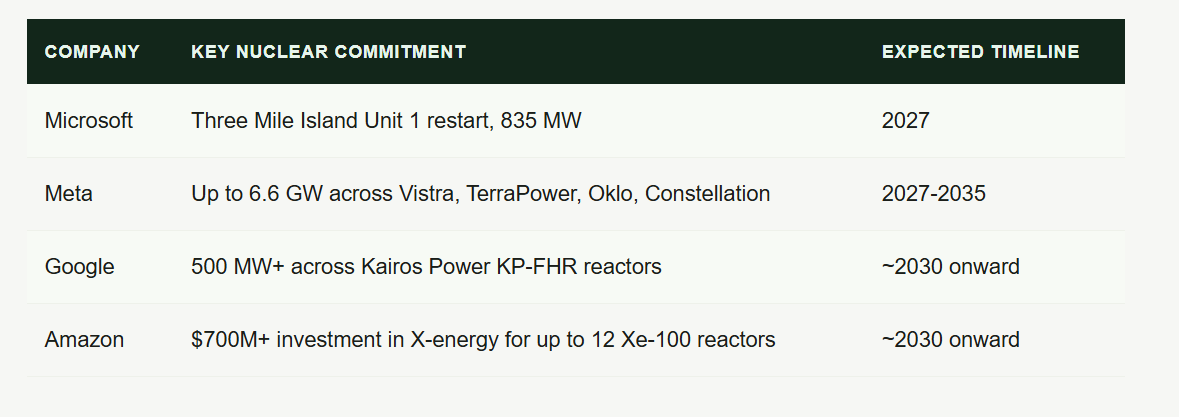
Three Mile Island spent decades as American shorthand for nuclear power's worst fears, the site of the country's most infamous reactor accident, permanently shuttered and half-forgotten. In 2026, its surviving reactor is being rebuilt, renamed the Crane Clean Energy Center, and pointed almost entirely at a single customer: Microsoft's AI data centers. It's one of the stranger plot twists in recent energy history, and it's not an isolated deal. It's the clearest sign yet of a fight most people haven't noticed is happening at all, a scramble by the world's biggest tech companies to secure enough electricity to keep the AI boom running. The Electricity Problem Nobody Priced In For most of the cloud-computing era, power was a background cost, unglamorous, predictable, and someone else's problem to manage. Generative AI broke that assumption completely. Training and running large language models at scale requires enormous, continuous electricity draw, and the numbers involved have startled even people inside the industry. According to International Energy Agency data, global data centers consumed roughly 415 terawatt-hours of electricity in 2024, a figure projected to more than double to around 945 terawatt-hours by 2030. In the United States specifically, AI data centers were already consuming over 10% of total national electricity by the first quarter of 2026, up from roughly 4% just three years earlier. The bottleneck isn't really generation capacity in the abstract, it's speed and certainty. Goldman Sachs has identified energy availability, not chip supply, as the single biggest infrastructure constraint on AI growth heading into the back half of the decade, with data center electricity demand projected to climb another 160% by 2030. Meanwhile, the queue of energy projects waiting for grid interconnection in the US has swelled past 2,600 gigawatts, with average wait times stretching to five years and roughly 80% of proposed projects eventually withdrawn entirely due to delays. For a company trying to bring a new AI data center online in the next two or three years, waiting in that queue simply isn't an option. "The surge in data center demand has propelled nuclear small modular reactors to become a major player in the future energy mix." Microsoft's $16 Billion Bet on a Notorious Reactor Microsoft made the highest-profile move first. In a deal that made global headlines when it was announced, the company signed a 20-year power purchase agreement tied to restarting Three Mile Island Unit 1, the undamaged reactor at the same Pennsylvania site where Unit 2 suffered a partial meltdown in 1979. The plant, now rebranded the Crane Clean Energy Center, represents an investment reported at roughly $16 billion and is expected to bring 835 megawatts of carbon-free electricity back online by 2027, dedicated specifically to feeding Microsoft's AI infrastructure. It marks the first restart of a shuttered US nuclear plant in the country's history, and Microsoft chose that path deliberately: restarting existing infrastructure is dramatically faster than building new reactors from scratch, which is exactly the kind of speed advantage the AI power race now rewards.
Meta's All-In Nuclear Shopping Spree
If Microsoft moved first, Meta has moved biggest. Across a series of deals announced through 2025 and into 2026, Meta has assembled what is now the largest nuclear commitment of any tech company, up to 6.6 gigawatts of capacity by 2035, according to industry trackers monitoring the sector. The agreements span multiple partners: a 20-year deal with Constellation Energy for 1.1 gigawatts from the Clinton Clean Energy Center in Illinois, a purchase agreement with Vistra and TerraPower for more than 2,600 megawatts from plants in Pennsylvania and Ohio, and direct financial backing for Oklo's development of 1.2 gigawatts of new reactor capacity at a site in Pike County, Ohio. Meta has also committed to funding two of TerraPower's next-generation Natrium reactor units, with rights to purchase power from six more in the future.
That combination of buying existing power and directly financing new reactor construction has made Meta something closer to a utility company than a traditional tech buyer. Industry analysts tracking the sector note that Meta's dual strategy, locking in near-term supply from existing plants while simultaneously bankrolling brand-new reactor designs, positions it more defensively than competitors relying on a single approach.
What "small modular reactors" actually are
Alongside restarting old plants, several companies are betting on small modular reactors, or SMRs, factory-built units generating roughly 50 to 300 megawatts each, compared to a legacy reactor's 800-plus megawatts. Google has committed to purchasing power from a fleet of Kairos Power's advanced reactors under a novel "order book" model, where Google's upfront purchase commitment gives Kairos the revenue certainty needed to secure financing and regulatory approval. Amazon has taken a similar approach, investing more than $700 million in X-energy for rights to up to twelve Xe-100 reactor units. SMRs promise faster construction timelines and lower upfront capital costs, though most are not expected to reach commercial operation until closer to 2030.
Why Nuclear, and Not Just More Solar and Wind
Renewables have grown rapidly across the US grid, but they share a fundamental limitation for AI's purposes: intermittency. Solar and wind generation fluctuates with weather and daylight, while an AI training cluster runs at full, unyielding capacity around the clock, every day of the year. Nuclear power's core appeal is precisely that it doesn't share that limitation, it delivers constant, predictable baseload output regardless of weather, time of day, or season, with a physical land footprint far smaller than an equivalent solar or wind farm generating the same output. For a data center operator signing 20-year power contracts, that reliability is worth paying a premium for, and it's part of why tech companies have been willing to provide the kind of long-term revenue certainty that has, for the first time in decades, made new nuclear construction genuinely bankable again.
There's a secondary factor at play too: geopolitics and energy security. Rising energy market volatility over the past couple of years, compounded by international conflicts affecting global supply chains, has pushed companies toward long-term, domestically sited power contracts that insulate them from short-term price shocks. A 20-to-30-year nuclear power purchase agreement offers exactly that kind of price certainty in a way that spot-market electricity purchases simply cannot.
The honest catch: none of this solves 2026's power crunch
For all the scale of these announcements, energy analysts have been blunt about one uncomfortable detail: the timeline doesn't line up with the urgency. Three Mile Island won't deliver power again until 2027 at the earliest. Google's Kairos reactors aren't expected before roughly 2030. AI cluster growth, meanwhile, is accelerating right now, in 2026, creating a gap between when the power is needed and when these nuclear projects will actually be generating it. In the meantime, several companies have quietly turned to less glamorous stopgaps, including natural gas turbines installed directly on-site at new data center campuses specifically because the surrounding regional grid can't supply power fast enough through conventional channels.
What This Means Beyond Silicon Valley
The ripple effects extend well past the tech industry's own balance sheets. Nuclear developers that spent decades struggling to secure financing for new projects suddenly have willing, deep-pocketed customers signing multi-decade purchase agreements, exactly the kind of revenue certainty that unlocks construction financing. That's part of why the US and Canada each announced plans in 2026 for ten new nuclear reactors, the most significant coordinated nuclear expansion North America has pursued in decades. Whether that expansion primarily benefits the broader public grid or remains largely earmarked for AI data centers is likely to become one of the more contentious energy-policy questions of the next several years, particularly in communities near these plants watching electricity prices and grid priorities shift in real time.