William BensonVIEW PROFILE →
Bitcoin in Your 401(k): What the New Retirement Rule Actually Changes, and What It Doesn't
Washington just made it easier for your 401(k) to hold crypto. Here's the honest version of what that actually means, and what it doesn't.
Washington just made it easier for your 401(k) to hold crypto. Here's the honest version of what that actually means, and what it doesn't.
Somewhere in the fine print of a Washington regulatory filing sits a number worth pausing on: $14.2 trillion. That's roughly what American workers currently hold in employer-sponsored retirement plans, money that has, for decades, lived almost entirely in stocks, bonds, and index funds. A new federal rule is quietly working its way toward letting a slice of that money flow somewhere it's never really been allowed to go before: crypto. Whether that's good news, bad news, or mostly irrelevant to your actual retirement account depends heavily on details most headlines have skipped past. What Actually Happened, in Plain English On August 7, 2025, President Trump signed Executive Order 14330, titled "Democratizing Access to Alternative Assets for 401(k) Investors." The order didn't add crypto to anyone's retirement account directly, what it did was instruct the Department of Labor, the SEC, and the Treasury to figure out how to make it realistically possible for the more than 90 million Americans in employer-sponsored retirement plans to access the same kinds of alternative investments, crypto, private equity, real estate, that wealthy investors and government pension funds have had for years. Seven months later, on March 30, 2026, the Department of Labor followed through with a formal proposed rule. Rather than mandating anything, the rule creates what's called a "safe harbor," essentially clearer legal protection for the fiduciaries, the plan administrators legally responsible for acting in workers' best interest, if they choose to add alternative assets like crypto to a retirement plan's menu. The proposal opened a 60-day public comment period, which closed June 1, 2026, and drew more than 20,000 submissions by early May alone, an unusually high volume of public engagement for a Labor Department rule.
The Headline You've Seen vs. What's Actually True
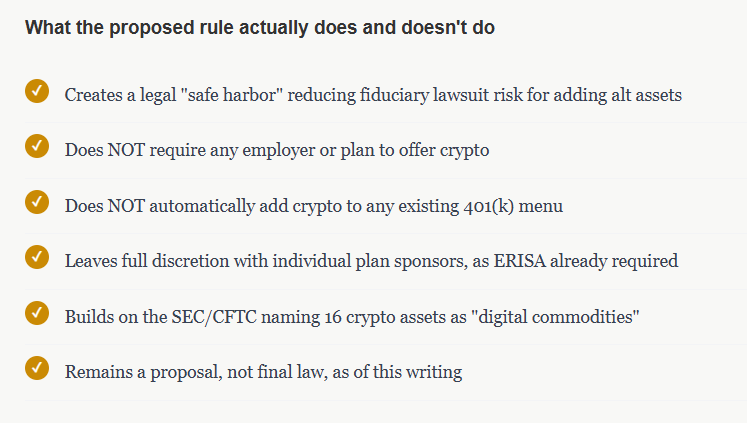
Here's the part worth being precise about, because a lot of coverage genuinely got this wrong: Bitcoin is not currently being added to your 401(k). Alternative assets, including crypto, were never technically banned from retirement plans in the first place. What actually kept them out for years wasn't a legal prohibition, it was fear. Specifically, fear of lawsuits. Plan administrators worried that offering something as volatile as crypto could expose them to legal liability under ERISA, the 1974 law governing retirement plan fiduciary duties, so almost none of them ever tried.
That fear had a specific origin point: in 2022, the Biden administration's Labor Department issued guidance urging "extreme care" before adding crypto to retirement plans, citing what it called "significant risks of fraud, theft, and loss." That guidance was formally rescinded in May 2025. The new proposed rule builds directly on top of that reversal, aiming to give administrators enough legal cover that the fear of litigation stops being the deciding factor. As one Labor Department official, Deputy Secretary Keith Sonderling, put it plainly in the announcement: the rule is "decidedly neutral" and doesn't declare any asset class better or worse than another, simply that fiduciaries must follow a documented, prudent process when evaluating whichever assets they consider.

Why This Is Genuinely a Big Deal, Even With All Those Caveats
None of those caveats mean this is a non-event. The scale of American retirement savings is genuinely enormous, and even a small shift in allocation carries real weight. Consider the math one industry analysis laid out: if a single large 401(k) plan covering tens of thousands of workers allocated just 1 percent of its portfolio to Bitcoin, that alone would translate into millions of dollars in new capital flowing into crypto markets. Multiply that across even a modest fraction of the $14.2 trillion currently sitting in these accounts, and the potential capital flow becomes difficult to overstate.
That's precisely why crypto industry figures reacted to the original executive order with such enthusiasm. Tom Dunleavy, head of venture at Varys Capital, called the development "WAY WAY BIGGER news than the ETFs" in a widely shared post, a notable claim given how much attention Bitcoin ETFs themselves had already drawn from institutional investors. Bitcoin's price moved measurably on the news too, climbing toward $117,500 in the immediate aftermath of the original executive order signing, reflecting how directly markets read regulatory legitimacy as a bullish signal.
Industry analysts studying the rule closely have offered a grounding reminder: "Participants are not going to wake up one day and find a bunch of standalone crypto funds on the menu of their 401(k) plan." The realistic path runs through cautious, incremental adoption, not an overnight transformation.
The Honest Case Against This Rule
Not everyone views this shift as progress, and the criticism deserves a fair hearing rather than a dismissive footnote. Senator Elizabeth Warren has been among the most vocal critics, warning that the rule change could expose ordinary workers to higher fees, greater volatility, and potential losses in accounts specifically meant to fund a secure retirement, not to chase speculative gains. Consumer advocacy groups have gone further, with one economic policy analysis describing the rule as turning 401(k) plans into potential "ticking time bombs," arguing that expanding the safe harbor for fiduciaries effectively incentivizes administrators to pitch riskier products to workers who may not fully understand what they're signing up for.
There's a specific tension worth sitting with here: ERISA's core legal standard requires fiduciaries to act with prudence, historically interpreted as favoring diversified, relatively stable investments appropriate for money people can't afford to lose. Critics argue the new rule quietly reframes that duty, shifting the emphasis toward maximizing risk-adjusted returns regardless of how much risk that actually involves, a meaningful departure from the caution retirement accounts have traditionally been built around.
What Happens Next, and On What Timeline
As of this writing, the rule remains a proposal, not final law. The Department of Labor could still revise, delay, or even withdraw it after reviewing the public comments submitted through June 2026, a process that historically takes months rather than weeks. Even once finalized, the rule wouldn't force a single employer to add crypto to its plan, individual plan sponsors retain the same full discretion under ERISA they've always had. A fiduciary who genuinely evaluates crypto as an option and decides against it has still met the legal standard the rule sets out.
The most likely near-term pathway for most workers, according to several financial analysts tracking the rule, runs through Bitcoin ETFs rather than direct crypto holdings, since ETFs already carry a more familiar regulatory structure that plan administrators are comfortable evaluating. A handful of plans may also offer exposure indirectly, through a self-directed brokerage window that some 401(k)s already include, giving individual savers the option to buy crypto-related products themselves, separate from their plan's default investment menu, without requiring the plan sponsor to formally add it company-wide.
A Few Honest Questions People Are Actually Asking
Will my employer be required to offer crypto in my 401(k)? No. Nothing in the proposed rule requires any employer or plan sponsor to add crypto, or any alternative asset, to their retirement plan menu. That decision remains entirely with individual plan fiduciaries.
If my plan does add crypto, will I be automatically invested in it? No. Even where an employer chooses to offer crypto as an option, it would appear as a choice on the investment menu, not a default allocation. You would need to actively select it, the same way you'd choose any other specific fund today.
Is Bitcoin actually a good fit for a retirement account? That's a genuinely personal financial decision that depends on your timeline, risk tolerance, and overall portfolio, not something this rule change settles one way or the other. Crypto's volatility is well documented, and financial advisors broadly recommend treating it, if at all, as a small satellite position rather than a core retirement holding.
What This Actually Means for Your Retirement Planning Today
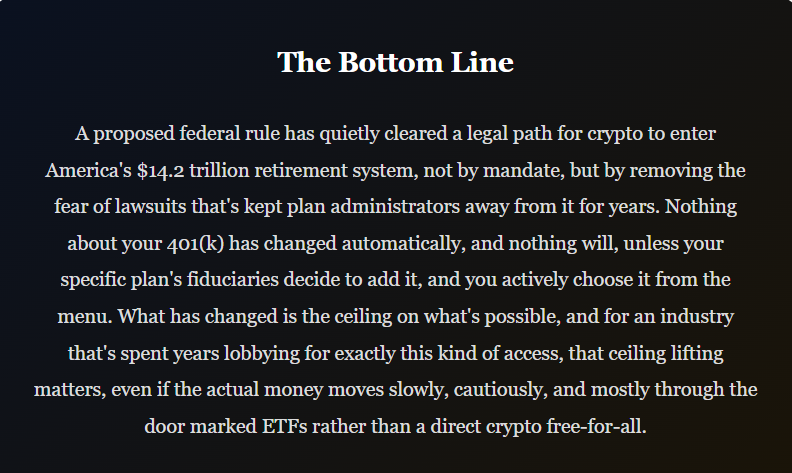
For the vast majority of people reading this, the practical, immediate impact is close to zero. Your current 401(k) menu almost certainly hasn't changed, and won't change automatically because of this rule. What has genuinely shifted is the regulatory landscape underneath the entire industry, removing a specific legal fear that had kept plan administrators from even seriously considering crypto as an option, regardless of what any individual worker might have wanted.
The more useful takeaway isn't "should I buy Bitcoin in my 401(k)" right now, since that option likely isn't available to most people yet. It's a signal worth watching if you're the kind of investor who pays attention to where retirement policy is heading over the next few years. If the rule is finalized largely as proposed, expect a slow, cautious rollout led by larger plans and Bitcoin ETFs specifically, not a sudden flood of crypto options across every workplace 401(k) in America.
This is not financial advice
This article explains a regulatory development, not a recommendation to invest in crypto through your retirement account. If you're considering how alternative assets might fit your retirement strategy, a licensed financial advisor familiar with your full financial picture can offer guidance tailored to your specific situation.What Happens Next, and On What Timeline
As of this writing, the rule remains a proposal, not final law. The Department of Labor could still revise, delay, or even withdraw it after reviewing the public comments submitted through June 2026, a process that historically takes months rather than weeks. Even once finalized, the rule wouldn't force a single employer to add crypto to its plan, individual plan sponsors retain the same full discretion under ERISA they've always had. A fiduciary who genuinely evaluates crypto as an option and decides against it has still met the legal standard the rule sets out.
The most likely near-term pathway for most workers, according to several financial analysts tracking the rule, runs through Bitcoin ETFs rather than direct crypto holdings, since ETFs already carry a more familiar regulatory structure that plan administrators are comfortable evaluating. A handful of plans may also offer exposure indirectly, through a self-directed brokerage window that some 401(k)s already include, giving individual savers the option to buy crypto-related products themselves, separate from their plan's default investment menu, without requiring the plan sponsor to formally add it company-wide.
A Few Honest Questions People Are Actually Asking
Will my employer be required to offer crypto in my 401(k)? No. Nothing in the proposed rule requires any employer or plan sponsor to add crypto, or any alternative asset, to their retirement plan menu. That decision remains entirely with individual plan fiduciaries.
If my plan does add crypto, will I be automatically invested in it? No. Even where an employer chooses to offer crypto as an option, it would appear as a choice on the investment menu, not a default allocation. You would need to actively select it, the same way you'd choose any other specific fund today.
Is Bitcoin actually a good fit for a retirement account? That's a genuinely personal financial decision that depends on your timeline, risk tolerance, and overall portfolio, not something this rule change settles one way or the other. Crypto's volatility is well documented, and financial advisors broadly recommend treating it, if at all, as a small satellite position rather than a core retirement holding.
What This Actually Means for Your Retirement Planning Today
For the vast majority of people reading this, the practical, immediate impact is close to zero. Your current 401(k) menu almost certainly hasn't changed, and won't change automatically because of this rule. What has genuinely shifted is the regulatory landscape underneath the entire industry, removing a specific legal fear that had kept plan administrators from even seriously considering crypto as an option, regardless of what any individual worker might have wanted.
The more useful takeaway isn't "should I buy Bitcoin in my 401(k)" right now, since that option likely isn't available to most people yet. It's a signal worth watching if you're the kind of investor who pays attention to where retirement policy is heading over the next few years. If the rule is finalized largely as proposed, expect a slow, cautious rollout led by larger plans and Bitcoin ETFs specifically, not a sudden flood of crypto options across every workplace 401(k) in America.
This is not financial advice
This article explains a regulatory development, not a recommendation to invest in crypto through your retirement account. If you're considering how alternative assets might fit your retirement strategy, a licensed financial advisor familiar with your full financial picture can offer guidance tailored to your specific situation.