 William BensonVIEW PROFILE →
Breaking Its Own Rules: Why ASEAN Let Britain Into a Regional Forum It Had Frozen for Everyone Else
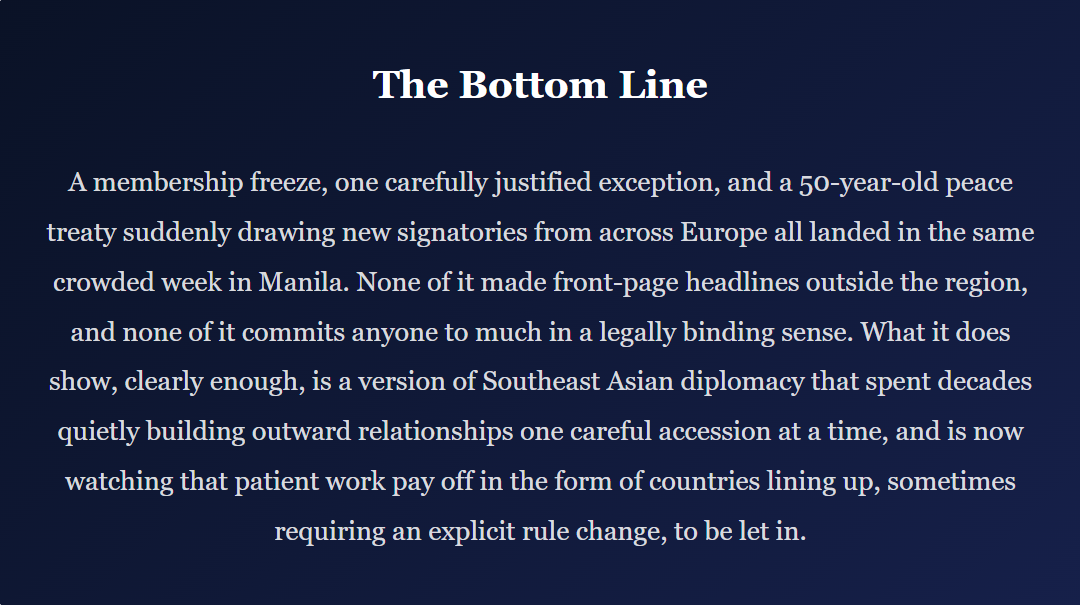
Diplomatic institutions rarely admit to bending their own rules, but the paperwork from Manila this July says exactly that, in almost as many words. The United Kingdom didn't simply join a regional forum. It became the one exception to a membership freeze ASEAN had maintained for years.
Diplomatic institutions rarely admit to bending their own rules, but the paperwork from Manila this July says exactly that, in almost as many words. The United Kingdom didn't simply join a regional forum. It became the one exception to a membership freeze ASEAN had maintained for years.
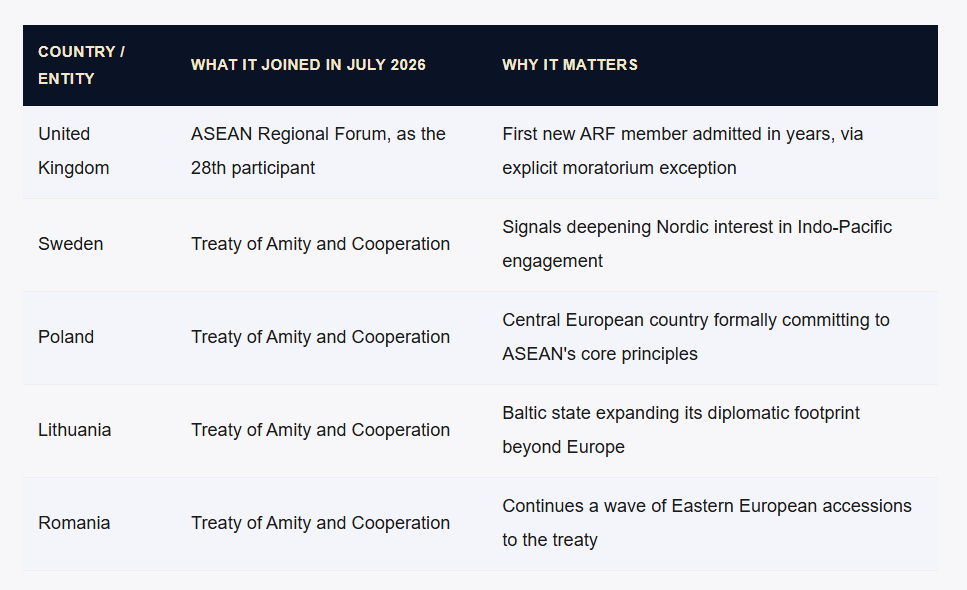
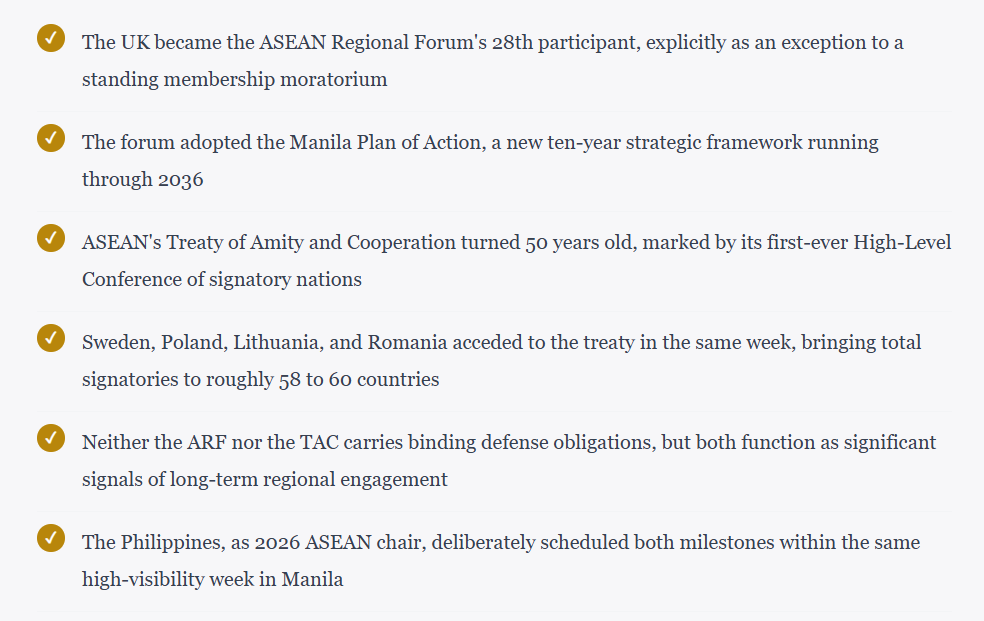
Late July in Manila had the particular kind of controlled chaos that comes with hosting an entire region's worth of foreign ministers at once, motorcades threading through Pasay City, translators cycling through half a dozen languages in adjoining conference rooms, and a schedule packed tightly enough that some of the week's most consequential decisions were announced almost as footnotes to bigger headlines. Buried inside that crush of joint statements and plan-of-action documents was a genuinely unusual moment: the ASEAN Regional Forum, the bloc's primary venue for security dialogue since the mid-1990s, admitted a new participant for the first time in years, and did so by explicitly carving out an exception to its own standing moratorium on new members. That new participant was the United Kingdom, formally welcomed as the forum's 28th member during the 33rd ASEAN Regional Forum, convened as part of a packed week of ministerial meetings that also marked the 50th anniversary of one of Southeast Asia's foundational peace treaties. The two developments, a rare membership exception and a landmark treaty anniversary drawing new signatories from well outside the region, happened within days of each other, and together they say something fairly pointed about how much outside interest in Southeast Asia's diplomatic architecture has grown, at exactly the moment ASEAN has been trying to keep that architecture from becoming unwieldy. A forum that had explicitly stopped taking new members The ASEAN Regional Forum was established in 1994 as the region's main platform for discussing security issues with countries far beyond ASEAN's ten member states, eventually growing to include major powers like the United States, China, Russia, and the European Union alongside smaller regional players. That growth eventually became its own problem. A forum built around confidence-building dialogue works best with a manageable guest list, and ASEAN had, in recent years, maintained an unofficial pause on admitting further participants specifically to keep the format functional rather than unwieldy.
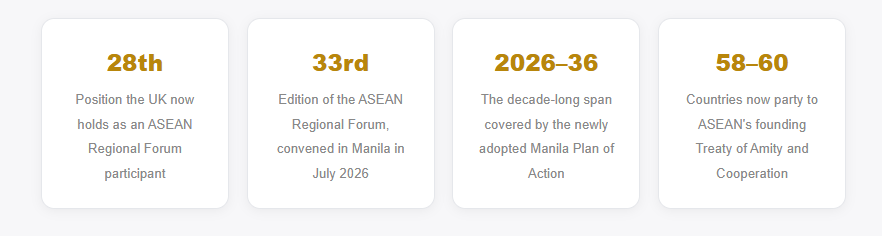
Formal ARF documentation from the Manila meeting describes the UK's admission plainly, as an exception to that moratorium, language that's notably direct for an organization that generally prefers consensus-driven ambiguity over explicit exceptions. The forum simultaneously adopted the Manila Plan of Action, a ten-year framework meant to guide its work through 2036, suggesting the UK's entry was less a one-off favor than a deliberate signal about who ASEAN wants at the table as it plans the forum's next decade.

The treaty everyone suddenly wants to join
The same week produced an even larger story, even if it drew somewhat less international coverage. ASEAN's Treaty of Amity and Cooperation in Southeast Asia, originally signed in 1976 as a founding pledge of peaceful coexistence among the bloc's early members, turned fifty years old, and the Philippines marked the occasion by convening the first-ever High-Level Conference of High Contracting Parties, bringing together representatives from dozens of countries that have formally acceded to the treaty over the decades. Four new signatories joined the treaty on the sidelines of that gathering: Sweden, Poland, Lithuania, and Romania, each represented by a senior government minister at the signing.
Why a 1976 peace pact still matters to European governments in 2026
Acceding to the TAC doesn't carry binding legal obligations in the way a defense pact would, but it does commit signatories to a set of foundational principles, respect for sovereignty, non-interference, and peaceful dispute resolution, that ASEAN treats as a prerequisite for deeper engagement with the region. For European nations increasingly focused on diversifying trade relationships and security partnerships beyond their immediate neighborhood, signing onto a decades-old Southeast Asian peace treaty has become a relatively low-cost, symbolically meaningful way to formally signal long-term interest in the region's stability.
The treaty represents ASEAN's invitation to the world to work together in maintaining peace and strengthening cooperation.
— Paraphrasing remarks by Philippine Foreign Affairs Secretary Ma. Theresa Lazaro at the July 2026 High-Level Conference
What the ARF actually is, and isn't
The ASEAN Regional Forum is a dialogue platform, not a mutual defense pact or a decision-making body with binding authority. Its real value lies in giving countries with genuinely competing interests, including several with active territorial disputes, a standing venue to discuss security concerns directly rather than only through bilateral channels. Joining doesn't commit a country to any specific policy, which is part of why membership, while symbolically significant, doesn't carry the same weight as a formal alliance.
Why now, and why the UK specifically
The UK's admission didn't happen in isolation from the broader diplomatic conversation happening in Manila that week. The same round of meetings included the fifth anniversary of the ASEAN-UK Dialogue Partnership, established in 2021, and a fresh joint ministerial statement reaffirming both sides' commitment to a rules-based regional order, freedom of navigation, and peaceful resolution of maritime disputes under international law. That framing lines up with a broader pattern of Western governments, the UK included, seeking deeper, more institutionalized engagement with Southeast Asia at a moment when regional tensions, particularly around competing maritime claims in the South China Sea and ongoing instability in Myanmar, have made the value of a standing dialogue forum harder to ignore.

For the Philippines, hosting all of this as ASEAN's 2026 chair carried its own significance. Manila used its chairmanship year deliberately, timing the TAC's 50th anniversary conference and the ARF's rare new admission within the same crowded week, a scheduling choice that maximized the diplomatic spotlight on Philippine soil during a period when the country has also been navigating its own tensions in contested waters closer to home. Whether that convergence was a matter of careful planning or simple calendar coincidence, it left Manila positioned, for one week at least, as the place where both of Southeast Asia's core outward-facing diplomatic instruments visibly expanded at once.
None of this restructures the region's security landscape overnight, dialogue forums and amity treaties are, by design, slower and softer instruments than formal alliances. But the sheer volume of outside interest on display in Manila this July, one rare exception granted, four new treaty signatories welcomed, a ten-year plan adopted, says something real about how central Southeast Asia has become to countries whose foreign policy attention used to sit almost entirely elsewhere. ASEAN spent years trying to keep its main security forum from growing too crowded. For one country, in one carefully negotiated exception, it decided the door was worth reopening anyway.