 William BensonVIEW PROFILE →
Bronx Man Faces Federal Hate Crime Charges After Violent Disruption of Shabbat Service at Central Synagogue
What began as a disturbance during Friday night prayers has become one of the more closely watched federal hate crime prosecutions in New York this year.
What began as a disturbance during Friday night prayers has become one of the more closely watched federal hate crime prosecutions in New York this year.
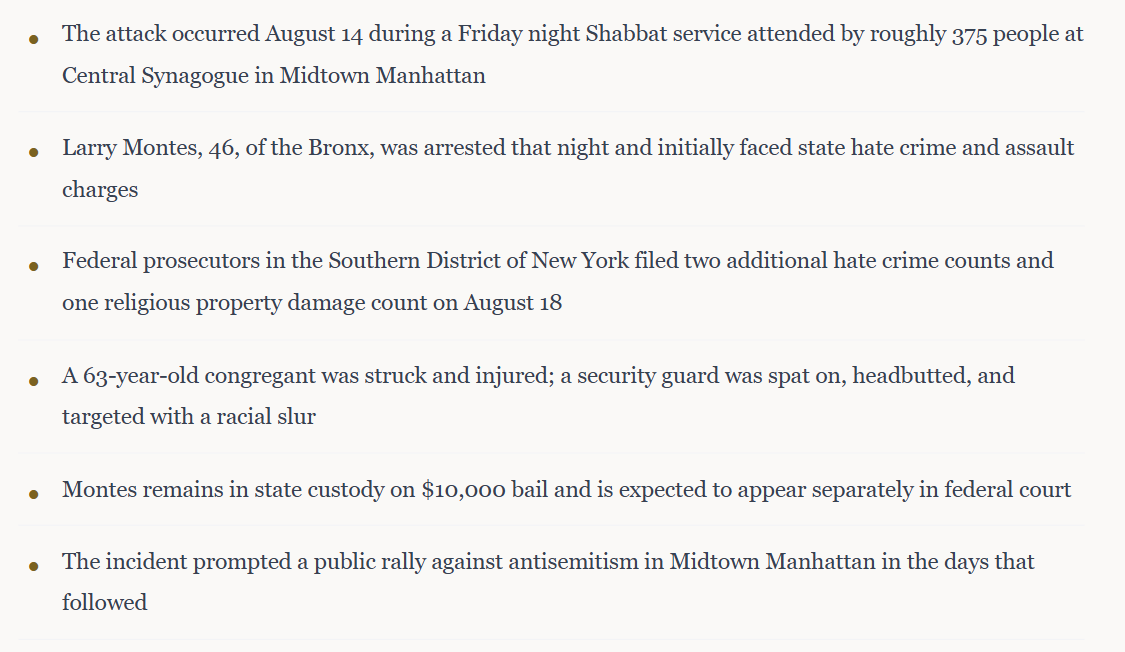
Central Synagogue has stood at the corner of Lexington Avenue and East 55th Street since 1872, a fixture of Midtown Manhattan long before the office towers grew up around it. On the evening of August 14, roughly 375 people had gathered there for Shabbat services, the weekly ritual that has anchored Jewish communal life for thousands of years. None of them expected the night to end with a federal hate crime case, a hospitalized congregant, and a citywide rally against antisemitism. But that is exactly what happened.
The details, as laid out in a federal criminal complaint filed in the Southern District of New York, describe a scene that unfolded with startling speed — a man rising from his seat, shouting, and turning what should have been an ordinary evening of prayer into a moment of violence that has since drawn condemnation from the Justice Department, the New York Police Department, and Jewish organizations across the country.What allegedly happened inside the sanctuaryAccording to the federal complaint, the man later identified as Larry Montes, 46, of the Bronx, stood up during the Friday evening service and began shouting near the front of the sanctuary. Prosecutors allege he struck and damaged two ceremonial silver candlesticks in the process. As the synagogue's head of security moved to intervene, Montes allegedly directed hostile, dismissive language at the congregation before turning physically violent — punching a 63-year-old woman attending the service, according to police, an act that left her with a cut lip and bruising. As security personnel and responding police officers worked to restrain and handcuff him, the complaint alleges Montes turned his aggression toward a Black security guard, spitting in his face, headbutting him near his left eye socket, and directing a racial slur at him. Prosecutors say Montes also stated, at the time, that he intended to return to the synagogue at a later date — a detail that has factored into the severity with which authorities have pursued the case.
In a recorded, Mirandized interview following his arrest, the complaint states that Montes made explicitly antisemitic remarks to investigators and described his actions as motivated by hostility toward Jewish people. He was initially arraigned on state charges, including criminal mischief and hate crime-related assault counts, and made his first court appearance the following night, during which prosecutors from the Manhattan District Attorney's Office laid out additional details of the incident, including allegations that Montes referred to the worshippers using a dismissive, dehumanizing phrase and claimed a religious identity of his own during the outburst.
The case moves to federal court
On August 18, the case escalated meaningfully. The U.S. Attorney's Office for the Southern District of New York announced that Montes now faces two federal counts of committing hate crimes, in addition to one count of damaging religious property resulting in bodily injury. Each hate crime count carries a maximum sentence of ten years in prison; the property damage count carries a maximum of twenty years, given that it resulted in injury to another person.
Federal hate crime statutes exist specifically to address violence motivated by a victim's actual or perceived race, religion, or national origin, and they allow federal prosecutors to pursue charges independently of, or alongside, state-level proceedings. That dual-track approach is precisely what's playing out here: Montes remains in state custody on the original charges while federal prosecutors build a parallel case that carries substantially steeper potential penalties.
"An attack on a house of worship is an attack on the fundamental right to practice one's faith safely, and our Office will work tirelessly to ensure the defendant is held fully accountable." — Jamie McDonald, U.S. Attorney for the Southern District of New York
Assistant Attorney General Harmeet Dhillon, who leads the Justice Department's Civil Rights Division, framed the charges as part of a broader federal posture toward attacks on religious communities, noting that the department intends to intervene decisively whenever violence appears to be motivated by bias. That message — that federal authorities are treating attacks on houses of worship as a distinct and serious category of crime — has become increasingly central to how prosecutors discuss cases like this one.
What "hate crime" means legally A hate crime charge doesn't replace an underlying offense like assault — it adds to it. Prosecutors must show the act was motivated, at least in part, by the victim's actual or perceived race, religion, ethnicity, or another protected characteristic. That's a distinct legal threshold from proving the underlying violence itself, which is part of why these cases often involve detailed post-arrest statements and interviews as evidence.
A rally, and a community on edge
In the days following the attack, members of the Jewish community and allies from other faiths gathered in Midtown for a rally against antisemitism, organized in direct response to what happened at Central Synagogue. The demonstration reflected something beyond anger at a single incident — a broader anxiety that has been building across Jewish communities in New York and nationally for several years now, one that this attack seemed to crystallize in a very public and very personal way.
That anxiety isn't abstract. According to the Anti-Defamation League's most recent annual audit, antisemitic incidents across the United States, while down significantly from the record highs of 2023 and 2024, remain the third-highest on record since the organization began tracking them in 1979. More troubling to many community leaders is a different trend line entirely: physical assaults targeting Jewish individuals actually rose in the most recent reporting year, even as overall incident counts fell, and assaults involving weapons climbed sharply. For a community watching those numbers, an attack unfolding live during Shabbat services, captured on the synagogue's own livestream, landed with particular force.
This piece is based on information contained in a publicly filed federal criminal complaint and statements from law enforcement officials. Larry Montes has not been convicted of any crime, and the charges against him remain allegations that prosecutors will need to prove in court.
The security guard's role, and a case within a case
One detail that has drawn particular attention is the alleged treatment of the synagogue's security guard, who according to prosecutors was targeted with a racial slur in addition to being spat on and headbutted while attempting to remove Montes from the building. Legal observers have noted that this detail effectively embeds a second bias-motivated assault within the larger case — one directed at the congregation over religion, and a separate one directed at the guard over race — which is part of why the federal complaint treats the incident as a compound, rather than singular, act of targeted violence.
Synagogue security has become a significant and, in recent years, increasingly professionalized part of Jewish communal life in major American cities, with trained guards, coordination with local police precincts, and organized safety protocols now standard at large congregations. Central Synagogue, like many prominent Jewish institutions in New York, had exactly that kind of security presence in place on the night of the attack — a fact that likely limited how the incident escalated further, even as it did not prevent it from happening in the first place.
What happens next
Montes remains in state custody, held on $10,000 bail from the original state proceedings, and is expected to be transported to Manhattan federal court at a later date for his initial appearance on the federal charges. From there, the case will follow the standard arc of a federal criminal prosecution: an arraignment, pretrial motions, and — barring a plea agreement, which is common in federal hate crime cases given the strength of recorded post-arrest statements — a trial timeline that could extend well into next year.
Federal hate crime prosecutions of this profile tend to draw sustained public attention throughout that process, particularly when, as here, portions of the incident were captured on video and the underlying facts are largely undisputed even if legal characterizations remain contested. For the congregation at Central Synagogue, and for Jewish communities watching from elsewhere in the city, the more immediate concern is less about courtroom procedure and more about a basic, unsettling question: what does safety look like at a house of worship in 2026, and what more, if anything, needs to change.
Why this case is resonating so widely
Part of what has made this incident different from many that make headlines briefly and then fade is the combination of factors involved: a livestreamed service that captured the moment as it happened, a named and identified suspect facing both state and federal charges, and a community response that materialized quickly and publicly rather than quietly. Together, those elements have turned what might have otherwise been a regional crime story into a case being watched closely by legal observers, faith leaders, and civil rights organizations well beyond New York.
There's also a broader pattern that observers of American religious life have been tracking for several years, in which houses of worship — synagogues, churches, and mosques alike — have had to reckon with security in ways that would have seemed unthinkable a generation ago. Metal detectors, trained guards, active-shooter drills, and coordinated relationships with local police departments have become part of religious life for many congregations, not because any single community wants it that way, but because incidents like the one at Central Synagogue keep demonstrating, in painful and immediate terms, why those measures exist.
The Bottom Line This case is still in its early stages, and the legal process — federal arraignment, pretrial proceedings, and eventually a resolution — will take months to play out. What's already clear is that federal prosecutors intend to treat the alleged attack on Central Synagogue as exactly what they've called it: a targeted act of hate-motivated violence against a house of worship, with penalties designed to reflect that seriousness. For the congregation that gathered that Friday night expecting nothing more than a familiar service, and for a broader Jewish community already on edge after several difficult years, the outcome of this case will be read as more than a single verdict. It will be read as a signal of how seriously the country's legal system takes the safety of people simply trying to pray.