 William BensonVIEW PROFILE →
Bucharest Is Having a Full-Blown Identity Crisis, and It's Playing Out One Cake at a Time
Forty-year-old communist-era cake shops are facing off against French-trained pastry chefs, and the whole city is quietly picking sides one slice at a time.
Forty-year-old communist-era cake shops are facing off against French-trained pastry chefs, and the whole city is quietly picking sides one slice at a time.
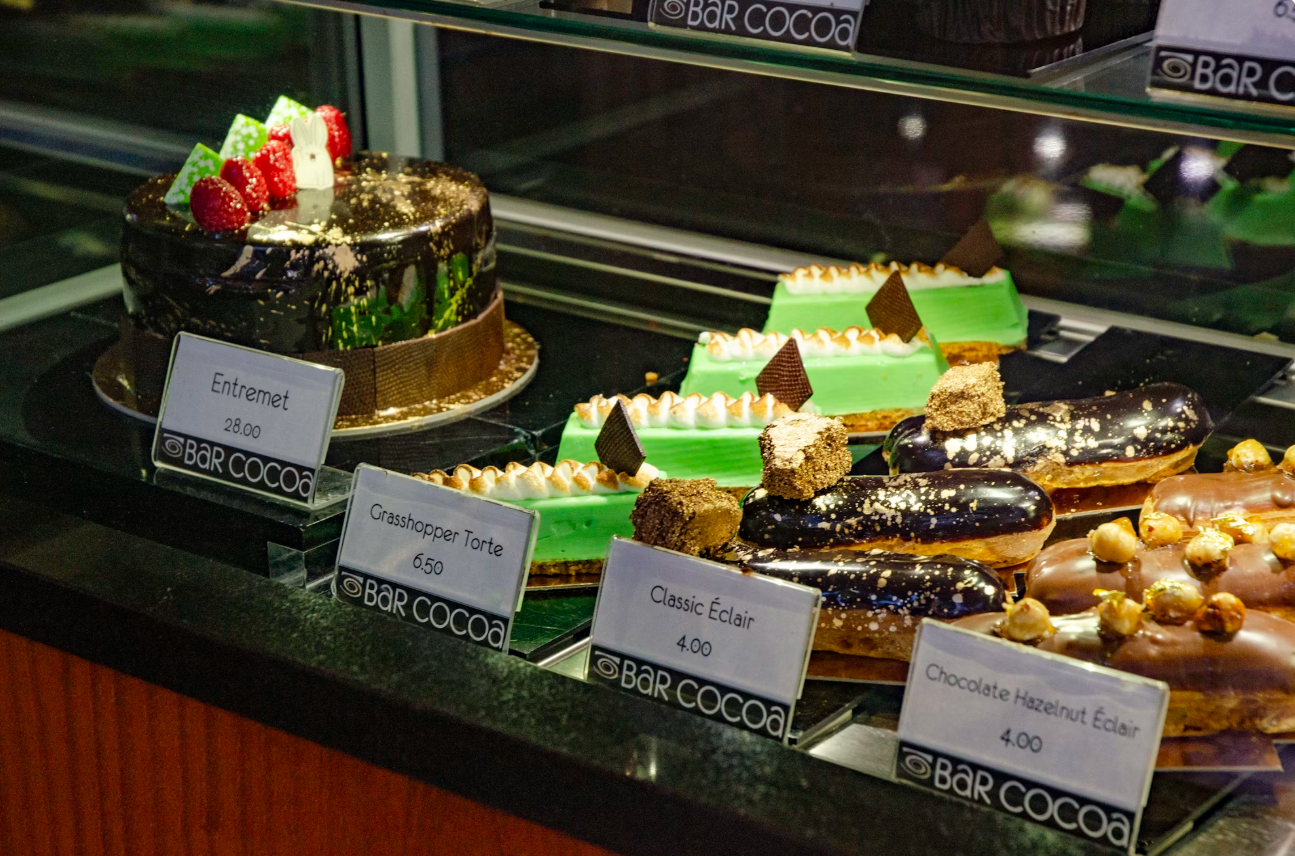
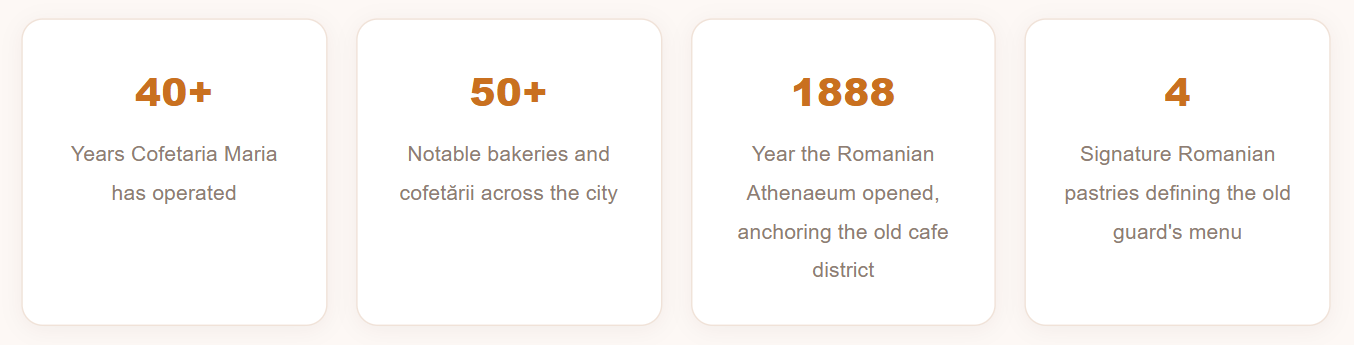
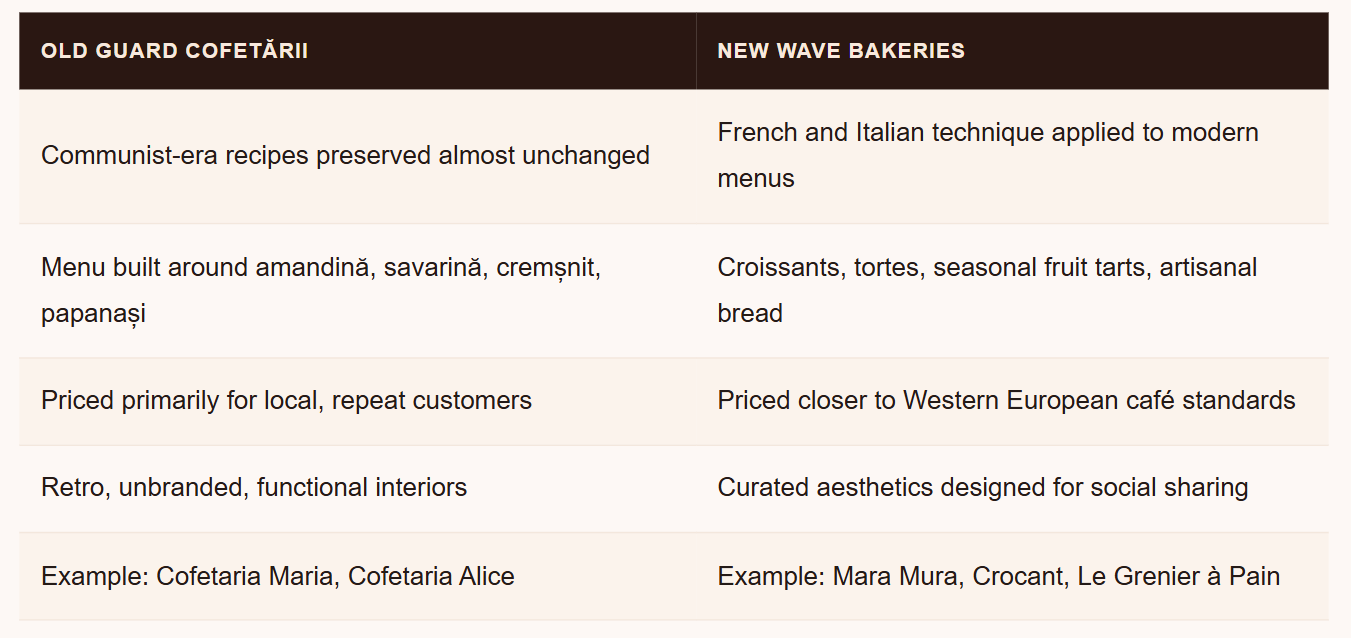
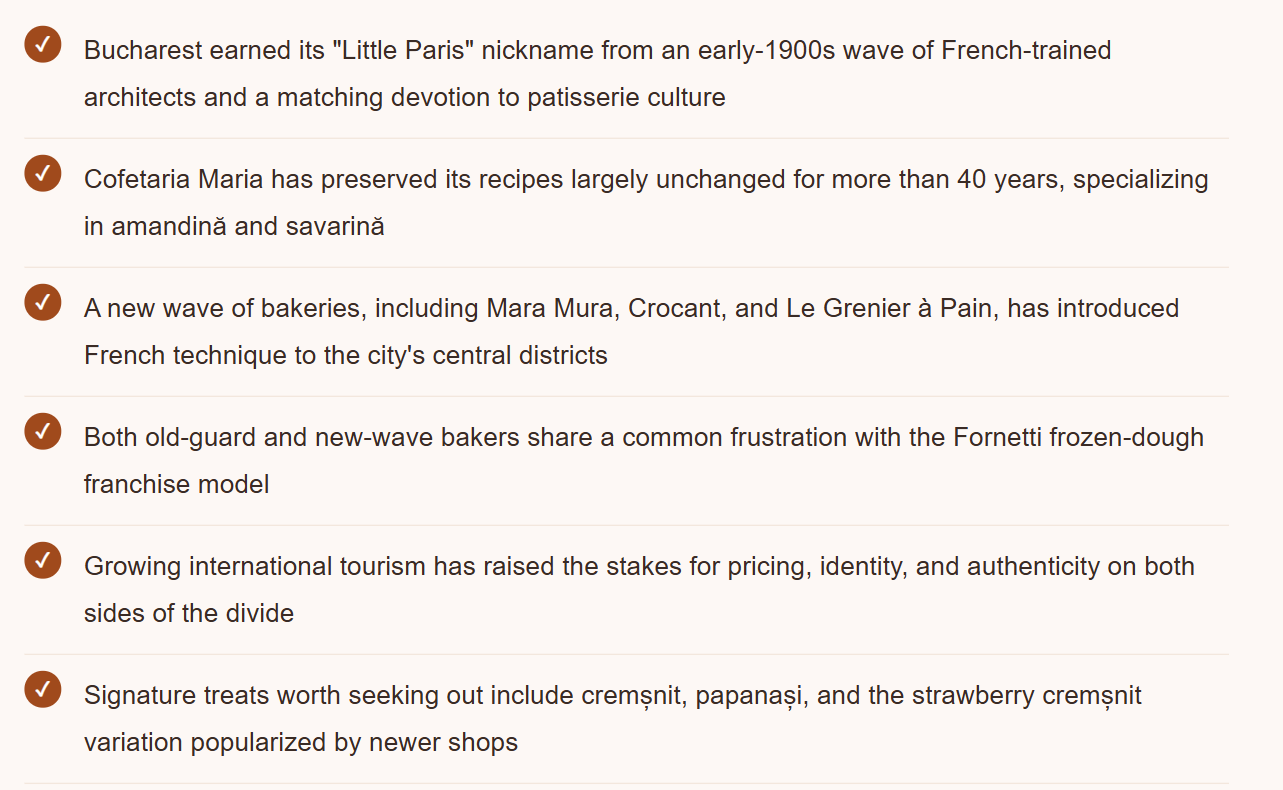
Walk ten minutes in almost any direction from Piața Romană and you'll pass at least two kinds of pastry shop that have nothing to do with each other. One has fluorescent lighting, laminate counters, and a cashier who's been ringing up the same amandină cake since before the Revolution. The other has hand-lettered signage, a barista running a proper flat white, and a croissant laminated with more patience than most people bring to their actual jobs. Neither shop is going anywhere, and that's exactly the tension driving one of the more interesting food stories happening in Eastern Europe right now. A City That Has Always Taken Its Cake Seriously Bucharest earned the nickname "Little Paris" for a reason that predates the current dessert boom by more than a century. In the late 1800s and early 1900s, the city's elite returned from studying in France and rebuilt their capital in its image, wide boulevards, Belle Époque facades, and a genuine devotion to the patisserie as a social institution. That inheritance never fully disappeared, even through decades of communist rule when ingredients were scarce and imagination had to do the heavy lifting. It's why a city of just under two million people supports a genuinely staggering density of cofetării, the Romanian word for pastry shop, packed into neighborhoods that in most cities would struggle to sustain even one. What's changed isn't the appetite, it's who's doing the baking and what they're baking. Over the past several years, a wave of French, Italian, and locally trained pastry chefs has opened shops across the city's central districts, bringing precise lamination technique, imported couverture chocolate, and Instagram-ready plating to a dessert culture that spent generations perfecting something entirely different: dense, cream-heavy, deliberately nostalgic cakes built for a Sunday visit to grandmother's, not a photo. The Old Guard: Cake Shops That Refused to Modernize Cofetaria Maria, tucked on Bulevardul Timișoara, is the closest thing this scene has to a living monument. It has operated for more than four decades, and by design, walking in still feels like stepping into 1985, right down to the recipes. Its amandină, a dense sponge cake soaked in syrup and coated in chocolate glaze, and its savarină, a rum-soaked ring cake piled with whipped cream, are made almost exactly the way they were when the shop opened, and regulars will tell you that's precisely the point. Reviewers consistently praise the shop's unbeatable quality-to-price ratio, treating a visit less like a dessert run and more like a small act of cultural preservation. These old-guard cofetării share a few defining traits: they're unapologetically retro, they price their cakes for locals rather than tourists, and they trade almost entirely on a specific, narrow menu of Romanian classics, amandină, savarină, cremșnit (a custard-and-cream puff pastry slice, sometimes called the Eastern European cousin of the mille-feuille), and papanași, fried dough dumplings drowned in sour cream and jam. There's no seasonal menu rotation, no matcha latte, no minimalist branding. There doesn't need to be. A shop like this survives because an entire generation of Bucharest residents grew up on exactly this cake, at exactly this price, and has never seen a reason to switch. "This has nothing to do with the traditional stuff. For one, Bucharest with its traditions wins on points." The New Wave: French Technique Meets Romanian Ambition A different kind of shop has been quietly reshaping the city's central neighborhoods, and it looks nothing like Cofetaria Maria. Mara Mura, positioned just steps from the Romanian Athenaeum, leans hard into a whimsical, vintage-but-curated aesthetic, pastel accents, delicate porcelain teacups, and a strawberry cremșnit built from crisp, laminated puff pastry layered with silky vanilla custard, a clear descendant of the old-school version but executed with noticeably more technical polish. A few blocks over, Crocant has built a reputation specifically around tortes, pairing a carrot torte with forest fruit against a meringue-and-chocolate creation, alongside a sunny terrace on one of the city's quietest streets. Then there's the openly French contingent. Le Grenier à Pain, a transplant with roots in the French bakery tradition, has become known for croissants that regularly get name-checked as among the city's best. Pain Plaisir has built its identity around exquisite French bread, baguettes calibrated for that specific crackle-then-soft bite, alongside curry buns with fennel and citrus tarts that would be entirely at home on a Parisian counter. Demetra Organic Bakery has taken a slightly different angle, applying a health-conscious, fermentation-forward approach even to fursecuri, Romania's beloved round shortbread cookies, proving the new wave isn't purely about importing French technique wholesale, some of it is genuinely reinterpreting Romanian tradition rather than replacing it.
The Real Enemy Isn't Each Other
Here's the twist that most outside coverage of this rivalry misses: talk to owners on either side of the divide, and the tension isn't really old guard versus new wave. It's both of them, together, against a third force that neither side has much respect for. Years ago, a franchise operation originating in Timișoara brought the Fornetti system into Romania, mass-produced frozen dough shipped to outlets across the country and baked on-site straight from the freezer, marketed and branded to look, at a glance, like genuine local pastry. It has spread aggressively, backed by marketing budgets neither a family-run cofetărie nor an independent French-inspired bakery can match.
Independent bakers, across both camps, describe the franchise model with a shared kind of exasperation: it isn't really pastry in the tradition either side is fighting to preserve, it's an industrial product wearing the costume of one. That shared frustration has, in a strange way, become one of the few things uniting a fragmented scene. An old-school amandină and a French-laminated croissant have almost nothing in common technically, but both represent actual craft, hours of hands-on work that a frozen-dough outlet simply isn't built to replicate, no matter how convincingly it's branded.
How to actually tell the difference as a visitor
If you're trying to distinguish a genuine independent cofetărie from a franchise outlet dressed up to look like one, look for a menu that changes seasonally or leans heavily on a handful of specific signature items rather than a long, uniform catalog available identically in five other locations across the city. Genuine cofetării also tend to display their pastries loose in a glass case rather than pre-packaged, and staff can usually tell you specifically what's made fresh that morning.
Why This Matters Beyond Just Cake
Bucharest's tourism numbers have climbed steadily as the city sheds its old reputation as a Eastern European layover destination and becomes a genuine short-break spot in its own right, and food culture has become one of the primary things travelers now come specifically to experience. That shift has raised the stakes for both sides of the pastry divide. For old-guard shops, rising foot traffic from curious visitors offers a lifeline against rents that have climbed sharply in central districts, but it also risks flattening a shop's identity into a tourist photo-op rather than the neighborhood institution it was built to be. For the new wave, growing international attention has been almost entirely upside, feeding directly into the kind of visual, shareable content that drives reservations and foot traffic in a way a 1985-style cake counter never will.
A short, honest guide to actually tasting the rivalry
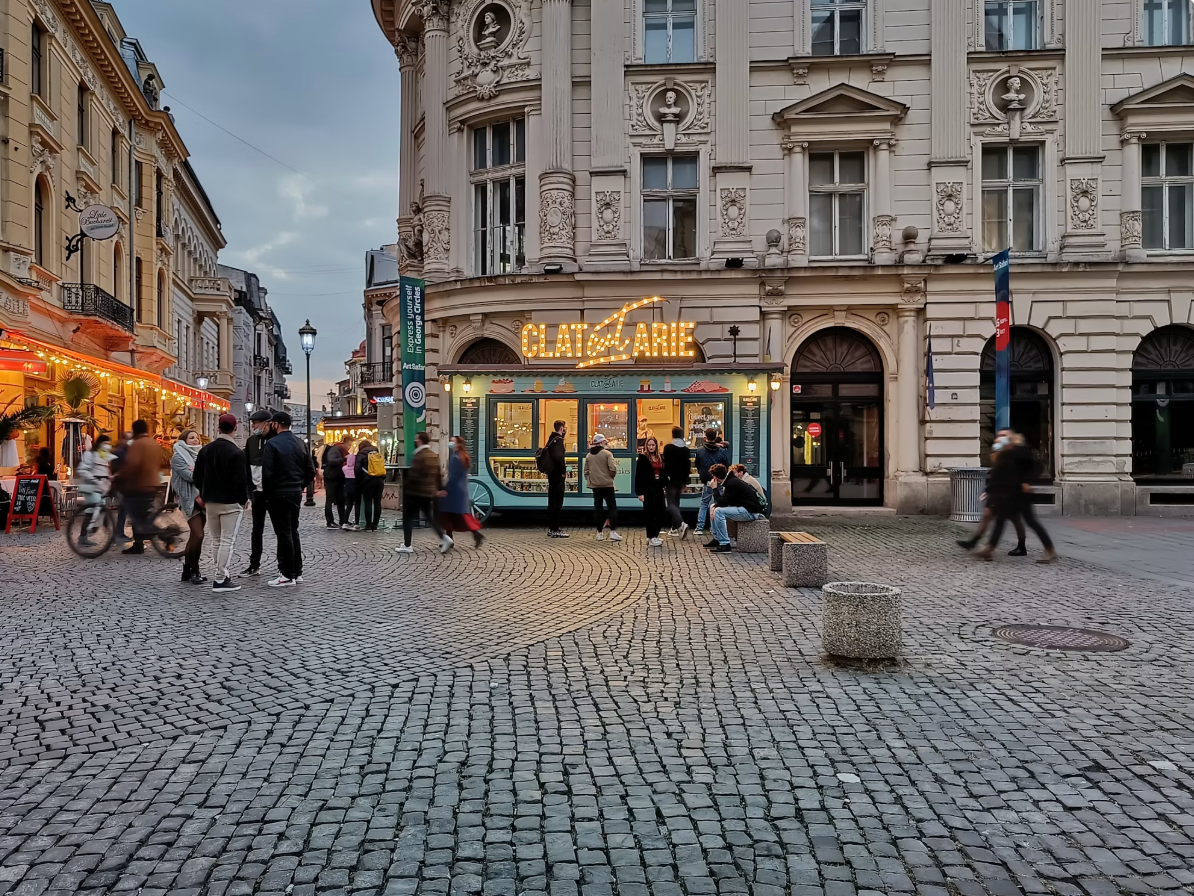
If there's a right way to experience this firsthand, it's not picking a side, it's doing a comparison crawl. Start at an old-guard shop like Cofetaria Maria for an amandină or savarină exactly the way locals have eaten it for decades, then walk toward the Athenaeum for a strawberry cremșnit at Mara Mura to taste the same basic concept filtered through modern technique. Round it out with a croissant from Le Grenier à Pain or Pain Plaisir, less because it's Romanian and more because it tells you something about how seriously this city now takes baking as a craft, regardless of which tradition it borrows from.






