 William BensonVIEW PROFILE →
Europe Went Dark at Sunset: What Actually Happened During the August 2026 Total Solar Eclipse, and Why the Next One Already Has People Booking Flights
For the first time in 27 years, the Moon's shadow swept across mainland Europe. The next great chase already has a date, and it's unlike anything Sydney has seen in 171 years.
For the first time in 27 years, the Moon's shadow swept across mainland Europe. The next great chase already has a date, and it's unlike anything Sydney has seen in 171 years.
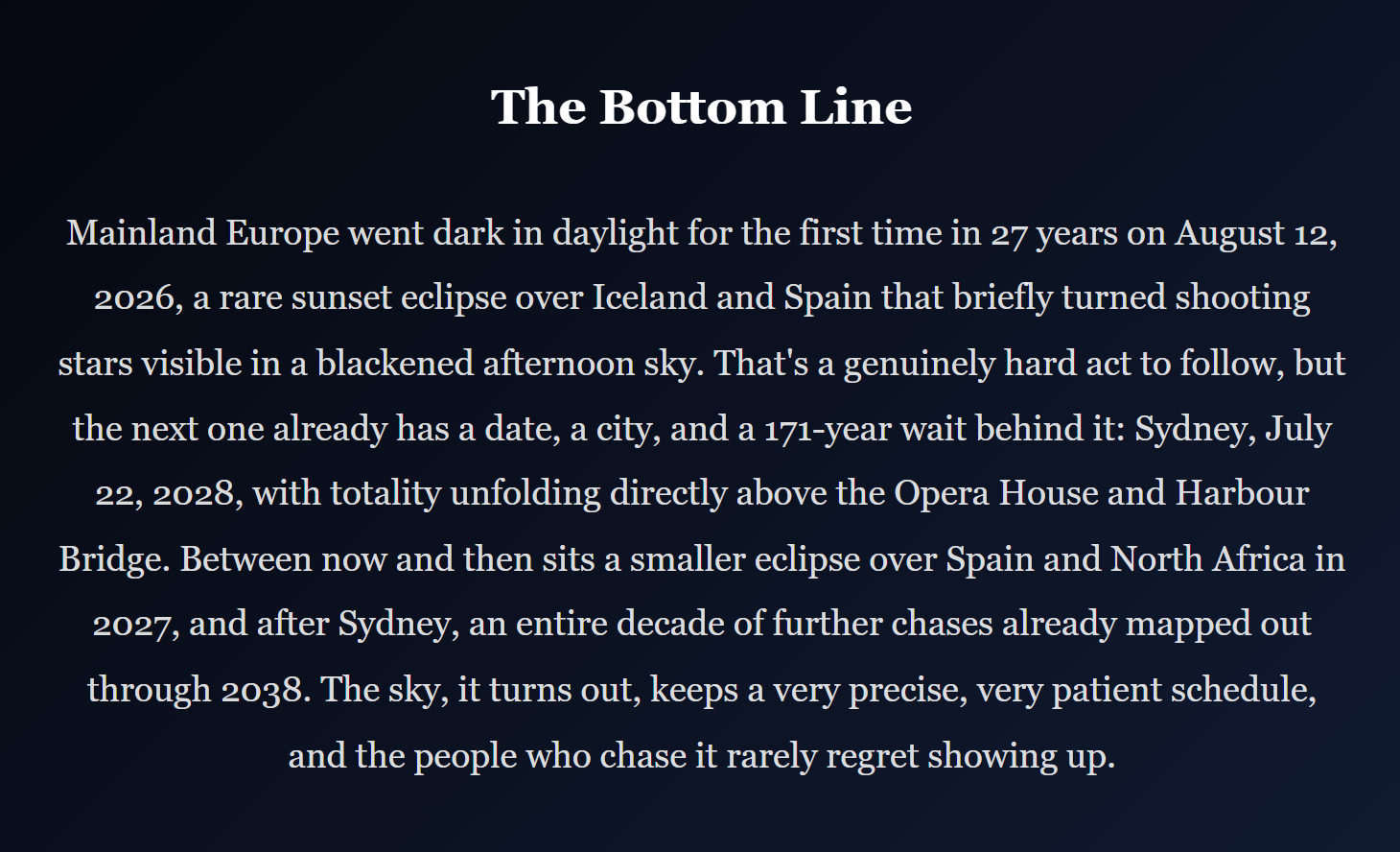
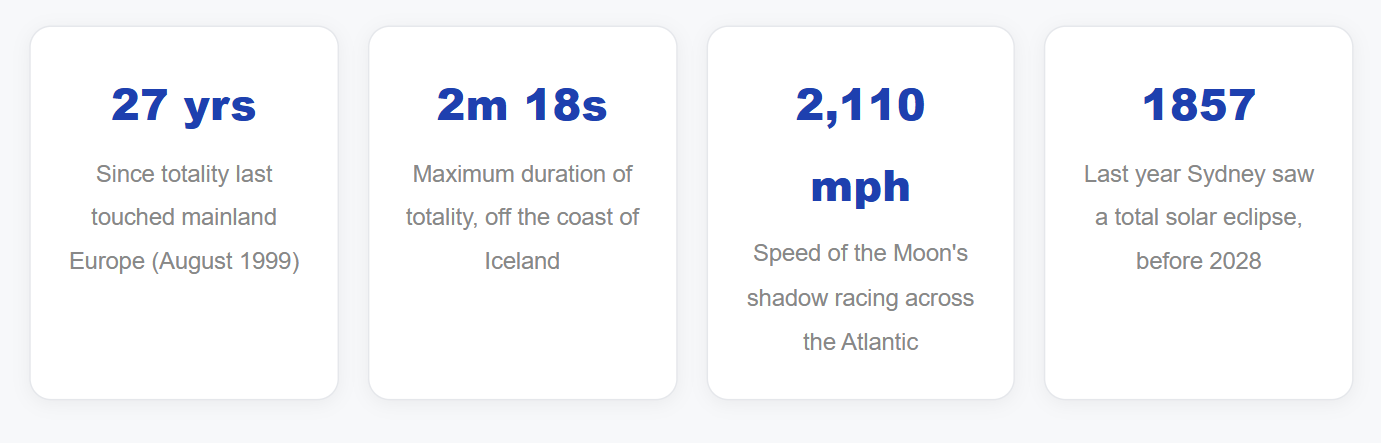
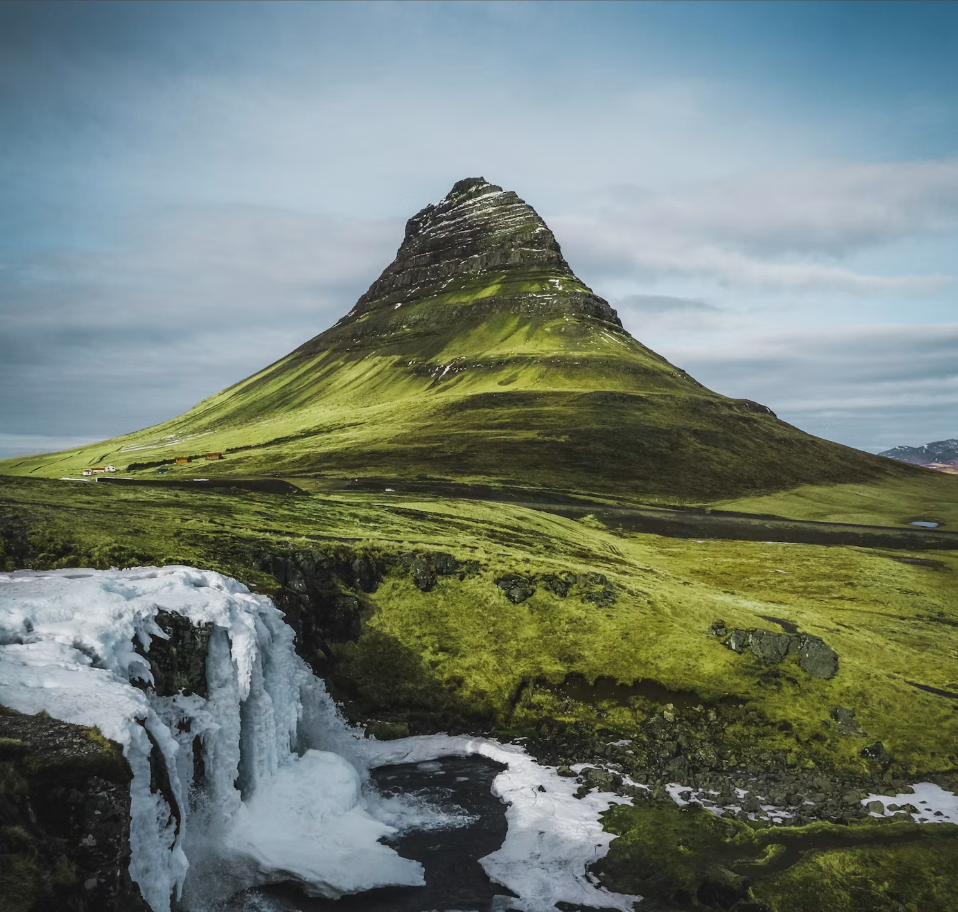
On the evening of August 12, 2026, something happened over Iceland and northern Spain that hadn't happened over mainland Europe since 1999: the sky went dark in the middle of the day, the temperature dropped, birds fell silent, and for a little under two and a half minutes, thousands of people looked up and watched the sun's ghostly outer atmosphere blaze around a perfectly black disk where the sun used to be. If you missed it, you're not alone. But the story doesn't end there, because the next chase is already circled on a lot of calendars, and this one belongs to a city that hasn't seen anything like it in 171 years. What Actually Happened on August 12 The eclipse itself followed a genuinely strange path. Rather than sweeping west to east the way most total solar eclipses do, this one arced up and over the North Pole, beginning at a technical "sunrise" over Siberia's uninhabited Taymyr Peninsula, where the Arctic summer sun barely dips below the horizon before rising again. From there, the Moon's shadow raced south-southwest across a remote stretch of Greenland before making its first real public appearance on the west coast of Iceland. Totality reached Iceland's Westfjords at 17:44 local time, sweeping down across the glacier-capped Snæfellsnes peninsula and directly over Reykjavík, where residents got roughly 59 seconds of full darkness. From there, the shadow crossed the Atlantic at a staggering 2,110 miles per hour, arriving in northern Spain about thirty-five minutes later, where totality lasted longer, up to 2 minutes and 18 seconds at its peak, near sunset over the Balearic Sea.
A Once-in-a-Generation Coincidence: The Perseids Joined the Show
What made this particular eclipse genuinely rare wasn't just its timing over Europe, it was what else was happening in the sky at the same moment. August 12 sits right at the peak of the Perseid meteor shower, one of the most reliable annual meteor displays visible from the Northern Hemisphere. For the brief window of totality, observers along the path had the surreal experience of watching shooting stars streak across a daytime sky gone dark, something that essentially never lines up this cleanly.
Along the Spanish stretch of the path, cities including sections of the Balearic Islands and the northern mainland found themselves directly in the centerline, with inland towns like León and Burgos experiencing slightly shorter totality, around 1 minute 45 seconds and 1 minute 43 seconds respectively, still a genuinely dramatic experience by any measure. Millions of people were expected across the path, enough that eclipse-chasing guides spent weeks beforehand warning about crowded roads and packed viewing areas in both countries.
Why an Eclipse Over the Ocean at Sunset Was Actually a Gift
Veteran eclipse chasers pointed out something worth appreciating about this particular event: the timing near sunset in Spain wasn't a drawback, it was a bonus. Totality occurring low on the horizon, close to sunset, tends to produce especially dramatic color along the horizon, deep oranges and reds bleeding into the darkened sky above, layered on top of the corona itself. It's a combination photographers chase specifically, and this eclipse delivered it as a built-in feature of its geometry rather than pure luck.
Longtime eclipse observers describe the corona's appearance during totality as something photographs never fully capture, ghostly white streamers of solar atmosphere extending far beyond what any camera sensor can register in a single exposure, visible only to the naked eye in that brief window of darkness.
The Countdown Everyone's Already Talking About: Sydney, 2028
If August's eclipse felt like a warm-up, the next major chase is the one circled hardest on calendars right now. On July 22, 2028, a total solar eclipse will sweep directly across Sydney, Australia, marking the first time the city has experienced totality since March 26, 1857, a gap of 171 years. It won't happen again after that until the year 2858, making this, quite literally, a once-in-several-lifetimes event for anyone living in the city.
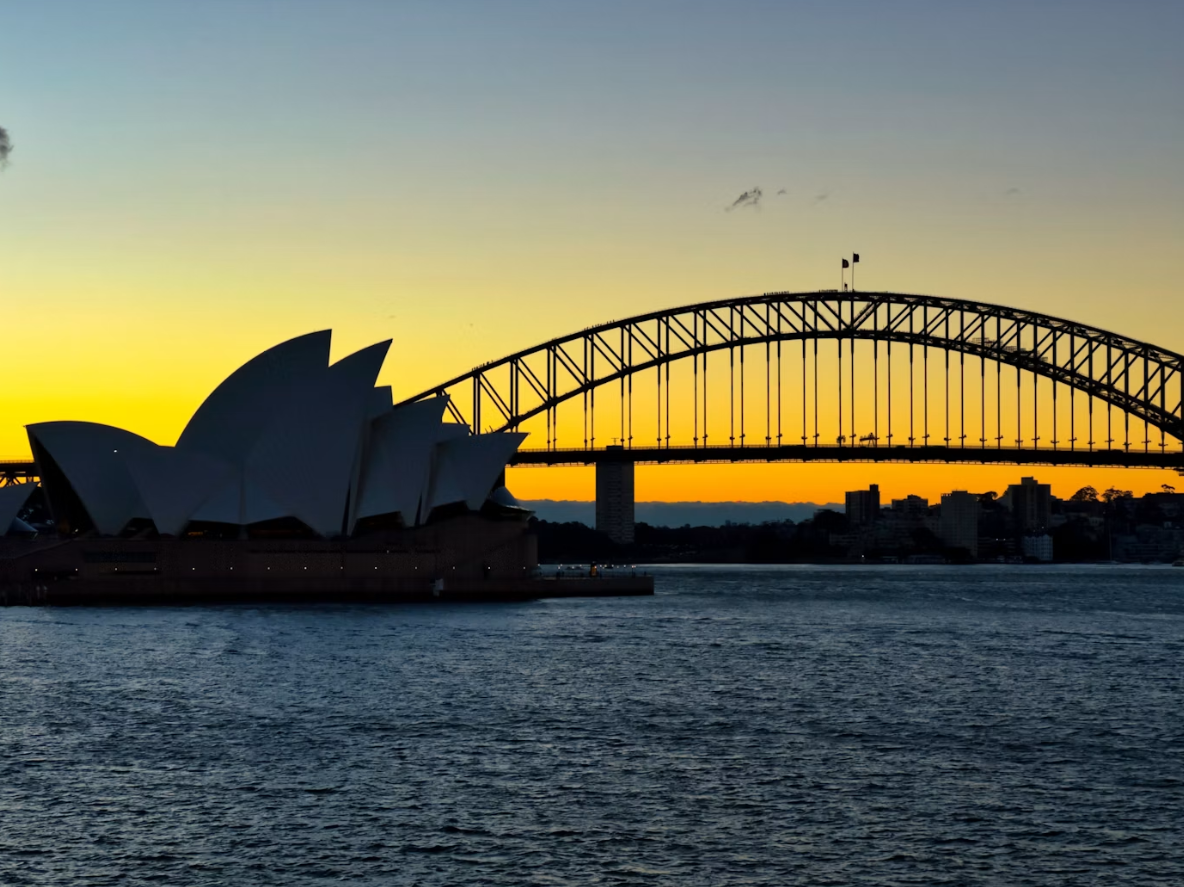
The path will make landfall on Australia's northwest coast in the Kimberley region of Western Australia, where totality lasts an extraordinary 5 minutes and 10 seconds, among the longest of any eclipse this decade. From there, the Moon's shadow tracks southeast across the Northern Territory and Queensland's outback before crossing directly over Sydney's central business district, with the Royal Botanic Garden sitting squarely in the path, offering views of the eclipsed sun above the Harbour Bridge and Opera House.
What Sydney's 2028 Eclipse Will Actually Look Like
Locals watching from the city center should expect totality to begin around 2:01pm local time, lasting roughly 3 minutes and 48 seconds, a genuinely long window compared to most total eclipses, which often clock in under two minutes. The full event, from the first bite taken out of the sun to the moment it's fully restored, will stretch across nearly three hours, though the darkness itself is confined to that brief, dramatic middle stretch.
Weather is already shaping travel plans. Regional areas in Western Australia, the Northern Territory, and Queensland carry better odds of clear skies than Sydney itself, which sits at higher risk of cloud cover in late July. Even so, few eclipse chasers are willing to skip watching totality unfold directly behind one of the most recognizable skylines on Earth, and Sydney is expected to draw enormous crowds regardless of the meteorological odds.
A Few Honest Questions People Are Actually Asking
Did I really miss my only chance to see this kind of eclipse? Not at all. Beyond Sydney in 2028, a follow-up eclipse crosses Spain, North Africa, and the Middle East on August 2, 2027, and additional Australian eclipses are already mapped out for 2030, 2037, and 2038.
Is it actually safe to look at a total solar eclipse? Only during the exact moment of totality, when the Sun is fully covered, is it safe to look with the naked eye. Every other phase, before and after, requires certified eclipse glasses or a proper solar filter; regular sunglasses are never sufficient.
Why do total solar eclipses feel so much rarer than they actually are? They aren't rare globally, one occurs roughly every 18 months somewhere on Earth, but the path of totality is typically only 100 to 150 miles wide, meaning any single location on the planet waits centuries between direct hits, which is exactly why Sydney's 2028 eclipse is such a big deal locally.
Why This Kind of Event Keeps Pulling People In
There's a reason eclipse chasing has become its own dedicated travel subculture rather than a passing curiosity. Unlike almost any other natural spectacle, a total solar eclipse is entirely predictable years in advance down to the second, and yet it still produces a reaction in people that borders on primal, animals audibly going quiet, temperatures visibly dropping, and a crowd of strangers standing in a field or a city square collectively gasping at the same instant. It's one of the only genuinely universal experiences left that requires nothing more than showing up in the right place at a precisely known moment.
That's likely why Sydney's 2028 eclipse is already generating serious planning this far ahead, hotel bookings, viewing-area proposals at the Botanic Garden, transportation planning for a city that hasn't dealt with this kind of event in living memory. When the sky doesn't go fully dark somewhere for 171 years, people tend not to want to be anywhere else when it finally does.
Planning ahead
Eclipse timing, weather patterns, and viewing logistics can shift as the actual date approaches. For the 2028 Sydney eclipse specifically, official viewing locations and travel advisories are expected to be finalized well before the date, so check verified astronomical sources closer to July 2028 rather than relying on early projections alone.