 William BensonVIEW PROFILE →
Everything You Need to Know About the SAVE America Act Before You Head to the Polls
Proof of citizenship to register. Photo ID to vote. One bill, two totally different Americas depending on who you ask. Here's everything you actually need to know before the midterms.
Proof of citizenship to register. Photo ID to vote. One bill, two totally different Americas depending on who you ask. Here's everything you actually need to know before the midterms.
Proof of citizenship to register. Photo ID to vote. One bill, two totally different Americas depending on who you ask. Here's everything you actually need to know before the midterms.
If you've caught even five minutes of cable news lately, you've probably heard someone yelling about the SAVE America Act. One side says it's the bare minimum for keeping elections honest. The other side says it's about to lock millions of legal, everyday Americans out of the voting booth. Both sides are talking about the exact same 12-page bill. That gap alone tells you almost everything you need to know about where this country's at heading into the midterms, so let's break down what this thing actually says, who's pushing it, who's fighting it, and what's really at stake for you come November.
Okay, So What Does This Bill Actually Do?
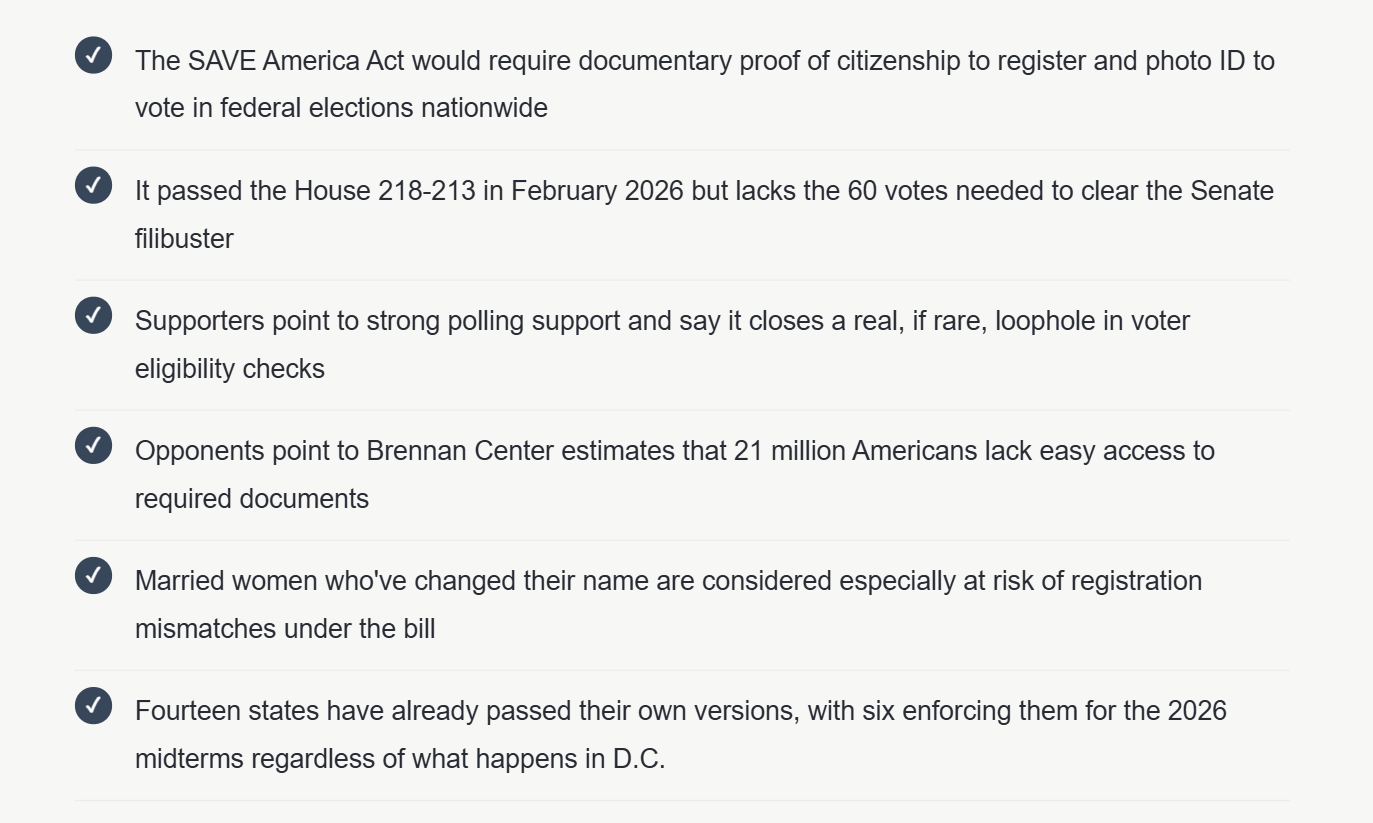
Strip away the campaign rhetoric and the SAVE America Act, officially the Safeguard American Voter Eligibility Act, does two main things. First, it requires anyone registering to vote in a federal election to show documentary proof of citizenship, think a passport or a certified birth certificate, in person, rather than just checking a box and signing your name under penalty of perjury, which is how it works right now. Second, it requires a government-issued photo ID at the actual polling place to cast your ballot. On top of that, it would have states hand over their full, unredacted voter registration lists to the Department of Homeland Security every quarter.
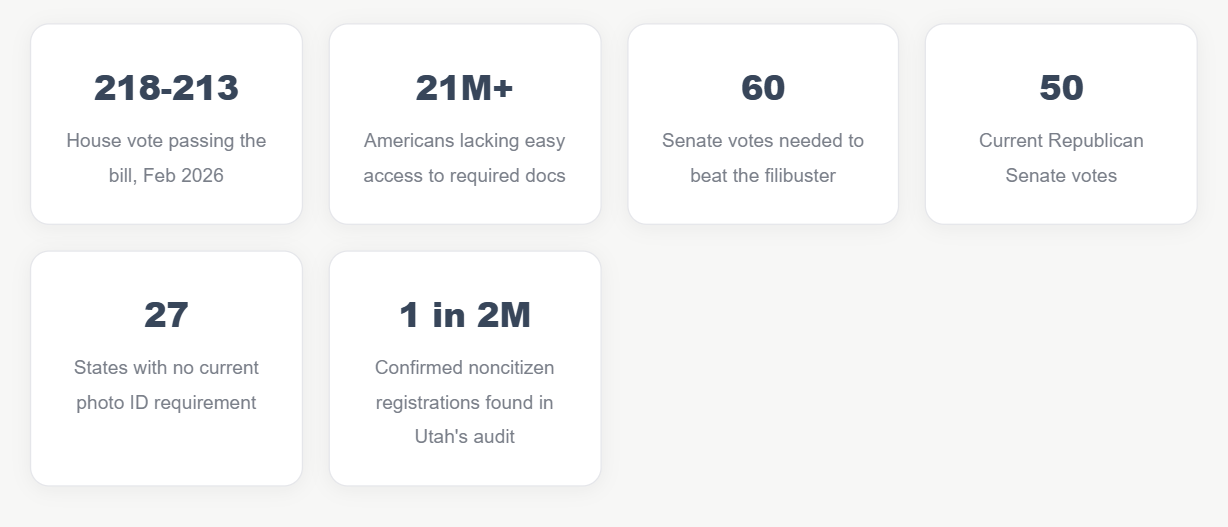
Here's the thing that trips people up: right now, only three states require proof of citizenship for everybody registering to vote, and 27 states don't require any photo ID at all to cast a ballot. So this isn't a small tweak. It's a total overhaul of how tens of millions of Americans register and vote, all at once, nationwide.
Both parties agree that voter registration should permit all eligible citizens, and only eligible citizens, to register and vote in federal elections.
The Case for It: "It's Just Common Sense"
Republican Rep. Chip Roy of Texas introduced the bill, and Utah Senator Mike Lee is carrying it in the Senate. Their pitch is pretty straightforward: only U.S. citizens should be voting in U.S. elections, and right now the honor system, that under-penalty-of-perjury attestation, isn't a real check. Supporters point to a poll cited by House Republicans claiming 83% of Americans, including a majority of registered Democrats, back requiring proof of citizenship at registration. To them, this isn't some fringe idea, it's a popular, common-sense fix that most people already assume is happening.
There's also a numbers argument buried in here that's worth understanding. Utah recently ran one of the most thorough citizenship audits any state has ever done, checking more than 2 million registered voters. The result: one confirmed case of a noncitizen registering, and zero confirmed instances of a noncitizen actually voting. Supporters of the bill will tell you that's exactly the point, even one is one too many, and a law like this closes the door before it becomes a bigger problem down the road, especially as the country grows and immigration numbers climb.
The Case Against It: "This Locks Out Millions of Real Voters"
Opponents aren't arguing that noncitizens should be allowed to vote, nobody is. What they're arguing is that this bill solves a problem that barely exists while creating a much bigger one. The Brennan Center for Justice, a nonpartisan law and policy institute, has estimated that more than 21 million eligible American citizens don't have quick, easy access to the specific documents this bill would require. The group didn't mince words, calling it flat out one of the worst voting bills Congress has ever pushed toward a vote.
The group most consistently flagged as at risk? Married women who changed their last name after their wedding. If your birth certificate says one name and your driver's license says another, that mismatch alone can get your registration flagged or rejected under a strict proof-of-citizenship standard, unless you're also carrying extra paperwork like a marriage certificate every time you register or update your address. Add in younger first-time voters who've never needed a passport, lower-income Americans who can't easily front the cost of a certified birth certificate, and voters of color who studies show are statistically less likely to have ready access to these documents, and you start to see why critics call this a disenfranchisement risk dressed up as a security fix.
The part election officials are actually panicking about
Forget the politics for a second, state election administrators across the country, red states and blue states alike, have raised a much more practical alarm: this bill doesn't come with a dime of federal funding to actually pull it off. No money for extra staff, no money for new equipment, no money for processing millions of new document checks. They'd be expected to build entirely new verification systems from scratch, with zero budget, and have it all running smoothly in time for the 2026 midterms. Even some Republicans who support the bill's goals have acknowledged the timeline is brutally tight.
Why It's Stuck, and Why That Might Be the Whole Point
Here's where it gets a little cynical. The bill sailed through the House back in February 2026 on a near party-line vote, 218 to 213, with every Republican except one and every Democrat opposed. But the Senate is a totally different animal. Republicans hold 50 seats there, and it takes 60 votes to get past a Democratic filibuster. Senate Majority Leader John Thune hasn't exactly sounded thrilled about burning weeks of floor time on a bill that, by his own math, doesn't have the votes to pass.
And that's led some political watchers to a pretty blunt read on the whole situation: this bill might not have been written to actually become law before November. Senator Lee himself has openly tied the SAVE America Act to Republican chances in the midterms, and Thune has said flat out that if it doesn't pass, it becomes a campaign issue this fall. Translation, according to skeptics: if the bill dies in the Senate, as basically everyone expects, it hands Republicans a talking point heading into the midterms about Democrats "blocking" election security, while also giving some voices on the right a built-in excuse to question the results if things don't go their way. Whether you buy that read or not probably depends a lot on which side of this fight you're already standing on.
Forget D.C. for a Second, This Is Already Happening in Your State
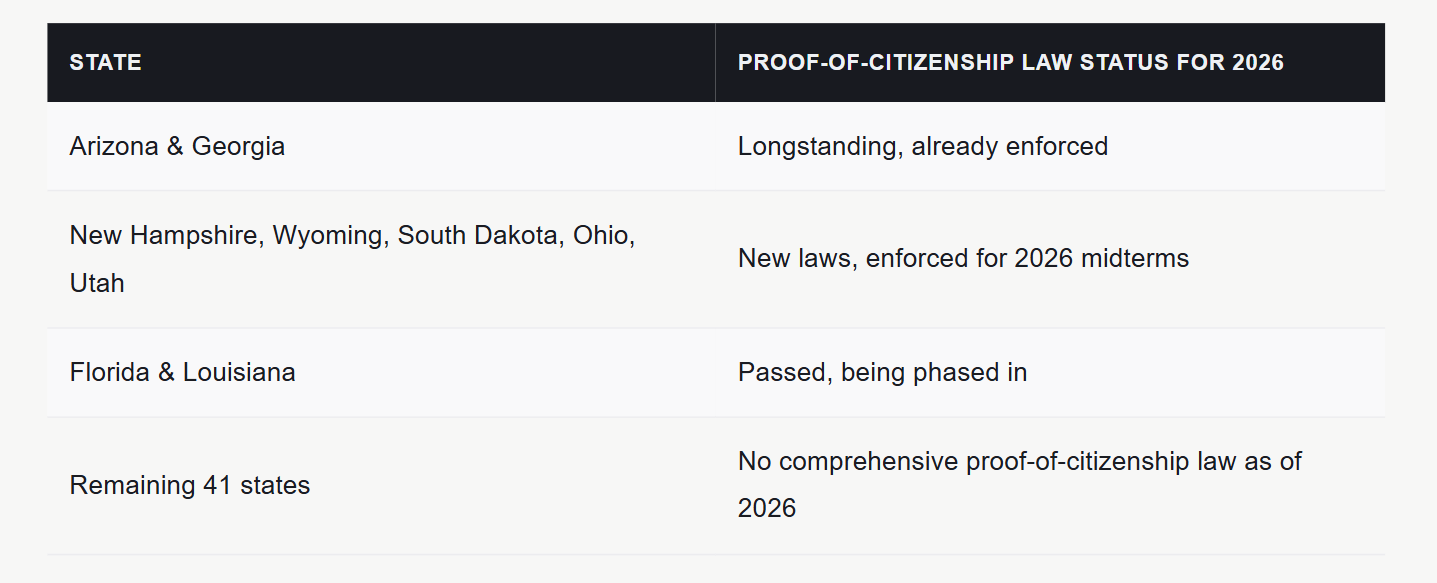
Here's the part that doesn't get nearly enough attention: while everyone's watching the Senate drama, state legislatures have quietly been doing the SAVE Act's job for it, one state capitol at a time. Since 2024, twelve more states have passed SAVE Act-style laws on top of the two, Arizona and Georgia, that already had them. Seven states now require documentary proof of citizenship from every single person registering to vote, not just new applicants.
For the 2026 midterms specifically, five of those states, New Hampshire, Wyoming, South Dakota, Ohio, and Utah, will actually be enforcing these proof-of-citizenship rules at the ballot box. Florida and Louisiana have similar laws on the books that are being phased in. So even if the federal version never gets a Senate vote at all, the practical reality on the ground for millions of voters is shifting fast, and mostly under the radar.
Regardless of how the Senate fight shakes out, the smartest move for any voter right now is to check your own state's specific rules well before Election Day, not the week of. If you live in one of the states already enforcing a proof-of-citizenship law, or one considering it, dig up your birth certificate or passport now, especially if your name has changed since it was issued, and confirm exactly what your local election office will accept. Waiting until you're standing in line to register is exactly how people get caught off guard by rules like these, on either side of this debate.