 William BensonVIEW PROFILE →
Your AC Isn't the Only Thing Working Overtime This Summer, So Is the Entire Grid
Texas just smashed a demand record that beat Winter Storm Uri. California's holding its breath. Florida's mailing out bills nobody wants to open. Here's what's actually happening to the power keeping your AC running.
Texas just smashed a demand record that beat Winter Storm Uri. California's holding its breath. Florida's mailing out bills nobody wants to open. Here's what's actually happening to the power keeping your AC running.
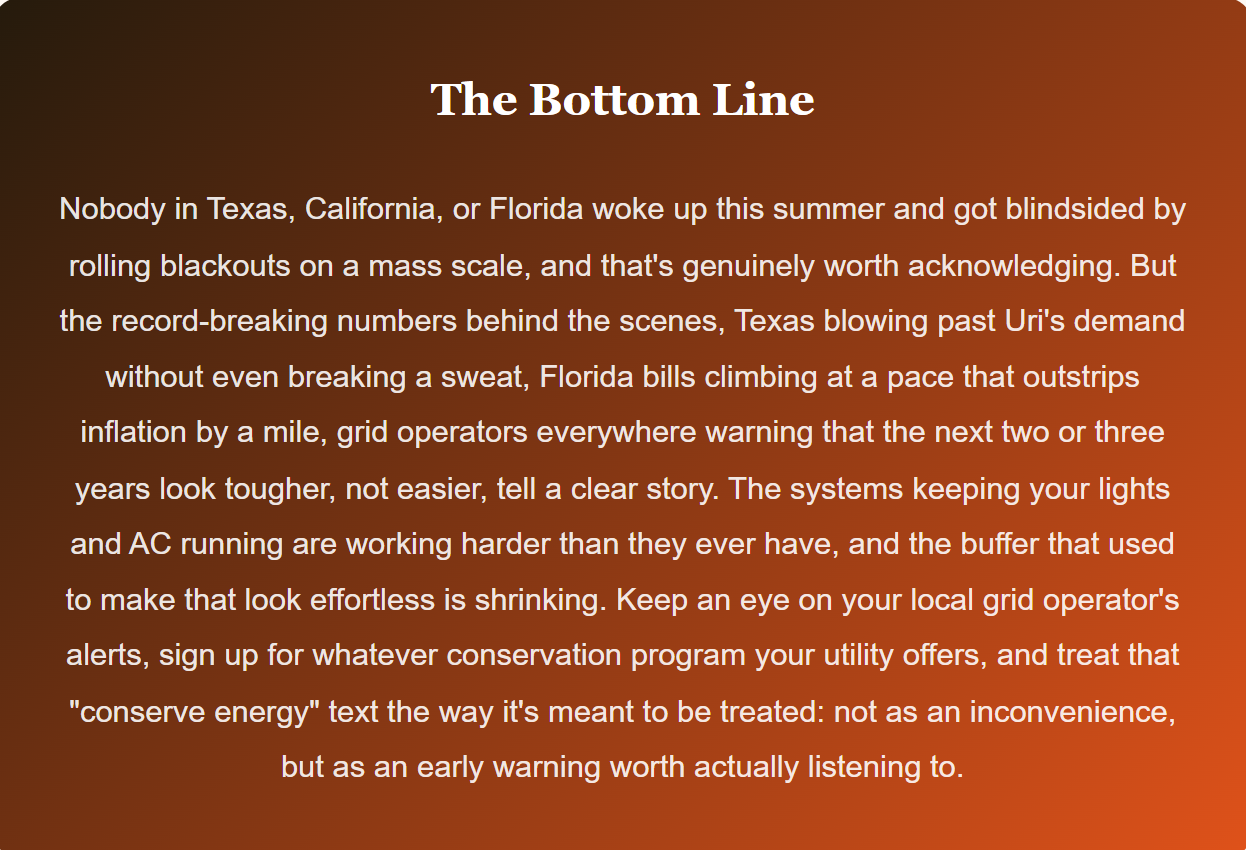
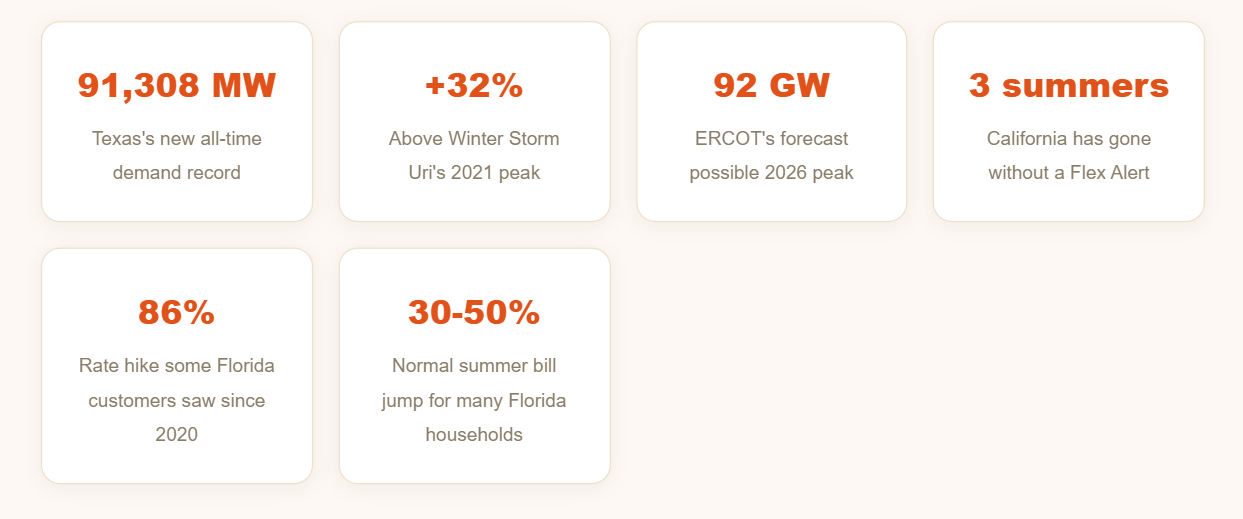
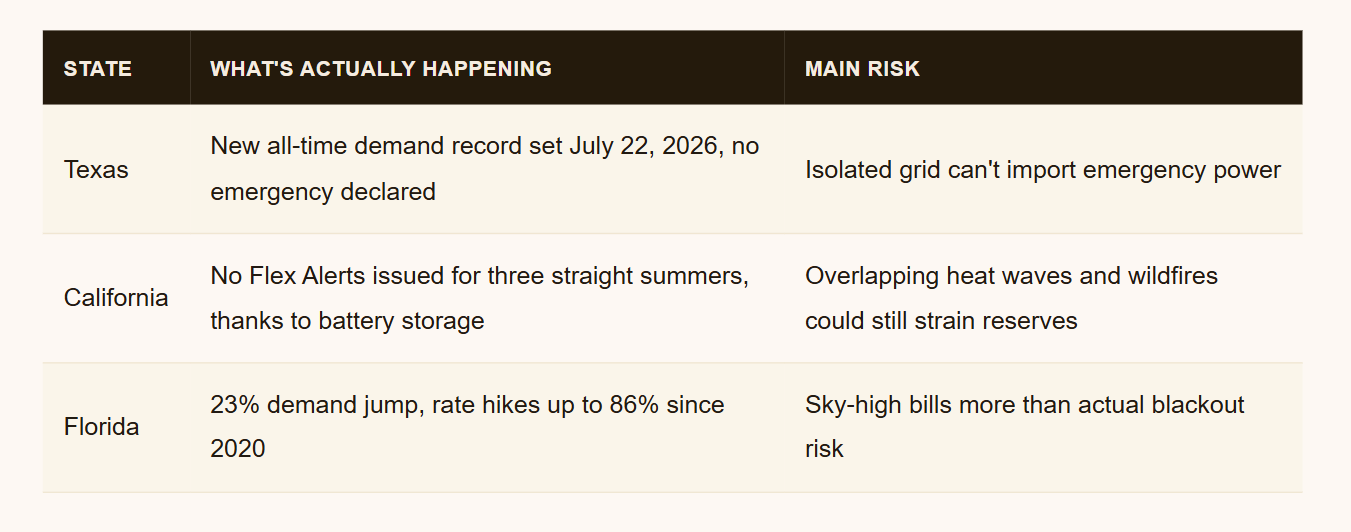
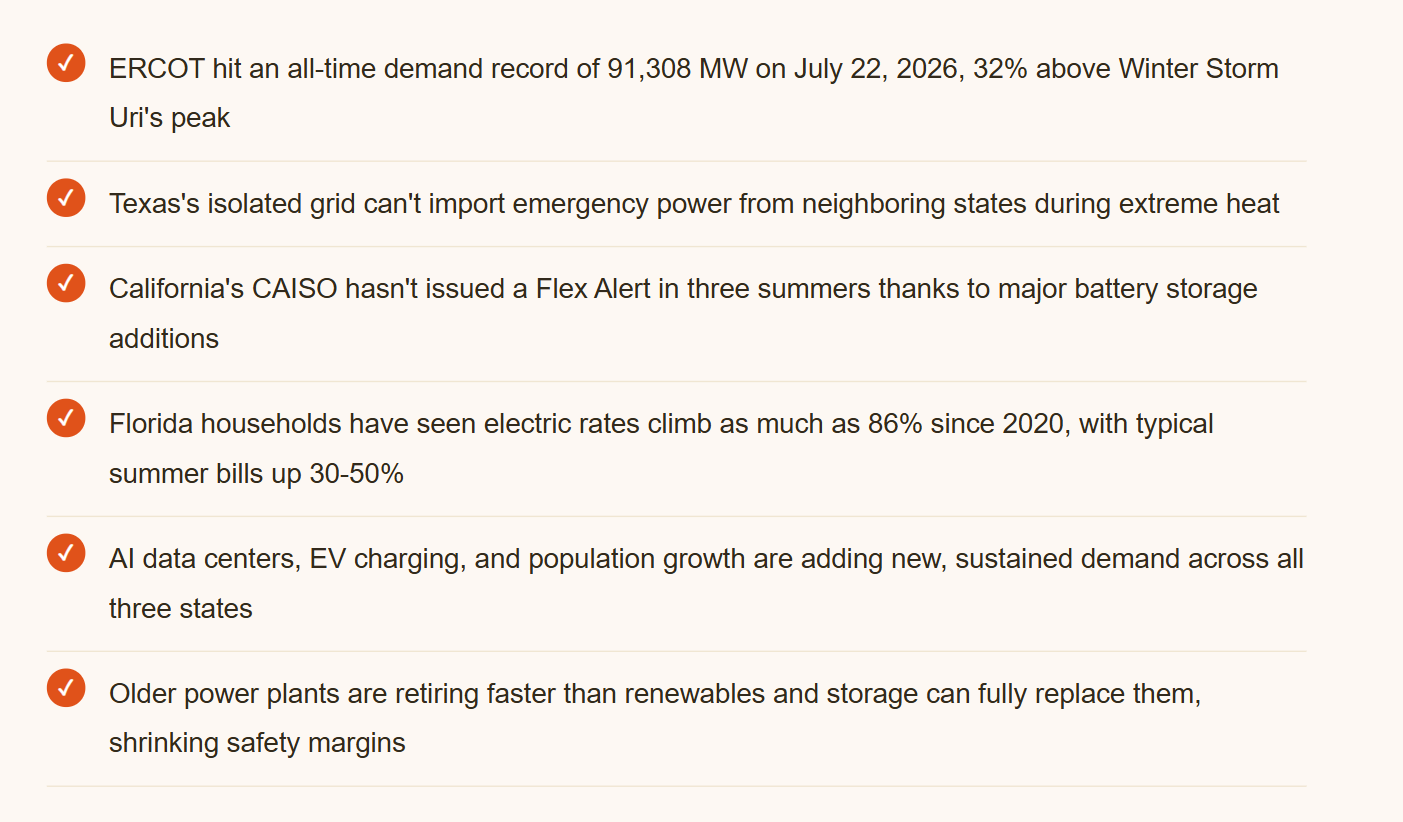
There's a specific kind of dread that sets in when your phone buzzes with a "conserve energy" alert at 4 p.m. on the hottest day of the year, right as you're about to crank the AC even higher. That exact scenario has played out across huge chunks of the country this summer, and it's not just an inconvenience, it's a genuine warning sign about how close the systems keeping our lights on are running to the edge. Texas, California, and Florida have all found themselves in the headlines for the same basic reason: it's hotter than it's ever been, more people and machines than ever are demanding power, and the grid is straining to keep up. Texas Just Blew Past a Record That Was Supposed to Be Untouchable Let's start with the big one. On July 22, 2026, ERCOT, the grid operator for most of Texas, recorded an all-time demand peak of 91,308 megawatts, a number that sounds abstract until you realize it's about 32% higher than the peak reached during Winter Storm Uri, the 2021 disaster that left millions of Texans without power and killed hundreds of people. This time, there was no emergency declared and no conservation call issued, ERCOT had more than 20 gigawatts of buffer to spare. Still, hitting a number that dwarfs Uri without breaking a sweat is exactly the kind of headline that makes energy watchers nervous about what happens next year, or the year after. Doug Lewin, a Texas energy analyst who tracks the grid closely, pointed out that the ease with which Texas cleared last month's peaks isn't a guarantee for the future. ERCOT's own president and CEO, Pablo Vegas, testified before the Texas Senate that things are only going to get tougher from here, driven by a triple threat of population growth, AI data centers multiplying across the state, and summers that keep getting hotter. ERCOT's own forecast for this summer projected a possible peak above 92 gigawatts, enough to power roughly 18 million homes, a number that would have sounded like science fiction a decade ago. The ease at which we got through last week's peaks would not be the way I would characterize the future in two to three years. I think it will be much more difficult. Why Texas Specifically Can't Just Borrow Power From Next Door Here's the part that makes Texas a special kind of nervous compared to other states: ERCOT runs its own isolated grid, mostly cut off from the rest of the country's electrical network. That independence was a deliberate choice decades ago to dodge federal regulation, but it comes with a serious downside. When Texas needs a little extra juice during a brutal heat spike, it can't just import emergency power from a neighboring grid the way most other states can. Whatever capacity is inside Texas's borders is what Texas has to work with, full stop. The silver lining, according to University of Houston energy fellow Ed Hirs, is that Texas has actually built out a serious amount of solar, wind, and battery storage capacity in recent years, enough that he says Texans shouldn't lose sleep over rolling blackouts specifically during summer heat waves right now. The bigger unsolved puzzle is winter, when solar panels are useless at night and wind turbines can freeze up during a cold snap, which is exactly what triggered the Uri catastrophe in the first place. Summer and winter turned out to be two completely different grid problems wearing the same "extreme weather" costume.
California's Actually Been Doing Okay, But Nobody's Getting Comfortable
California tells a slightly different, more hopeful story this year. The state's grid operator, CAISO, hasn't had to issue a single Flex Alert, that "please ease up on your AC" appeal, for three summers running now, despite plenty of record-setting heat along the way. CAISO president and CEO Elliot Mainzer credited a serious buildout of battery storage that kicks in right as solar power fades in the evening, exactly when air conditioning demand is still climbing. It's a genuinely good news story in a summer full of grid anxiety headlines.
That said, California officials aren't exactly throwing a party. They've been careful to flag that overlapping disasters, say, a heat wave combined with a wildfire that knocks out transmission lines, could still create a genuinely tight squeeze even with all that new storage online. If you're in California, the Flex Alert system is still very much active and worth signing up for at flexalert.org, since these things tend to get called with only a day's notice once conditions actually tighten up.
What a Flex Alert actually asks you to do
If California calls a Flex Alert, it's asking for voluntary conservation, not a mandatory shutoff, typically between 4 and 9 p.m. when solar power drops off but everyone's AC is still cranking. The ask is simple: set your thermostat to 78°F or higher if your health allows it, hold off on running the dishwasher or washing machine until later in the evening, and avoid charging your EV during those peak hours. It sounds small, but when millions of households do it at once, it genuinely takes pressure off the system and helps avoid the more serious step of actual rotating outages.
Florida's Problem Isn't Blackouts, It's the Bill in Your Mailbox
Florida's summer 2026 story looks less like a blackout crisis and more like a slow-motion wallet crisis. Florida Power & Light reported a 23% jump in summer demand compared to last year, while base rates climbed another 8.5% to cover infrastructure upgrades. For Tampa Electric customers specifically, an analysis by Food & Water Watch found that regulators approved rate increases adding up to an 86% jump since December 2020 for a household using 1,000 kilowatt-hours a month, translating to roughly $980 more per year than the same household paid just five years earlier.
Part of what makes Florida uniquely brutal is that the heat doesn't really let up at night the way it does in drier climates. Overnight lows sitting in the mid-70s mean air conditioners run nearly around the clock instead of getting a break once the sun goes down, and Florida's suffocating humidity forces AC units to work overtime just removing moisture from the air, a process that alone can eat up 30% of a system's total energy use. Add tiered peak-hour pricing that can jump 35% above baseline rates between 2 and 7 p.m. in some areas, and you get bills that can run 30% to 50% higher every summer almost as a matter of routine.
The Bigger Story Behind All Three States
Zoom out and a common thread runs through Texas, California, and Florida's grid headaches: it's not just about hotter summers, it's about hotter summers colliding with a genuinely new kind of electricity demand. AI data centers are multiplying fast and pulling enormous, constant loads around the clock. Electric vehicle adoption keeps climbing, adding a whole new category of household demand that didn't exist at scale a decade ago. And in a lot of regions, older fossil fuel plants are retiring faster than new renewable capacity and battery storage can fully replace them, shrinking the safety cushion grid operators used to count on.
None of that means the lights are guaranteed to go out. Grid operators in all three states have gotten noticeably better at forecasting, storage deployment, and public conservation appeals over the past few summers. But the margin for error keeps getting thinner, and that's exactly why you're seeing so many "record demand" headlines lately even in years when the actual outages stayed rare.
What to actually do if your area gets a conservation alert or an outage
If you get a conservation request, the small stuff genuinely adds up: bump your thermostat a few degrees, hold off on the dishwasher and laundry until after 9 p.m., and skip the EV charging session until later. If the power actually does go out during a heat wave, that becomes a health situation fast, not just an inconvenience. The CDC recommends getting to an air-conditioned space as quickly as possible, whether that's a neighbor's place, a library, a mall, or an official cooling center, since fans alone don't lower your body temperature once things get dangerously hot. Watch for heat exhaustion warning signs like heavy sweating, dizziness, nausea, and headache, and treat any confusion, slurred speech, or a very high body temperature as a heat stroke emergency that needs a 911 call immediately. Check in on elderly neighbors and relatives especially, since older adults and young kids are at the highest risk when the AC stops working.