 William BensonVIEW PROFILE →
Locked Out: Why Buying a House in America Feels Impossible Right Now
It's not just you. It's not just your city. The whole market is stuck, and here's exactly why.
It's not just you. It's not just your city. The whole market is stuck, and here's exactly why.
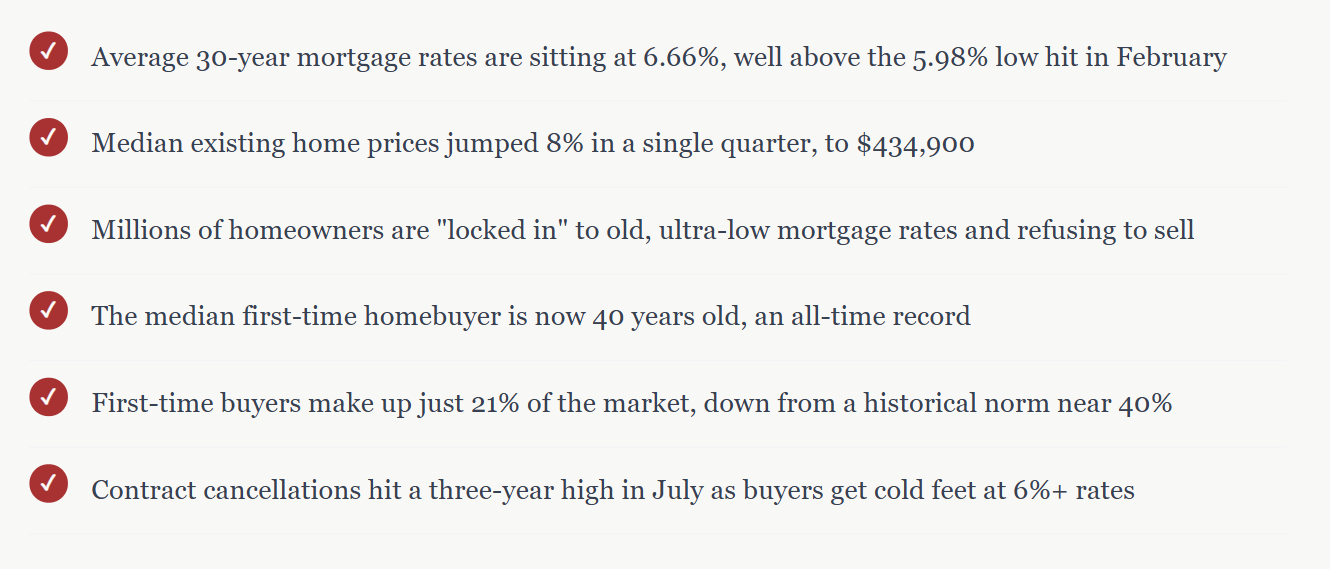
If you've spent any time lately scrolling Zillow at 1 a.m., doing that thing where you punch numbers into a mortgage calculator and then immediately close the tab because the payment made your stomach drop, you already know something's off. You're not imagining it, and you're definitely not alone. Right now, in the summer of 2026, buying a home in America has hit a level of difficult that even seasoned real estate folks are calling historic. Not "tough market" difficult. Frozen-solid, nobody's-winning, everybody's-stuck kind of difficult. Here's the thing that makes this moment genuinely weird, though: it's not one single problem. It's two separate problems, high mortgage rates and a serious shortage of affordable homes, that decided to show up to the party at the exact same time, feed off each other, and basically lock the whole market in place. Buyers can't afford to buy. Sellers don't want to sell. And everybody in the middle is just... stuck, watching the numbers, waiting for something to give. Let's talk numbers, because they tell the story better than any headline can As of August 26, the average 30-year fixed mortgage rate sits at 6.66%, according to Freddie Mac's weekly survey. That's actually down a hair from where it was earlier in the month, when Forbes clocked it at 6.77%. Rates had actually dipped down to 5.98% back in late February, a genuine bright spot that got a lot of would-be buyers excited, before climbing right back up over the following months. The culprit behind that climb: the 10-year Treasury yield, which jumped from 3.94% to 4.70% over roughly the same stretch, dragging mortgage rates up right along with it.
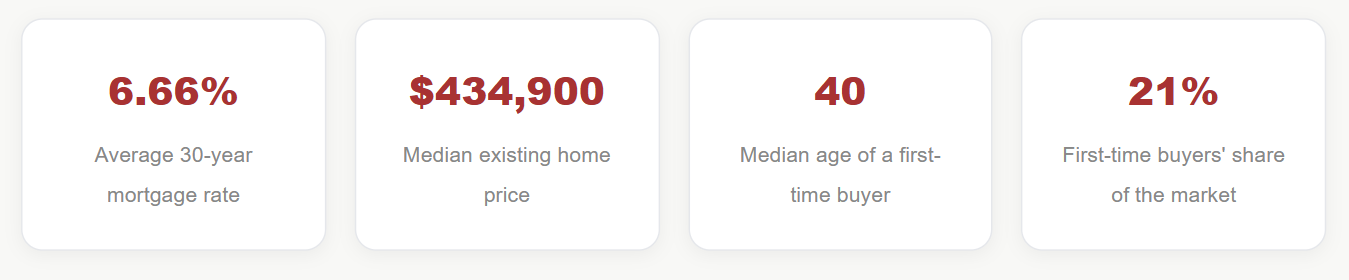
Six-point-six percent might not sound catastrophic if you're picturing the double-digit rates your parents dealt with back in the '80s, but here's what actually matters: it's the payment that number produces on today's sky-high home prices. And those prices haven't been playing nice either. The median price of an existing home jumped 8% in a single quarter, hitting $434,900 between Q1 and Q2 of 2026. New construction wasn't quite as brutal, up 2% to $410,700, but still nowhere close to what most families can comfortably swing.
The "golden handcuffs" nobody saw coming
Here's the part of this story that doesn't get talked about enough, and it's honestly the key to understanding why the market feels so gridlocked. Millions of homeowners across the country are sitting on mortgages they locked in back during the ultra-low-rate years, 2020, 2021, sub-3% territory. The effective rate on all outstanding mortgages nationally is sitting at just 4.33% as of June, more than two full percentage points below what anyone shopping for a new mortgage would pay today.
Think about what that actually means for a second. If you're one of those homeowners, moving isn't just inconvenient, it's financially brutal. Sell your house, buy a new one, and you're trading a 3% mortgage for a 6.7% mortgage on top of higher prices. For a lot of families, that math just doesn't math. So they stay put. Even if they'd genuinely like to move, upsize, downsize, relocate for a job, they don't, because the alternative costs them thousands of extra dollars a year. That's the lock-in effect, and it's a massive reason why there just aren't enough homes hitting the market for buyers to choose from.
Why this matters more than it sounds
A housing market needs turnover to function. When existing homeowners stop selling because moving costs them too much, the whole supply pipeline backs up. Total inventory nationally sat at just 1.54 million homes in July, down nearly 2% from June, equal to only 4.6 months of supply at the current sales pace. A balanced market usually runs closer to six months.
The affordability gap, laid out in plain English
The National Association of Home Builders tracks something called the Cost of Housing Index, and their latest numbers are rough. A family earning the nation's median income, $106,800 a year, now needs to hand over 34% of that income just to cover the mortgage payment on a median-priced new home. That's up from 32% just one quarter earlier. Blink and it got worse.
Now here's where it gets genuinely painful: for low-income families, defined as households earning half the median, that same new home eats up 67% of their entire income. Two-thirds. Gone. Just on the mortgage payment. And if you're one of the eight metro areas nationally where the typical household now spends over half their income on housing, you've crossed into what HUD officially classifies as a "severe cost burden," a category that used to describe extreme, worst-case scenarios and is now just... Tuesday, in a growing number of American cities.
A family earning the median U.S. income now needs 34 cents of every dollar just to cover the mortgage on a median-priced new home. A year ago, that number was meaningfully lower. It's only heading in one direction.
First-time buyers are taking the hardest hit, by far
If you're trying to buy your very first home right now, brace yourself, because the data on this group is genuinely wild. The National Association of Realtors' overall housing affordability index sat at 105 in Q2 2026, not great, but not a disaster either. The first-time buyer index, though? Just 70. That gap tells you everything: the market is rough for everybody, but it's absolutely brutal specifically for people trying to get in the door for the first time.
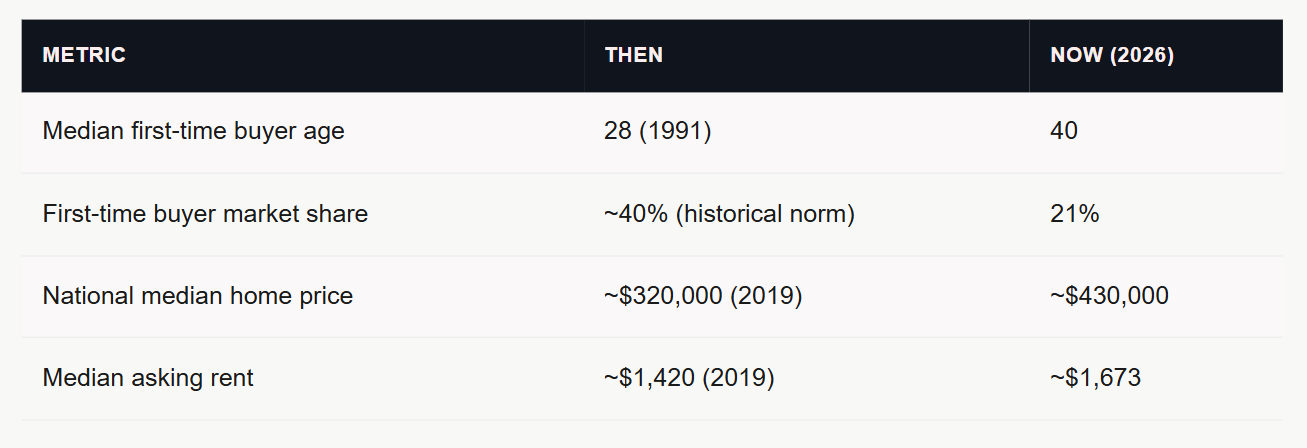
And it shows up in the demographics in a way that should honestly stop everyone in their tracks. The median age of a first-time homebuyer has climbed to 40 years old, an all-time record, according to NAR. Rewind to 1991 and that number was 28. In one generation, the milestone that used to belong to your mid-to-late twenties has drifted all the way into your forties, if it happens at all. First-time buyers now make up just 21% of the market, a near-record low, way down from the 40% share that used to be historically normal.
Part of what's driving that shift is who's actually winning the bidding wars. Repeat buyers, older, often cash-rich, sitting on equity from a home they bought years ago, are dominating the market. Some estimates put all-cash buyers at roughly a quarter of all purchases. When you're a 28-year-old with student debt and a starter salary going up against a boomer offering cash with no financing contingency, guess who the seller picks.
It's not just buying. Renting isn't the easy escape hatch anymore either
A lot of people hear all this and think, fine, I'll just rent forever then. Except renting has gotten a whole lot less "easy" too. The national median asking rent has climbed nearly 18% since 2019, landing around $1,673 a month, while the median home listing price over that same stretch shot up 34%. Rent growth has cooled off a bit in some cities lately as new apartment buildings come online, which is genuinely good news, but "cooled off" doesn't mean cheap. It just means the bleeding slowed down.
That combination, expensive to rent, way more expensive to buy, has trapped a lot of young Americans in a holding pattern nobody really wants to be in. Roughly one in three adults under 35 are currently living with a parent, according to recent reporting, a number that reflects just how squeezed both sides of the housing equation have become. Some of that is a deliberate strategy, stack cash for a down payment, avoid throwing money at rent, but plenty of it is just people genuinely running out of affordable options.
Why sellers are just as stuck as buyers, if you can believe it
Here's a detail that might genuinely surprise you: this is technically a buyer's market right now. Prices have gotten soft enough in some corners of the country, inventory has crept up just enough, that buyers theoretically have more leverage than they've had in years. Bloomberg summed it up perfectly: it's a buyer's market, trouble is, there aren't many buyers. Rates are simply too high for a lot of people to pull the trigger, buyer's market or not.
That hesitation is showing up in the deal-flow data in a big way. Redfin reported that home-purchase contract cancellations hit a three-year high in July, with 14% of signed contracts falling through before closing. Buyers are getting cold feet mid-transaction, walking away, and using whatever leverage they've got to renegotiate or bail entirely. Pending home sales slid to their weakest point since the start of the year. New-home sales dropped to their lowest level since January. Even homebuilders have pulled back, with residential construction slowing across the board.
Figures cited throughout this piece reflect data from Freddie Mac, the National Association of Realtors, the National Association of Home Builders, Redfin, and Bloomberg as of August 2026. Housing market conditions can shift quickly, and readers considering a home purchase should check current, localized data before making financial decisions.
So... is this actually the government's fault?
This is genuinely one of the more contested questions in economics right now, and reasonable people land in very different places on it. Some economists and policy groups point to decades of heavy federal involvement in the mortgage market, arguing that programs meant to boost homeownership have, over time, pushed prices up rather than down, since homeownership rates have stayed roughly flat, around 65% today versus 62-63% in the early 1960s, despite all that intervention. Others point squarely at supply: decades of restrictive local zoning laws, NIMBY resistance to new construction, and a homebuilding industry that simply hasn't kept pace with population growth, especially in the country's most in-demand metro areas.
The honest answer is probably "some of both, depending on which city you're looking at." What almost everyone across the political spectrum agrees on is the diagnosis: not enough homes are getting built where people actually want to live, and whatever gets built isn't getting built fast enough or cheap enough to meet demand.
What the Fed is (and isn't) doing about it
A lot of people assume the Federal Reserve can just wave a wand and drop mortgage rates whenever it wants. It's more complicated than that. The Fed chose to leave the federal funds rate untouched at its late-July meeting, and mortgage rates are more directly tied to that 10-year Treasury yield than to the Fed's benchmark rate itself. So even if the Fed eventually does cut rates further, mortgage rates won't necessarily follow in lockstep.
Forecasters are, at least, not predicting things get dramatically worse from here. Fannie Mae's latest housing forecast has 30-year rates hovering around 6.4% for the rest of 2026. The Mortgage Bankers Association is projecting something similar, around 6.5% through Q3 and Q4. Nobody serious is predicting a return to the sub-3% rates of the pandemic years. As one Bank of America lending exec put it, hopeful buyers shouldn't necessarily wait around for a magic number, if the house works for your budget today, waiting for rates to drop might just mean paying more for the same home later.
What this actually means if you're trying to buy right now
None of this is meant to talk you out of buying a home if the timing and numbers genuinely work for your life. It's meant to explain why it feels so much harder than it probably did for your older siblings, your parents, or basically anyone who bought before 2022. You're not bad at budgeting. You're not doing something wrong. You're navigating a market where two structural forces, high rates and thin supply, are actively working against each other, and against you.
If there's a silver lining buried in all this, it's that the "everybody's stuck" dynamic cuts both ways. Sellers who genuinely need to sell are facing softer demand and more negotiating room for the buyers who do show up. Cancellations are climbing precisely because buyers finally have enough leverage to walk away from a deal that doesn't feel right. That's cold comfort if you're staring down a $2,800 monthly payment on a starter home, but it's a real shift from the frenzied, bid-over-asking chaos of a few years back.