 William BensonVIEW PROFILE →
How a Shy Kid From Bucharest Became the Most Consistent Sprinter in Swimming
A childhood scoliosis diagnosis led David Popovici into the water at age four. Two decades and a third consecutive European double later, he's one of the most consistent freestylers swimming has ever produced.
A childhood scoliosis diagnosis led David Popovici into the water at age four. Two decades and a third consecutive European double later, he's one of the most consistent freestylers swimming has ever produced.
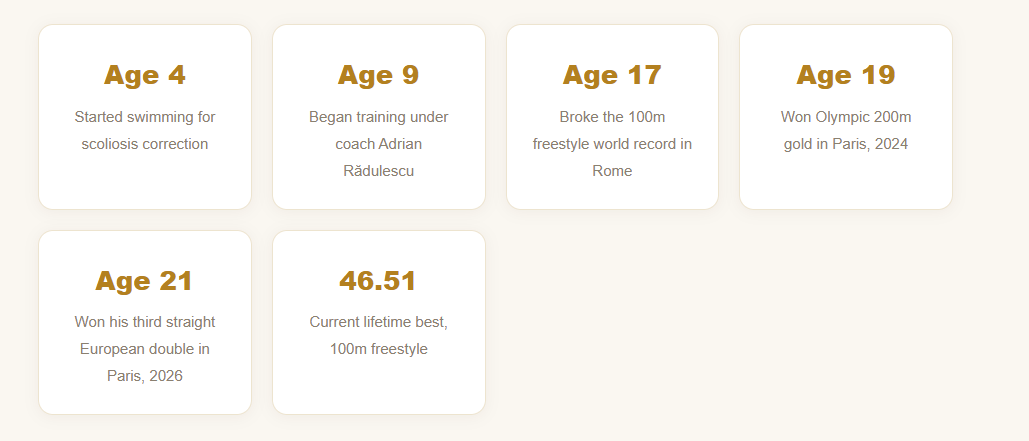
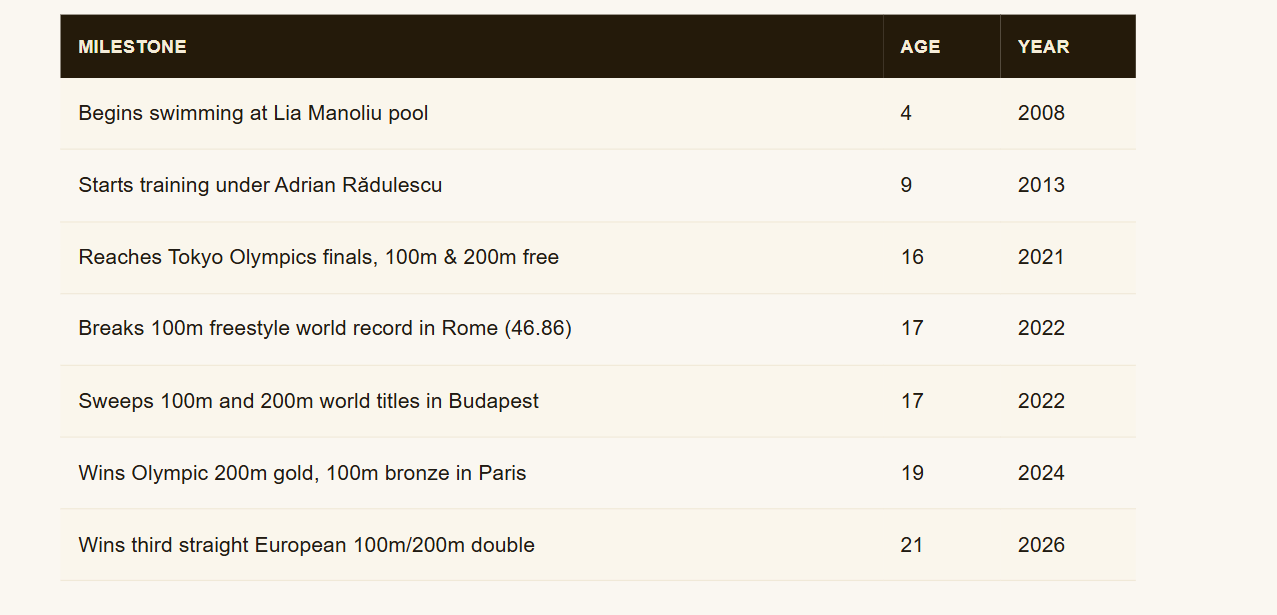
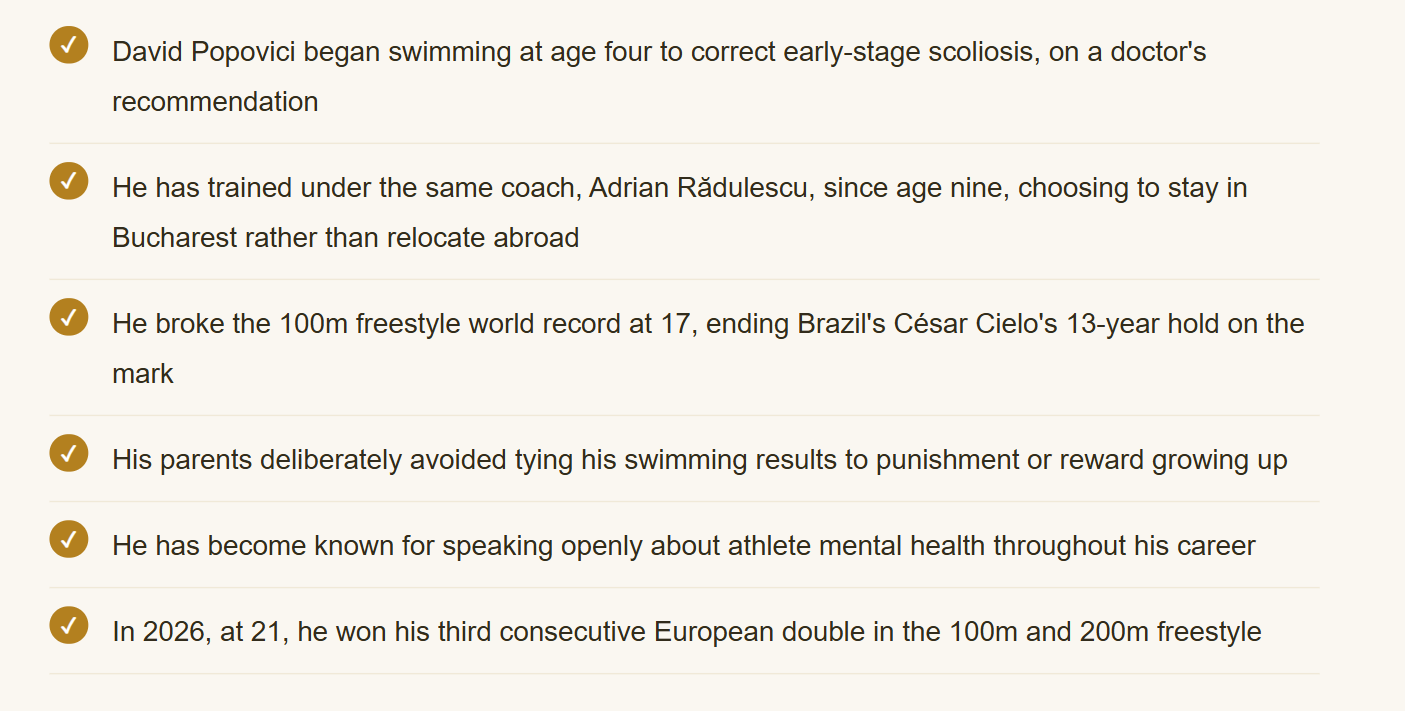
Most origin stories in elite sport involve at least a little myth-making, a childhood dream, a poster on a bedroom wall, a promise made to a parent. David Popovici's origin story is almost aggressively unglamorous by comparison: his parents put him in a swimming pool at age four for two reasons, they hoped it would tire him out, and a doctor had recommended it to correct early-stage scoliosis. There was no grand plan. There was a tired toddler and a slightly curved spine. Everything that followed, three European titles running in two separate events, a world championship, an Olympic gold medal, was built on top of that thoroughly unromantic beginning. A Cure for Scoliosis That Became a National Obsession Popovici was born in Bucharest on September 15, 2004, and began swimming at the Lia Manoliu pool as a small child under medical advice rather than athletic ambition. For years, that's genuinely all it was, a corrective activity, not a career path. The shift began at age nine, when he started training under Adrian Rădulescu at Aqua Team Bucharest, a coach with a somewhat unusual academic profile for the sport: a PhD in athletic performance, with his doctoral research focused specifically on metabolic and physical effort zones in pubertal and prepubertal swimmers, essentially, the science of how young bodies actually adapt to serious training loads. Rădulescu has been candid that there was no single dramatic moment that revealed Popovici's potential, no record-breaking swim at age ten that made everyone in the building stop and stare. "It's hard to see a 12-year-old kid and say he's the next star in swimming," he explained to Romania Insider, describing it instead as a gradual process of watching a boy respond consistently well to challenges and rising bars. He's seen plenty of talented kids lose their way before reaching that potential. What kept Popovici on track, in his coach's assessment, wasn't raw talent alone, it was the specific relationship he had with his parents, Mihai and Georgeta. There's a lot going on in life, from your relationship with your family, the situation at home. A lot of things can sidetrack you. The Coach Who Never Left, and the Swimmer Who Never Wanted To One detail that separates Popovici's development from many of his rivals is geographic: he never left. Coaches and commentators have repeatedly drawn a comparison between Rădulescu and Bob Bowman, the coach who guided Michael Phelps through his entire competitive career, a lifelong, singular coaching relationship rather than the more common pattern of switching programs, countries, or training groups as a swimmer matures. France's Léon Marchand, by contrast, relocated to Arizona to train under Bob Bowman himself as his own career accelerated. Popovici made the opposite choice, staying in Bucharest with the same coach who had guided him since age nine, a decision Global Times noted directly when profiling the two rising stars side by side. That continuity shows up in the numbers Rădulescu has kept in his own hardcover notebook for over a decade, physically walking poolside with a stopwatch, timing sprint sets, and jotting down splits by hand, the same unglamorous, detail-obsessed process that eventually produced a world record holder. It's a strikingly analog picture for a sport that has become increasingly reliant on underwater cameras, biomechanical sensors, and real-time data dashboards, and yet it's precisely the relationship that took a nine-year-old learning to swim properly and turned him, by seventeen, into a world champion.

Parents Who Refused to Turn Medals Into Currency
Rădulescu has pointed to one specific parenting choice as foundational to Popovici's long-term development: his parents never tied his swimming results to punishment or reward. They didn't ground him after a disappointing meet. They didn't hand out phones, money, or prizes for medals, a pattern Rădulescu says he's watched plenty of other talented young swimmers' families fall into, often with corrosive long-term effects on the athlete's relationship with the sport itself. Instead, Mihai and Georgeta Popovici emphasized encouragement over expectation, an approach aimed at protecting intrinsic motivation rather than manufacturing external pressure to perform.
That foundation appears to have paid off in a way that extends well beyond swim times. Popovici has become known in recent years for speaking candidly about athlete mental health, at a point in his career, still just 21, when many swimmers are only beginning to grapple publicly with the psychological weight of sustained elite competition. "A happy swimmer is a fast swimmer," he said in a July 2025 interview, a philosophy that reads less like a slogan and more like a genuinely held belief shaped by how he was raised inside the sport in the first place.
The world record that announced him to the sport
Popovici's true breakthrough onto swimming's global stage came at the 2022 European Championships in Rome, where, at just 17 years old, he shattered the men's 100m freestyle world record with a time of 46.86, breaking a mark Brazil's César Cielo had held for 13 years, since the height of the now-banned high-tech polyurethane swimsuit era. Breaking a textile-era-resistant record set during swimming's most controversial technological period, and doing it as a teenager, was the moment the broader swimming world stopped treating Popovici as a promising junior and started treating him as a genuine generational talent.
From Junior Prodigy to "King David"
Popovici's rise wasn't instantaneous even after that record-breaking swim. He'd already made his senior international debut at 16, reaching the finals of both the 100m and 200m freestyle at the Tokyo 2021 Olympics, finishing an agonizing 0.02 seconds from a bronze medal in the 200m. That near-miss became fuel rather than disappointment. By the 2022 World Championships in Budapest, still only 17, he'd completed his transformation into what Romania's leading sports newspaper dubbed "King David," sweeping both the 100m and 200m freestyle world titles. "You know, my neck is quite heavy because of the medals," he joked afterward. "So I need to strengthen that part for the next meets."
What Paris 2026 Actually Confirmed
When Popovici touched the wall first in both the 100m and 200m freestyle finals at the 2026 European Aquatics Championships, held fittingly in the same Paris pool where he'd won Olympic gold two years earlier, it wasn't really a new chapter in his story so much as confirmation of the one that had been building since that scoliosis diagnosis two decades prior. The specific times, records, and rivals change from meet to meet, but the underlying pattern, a coach who never left, parents who never turned results into leverage, and a swimmer who has learned, slowly and publicly, to separate his identity from his stopwatch, has remained remarkably constant across his entire career.
The nickname that outgrew the joke
Popovici's social media persona, built around the tongue-in-cheek handle "Chlorine Daddy," reflects a broader shift in how he's approached fame as it's grown around him. What began as an internet joke about his good looks and dominance in the pool has evolved into a platform he uses to share genuine training philosophy and reflections with a large, engaged following, a far cry from the guarded, media-trained persona common among athletes managing similar levels of attention. It's consistent with everything else about his development: unhurried, largely on his own terms, and shaped more by the people closest to him in Bucharest than by any outside pressure to become something else.