 William BensonVIEW PROFILE →
Inside Fashion's Quiet AI Takeover: Virtual Fitting Rooms, AI Models, and Designs Born From a Sketch
The industry that was slowest to digitize just became one of AI's biggest success stories, compressing months of work into days without most shoppers ever noticing the shift.
The industry that was slowest to digitize just became one of AI's biggest success stories, compressing months of work into days without most shoppers ever noticing the shift.
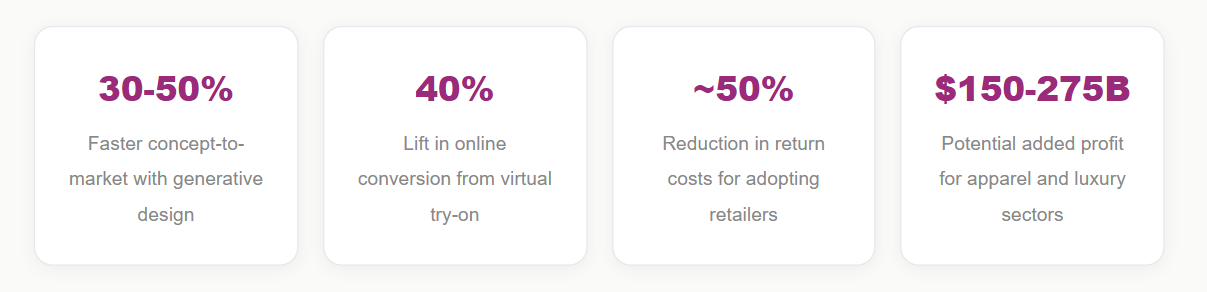
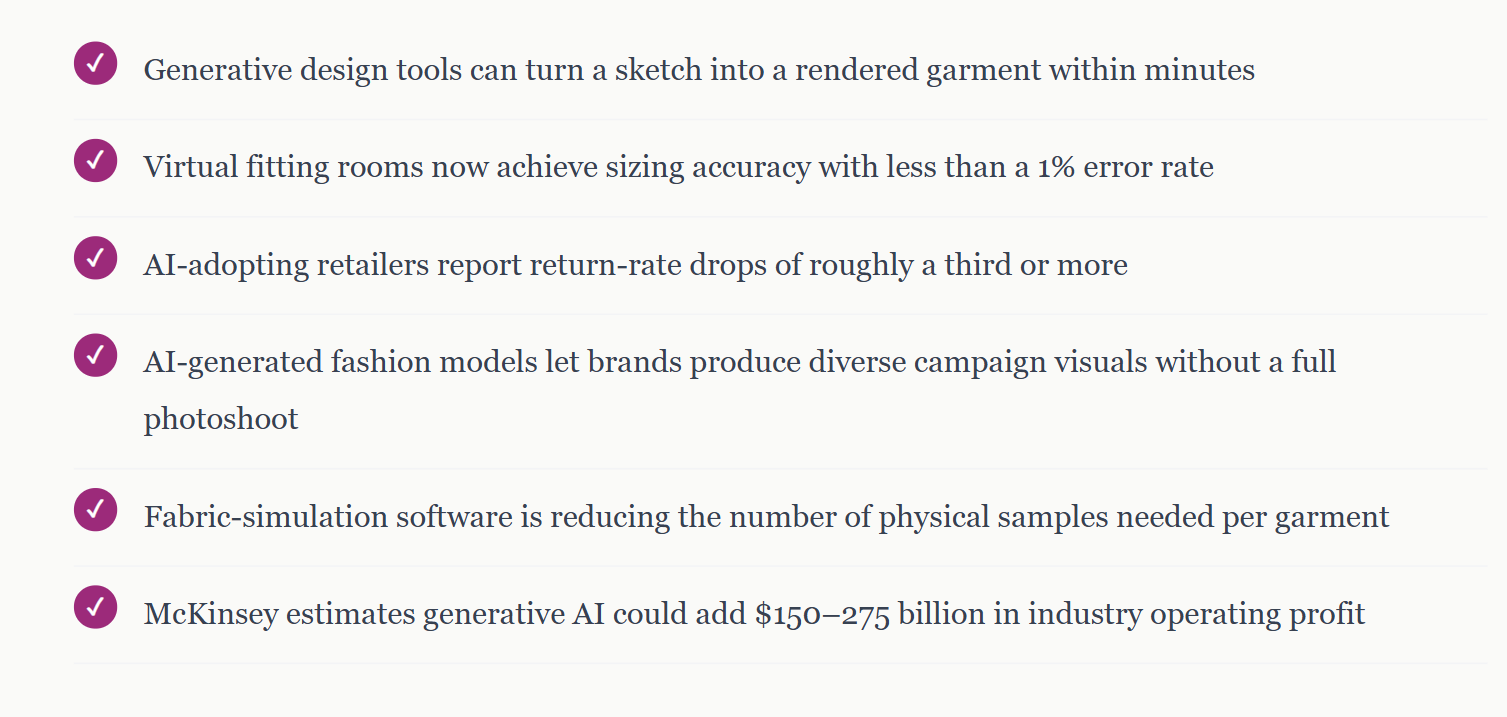
Fashion has always run on a peculiar kind of faith. A designer sketches a silhouette months before a single garment exists. A factory commits to fabric and cut long before knowing whether shoppers will actually want it. A customer clicks "buy" on a dress, hoping it fits, often mailing it right back when it doesn't. For an industry built on so much guesswork, artificial intelligence has arrived less like a disruption and more like a long-overdue correction, and in 2026, it has quietly become the infrastructure running underneath nearly every stage of how clothes get designed, shown, and sold. None of this happened with a single dramatic launch. It crept in through dozens of smaller tools, a rendering engine here, a virtual fitting room there, until the accumulated effect reshaped how entire fashion houses and scrappy online brands alike now operate. Here's what that shift actually looks like, and why an industry famous for resisting technology finally let this one in. From Sketch to Finished Garment in Days, Not Months The most fundamental change has happened at the very start of the design process. Generative design tools can now take a rough sketch, sometimes even a simple text description, and turn it into a fully rendered garment complete with realistic fabric drape, lighting, and finish, all within minutes rather than the weeks a physical prototype used to require. Platforms in this space can generate new concepts, print variations, and full colorways at a scale no individual design team could match manually. That speed compounds fast. One enterprise manufacturer cited in recent industry analysis cut its prototype creation time from six weeks down to less than two days by shifting to generative tools for early-stage concepting. Multiply that kind of time savings across an entire seasonal collection, and the arithmetic starts to explain why so many fashion houses have moved so quickly to adopt these systems, not because the technology was flashy, but because it solved a genuinely expensive bottleneck.
The Virtual Fitting Room Problem That Finally Got Solved
Anyone who has ever ordered three sizes of the same shirt online, just to return two of them, understands fashion e-commerce's oldest unsolved problem: nobody can try clothes on through a screen. Virtual try-on technology, powered by the same generative image techniques behind popular AI image generators, has spent 2026 closing that gap at a pace that surprised even people inside the industry.
The 2026 generation of these tools leans on multi-angle 3D body scanning captured from something as simple as a smartphone video, synced against digital garment libraries that simulate how real fabric actually moves and drapes on an individual body. According to industry data, virtual fitting rooms built on this kind of machine learning and 3D simulation now deliver sizing accuracy with less than a 1 percent error rate, a level of precision that has translated directly into fewer returns and materially better conversion rates for the retailers that have adopted it.
"A mid-tier e-commerce brand integrating instant AI fitting technology saw a 33 percent drop in returns and a 25 percent increase in average order value." — Style3D AI, 2026 fashion tech trends report
Two Very Different Kinds of "Trying It On"
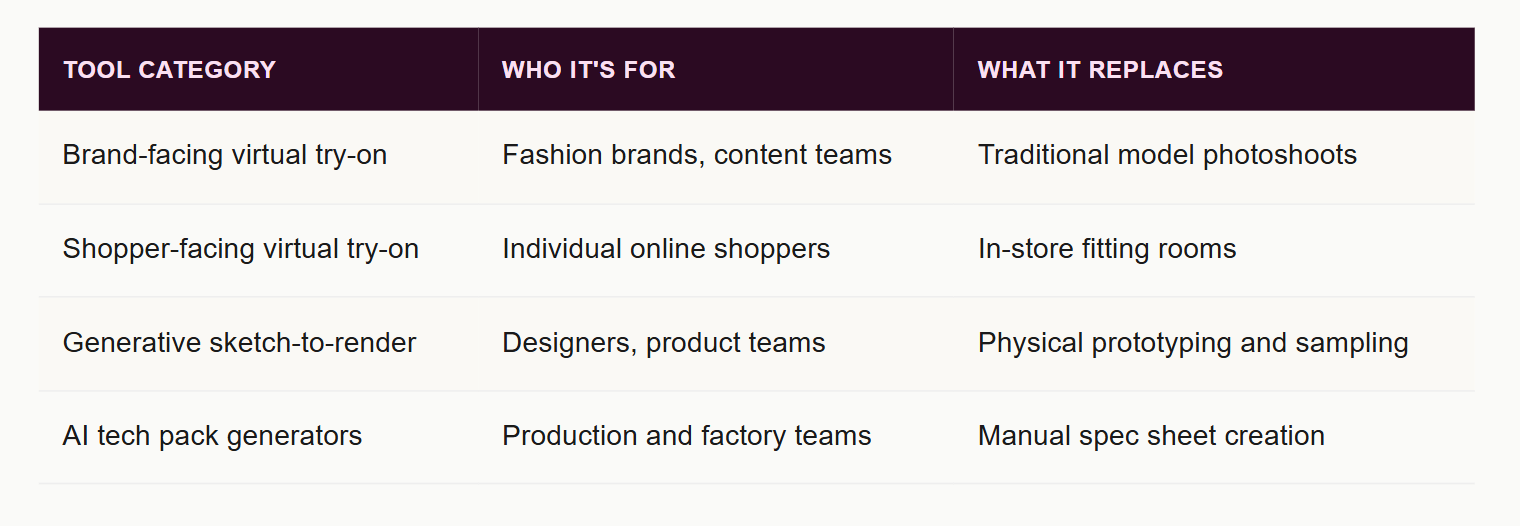
It's worth understanding that virtual try-on has actually split into two distinct categories serving very different purposes. The first, aimed squarely at brands and content creators, generates images of clothing on virtual models with varied body types, poses, and styles, replacing traditional photoshoots for lookbooks, marketing images, and product galleries. It's less about a shopper trying anything on personally, and more about giving brands a faster, cheaper way to produce large volumes of realistic, campaign-ready visuals.
The second category is built for the shopper directly. These tools let an individual upload a photo or scan and see approximately how a specific garment would look on their own body, integrated straight into an e-commerce checkout flow. Zalando, one of Europe's largest online fashion retailers, has been refining exactly this kind of consumer-facing try-on experience for nearly eight years, a reminder that even the most futuristic-feeling AI feature can have a surprisingly long, patient road to mainstream adoption behind it.
AI Models: Marketing Without the Photoshoot
Perhaps the most quietly controversial shift has been the rise of entirely AI-generated fashion models. Rather than booking a real model, photographer, stylist, and studio for a single product shoot, brands can now place a garment they already sell onto an AI-generated model, adjust the pose, swap the scene, and generate a campaign-ready image in a fraction of the time and cost. The same underlying workflow can then push finished visuals directly to product pages, social platforms, or marketplace listings.
Google made this dynamic impossible to ignore when it rolled out a feature letting shoppers see how a garment would look across a wide range of AI-generated models directly within search results, using the same generative technique underpinning some of the most widely used AI image tools available today. For smaller brands especially, that capability represents something genuinely new: the ability to show a product on diverse body types and styling contexts without ever booking a second photoshoot.
Why this matters beyond convenience
Being able to generate product visuals across a wide range of body types, skin tones, and styling contexts, without the cost of multiple physical photoshoots, gives smaller and mid-sized brands a kind of representation and visual range that used to be affordable only to major fashion houses with much larger marketing budgets.
Fabric Physics, Simulated to the Fiber
Underneath the flashier, consumer-facing features sits a less visible but arguably more consequential layer of technology: 3D design software capable of simulating real-world fabric physics with enough accuracy to replace physical sampling almost entirely. These platforms model how specific textiles stretch, fold, and hang under gravity, letting designers test a garment's drape and fit digitally before a single yard of actual fabric gets cut.
That capability matters enormously for sustainability, an issue the fashion industry has faced mounting pressure over for years. Every physical sample that doesn't need to be sewn, shipped, and eventually discarded represents real material and carbon savings, multiplied across an industry that has historically produced dozens of physical samples for every garment that actually makes it to production.
The waste problem AI is actually addressing
Traditional fashion sampling can involve producing anywhere from a handful to dozens of physical prototypes per garment before a final version is approved, most of which are never sold and often end up discarded. Digital sampling through fabric-simulation software directly attacks this waste at its source, rather than trying to manage the problem after the fact.
The Business Case Nobody in Fashion Can Ignore
Beyond the individual tools, the aggregate financial case for AI adoption in fashion has become difficult for any major player to dismiss. Analysis from McKinsey estimates that generative AI alone could add somewhere between 150 and 275 billion dollars in operating profit to the global apparel, fashion, and luxury sectors within the next few years, a figure large enough to reshape competitive dynamics across the entire industry, not just for early adopters.
That kind of number explains the surge in venture investment behind the space as well. Industry tracking has identified 17 AI-powered fashion startups that have collectively raised more than 400 million dollars over the past five years, offering design, operations, and shopping tools aimed specifically at helping brands cut costs while accelerating how quickly new ideas move from concept to shelf.
What This Doesn't Fix, At Least Not Yet
For all the momentum, it would be a mistake to treat this shift as fully solved. Consumer adoption of shopper-facing virtual try-on still lags behind the sophistication of the underlying technology, industry coverage has repeatedly flagged that getting people to actually use these tools consistently, rather than simply being impressed by a demo, remains an open challenge even for retailers with genuinely accurate systems in place.
There are also unresolved questions around representation and authenticity that the industry hasn't fully worked through. As AI-generated models become more common in marketing, brands face a genuine tension between the efficiency gains on offer and concerns from within the industry, and from consumers, about what gets lost when a real photoshoot with real models becomes optional rather than standard.
Where the technology is heading next
Industry analysts increasingly describe the endpoint of this trend as a kind of merged digital-physical loop, where a customer's digital body profile and a garment's digital twin interact continuously, informing everything from personalized recommendations to on-demand, made-to-fit production. Predictive shopping, where a platform anticipates what a customer wants before they've explicitly searched for it, is frequently cited as the next major frontier once these underlying digital twin systems mature further.
An Industry That Used to Resist Change, Now Racing to Adopt It
Fashion has historically been one of the slowest sectors to digitize, running for generations on hand sketching, physical sampling, and gut-instinct merchandising decisions. What makes 2026 genuinely notable isn't any single breakthrough tool, it's the speed at which an industry famous for resisting exactly this kind of disruption has instead moved to embrace it, once the technology proved it could solve problems, waste, returns, slow time-to-market, that fashion had simply lived with for decades because nothing better existed.