 William BensonVIEW PROFILE →
Inside F1's 2026 Regulations: The Most Radical Reset the Sport Has Seen in a Decade
Lighter cars, moving wings, and a power unit built around a near-even split between petrol and electricity. Here's how the most radical rule change in a decade actually works.
Lighter cars, moving wings, and a power unit built around a near-even split between petrol and electricity. Here's how the most radical rule change in a decade actually works.
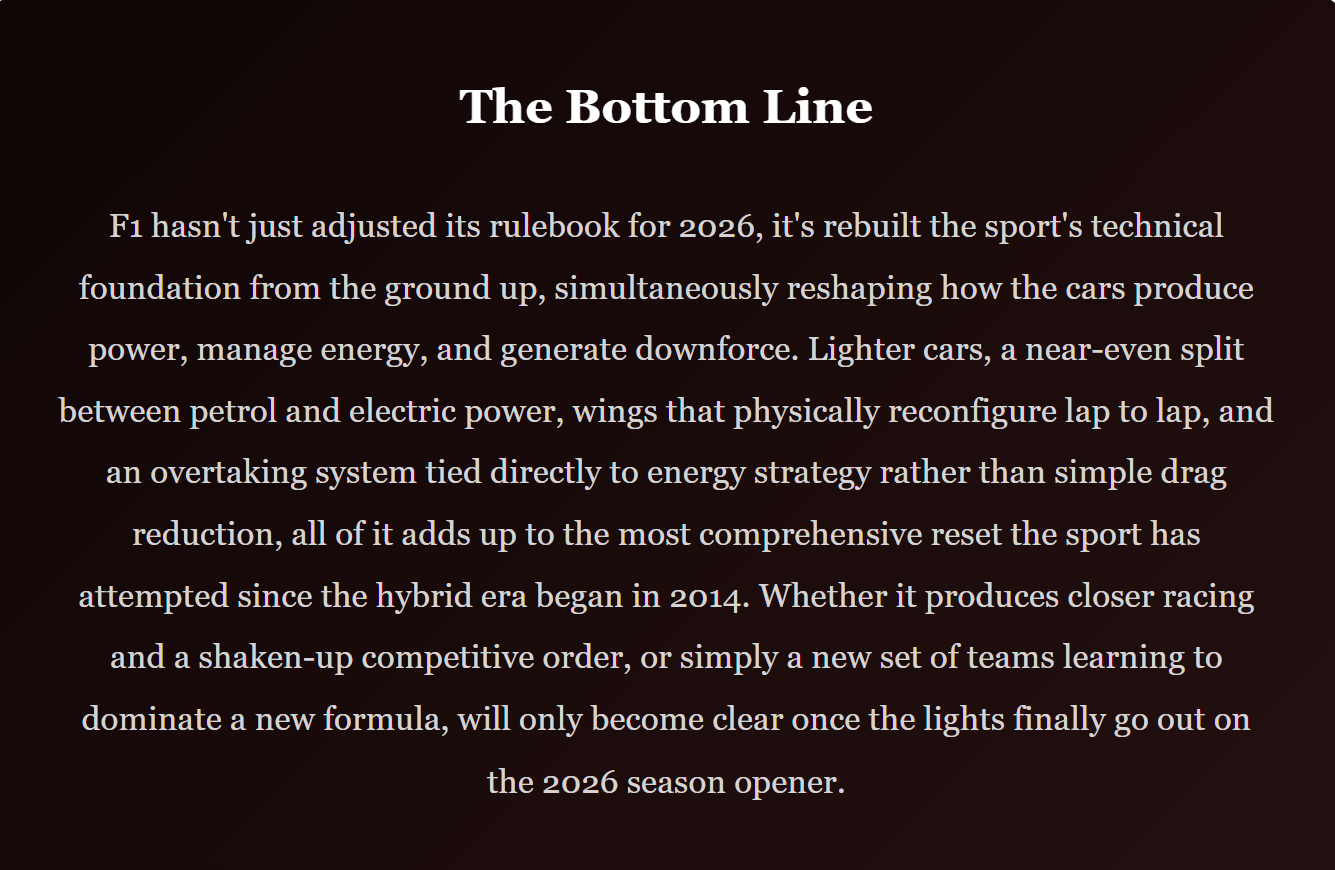
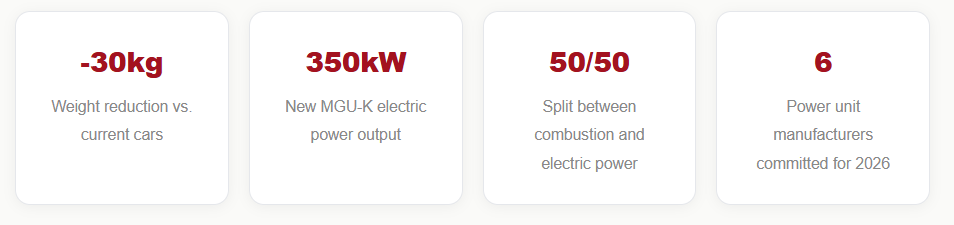
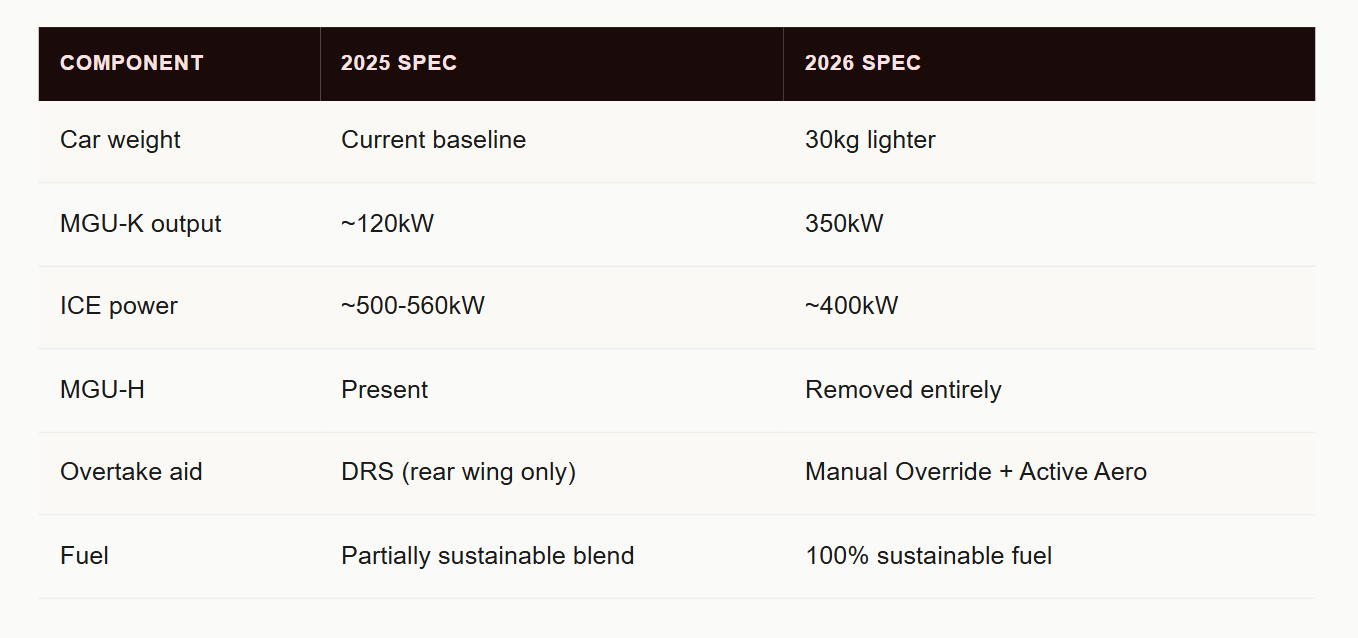
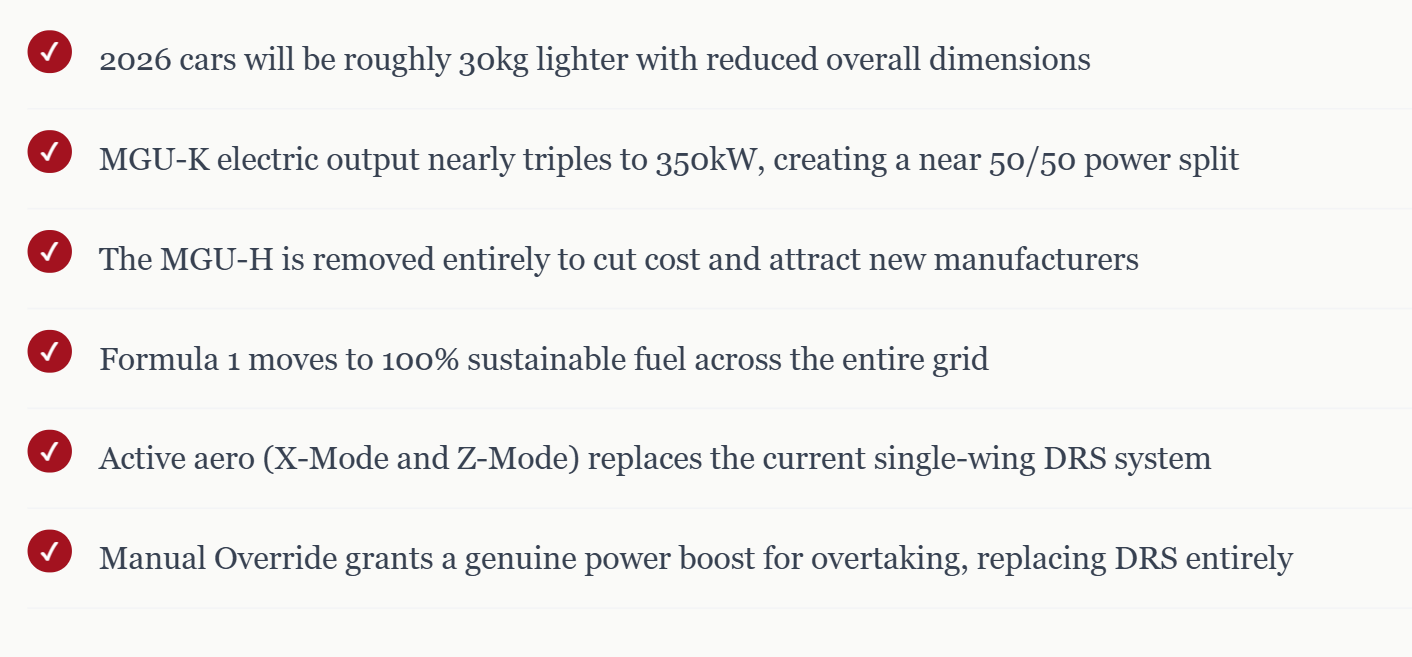
Every so often, Formula 1 doesn't just tweak its rulebook, it tears it up and starts again. That's exactly what's happening for the 2026 season, and the scale of the change is difficult to overstate. This isn't a new front wing shape or a tweaked tyre compound, it's a simultaneous overhaul of the engine, the aerodynamics, the car's dimensions, and even how drivers will need to think about energy management mid-race. The last time the sport reset this many fundamentals at once was 2014, when hybrid power units first arrived. What's coming in 2026 goes even further. For fans trying to make sense of terms like "X-Mode," "Manual Override," and "MGU-K," here's a plain-language breakdown of what's actually changing, why the FIA decided to change it, and what it might mean for who wins races once the new cars finally hit the track. Smaller, Lighter, and Built to Fight Closer The most immediately visible change is physical. The FIA has confirmed the new generation of cars will be roughly 30 kilograms lighter than the current generation, alongside reduced overall dimensions designed to make them more agile and better suited to close, wheel-to-wheel racing. FIA Single Seater Technical Director Nikolas Tombazis has described the goal explicitly: cars that stay true to Formula 1's core identity, light, extremely fast, and genuinely exciting to watch battle on track. That emphasis on agility isn't just about aesthetics. Heavier, wider cars have made overtaking and close racing progressively harder over the past several regulatory eras, as aerodynamic wake from a leading car disrupts the following car's own downforce. Shrinking the cars and rethinking how their aerodynamics behave around other cars is a direct attempt to reverse that trend.
A Power Unit Almost Entirely Rebuilt
Underneath the bodywork sits the most consequential change of all: a fundamentally redesigned hybrid power unit. The V6 turbo 1.6-litre internal combustion engine stays, preserving some continuity with the current era, but nearly everything around it has been reworked. The MGU-K, the motor generator unit responsible for harvesting and deploying electric power under braking and acceleration, will nearly triple its output to 350 kilowatts, up dramatically from current levels.
That boost in electric power fundamentally rebalances how the car actually produces its performance. Where today's power units lean heavily on the combustion engine, with electric power playing a supporting role, the 2026 units are built around close to a 50/50 split between the two, internal combustion engine output drops to roughly 400 kilowatts, while the battery and electric motor system contributes up to 350 kilowatts of its own. It's a genuinely different power unit philosophy, not just a bigger battery bolted onto the existing setup.
Why the MGU-H is finally gone
One of the most technically significant, if less flashy, changes is the complete removal of the MGU-H, the motor generator unit that has been harvesting energy from exhaust heat since the hybrid era began. It's being cut for a combination of practical reasons: it's extremely expensive to develop, offers little relevance to road car technology that manufacturers actually want to transfer to consumer vehicles, and has historically served as a steep technical barrier discouraging new manufacturers from entering the sport.
Why manufacturers actually care about this change
The MGU-H's removal isn't just a cost-cutting measure, it's a deliberate move to make F1 engine technology more transferable to road cars and more accessible to new manufacturers. A record six power unit manufacturers have committed to the 2026 regulations, a signal that simplifying the technology, even while increasing electric output elsewhere, has made the sport more attractive to enter.
Sustainable Fuel Becomes Mandatory
Alongside the electrical overhaul, F1 is shifting entirely to what the sport calls a fully sustainable fuel source, part of its broader push toward net-zero carbon status by 2030. These fuels are designed as "drop-in" replacements, meaning they can technically run in existing combustion engines without modification, though the 2026 power units have been specifically engineered to extract maximum performance from this new fuel chemistry.
Fuel chemistry isn't a neutral variable in a racing engine. It directly affects knock resistance, how quickly combustion occurs, exhaust temperatures, and how aggressively engineers can push the engine's performance mapping under load. Teams are already treating the fuel switch as a genuine performance variable to optimize around, not simply a sustainability checkbox to tick.
Active Aero: Two Wings That Actually Move
Perhaps the most visually dramatic change is the introduction of genuinely active aerodynamics. Rather than the current system where only the rear wing opens for DRS, the 2026 cars feature both front and rear wings that physically move between two distinct configurations. In what's being called X-Mode, the wings flatten out to cut drag on straights, letting the car carry speed more efficiently. In Z-Mode, they reconfigure to generate maximum downforce and grip through corners.
Critically, the FIA has framed this system's primary purpose not as an overtaking gimmick but as an energy management tool. Because the 2026 power units rely so heavily on electric deployment, reducing aerodynamic drag on straights directly reduces how much energy the car needs to maintain speed, freeing up more battery charge for acceleration, defense, and attacking moves elsewhere on the lap. Aerodynamics, drag, and energy management have effectively become a single, interconnected system rather than three separate engineering problems solved in isolation.
"Active aero is primarily designed to conserve energy, since reducing drag on straights is essential for efficient energy use with the 2026 power units." — FIA technical regulations summary.
Manual Override: DRS's Replacement
Replacing the current DRS system entirely is a new mechanism called Manual Override. Rather than simply reducing drag for a trailing car, as DRS does today, this system grants a driver within a set distance of the car ahead a genuine burst of additional electrical power, up to the full 350 kilowatts, at high speed, specifically to aid overtaking. At the same time, the car being chased sees its own energy deployment begin to taper off, narrowing the performance gap at exactly the moment it matters most for a passing attempt.
It's a subtly different philosophy from DRS. Where the old system reduced aerodynamic disadvantage for the chasing car, Manual Override actively hands that car a genuine power advantage drawn directly from the same energy system that governs the rest of the lap, tying overtaking opportunities much more tightly to how well a driver and team have managed their battery deployment throughout the race.
What could feel different for drivers and fans
With turbo response less continuously and directly controlled than in the current generation, drivers may notice different throttle characteristics compared to what they're used to. That doesn't mean turbo lag is making a comeback in the old sense, but it does mean the underlying control problem for engineers has genuinely changed, and adapting driving style to the new power delivery curve will be part of every team's early-season learning process.
Why the FIA Is Betting Big on This Reset
Behind all the individual technical changes sits a broader strategic bet. By simplifying the power unit, removing the MGU-H, and standardizing certain battery hardware across manufacturers, the FIA is explicitly trying to lower the barrier to entry for new engine suppliers while keeping the sport's technology meaningfully connected to real automotive engineering trends. Six manufacturers committing to the new formula, a record number for the sport, suggests that bet is already paying dividends before a single car has turned a competitive lap.
At the same time, tying aerodynamics directly to energy management is meant to reward strategic thinking and driver skill in ways that pure aerodynamic downforce, which had increasingly become the dominant performance differentiator, arguably didn't. The FIA's stated ambition is a sport where race intelligence and energy deployment decisions matter as much as raw engineering horsepower, a shift that could meaningfully reshape which teams and drivers thrive once the new era actually begins.
What teams are doing right now
With the regulations finalized, teams have moved into advanced stages of wind tunnel testing and simulator development, working to translate the new ruleset into competitive car concepts before the cars ever turn a wheel in anger. Because the changes touch power unit architecture, aerodynamics, weight distribution, and energy strategy simultaneously, teams that most successfully integrate all of these shifting variables into a coherent car concept are widely expected to gain a genuine competitive advantage once the season begins, potentially reshuffling the sport's competitive order in the process.