 William BensonVIEW PROFILE →
How Cadillac Finally Broke Into Formula 1, and What Its Debut Season Actually Reveals
It took two rejected applications, a $14 billion power-unit commitment, and a Super Bowl commercial to get an American manufacturer back onto the Formula 1 grid. Six months into the season, Cadillac still hasn't scored a single point. Here's the real story of the sport's newest, and most closely wat
It took two rejected applications, a $14 billion power-unit commitment, and a Super Bowl commercial to get an American manufacturer back onto the Formula 1 grid. Six months into the season, Cadillac still hasn't scored a single point. Here's the real story of the sport's newest, and most closely watched, entry.
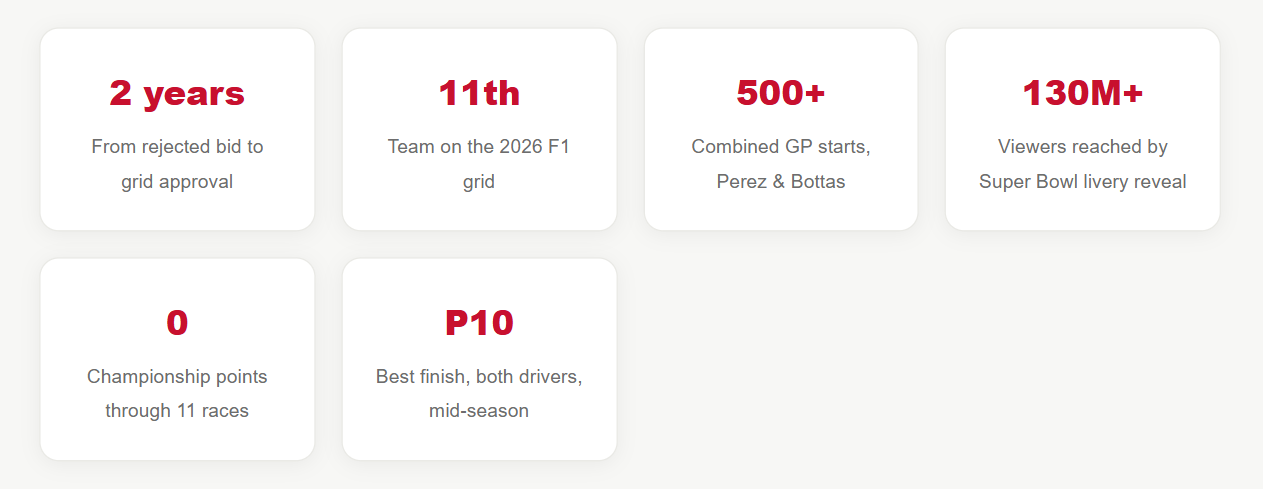
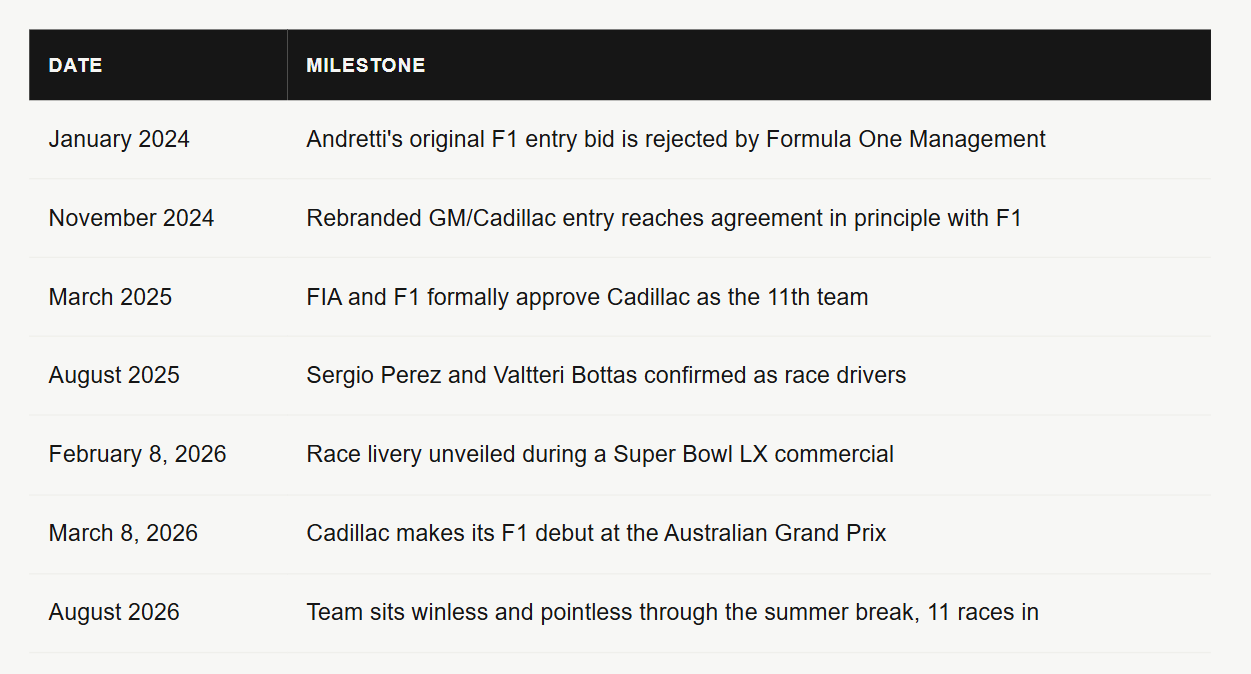
Formula 1 doesn't let new teams in easily. The grid had been frozen at ten entries for a full decade before Cadillac forced the door open in 2026, and the road to get there was littered with rejection, boardroom politics, and a name change that quietly buried one of the most contentious sagas in recent motorsport history. Now that the season is underway, the story has shifted from whether Cadillac would make it onto the grid to what happens once a brand-new team, backed by one of America's biggest car companies, actually has to race against machines that have had a decade or more to mature. The Long, Messy Road to a Grid Slot Cadillac's F1 story didn't start as Cadillac's story at all. It began in 2023 as Andretti Global, when team owner Michael Andretti filed a formal petition with the FIA to enter Formula 1, backed by General Motors as an engine and technical partner. The FIA approved the entry on paper, but Formula One Management, the commercial body that actually controls the championship, rejected it in January 2024, arguing the Andretti name wouldn't add enough value to the series and raising doubts about whether the team could be competitive. What followed was a year of quiet renegotiation rather than a clean second attempt. General Motors, working alongside investment group TWG Motorsports, restructured the proposal entirely, dropping the Andretti name from the entry and committing GM not just as an engine customer but eventually as a full works power-unit manufacturer by the end of the decade. That extra commitment was the piece that had been missing. In November 2024, Formula 1 announced an agreement in principle to bring the rebranded GM and Cadillac entry onto the grid, and by March 2025 the FIA and F1 had granted full, formal approval, confirming Cadillac as the sport's 11th team and its first genuinely new entrant in a decade. The team that eventually made it onto the grid wasn't the same team that first applied. Losing the Andretti name turned out to be the price of admission, and General Motors' willingness to commit to building its own engine, not just buying one, was what finally moved Formula 1 from skepticism to approval. Building a Team From Zero, Fast Once approved, Cadillac had roughly a year to build an entire racing operation from scratch, a timeline that would be tight for an experienced organization and genuinely daunting for a brand-new one. The team, based in Silverstone, England, with plans to eventually shift significant operations to Fishers, Indiana, hired former Marussia sporting director Graeme Lowdon as team principal and Nick Chester as technical chief. For its driver lineup, Cadillac chose experience over potential, signing former Mercedes and Sauber driver Valtteri Bottas and former Red Bull driver Sergio Perez, a pairing with more than 500 combined Grand Prix starts and 16 wins between them, both of whom had been without race seats after the 2025 season. The car itself, designated the MAC-26, runs on Ferrari power units for its first three seasons, since General Motors' own in-house engine program isn't expected to be race-ready until 2029. Colton Herta, the American IndyCar star, was brought on as test driver, with Zhou Guanyu signed as reserve, giving the team a driver roster that blended proven Formula 1 pedigree with an eye toward developing American talent for the future.
A Launch Built for America, Not for the Paddock
Cadillac's approach to introducing itself to the world broke sharply from Formula 1 tradition. Rather than a low-key online reveal or a private team event, the team unveiled its official black-and-white livery during a nationally televised commercial in the middle of Super Bowl LX, reaching an audience that dwarfs anything Formula 1 typically commands in the United States. The advertisement, built around archival audio of John F. Kennedy's 1962 "we choose to go to the Moon" speech, framed Cadillac's F1 entry explicitly as an extension of American ambition rather than simply another racing sponsorship.
It was, by any measure, an unusually bold marketing swing for a team that hadn't yet turned a wheel in anger. Team principal Graeme Lowdon later described the approach as tapping into one of the most culturally significant sporting events on Earth in a way no Formula 1 team had attempted before, and the strategy generated exactly the kind of mainstream American attention Cadillac and General Motors were clearly chasing, even if it meant the team's on-track performance would now be judged against genuinely outsized expectations.
A detail that captures the ambition, and the risk
Cadillac's asymmetrical livery design, split almost evenly between stark black and white, was described by the team as a deliberate symbol of the tension between grit and aspiration. It's a fitting metaphor for the season that followed: a team built with real ambition and serious backing, running headlong into the far grittier reality of competing against organizations with years of aerodynamic and operational head start.
The Reality of Racing at the Back of a New Regulation Era
Cadillac's timing carried both an opportunity and a serious complication. The 2026 season introduced Formula 1's biggest regulatory overhaul in years, covering both chassis rules and an entirely new power-unit formula, which theoretically gave every team, new or established, a fresh starting point. In practice, established teams still carried enormous advantages in simulation tools, aerodynamic know-how, and operational experience that a brand-new organization simply couldn't replicate in a single off-season, no matter how experienced its drivers were.
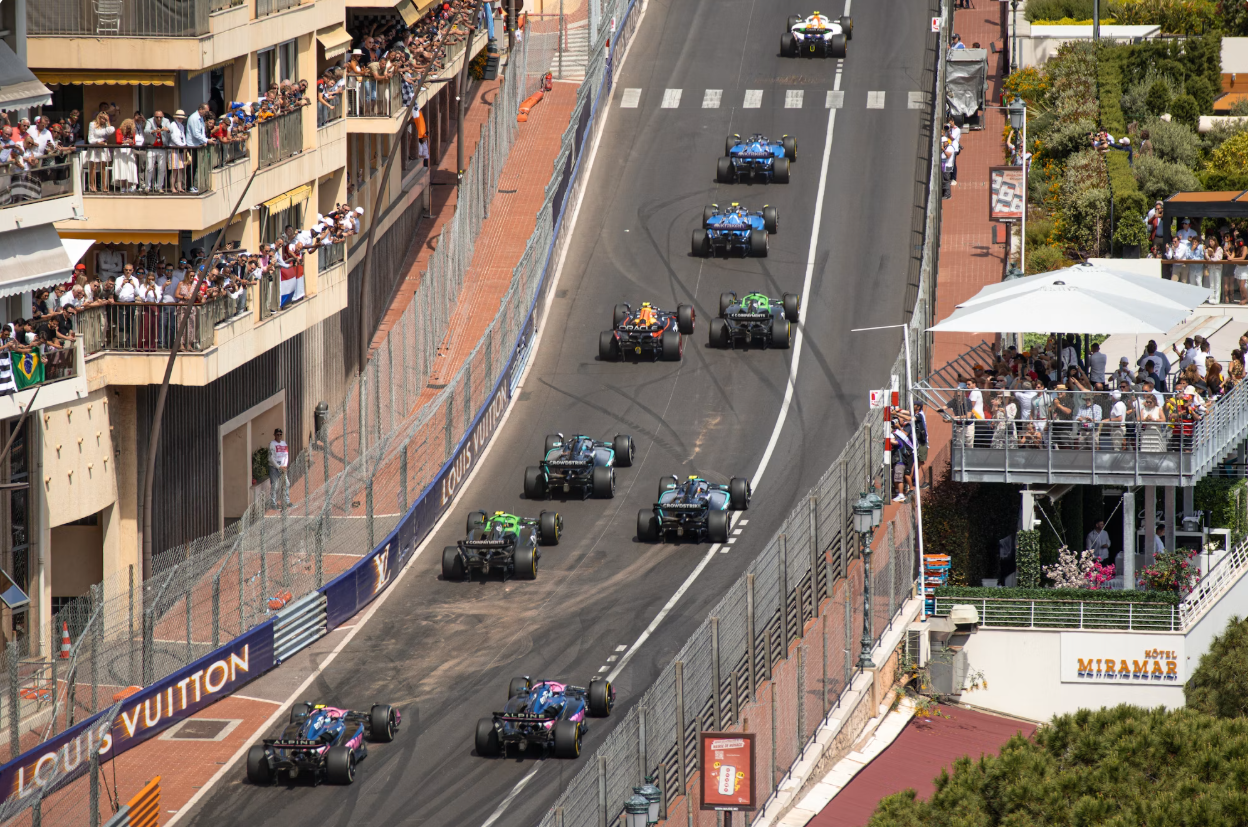
The results have reflected exactly that gap. Through the first eleven races of the season, Cadillac sat last in the constructors' championship with zero points, the only team on the grid yet to score. The closest brush with a point came at the Monaco Grand Prix, where Perez crossed the line tenth before losing the position to a post-race penalty that instead handed the point to Aston Martin. Bottas's best finish through the summer break was 13th in China, while Perez posted a pair of 14th-place results in Barcelona and Silverstone. The team has also suffered nine retirements across the first eleven races, including a recurring brake-overheating problem that struck both cars in Austria and resurfaced again in Hungary.
Growing pains the team saw coming
None of this appears to have caught Cadillac's own leadership off guard. Board member Mario Andretti, who remains involved as a director despite his name no longer being attached to the entry, said back in March that he expected the team to be competing for top-ten finishes by the end of its debut season, a target that still looks reachable if incremental progress continues. Perez himself struck a similarly measured tone heading into the Hungarian Grand Prix, suggesting the team was close to finding the half-second to eight-tenths of lap time needed to break into the points, while Bottas has been candid that scoring at this stage would likely require either a genuine performance step or a fortunate result rather than raw pace alone.
There have been bright spots buried inside the disappointing points total. Perez holds a narrow qualifying edge over his more experienced teammate and a clear lead in sprint session results, while Bottas, despite a year away from full-time racing, has largely matched him on single-lap pace, suggesting the driver pairing itself isn't the limiting factor. Independent mid-season assessments from motorsport analysts have generally been sympathetic to the team's position, awarding Cadillac a solidly respectable grade for a first-year operation given the scale of what it was attempting: designing a car, building a factory culture, and meeting every single operational deadline from a cold, rainy filming day in Silverstone through preseason testing in Bahrain, all inside about a year.
What the rest of the season, and beyond, actually depends on
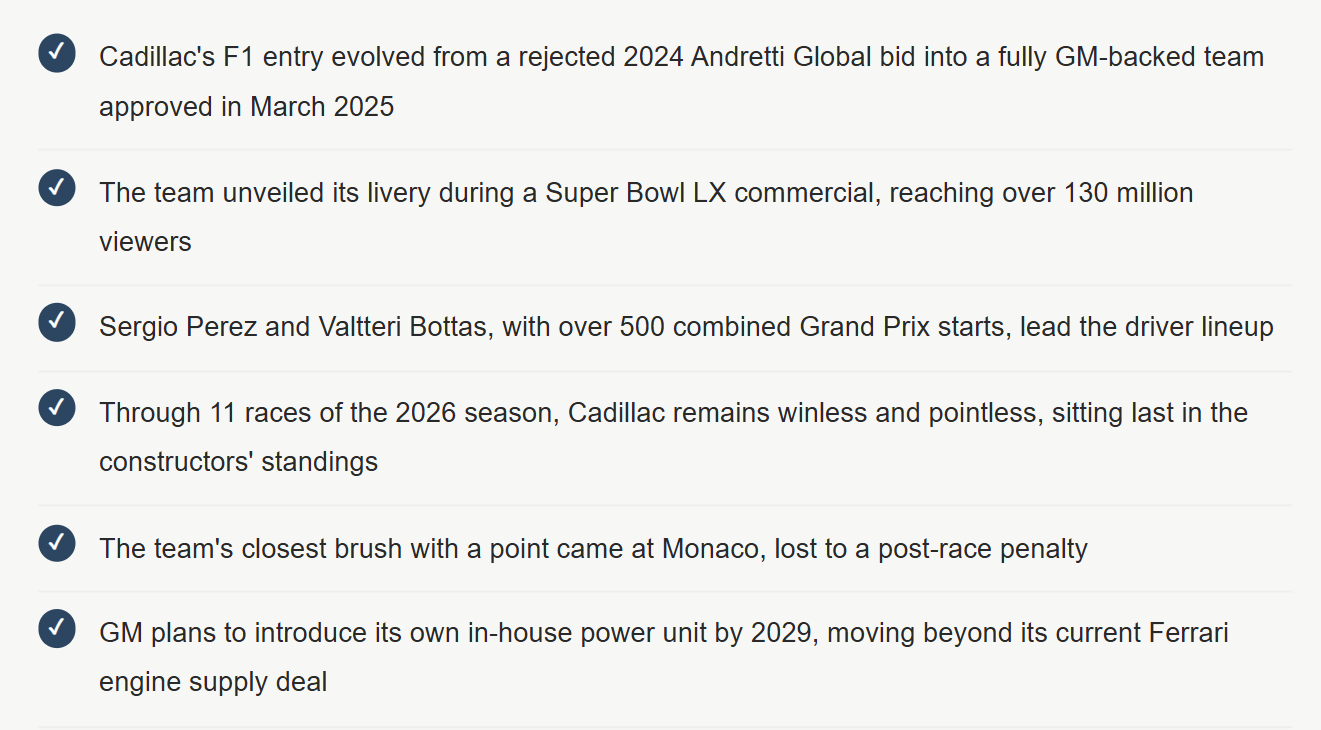
Formula 1 has a long history of punishing new entrants in their first year and rewarding patience in the years that follow, and Cadillac's leadership appears to be planning on exactly that trajectory rather than expecting overnight results. The bigger long-term storylines, GM's transition to a full works power unit by 2029, the team's eventual expansion into its Indiana facility, and whether American drivers like Colton Herta or junior prospects can eventually earn a race seat, will matter far more to Cadillac's future than any single result from its debut campaign. For now, the story of Cadillac's first season is less about the scoreboard and more about proof of concept: an American manufacturer forced its way back onto the world's most competitive racing grid after a decade of a closed door, and is now doing the unglamorous, expensive work of learning how to actually compete on it.