 William BensonVIEW PROFILE →
Inside Jalapeno: The Chip OpenAI Built to Stop Depending on Nvidia
After a decade of renting every ounce of its computing power, ChatGPT's creator designed a working AI chip in nine months, with help from its own AI. Meet Jalapeno, and the quiet end of Nvidia's near-total grip on the industry it built.
After a decade of renting every ounce of its computing power, ChatGPT's creator designed a working AI chip in nine months, with help from its own AI. Meet Jalapeno, and the quiet end of Nvidia's near-total grip on the industry it built.
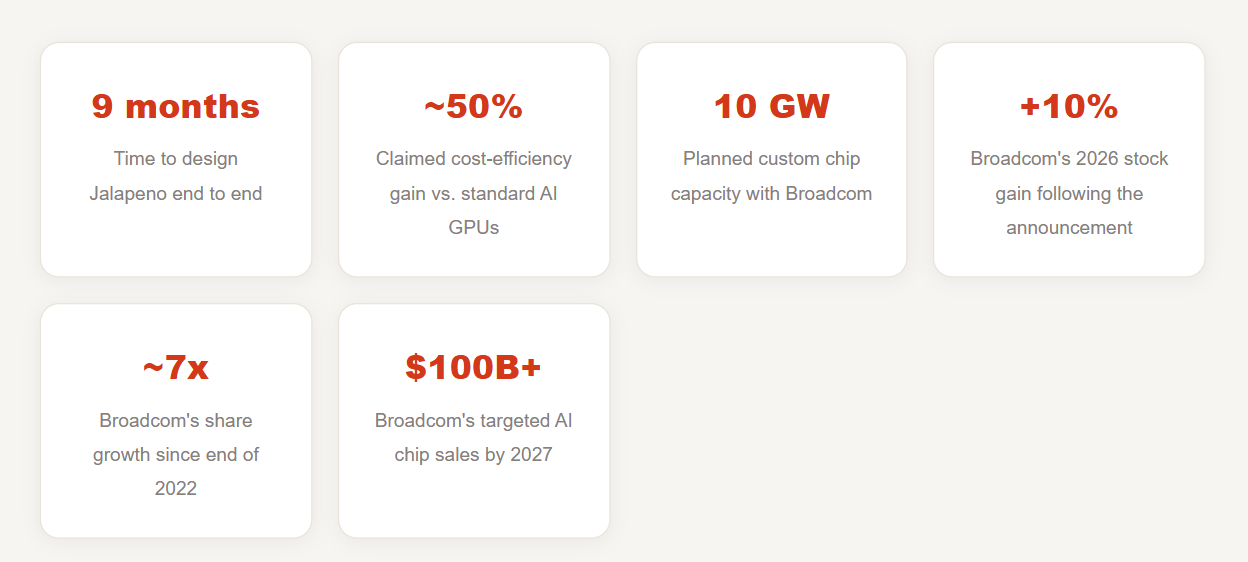
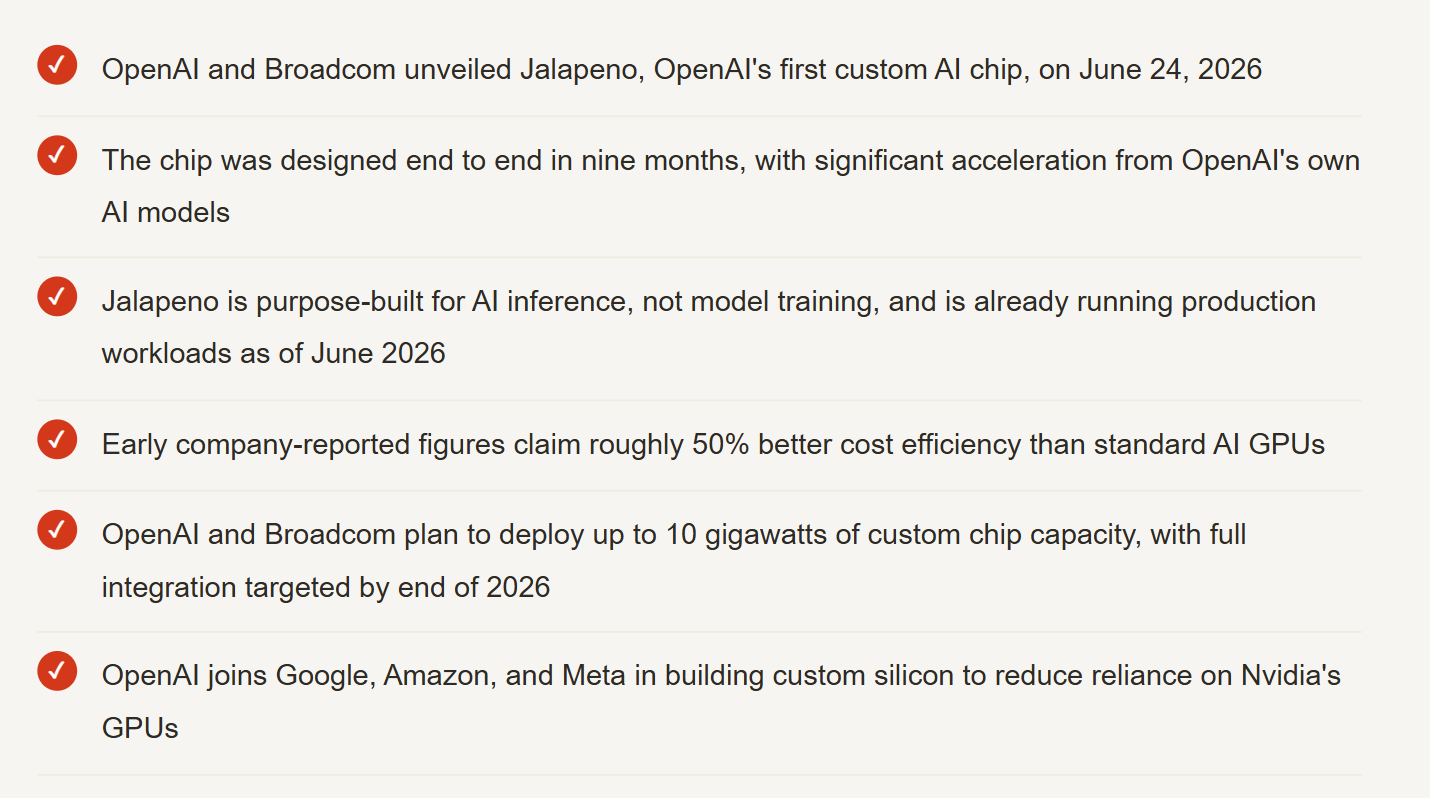
For most of its existence, OpenAI has been, in the most literal sense, a tenant. It rented the computing power behind every version of ChatGPT from Nvidia's chips and Microsoft's data centers, a dependency so total that the company's ability to train its next model has effectively been gated by how many GPUs it could get its hands on. That changed on June 24, 2026, when OpenAI and Broadcom unveiled Jalapeno, OpenAI's first custom-designed processor, and the clearest signal yet that the company building some of the world's most-used AI products no longer wants to be renting the ground it stands on. Nine Months, One Chip, and an AI That Helped Design Itself What makes Jalapeno's origin story genuinely unusual isn't just that OpenAI built it, it's how fast the company managed to do it. OpenAI President Greg Brockman told CNBC the chip was designed end to end in just nine months, with substantial help from OpenAI's own AI models accelerating the engineering process. "The degree to which our models have been able to accelerate it was very surprising to us," Brockman said, a detail that reads almost recursively: an AI company used its own AI to help design the hardware its future AI models will run on. The partnership itself had been public since October 2025, when OpenAI and Broadcom first announced plans to jointly develop custom AI processors, with Broadcom handling the physical chip implementation, networking, and connectivity, while OpenAI's in-house hardware team, led by Richard Ho, designed the underlying architecture. Reuters reported the two companies planned to deploy up to 10 gigawatts of custom AI chip capacity, with rollout beginning in the second half of 2026, an enormous figure that puts the scale of OpenAI's hardware ambitions in perspective. By designing more of the stack ourselves, we can serve more intelligence with greater efficiency and keep pushing advanced AI toward broader access. What Jalapeno Is Actually Built to Do Jalapeno isn't designed to replace Nvidia's GPUs across every AI workload, it's purpose-built specifically for inference, the computationally intensive process of actually running a trained AI model to generate responses for millions of ChatGPT users in real time, as opposed to training, the separate and equally demanding process of building a model from scratch. Richard Ho, who leads OpenAI's hardware program, explained that the chip's architecture was optimized specifically around the memory movement, networking patterns, and serving demands that matter most for large language models in production, rather than being a general-purpose accelerator trying to do everything reasonably well. That specialization is precisely the strategy behind the custom ASIC, or application-specific integrated circuit, approach that Google pioneered years earlier with its Tensor Processing Units, and that Amazon has pursued with its Trainium and Inferentia chips. Rather than paying a premium for a flexible, general-purpose Nvidia GPU capable of handling any AI workload thrown at it, companies with enough scale and technical capability can design silicon narrowly tailored to their own specific, high-volume use case, often at a meaningfully lower cost per unit of useful compute.
The Numbers Behind the "Nvidia Killer" Headlines
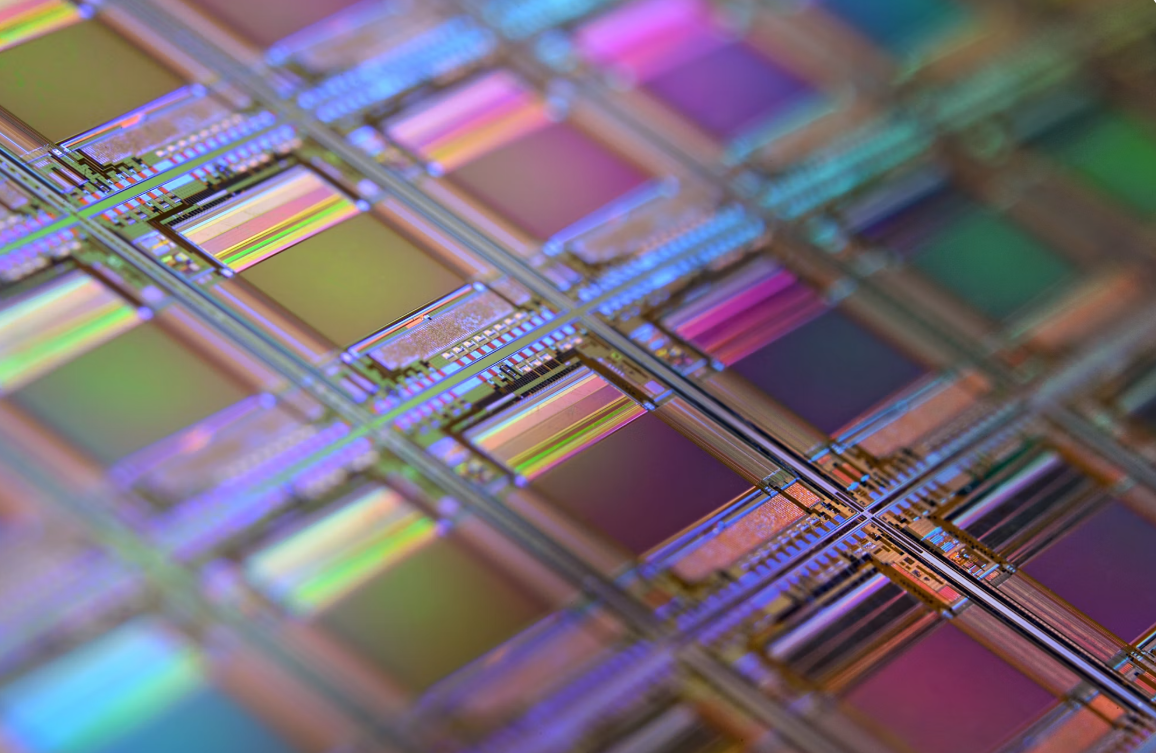
Early performance claims, all currently sourced from OpenAI and Broadcom themselves rather than independent third-party verification, have been eye-catching. Broadcom CEO Hock Tan described initial testing results as showing performance roughly on par with Nvidia's Blackwell chips and Google's Tensor Processing Units, alongside a cost-efficiency improvement of approximately 50% compared to standard AI GPUs. Separately, OpenAI reported that Jalapeno outperformed Nvidia's Blackwell systems on performance per watt in nearly all tested scenarios, though industry analysts have cautioned that Nvidia's newer platforms represent a more directly comparable benchmark than the specific systems used in OpenAI's tests.
Critically, this is no longer purely theoretical. As of June 2026, Jalapeno was already running production-level workloads for GPT-5.3-Codex-Spark, according to Yahoo Finance, giving OpenAI its first genuine real-world signal on whether the chip's promised economics hold up outside a controlled lab environment. Broadcom shipped the first Jalapeno samples to OpenAI the same day the partnership went fully public, and OpenAI has confirmed it's already developing second- and third-generation versions of the chip, with full deployment inside its own infrastructure targeted for the end of 2026.
What hasn't been independently verified yet
It's worth being precise about what's actually confirmed here versus what remains a company claim. As of the most recent reporting, OpenAI and Broadcom have not disclosed Jalapeno's memory configuration or confirmed manufacturing process node, and no neutral third party has published an independently verified benchmark sheet. Every specific performance and cost figure currently in circulation originates from the two companies building the chip, not from outside labs or analysts running their own tests. That doesn't make the claims false, but it does mean the full picture of how Jalapeno actually stacks up remains incomplete until independent verification catches up with the announcement.
Why This Genuinely Threatens Nvidia's Business Model
Nvidia's dominance in AI computing has never rested purely on having the fastest chips, it's rested on controlling both the hardware and CUDA, the software layer developers have built their entire AI infrastructure around for over a decade. Custom ASICs like Jalapeno chip away at that moat from a different angle entirely: instead of competing with Nvidia on general-purpose GPU performance, they remove specific, extremely high-volume workloads, in this case, OpenAI's own inference traffic, from Nvidia's addressable market altogether.
Alexander Harrowell, senior principal analyst at Omdia, told CNBC that Jalapeno represents an impressive achievement, particularly in terms of efficiency, while projecting that custom ASIC chips like it are expected to exceed GPUs in raw volume by 2028, though he noted that revenue parity will take considerably longer, since Nvidia's GPUs remain substantially more expensive per unit. That distinction matters: Nvidia isn't at risk of losing the AI chip market overnight, but it is increasingly at risk of losing its largest, highest-margin customers' inference workloads specifically, the exact segment analysts describe as facing the most direct "threat" from custom silicon.
OpenAI Isn't Alone, and That's the Bigger Story
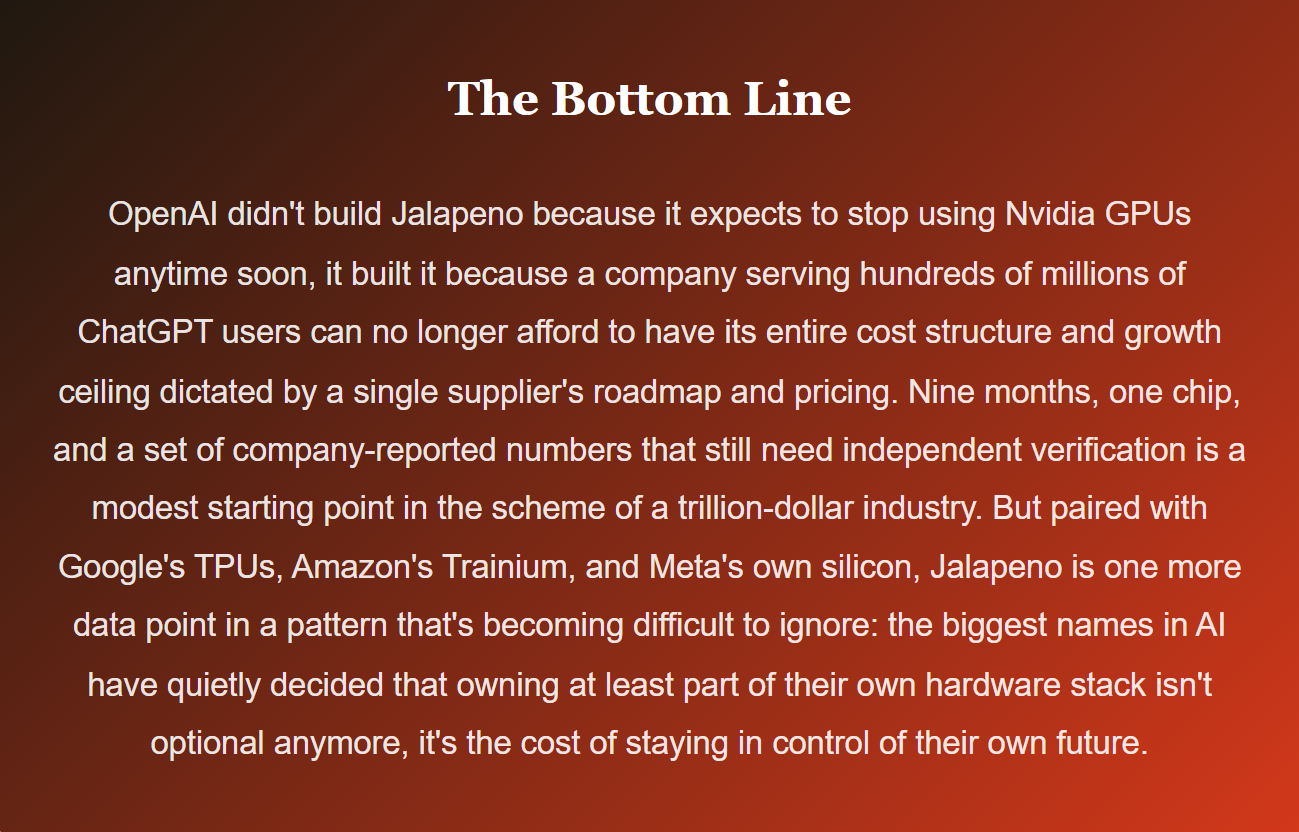
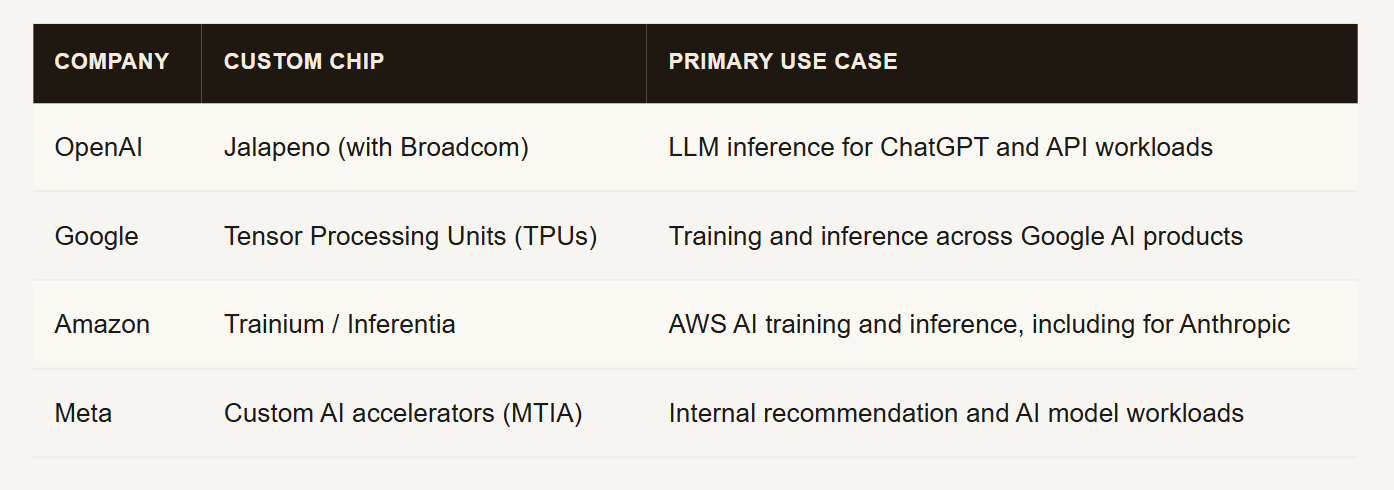
Jalapeno places OpenAI alongside a growing list of AI companies that have concluded owning at least part of their chip supply chain is now a strategic necessity rather than a luxury. Google has used its own Tensor Processing Units for years. Amazon has built Trainium and Inferentia specifically to reduce its reliance on Nvidia within AWS. Meta has developed its own custom AI accelerators internally. Even Anthropic, a direct OpenAI competitor, recently committed to spending more than $100 billion on AWS infrastructure over the next decade, explicitly including current and future generations of Amazon's Trainium chips, according to reporting on the deal.
With hyperscalers collectively planning to spend more than $700 billion on AI infrastructure in 2026 alone, the pattern emerging across the industry looks less like a single company trying to dethrone Nvidia and more like a broad, structural shift: the biggest AI labs no longer view chip supply as something to simply purchase at whatever price and availability Nvidia sets, but as critical infrastructure worth designing themselves once they reach sufficient scale to justify the enormous upfront engineering investment.
What this means for the rest of 2026 and beyond
Nvidia isn't standing still while this unfolds, and coexistence rather than outright displacement remains the most likely near-term outcome. The company's own newer chip platforms, including Blackwell and its successors, continue to set the performance benchmark that custom ASICs like Jalapeno are explicitly measured against, and Nvidia's CUDA software ecosystem remains deeply embedded across the broader AI industry in ways that a narrow, inference-specific chip doesn't directly threaten. What Jalapeno really signals is the end of an era in which OpenAI, and by extension much of the frontier AI industry, treated Nvidia's hardware roadmap as an unavoidable bottleneck rather than one input among several increasingly viable options.