 William BensonVIEW PROFILE →
How Hundreds of Ordinary Companies Quietly Turned Themselves Into Bitcoin Funds, and Why the Model Is Now Cracking
More than 200 public companies turned themselves into de facto Bitcoin funds since 2020, borrowing and issuing stock to stockpile coins instead of running their original businesses. In the past 13 months, roughly $80 billion of that experiment has quietly evaporated.
More than 200 public companies turned themselves into de facto Bitcoin funds since 2020, borrowing and issuing stock to stockpile coins instead of running their original businesses. In the past 13 months, roughly $80 billion of that experiment has quietly evaporated.
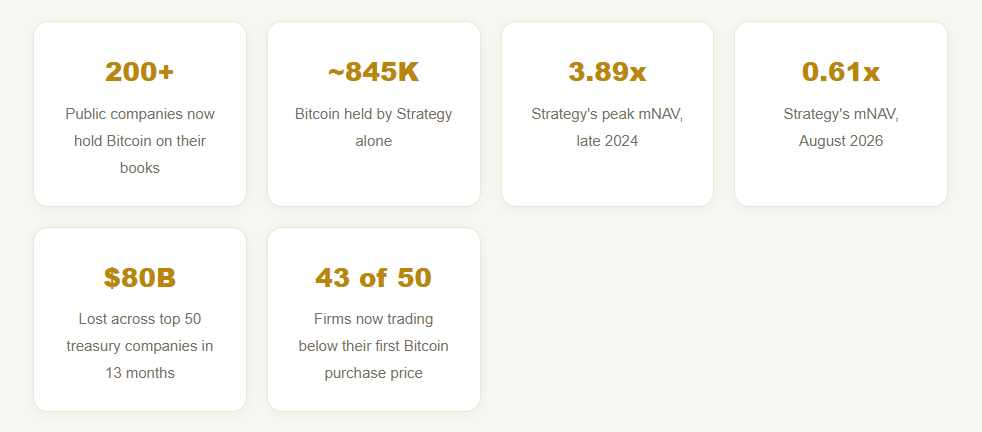
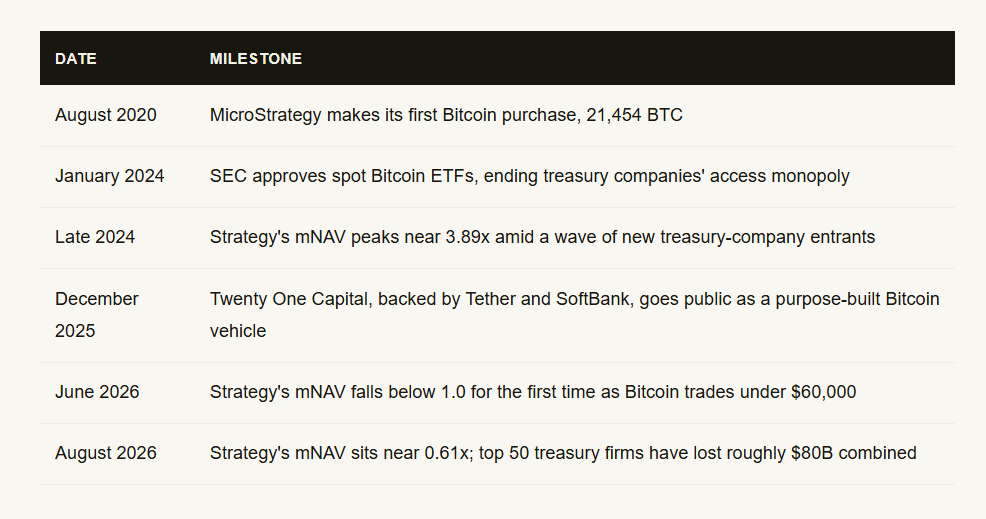
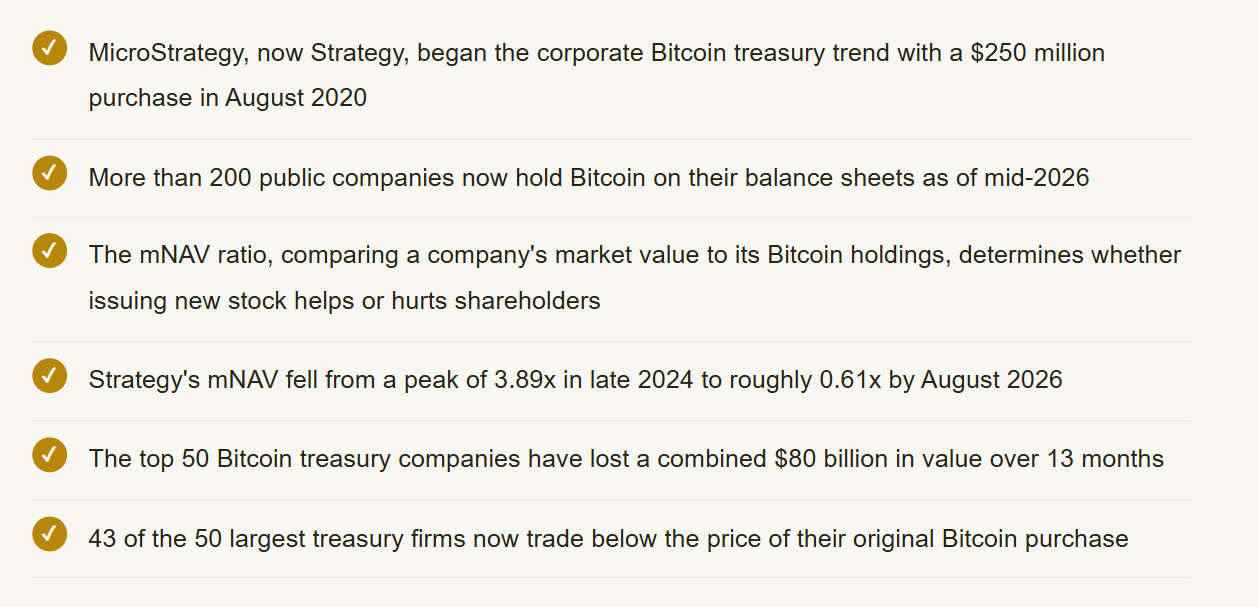
Somewhere in the last five years, the job description of a corporate treasurer changed for a small but growing group of public companies. Instead of parking spare cash in government bonds and calling it a day, treasury teams at firms with no obvious connection to cryptocurrency started borrowing money, selling stock, and using the proceeds to buy Bitcoin, sometimes in amounts large enough to dwarf the company's actual operating business. It worked spectacularly well for years. In 2026, the math behind it is starting to fail, and the fallout is turning into one of the more instructive corporate finance stories of the decade. The One Company That Started All of This The entire trend traces back to a single decision made in August 2020, when a business intelligence software company called MicroStrategy bought 21,454 Bitcoin for roughly $250 million, at an average price of about $11,650 per coin. Founder and then-CEO Michael Saylor framed the move as a defensive response to currency debasement, arguing that holding cash on a balance sheet during a period of aggressive monetary expansion was a slow, guaranteed way to lose value in real terms. Buying Bitcoin instead, he argued, was simply protecting shareholders from an inflation problem the company couldn't otherwise avoid. What made MicroStrategy different from a company that simply buys some Bitcoin and moves on is that it never stopped. The company, which rebranded simply as Strategy in early 2025, kept issuing new shares and convertible debt specifically to buy more coins, turning an initial defensive hedge into the company's actual core identity. As of mid-2026, Strategy holds close to 845,000 to 847,000 Bitcoin, purchased for a combined total of roughly $64 billion, at an average cost basis near $75,700 per coin, by far the largest corporate Bitcoin position on Earth. Over the following five years, the stock's total return outpaced both the S&P 500 and Bitcoin itself, at one point climbing more than 3,300%, a run spectacular enough that it inspired an entirely new corporate category. Strategy didn't just buy Bitcoin. It built a machine for buying Bitcoin, one that funded itself by convincing investors to pay more for the company's stock than the coins underneath it were actually worth. For years, that machine worked exactly as designed. How the Machine Actually Worked The mechanism at the heart of every Bitcoin treasury company has a name: mNAV, short for market-value-to-net-asset-value. It's a simple ratio comparing what the stock market values a company at against the dollar value of the Bitcoin sitting on its balance sheet. When mNAV sits comfortably above 1.0, a company can issue new shares at a premium, use the cash to buy more Bitcoin, and end up with more Bitcoin per existing share than before, an accretive loop that rewards shareholders as long as investor enthusiasm holds. Strategy's mNAV reached as high as 3.89 at its late-2024 peak, meaning investors were willing to pay nearly four dollars for every dollar of Bitcoin the company actually held, essentially betting on Saylor's ability to keep expanding the pile. That premium wasn't irrational on its own terms. For years, buying MSTR stock was one of the only ways an ordinary brokerage account could get leveraged exposure to Bitcoin without navigating a crypto exchange directly, and scarcity of access commanded a real price. The approval of spot Bitcoin ETFs by the U.S. Securities and Exchange Commission in January 2024 changed that math permanently, giving investors a simpler, cheaper, unleveraged way to hold Bitcoin exposure through funds like BlackRock's iShares Bitcoin Trust, which became the fastest ETF in history to reach $10 billion in assets, hitting that mark in just seven weeks.
From One Believer to an Entire Corporate Category
What began as one unusual company's experiment turned, by 2024 and 2025, into a genuine trend spanning industries that had nothing to do with software or finance. Tesla entered early with a $1.5 billion purchase in 2021, though it treats its roughly 11,509 Bitcoin as a modest strategic reserve rather than a core identity, a position worth a small fraction of its overall market value. Block, the payments company formerly known as Square, began accumulating Bitcoin in late 2020 as a natural extension of its existing crypto and payments business. Metaplanet, listed in Tokyo, grew its holdings from under 100 Bitcoin to more than 40,000 in roughly eighteen months, effectively importing Strategy's playbook into the Japanese market. Twenty One Capital, backed by Tether and SoftBank, went public in December 2025 as a purpose-built Bitcoin accumulation vehicle from day one, with no pretense of an unrelated underlying business at all.
By the middle of 2026, more than 200 publicly traded companies held Bitcoin on their balance sheets in some form, alongside a growing number of private firms and even a handful of pension funds. Third-party trackers like BitcoinTreasuries.net now exist purely to monitor this population, a sign of how quickly a single company's defensive hedge turned into an entire recognized asset class with its own vocabulary, its own risk disclosures in mutual fund filings, and its own dedicated analyst coverage.
Why this isn't the same as just owning Bitcoin
Buying shares in a Bitcoin treasury company is not the same trade as buying Bitcoin directly, even though the two are closely correlated. Because these stocks carry an added premium or discount layered on top of the coin price itself, they tend to rise faster than Bitcoin in rallies and fall harder than Bitcoin in selloffs, a dynamic that caught many newer retail investors off guard once the premium started working in reverse during 2026.
The Reckoning: When the Flywheel Runs Backward
The mechanism that made these companies attractive for years only functions in one direction. Above an mNAV of roughly 1.0, issuing new stock to buy more Bitcoin adds value for existing shareholders. Below that line, the same maneuver does the opposite, diluting shareholders by selling stock for less than the Bitcoin it's meant to fund is actually worth. NYDIG, a Bitcoin-focused financial services firm, estimated in a May 2026 report that Strategy specifically needs its mNAV above roughly 1.22 before new equity issuance becomes genuinely additive for common shareholders, a bar the stock has failed to clear for most of the year.
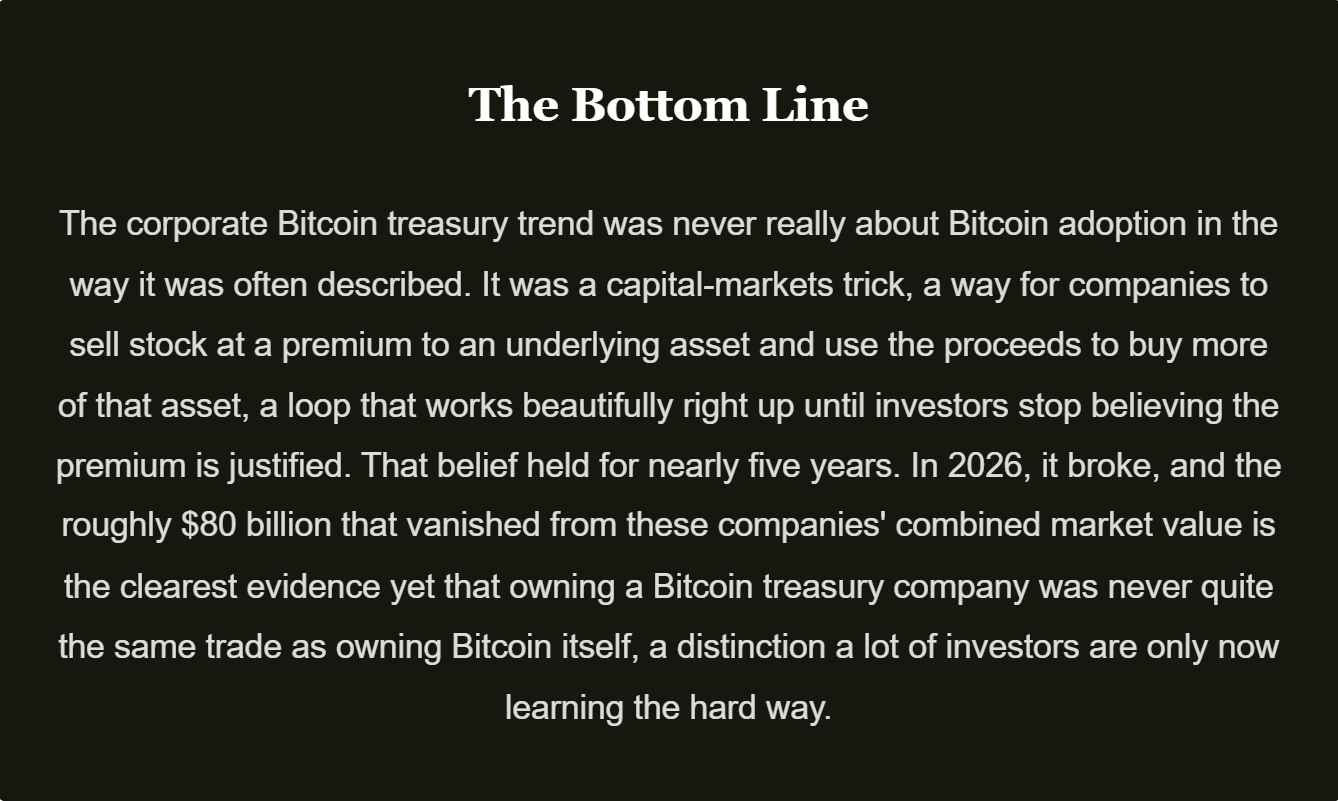
The numbers by late August 2026 tell the story plainly. Strategy's mNAV had fallen to roughly 0.61, down from that 3.89 peak less than two years earlier. Bitcoin itself, after touching an all-time high above $126,000 in October 2025, spent much of 2026 trading in a rough $60,000-to-$80,000 range, a sharp decline that compounded the pressure on every treasury company's balance sheet simultaneously. According to Financial Times analysis, the aggregate market value of the fifty largest Bitcoin treasury companies fell from roughly $124 billion a year earlier to close to $67 billion, a combined loss near $80 billion over thirteen months, with Strategy alone accounting for roughly $79 billion of that decline from its own peak. Perhaps the starkest single data point: 43 of the 50 largest treasury firms now trade below the price of their very first Bitcoin purchase, a benchmark that, until recently, would have seemed almost impossible to fall under given how much Bitcoin itself had appreciated since most of these companies started buying.

Saylor's own response to the pressure
Michael Saylor, now Strategy's executive chairman, has spent recent weeks drawing a clear line between his personal Bitcoin holdings and the company's balance sheet, publicly stating on social media that he has never sold even a single satoshi of his own coins, even as institutional-level selling pressure built around treasury stocks more broadly. The company also doubled its long-term bond buyback activity in August 2026, a move that briefly pushed MSTR shares up around 12% in a single session, though analysts were quick to note the underlying flywheel problem, an mNAV still sitting well below the 1.22 threshold NYDIG identified as the real breakeven point, remained fundamentally unresolved by that rally alone.
What This Means Beyond Strategy Itself
The broader implication reaches well past any single company's stock price. Analysts increasingly describe the Bitcoin treasury model as reaching a point of structural rationalization rather than simple bad luck: falling premiums have already forced many firms from being net Bitcoin buyers into reluctant net sellers, and the pace of new companies entering the space has slowed considerably compared to the rush seen in 2024 and 2025. Some treasury companies with smaller Bitcoin positions relative to their overall balance sheets, like Tesla and Block, are largely insulated from an existential threat, since Bitcoin represents a modest slice of a much larger, independently profitable business. The purpose-built treasury vehicles, the companies whose entire stock story is the Bitcoin pile itself, face a much harder question: what happens to a company's valuation once the premium that justified its existence disappears, and all that's left is the Bitcoin, valued at par, with none of the leverage story that made owning the stock more attractive than owning the coin.
Where the story goes from here
None of this necessarily means the corporate Bitcoin treasury concept disappears entirely. Companies with genuinely diversified businesses, sensible position sizing relative to their overall balance sheet, and management teams willing to actually stop issuing dilutive stock during a downturn are likely to weather this period without lasting damage. What does appear to be ending is the specific version of the trade that made headlines for the last two years: publicly traded companies with no meaningful operating business beyond stockpiling a volatile asset, funded by a capital-markets premium that depended entirely on investor optimism never wavering. That version of the gold rush found its limit in 2026, and the companies still standing at the other side of it will likely look very different from the ones that rushed in at the top.