William BensonVIEW PROFILE →
How Jensen Huang Turned a Gaming Graphics Startup Into the Company the Entire AI Industry Runs On
In 1993, three engineers sketched an idea on a napkin over cheap coffee, with what their own founder later admitted was close to a zero percent chance of success. Today, that company is the most valuable in human history.
In 1993, three engineers sketched an idea on a napkin over cheap coffee, with what their own founder later admitted was close to a zero percent chance of success. Today, that company is the most valuable in human history.
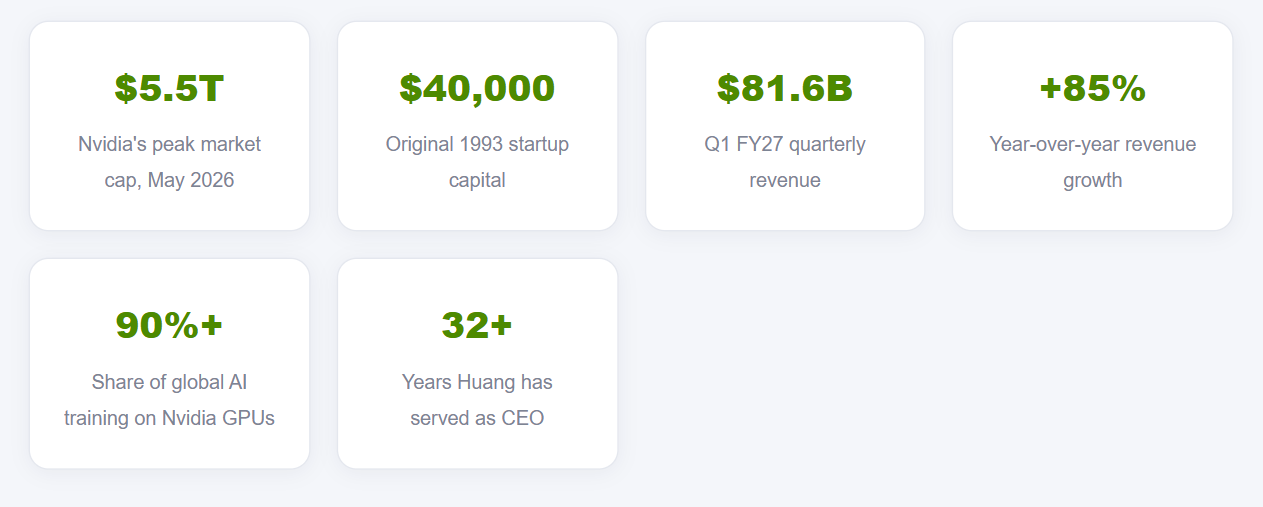
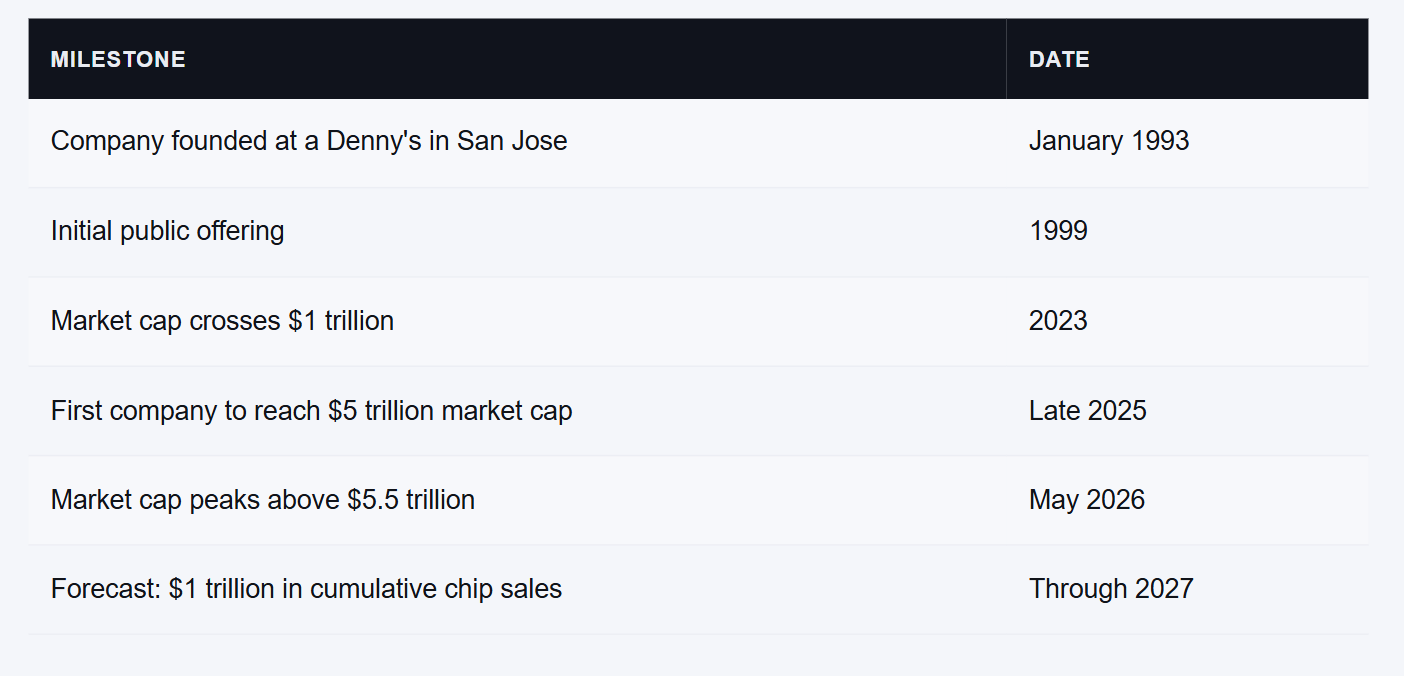
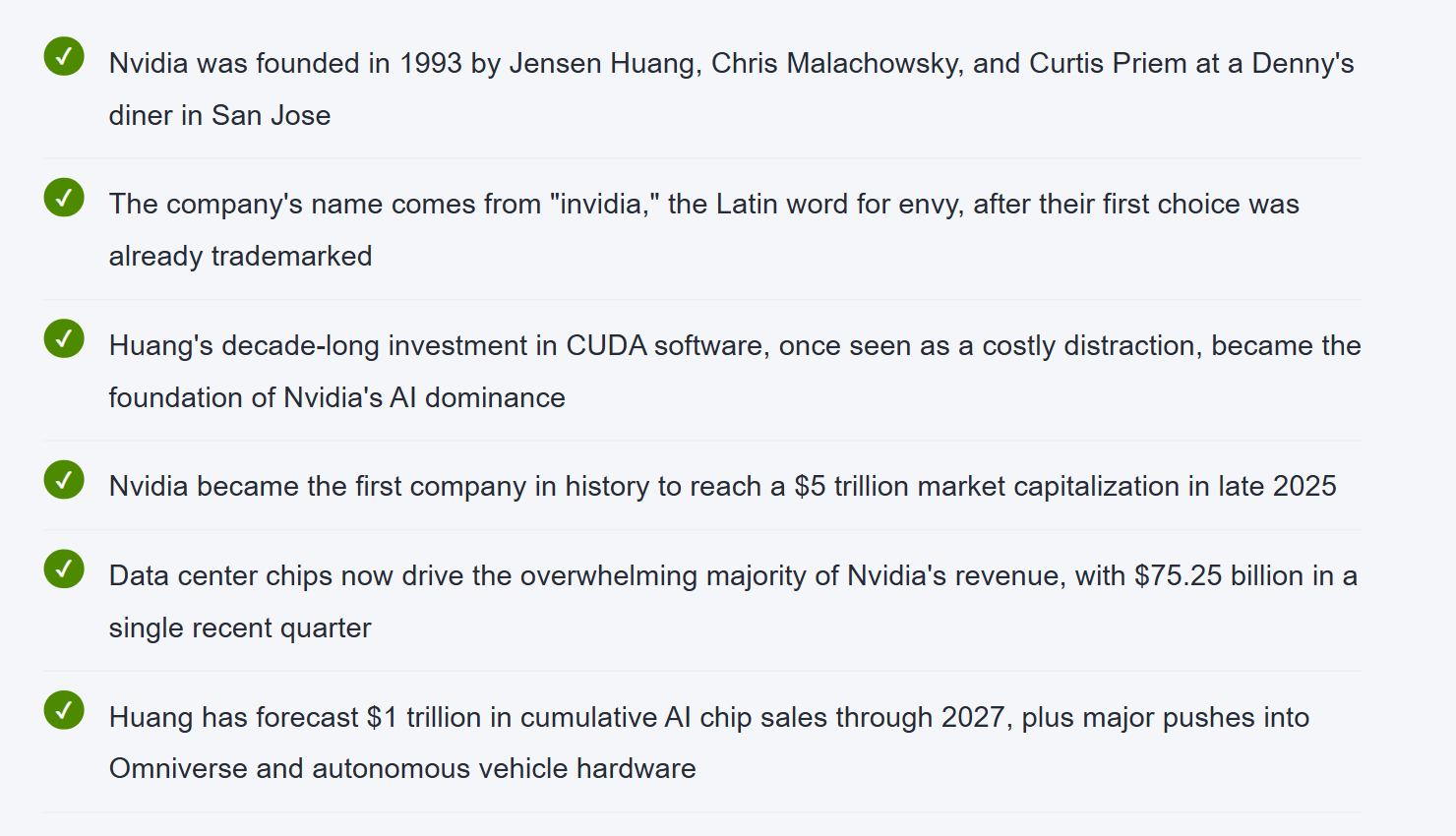
Every time a chatbot answers a question, a self-driving car reads the road ahead of it, or a research lab trains a new model that makes headlines, there's a very good chance the actual computation happened on hardware built by a company that started as three engineers arguing over graphics chips in a Denny's booth. Nvidia is now worth more than any publicly traded company in history, at times touching $5.5 trillion in market value, more than the entire GDP of Germany. The story of how it got there is stranger, riskier, and more improbable than most people realize. Three Engineers, One Booth, and a Company Named After Envy On January 25, 1993, Jensen Huang, then a 30-year-old engineer, met his friends Chris Malachowsky and Curtis Priem at a Denny's diner just outside San Jose, California. Huang had a personal history with the restaurant chain that made the setting almost poetic: as a teenager, he had worked there as a dishwasher, busboy, and waiter after his family emigrated from Taiwan, and he still returns to visit the same booth on occasion decades later. Over diner coffee and $40,000 in starting capital, the trio decided to build a chip that could render fast, realistic 3D graphics for personal computers, a market that, at the time, barely existed. Most gaming still happened on consoles, and the idea of a dedicated graphics processor for PCs was closer to speculation than product roadmap. They initially planned to call the company NVision, until a trademark search revealed a toilet paper manufacturer already owned the name. They pivoted to NVIDIA, drawing on "invidia," the Latin root for envy, a name that, in hindsight, reads almost like a prophecy about how every competitor in the AI hardware space now feels about the company's position. Huang has been characteristically blunt about the odds they were facing at the time, later describing the venture as having a market challenge, a technology challenge, and an ecosystem challenge all at once, with what he estimated as close to a zero percent chance of success. He has even said, with some amusement, that he wouldn't have invested in Nvidia himself if someone else had pitched it to him. Frankly, I had no idea how to do it, nor did they. None of us knew how to do anything. We just knew we wanted to build it anyway. The Bet Nobody Else Was Willing to Make Nvidia's early years followed the standard, brutal script of a hardware startup: near-bankruptcy, a product recall, and years of grinding to stay relevant in a crowded, low-margin graphics card market. What separated the company from its competitors wasn't a single breakthrough chip, it was a decision Huang made in the mid-2000s that looked, at the time, like a wildly expensive distraction from the actual business. Nvidia began investing heavily in CUDA, a software platform that let developers use Nvidia's graphics chips for general-purpose computing far beyond rendering video game frames, things like scientific simulations and, eventually, machine learning. For close to a decade, CUDA was widely viewed on Wall Street as a costly indulgence with no obvious payoff, since gaming graphics cards remained the company's actual revenue engine the entire time. Huang kept funding it anyway, betting that owning the software layer developers built on top of would matter more in the long run than owning any single generation of hardware. When the deep learning boom arrived in the early 2010s, researchers discovered that Nvidia's GPUs, thanks entirely to that unglamorous, decade-long CUDA investment, were dramatically better suited to training neural networks than traditional processors. The bet that had looked irrational for years suddenly looked like the smartest call in the entire semiconductor industry.
From $40,000 to the First $5 Trillion Company in History
Nvidia went public in 1999, and for most of its first two decades as a public company, it traded as a solid but unspectacular chipmaker, valued in the billions, not the trillions. The generative AI boom that followed the release of tools like ChatGPT changed that trajectory almost overnight, since virtually every major AI lab needed Nvidia's most powerful chips to train and run their models at scale. The company crossed $1 trillion in market value in 2023, then $2 trillion, then $3 trillion, each milestone arriving faster than the last.
In late 2025, Nvidia became the first company in history to reach a $5 trillion market capitalization, a threshold no publicly traded company had ever touched. By May 2026, shares had pushed the company's value past $5.5 trillion for the first time, coinciding with news that Huang would join a presidential delegation to China, a single day that reportedly added roughly $5 billion to Huang's personal net worth. The stock has swung considerably since, briefly losing the title of world's most valuable company to Apple in mid-2026 before Huang publicly reaffirmed his conviction that the AI infrastructure buildout represented, in his words, the largest expansion of its kind in human history.
A number that's hard to actually picture
Analysts trying to contextualize Nvidia's scale have started comparing it directly to national economies rather than other companies. At roughly $5 trillion, Nvidia's market capitalization already exceeds Germany's entire projected 2026 GDP of about $5.4 trillion, and sits well above India's projected $4.15 trillion economy, the world's sixth largest. If the company's value were to double from here, as Huang has suggested is plausible, it would surpass the projected GDP of China, the second-largest economy on Earth.
What Actually Powers a $5 Trillion Company Right Now
Nvidia's current dominance rests on more than its historical GPU business. Data center revenue, driven by AI-focused chips like the Blackwell and upcoming Rubin architectures, reached $75.25 billion in a single recent quarter, up 92% year-over-year, and now represents the overwhelming majority of the company's total business. Huang has publicly forecast that Nvidia's flagship AI chip lines will generate $1 trillion in cumulative sales through 2027, double an earlier $500 billion projection, while Chief Financial Officer Colette Kress has told investors that annual AI infrastructure spending industry-wide could reach $3 trillion to $4 trillion by the end of the decade.
Beyond chips, the company has been aggressively expanding into adjacent platforms it believes will define the next phase of computing. Omniverse, Nvidia's platform for building detailed digital twins of physical environments, is being positioned as critical infrastructure for industrial simulation and robotics training. The company has also pushed hard into autonomous vehicle hardware and what Huang calls "physical AI," systems designed to let robots and self-driving cars perceive and navigate the real world, a bet that mirrors the same long-horizon logic that made the original CUDA gamble pay off decades later.
The risk nobody at Nvidia likes to dwell on
A company valued at more than most national economies inevitably draws harder questions, and Nvidia has faced its share in 2026. Huang has publicly addressed a chip-smuggling scheme valued at roughly $2.5 billion, condemning attempts to route restricted Nvidia hardware around export controls at the company's own stockholder meeting. Investors have also started asking a more structural question: with so much of the AI industry's infrastructure spending flowing through a single supplier, how much of Nvidia's continued growth depends on demand that is itself somewhat concentrated among a handful of massive AI labs and cloud providers. Wall Street's price targets reflect that tension directly, some banks see meaningful upside from current levels, while others have grown more cautious about how much further a company already valued near $5 trillion can realistically climb.