 William BensonVIEW PROFILE →
How Larry Page and Sergey Brin's Search Algorithm Turned Into a $4.2 Trillion Company Facing Down the Federal Government
A federal court ruled Google runs an illegal search monopoly. The company kept its browser, kept its phone software, and just posted one of the biggest quarters in its history anyway. Here's how that actually happened.
A federal court ruled Google runs an illegal search monopoly. The company kept its browser, kept its phone software, and just posted one of the biggest quarters in its history anyway. Here's how that actually happened.
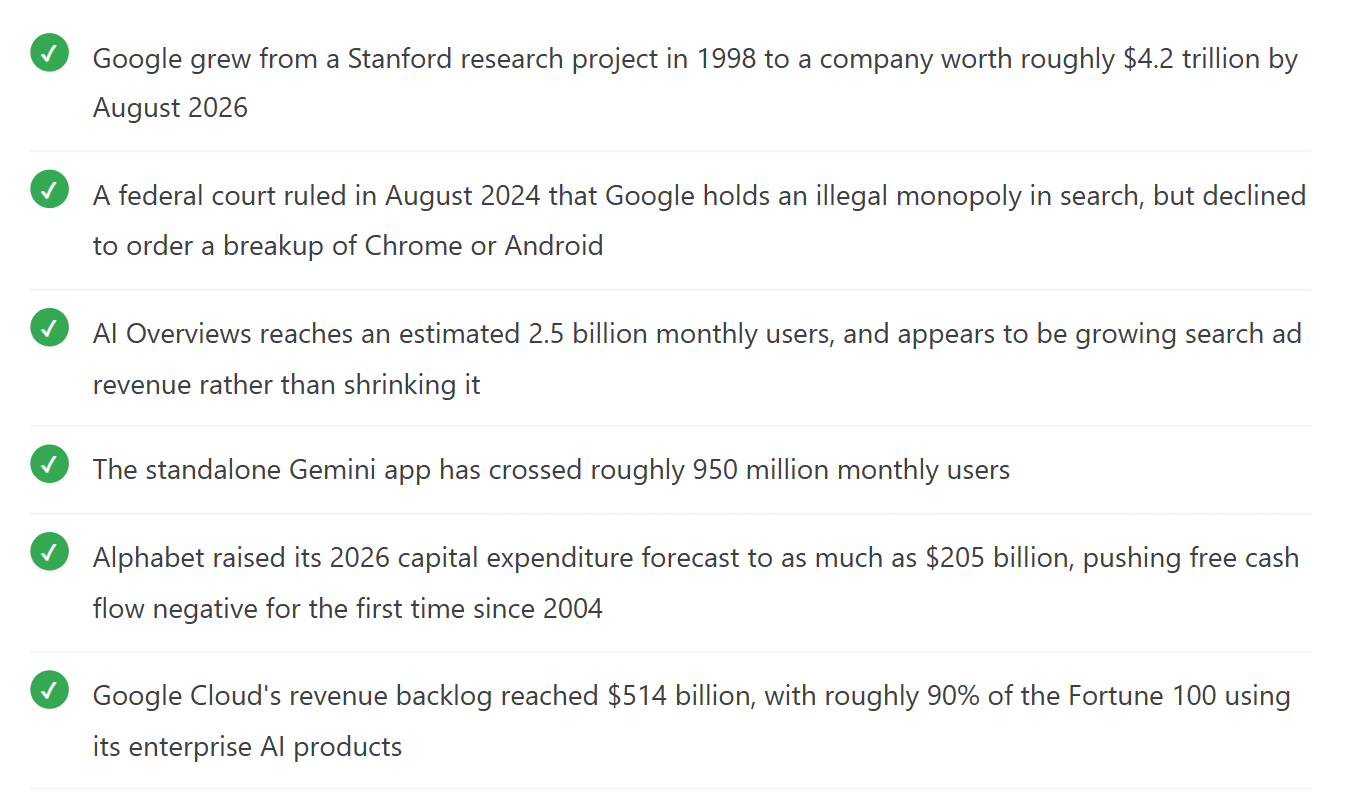
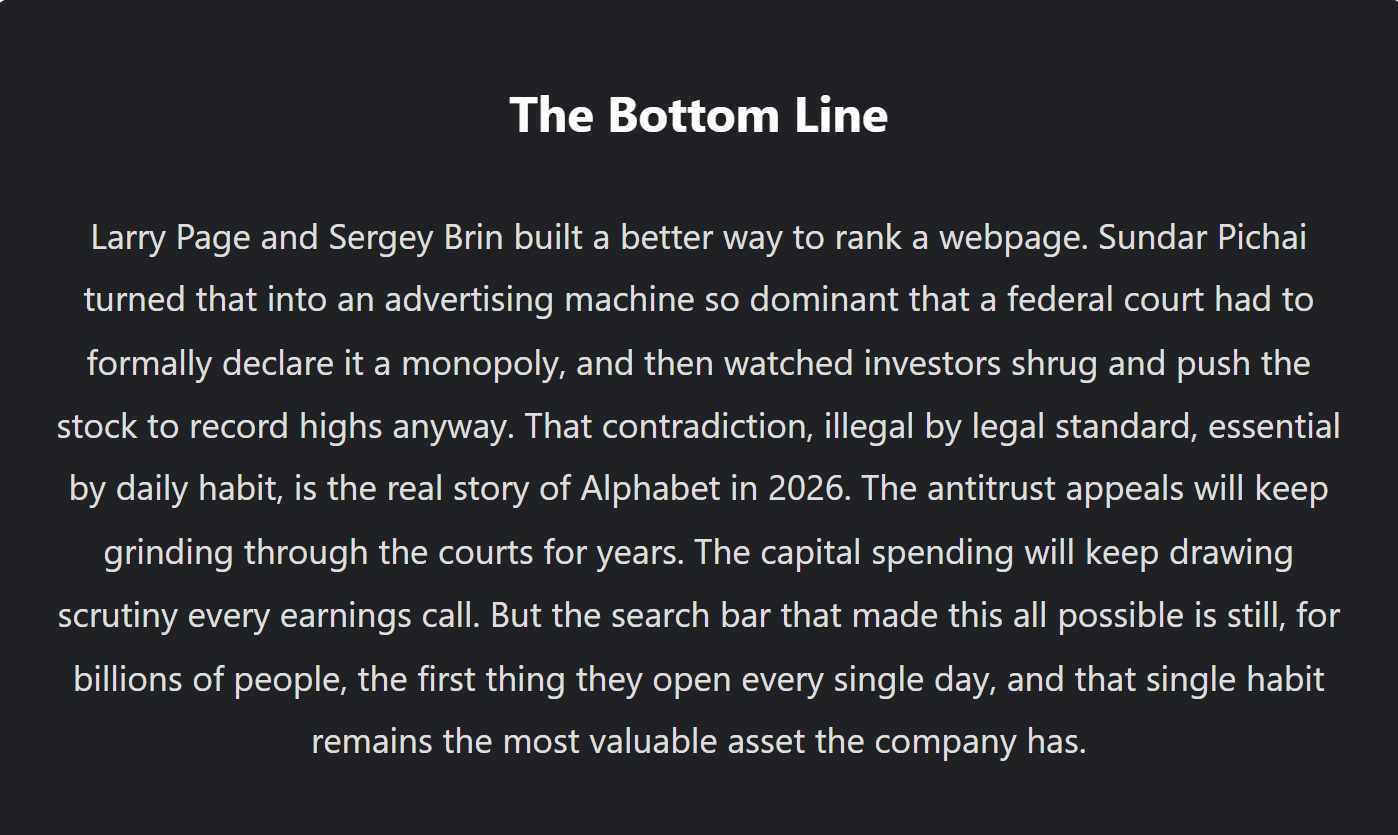
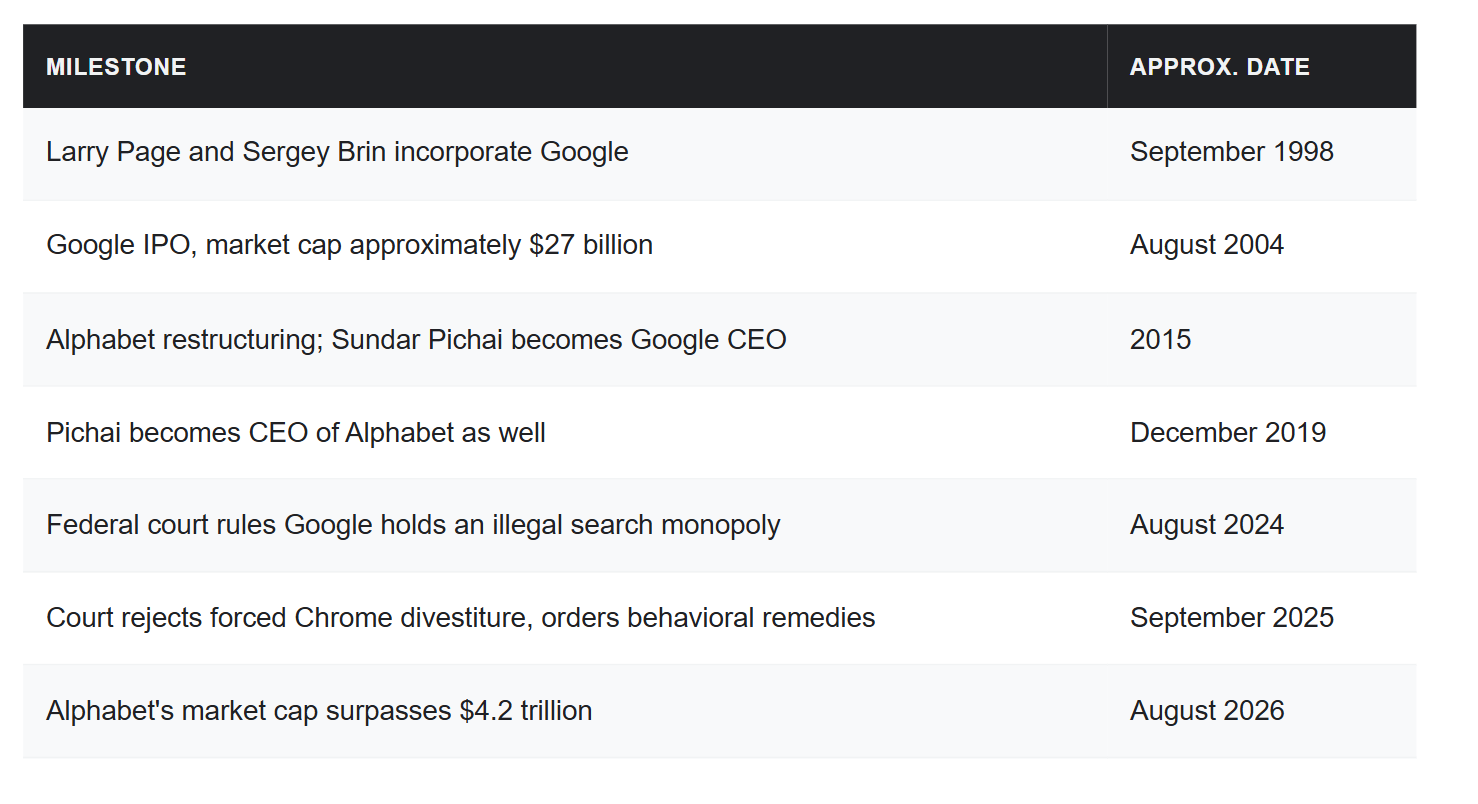
There's a version of the last two years that should have been genuinely dangerous for Google. A federal judge ruled the company had built and maintained an illegal monopoly in online search. The Department of Justice pushed for the forced sale of Chrome, one of the most widely used pieces of software on Earth. And yet, by late August 2026, Alphabet's market capitalization had climbed past $4.2 trillion, making it one of the three most valuable companies in the world. Understanding how both of those things are true at the same time says a lot about how deeply embedded this company has become in daily life, and how much is still genuinely unresolved. From a Stanford Dorm Room to the Default Way the World Searches The origin story is almost quaint by the standards of modern tech giants. Larry Page and Sergey Brin met as graduate students at Stanford in the mid-1990s and built a ranking system, PageRank, that judged a webpage's importance by counting and weighing the links pointing to it, rather than just matching keywords the way earlier search engines did. It was a research project before it was a business. The company incorporated in September 1998, went public in August 2004 at a market valuation of roughly $27 billion, and has since compounded at an annualized rate above 25% for more than two decades, an almost unheard-of run for a company already worth billions at the starting line. What makes that growth even more remarkable is how little the core product has changed in spirit. Search is still, at heart, the same problem Page and Brin set out to solve: take an enormous, chaotic web and surface the most useful answer in a fraction of a second. Sundar Pichai, who joined Google in 2004 and rose through product leadership on Chrome and Android before becoming Google's CEO in 2015 and Alphabet's CEO in 2019, inherited a company that already dominated search. His job was never to reinvent that core business. It was to build the layers of advertising, cloud infrastructure, and now artificial intelligence on top of it that turned a search engine into one of the most valuable companies in history. Google didn't become one of the most valuable companies on Earth by inventing something new every year. It became that by defending one very good idea from 1998 so completely that an entire federal court case couldn't meaningfully dislodge it. The Ad Machine That Search Still Runs It's easy to think of Google as an AI company now, and increasingly that's accurate, but the business underneath it is still overwhelmingly advertising. In the most recent quarter, Google generated $81 billion in advertising revenue alone, up 14% year over year, and that growth is arguably the most important data point in the entire AI story unfolding across the industry. When Google first rolled out AI-generated answer summaries directly in search results, known as AI Overviews, plenty of analysts assumed it would cannibalize the click-based ad model that built the company. Instead, Pichai has reported that AI Overviews now reaches roughly 2.5 billion monthly users, and rather than shrinking ad revenue, it appears to be driving more search queries overall, which has, if anything, strengthened the underlying ad business. The number that quietly explains Google's AI confidence Google's standalone Gemini app has reportedly crossed 950 million monthly users, a scale that puts it in the same conversation as the world's largest consumer apps. Combined with AI Overviews reaching billions more people passively through search, Google may already have the single largest AI distribution footprint of any company on the planet, even if its underlying models aren't always rated the most advanced by benchmark testers.
The Antitrust Battle That Could Have Broken Up the Company
None of that growth erases what happened in court. In August 2024, a federal judge found that Google had illegally maintained a monopoly in general search and search advertising, largely through the multibillion-dollar payments it made to companies like Apple and Samsung to remain the default search engine on their devices. The Department of Justice pushed hard for structural remedies, including an immediate sale of Chrome and a contingent, future sale of Android if lighter measures failed to restore competition.
In September 2025, the court's final decision landed somewhere in between. Judge Amit Mehta rejected the divestiture demands outright, calling that kind of structural breakup a drastic step reserved for far narrower circumstances, but he did impose real behavioral constraints: Google can no longer sign exclusive contracts tying Search, Chrome, or its Gemini app to device makers, and it must share portions of its search index and user-interaction data with qualified competitors on commercial terms. Alphabet's stock actually jumped about 8% in after-hours trading the moment the ruling came out, a clear signal that investors had been bracing for something far worse. Both sides have since filed competing appeals, with Google challenging the data-sharing requirements and the DOJ pushing for the divestitures the court declined to order, a legal fight that's expected to stretch well into 2027 and beyond.

The AI Spending Question Now Hanging Over the Stock
If the courtroom risk has cooled for now, a different kind of pressure has taken its place: the sheer scale of what Alphabet is spending to stay competitive in AI. On its most recent earnings call, the company raised its 2026 capital expenditure forecast to a range of $195 billion to $205 billion, up from an earlier estimate closer to $180 billion, almost entirely to fund data centers and AI infrastructure. The market's initial reaction wasn't celebration, the stock actually fell roughly 7% in the days following that announcement, and Alphabet's free cash flow turned negative in the second quarter for the first time since 2004, a genuinely striking detail for a company this large and this profitable on paper.
To help fund that buildout, Alphabet raised $80 billion in new equity in June 2026 and has continued tapping debt markets since, moves that inevitably raise the specter of shareholder dilution even as they keep the infrastructure race funded. The counterargument from the company is straightforward: Google Cloud's revenue backlog, essentially contracted future business not yet recognized, reached $514 billion, and Pichai has said roughly 90% of the Fortune 100 now uses Google's enterprise AI offerings in some capacity, with existing customers routinely exceeding their original spending commitments by more than half. Alphabet expects to recognize a little over half of that backlog as actual revenue within the next 24 months, which, if it holds, would go a long way toward justifying the current spending pace.
What's genuinely still uncertain
Beyond the antitrust appeals and the capex debate, Alphabet has also seen real turbulence inside its AI organization itself, including the recent departure of high-profile research leadership, a reminder that even a company with this much distribution and cash flow is still fighting an unusually competitive war for AI talent against OpenAI, Anthropic, and a fast-growing field of well-funded rivals. None of that changes the fundamental picture, Google Search remains the default gateway to the internet for most of the world, but it does mean the next few years will test whether Alphabet's AI investments convert into durable revenue as cleanly as its search advertising business has for the past two decades.