 William BensonVIEW PROFILE →
How the UK Nearly Rewrote Copyright Law for AI, and Why Creatives Are Calling It a Narrow Escape
Westminster came within one written statement of quietly rewriting copyright law in AI's favor. Here's what actually happened, and why creatives are calling it a rare win they can't afford to relax about.
Westminster came within one written statement of quietly rewriting copyright law in AI's favor. Here's what actually happened, and why creatives are calling it a rare win they can't afford to relax about.
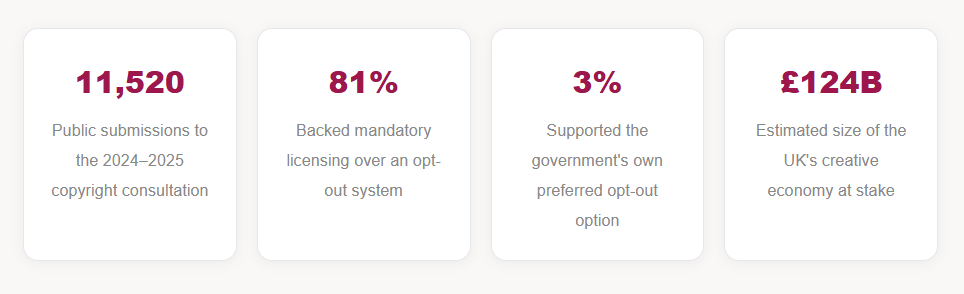
For the better part of a year, a genuinely strange proposal sat quietly inside UK government policy: artificial intelligence companies would be allowed, by default, to train their models on the copyrighted work of British musicians, authors, illustrators, and photographers, unless each individual creator found a way to actively opt out. It sounds almost too blunt to be real policy. It very nearly became law anyway, and the story of how it got stopped says a lot about who actually gets heard when technology policy collides with a livelihood. The Proposal That Alarmed an Entire Industry Back in December 2024, the UK government opened a public consultation on copyright and AI, and laid out its clearly preferred option: a broad text and data mining exception, paired with an opt-out mechanism, that would let AI developers use copyrighted material to train their models unless a rights holder specifically flagged their work as off-limits. In practice, this would have flipped the basic logic of copyright on its head. Instead of needing permission to use someone's creative work, AI companies would have needed permission to be told no, and the burden of policing that would fall entirely on individual creators, most of whom have neither the legal teams nor the technical tools to track how their work is being scraped and used. The consultation ran through February 2025 and drew an extraordinary 11,520 submissions, one of the largest responses to any UK government consultation in recent memory. When the results came back, they weren't close. Roughly 81 percent of respondents backed a mandatory licensing approach instead, requiring AI companies to actually pay for and negotiate access to copyrighted work. The government's own preferred opt-out option? It drew support from just 3 percent of respondents.
The House of Lords Steps In
As momentum built against the opt-out proposal, the House of Lords Communications and Digital Committee published its own report in early March 2026, and it didn't mince words. The Committee warned that generative AI, left unchecked by weak copyright protections, posed what it called a clear and present danger to the UK's creative economy, an industry it valued at roughly £124 billion. Its central recommendation was blunt: the government should rule out the opt-out model entirely, and focus instead on strengthening licensing, transparency, and enforcement within the existing legal framework, rather than carving out a brand-new exception that favored AI developers over the people whose work trains their systems.
The Committee's intervention landed at a genuinely pivotal moment, arriving just days before the government's own statutory deadline to publish its formal position. Under the Data (Use and Access) Act 2025, ministers were legally required to publish both an economic impact assessment and a report on copyright reform options by March 18, 2026, a deadline that concentrated attention and pressure on Westminster from every direction at once.

The U-Turn: What Actually Happened on March 18
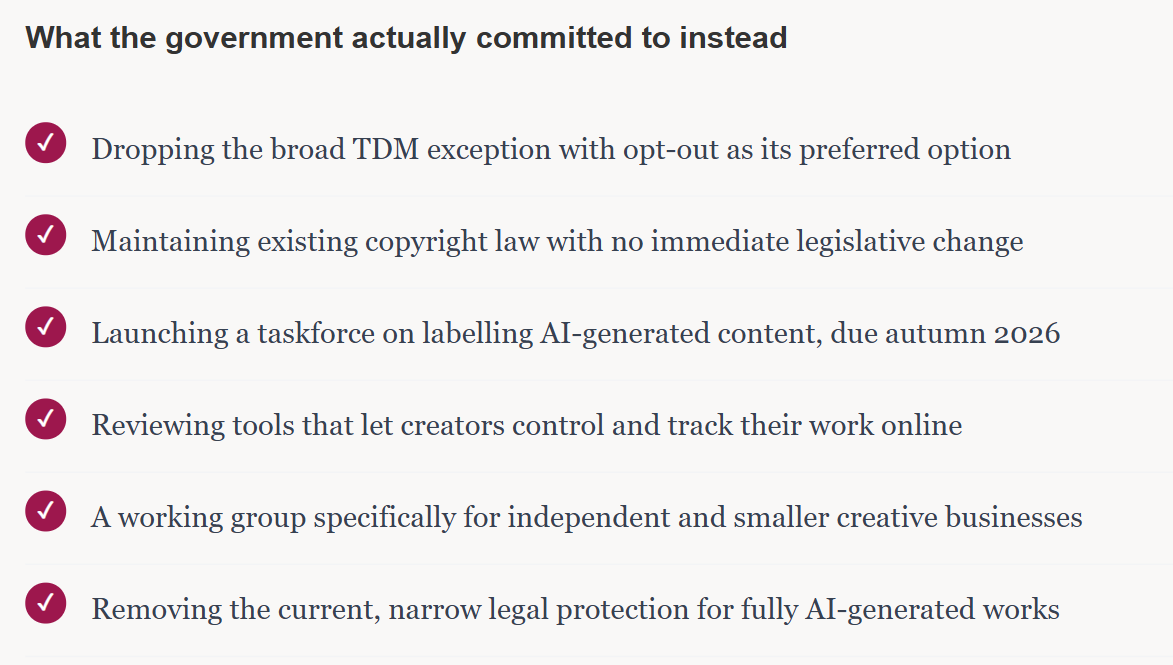
On the deadline itself, Technology Secretary Liz Kendall made a written statement to Parliament that amounted to a genuine reversal. The government, she confirmed, no longer had a preferred option on copyright reform. The opt-out proposal that had defined its position for over a year was quietly shelved, not through a dramatic announcement, but through the understated language of a written statement acknowledging that ministers had, in Kendall's own words a few months earlier, been "wrong" to have expressed a preference at all.
Crucially, this wasn't the government fully adopting the House of Lords' recommendations either. Rather than swinging to a licensing-first model, as the Committee had urged, the government settled into something closer to a holding pattern: maintaining the legal status quo, avoiding any immediate legislative change, and committing to gather further evidence before deciding on a longer-term approach. For the creative industries that had lobbied hard against the opt-out model, it was a genuine, if incomplete, win.
Why This Almost Went the Other Way
It's worth being honest about how close this came to a very different outcome. Sources close to the previous technology secretary confirmed as early as May 2025 that the opt-out model was already just one of several options under serious consideration, but for well over a year it remained the government's clearly stated preference in public. That preference wasn't abandoned because officials suddenly changed their minds unprompted, it shifted because an unusually large and unusually unified public response, backed by a pointed House of Lords report, made the political cost of proceeding too high to ignore.
Legal analysts who tracked the reversal closely describe it less as a genuine policy resolution and more as a government adopting a deliberate "see how it goes" posture, monitoring how the United States, the EU, and ongoing court cases handle the same question before committing UK law to any single path.

The Fight Isn't Actually Over
Here's the part worth sitting with rather than celebrating too early: dropping a "preferred option" is not the same as settling the underlying question. The government has explicitly left the door open to future legislative change, and it continues to weigh four broad paths forward, ranging from keeping the law entirely as-is, to a full licensing requirement, to some version of a narrower, more targeted data mining exemption. Nothing has actually been ruled out for good, and the government's formal response to the House of Lords Committee wasn't even due until early May 2026, well after the March reversal was announced.
Meanwhile, the courts are still actively shaping the practical reality on the ground. The UK's most closely watched AI copyright dispute, Getty Images' case against Stability AI, is headed for appeal later in 2026, and its outcome could meaningfully affect how existing copyright law actually applies to AI systems trained outside UK borders, a jurisdictional question the current policy reset doesn't resolve on its own. Universities and research libraries, for their part, have raised a very different complaint, arguing the current text and data mining exception, limited strictly to non-commercial research, is actually too narrow, restricting their own ability to computationally study the vast datasets they themselves produce.
A Few Honest Questions People Are Actually Asking
Does this mean AI companies can't legally train on UK creative work at all now? Not exactly. It means the specific proposal that would have made that broadly legal by default has been dropped. Existing copyright law, which generally still requires permission, remains in force, though enforcement and jurisdictional questions remain genuinely unsettled.
Is this reversal permanent, or could the opt-out model come back? Nothing here is permanent. The government has explicitly kept multiple options on the table and committed only to gathering more evidence, not to a final position, meaning this specific fight could resurface in a future consultation or bill.
What does this mean for individual creators right now, practically? In the near term, not much changes day to day, existing legal protections remain in place. The more meaningful shift is political: the creative sector has demonstrated it can mobilize a large, decisive response, which likely shapes how cautiously government approaches any future proposal in this space.
What This Says About Tech Policy More Broadly
Strip away the legal detail, and this episode is a genuinely useful case study in how technology policy actually gets made, and occasionally unmade. A government arrived at a clear preference, shaped substantially by the practical needs of a fast-moving AI industry eager for as much unrestricted training data as possible. That preference collided with an unusually well-organized, well-evidenced pushback from an industry, the UK's creative sector, that rarely gets treated as having equivalent lobbying weight to Silicon Valley-scale technology interests. For once, the numbers and the political pressure ran the other way, and the government listened, at least for now.
Whether that pattern holds when the next consultation, court ruling, or international pressure point arrives is genuinely an open question. What's clear is that UK creatives, and the lawyers and advocacy groups who organized on their behalf, proved they could move a government off a settled position, a result that matters well beyond this one specific piece of policy.
A note on where things stand
UK AI copyright policy remains actively in motion as of August 2026, with the government's formal response to the House of Lords Committee, the Getty v. Stability AI appeal, and the Creative Content Exchange pilot all still pending. Treat this as a snapshot of an unresolved, evolving situation rather than a final legal outcome.