 William BensonVIEW PROFILE →
Inside Apple's Best-Rehearsed Leadership Change in Company History
On September 1, John Ternus becomes only the third CEO in Apple's modern history. The stock barely moved. That's not indifference, it's the payoff of a handoff Apple spent years quietly rehearsing.
On September 1, John Ternus becomes only the third CEO in Apple's modern history. The stock barely moved. That's not indifference, it's the payoff of a handoff Apple spent years quietly rehearsing.
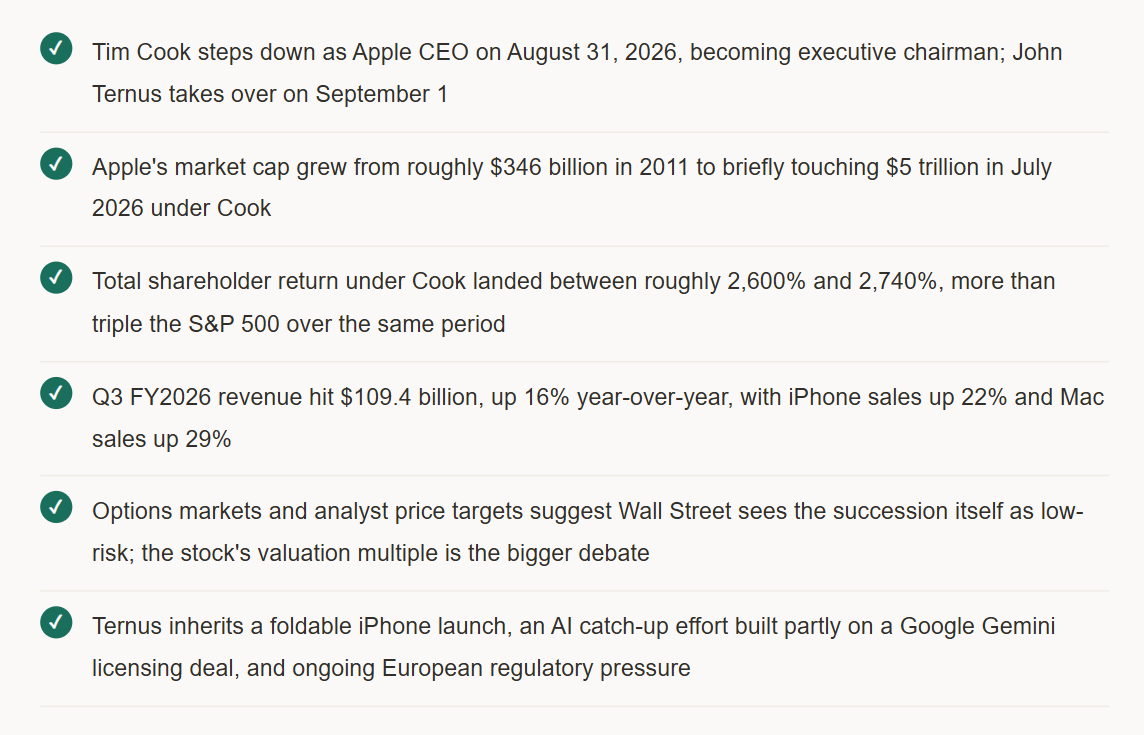
Most CEO transitions at trillion-dollar companies come with some kind of drama, a boardroom fight, an activist investor, a stock that wobbles for a week while analysts scramble to explain what just happened. Apple's didn't. When the company confirmed on April 20, 2026 that Tim Cook would step aside for hardware chief John Ternus, the announcement read almost like a routine press release, and the market treated it that way too. That calm is the actual story here, and it's worth digging into exactly how Apple engineered it, what it cost to build, and what's genuinely uncertain about the next chapter. A Handoff Apple Had Been Rehearsing for Years The formal announcement landed on a Monday afternoon in April, delivered through Apple's own newsroom rather than leaked to a reporter, which itself tells you something about how tightly this was managed. The board's decision was unanimous, reached after what the company described as a long-term succession process rather than a sudden vacancy. Cook stayed on as CEO through the summer, working alongside Ternus on the handover, before officially stepping down on August 31. Ternus took the corner office the very next morning, September 1, joining Apple's board of directors on the same day. Compare that to how Cook himself got the job. Steve Jobs handed him the CEO title in August 2011 already gravely ill, and died just six weeks later, leaving Cook to step into the role publicly grieving and under a level of scrutiny few executives ever face. There was no four-month runway, no joint earnings calls, no chance to be introduced to investors as anything other than the man following a legend. Apple clearly didn't want to repeat that experience twice in fifteen years, and the long, quiet build-up to Ternus's promotion, including a widely read profile the previous January that all but named him as the frontrunner, meant that by the time the announcement actually came, it wasn't really news to anyone who'd been paying attention. Apple didn't just choose a successor. It spent years training the market to expect him, so that by the time the handoff actually happened, there was nothing left to react to. Who John Ternus Actually Is Unlike Cook, who came from operations and supply-chain management, Ternus is a product person through and through, which Apple has framed as a deliberate return to form. He grew up in suburban Pennsylvania, studied mechanical engineering at the University of Pennsylvania, and swam competitively for the school before graduating in 1997. His first job out of college was designing early virtual reality headsets at a small outfit called Virtual Research Systems, an oddly fitting detail given that decades later he'd help ship Apple's own headset, Vision Pro. He joined Apple's product design team in 2001 and spent the next two decades climbing almost entirely within hardware engineering, becoming a vice president by 2013 and senior vice president in 2021, when he stepped in for Dan Riccio, who moved aside to focus on what would eventually become Vision Pro. At 50, Ternus became the youngest member of Apple's executive bench, and insiders have long described him as someone who prefers to be in the lab with engineers over the boardroom, a style much closer to Jobs's product obsession than Cook's spreadsheet discipline. Alongside the CEO change, Arthur Levinson, who spent fifteen years as Apple's non-executive chairman, is shifting into the role of lead independent director, another quiet signal that this transition was built to preserve continuity at every level of leadership, not just at the very top. Why Apple picked an insider again Both of Apple's last two CEOs were promoted from deep inside the company rather than recruited externally. That's unusual for a company this size. Boards often bring in outsiders during a transition to signal a fresh strategic direction, but Apple has twice bet that continuity of culture matters more than a shake-up, a wager that paid off enormously with Cook and one the board is clearly hoping repeats with Ternus. The Numbers Ternus Has to Live Up To It's genuinely hard to overstate the scale of what Cook built. When he took over in August 2011, Apple's market capitalization sat around $346 billion. By the time of his final earnings call on July 30, 2026, the company had briefly touched $5 trillion, only the second company in history to reach that milestone, and closed out his tenure at roughly $4.5 to $4.6 trillion depending on the trading day. Total shareholder return over those fifteen years, including dividends and buybacks, landed somewhere between 2,600% and 2,740% by different analysts' counts, more than triple the S&P 500's performance over the same stretch, even though Apple was already one of the largest companies on Earth when Cook started. One Bank of America analyst put a strange but memorable number on it: Apple's market cap grew at a pace of roughly $32 million an hour, every hour, for almost fifteen straight years. That's the bar Ternus is inheriting, not a target written into any contract, but the implicit expectation that comes with taking over a company this dominant.
What Wall Street Is Actually Betting On
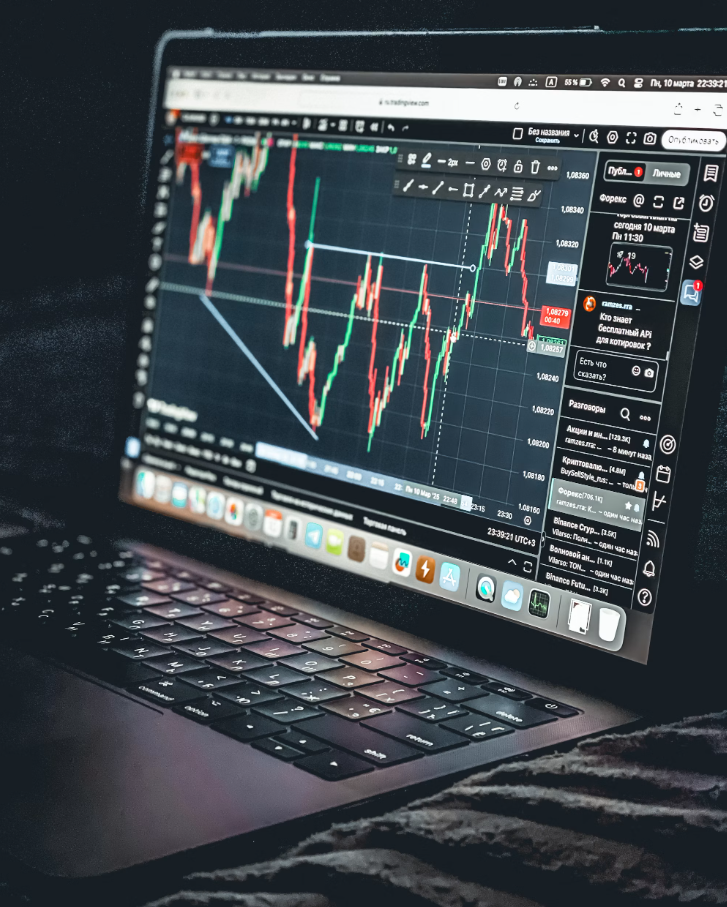
If a CEO change at a company this size were genuinely risky, the options market would show it, and largely, it doesn't. Apple shares closed near $309 to $311 in the days surrounding the handover, comfortably within a 52-week range spanning roughly $224 to $345, and up double digits for the year even after pulling back about ten percent from its late-July peak. December options contracts price a rally to $350 at roughly a one-in-five chance, while a drop to $250 sits at closer to one-in-eight, even though the $250 put remains, curiously, the single most crowded strike on the board. Analysts reading that setup have generally concluded the succession itself isn't what worries traders. The valuation multiple is.
That reading is echoed by the sell side. Bank of America reiterated a buy rating with a $380 price target shortly before the handover, while Rothschild & Co Redburn upgraded Apple from neutral to buy, lifting its own target from $260 to $400 on the back of an expected foldable iPhone launch. None of that enthusiasm hinges on Ternus specifically proving himself; it hinges on a product roadmap that was already set in motion well before he took the job.
The Four Problems Waiting on Ternus's Desk
A calm handover doesn't mean an easy inbox. Ternus steps into a company facing several genuinely open questions that Cook's operational discipline never fully resolved.
1. The foldable iPhone bet
Apple is widely reported to be preparing its first foldable device, unofficially nicknamed the iPhone Ultra, with a rumored starting price near $2,199. Supply chain estimates suggest a cautious initial run of half a million to a million units, scaling to seven or eight million in the back half of the year. It's the kind of category expansion that could define Ternus's first year in the job, and the kind of hardware bet that plays directly to his engineering background rather than Cook's.
2. Catching up on AI
This is the clearest blemish on Cook's record. Apple Intelligence and the long-promised Siri overhaul both slipped repeatedly, with the Siri upgrade only reaching consumer beta testing years after it was first announced. In January 2026, Apple struck a multiyear deal to license Google's Gemini models to power parts of its own AI stack, a move that drew criticism for outsourcing a technology many rivals see as existential. Apple has since tried to change that narrative, unveiling its own Apple Foundation Models and a suite of on-device AI features at WWDC in June 2026, betting that AI running privately on the device itself, rather than routed through the cloud, is the more defensible long-term position.
3. Regulatory pressure in Europe and beyond
Apple has been negotiating a settlement with European regulators over App Store rules, part of a broader push toward interoperability that has already forced changes to how the company handles third-party payments and app distribution on the continent. More of that pressure is likely to follow Ternus into the job rather than resolve neatly before he arrives.
4. Proving the culture survives the founder-adjacent generation
Every executive who worked directly under Steve Jobs eventually leaves the building. Ternus is one of the last senior leaders with meaningful early-Jobs-era experience, and how he balances that inherited design philosophy against genuinely new categories, foldables, spatial computing, on-device AI, will likely define whether Apple's culture outlives the two men who built it.
The one thing that hasn't changed
Whatever Ternus builds next, the underlying machine he's inheriting doesn't reset with him. Apple's roughly two and a half billion active devices, and the recurring services revenue tied to them, keep generating cash regardless of who sits in the CEO's office. That's arguably Cook's most durable legacy: not any single product, but a business so structurally embedded in daily life that a leadership change at the very top barely shows up as a blip in the numbers. Ternus doesn't need to reinvent that system to succeed. He mainly needs to avoid breaking it while he adds the next chapter.