 William BensonVIEW PROFILE →
Inside AVALW Studio: What Happens When a Publishing Platform Stops Stopping at "Publish"
Not a place where someone grants you permission to write, but a full media desk handed to your account from the very first article.
Not a place where someone grants you permission to write, but a full media desk handed to your account from the very first article.
Most publishing platforms follow the same quiet pattern. They hand you a text box, a publish button, and maybe a view counter, and then they leave you completely alone with everything that actually determines whether writing turns into a career: distribution, monetization, audience loyalty, and the sheer discipline of doing this consistently rather than occasionally. AVALW Studio was built around a different, more stubborn idea, that the tools a properly staffed newsroom takes for granted shouldn't be something a creator earns after years of grinding. They should be sitting there on day one, whether the account belongs to a first-time writer, a career journalist, or a company building a communication channel it doesn't have to rent from anyone else. The Problem With Most Publishing Platforms There's a fundamental difference between a service that lets you publish text and infrastructure built to sustain editorial work over years, not weeks. The gap between those two things is where most independent writers actually struggle, not in finding something to say, but in everything downstream of saying it: understanding which pieces actually land, turning attention into income, and building the kind of rhythm that keeps an audience coming back rather than drifting off after a strong first post. AVALW Studio's entire structure is a direct answer to that gap, organized so the natural stages of editorial work, create, build an audience, monetize it, consolidate a reputation, are all visible and usable from the very first login.
A Full Media Desk, Visible From the First Login
Open the panel and the philosophy is immediately obvious in how it's organized. The sidebar groups every section a working account needs, Dashboard, Stories, Write, Premiere, Contribute, Statistics, Weekly Report, Earnings, Badges, Perks, Tips, Rewards, Payments, Invite, in a logical order that mirrors the actual stages of editorial work rather than the cluttered menu structure of a typical blogging tool. The Dashboard itself deliberately keeps things simple: readers gathered, confirmed ad clicks, published articles, and email subscribers, four numbers rather than a wall of distracting charts, alongside a seven, fourteen, and thirty-day traffic trend and a list of the best-performing pieces, a genuinely practical way to see which subjects, angles, and headlines are actually resonating before deciding what to write next.
The Write section is where the actual composing happens, a fully integrated editor requiring no external tools: title, introduction, body, a cover image uploaded directly, category, and language, with publishing itself reduced to a single step. Every published piece then lands in a running, searchable archive, which functions differently depending on who's using it. For an independent creator, it slowly becomes a portfolio. For a journalist, it's a visible, standing record of a career's actual body of work. For a company, it's a structured log of everything the brand has said publicly, in one place, rather than scattered across social platforms it doesn't control.
Statistics and the Discipline of a Weekly Report Where the Dashboard offers a glance, the Statistics section is built for actual analysis: audience evolution over time, where traffic is actually coming from, and how readers behave on individual pieces, how much they read, what brings them back. It's a deliberate shift away from guesswork. Instead of assuming what an audience wants, the data shows what's already worked, which over time helps define something a lot of creators never quite land on their own: a clear niche. A focused audience, even a smaller one, tends to be worth more than a large, directionless one, and for a company, the exact same data becomes a direct way to measure whether its public communication is actually landing. Layered on top of that analysis is a feature aimed less at insight and more at rhythm: the Weekly Report. Every Friday, the account receives a complete summary of the week just closed, readers gained and the percentage change from the previous week, ad earnings and balance, articles published, new subscribers, and the single best-performing piece, laid out in clear cards with a seven-day reader chart. The report is downloadable as a PDF and arrives automatically by email, so the week's summary comes to the user rather than requiring them to go dig for it. For an individual creator, it's the thing that actually sustains consistency over months. For a journalist, a clean, standing record of impact. For a company, a ready-made communications report, delivered every single week without anyone having to compile it manually.
How the Money Actually Works
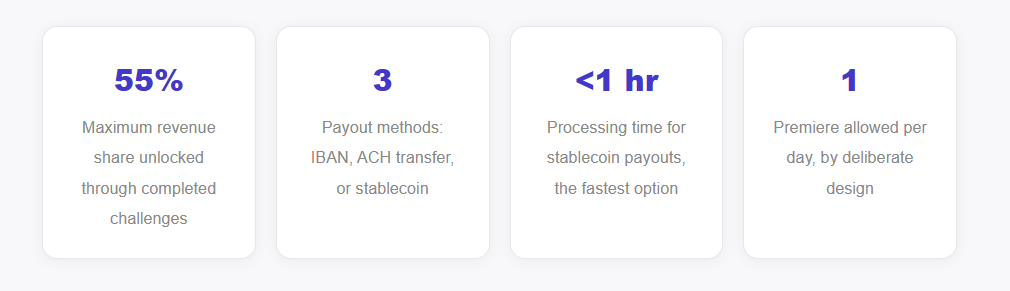
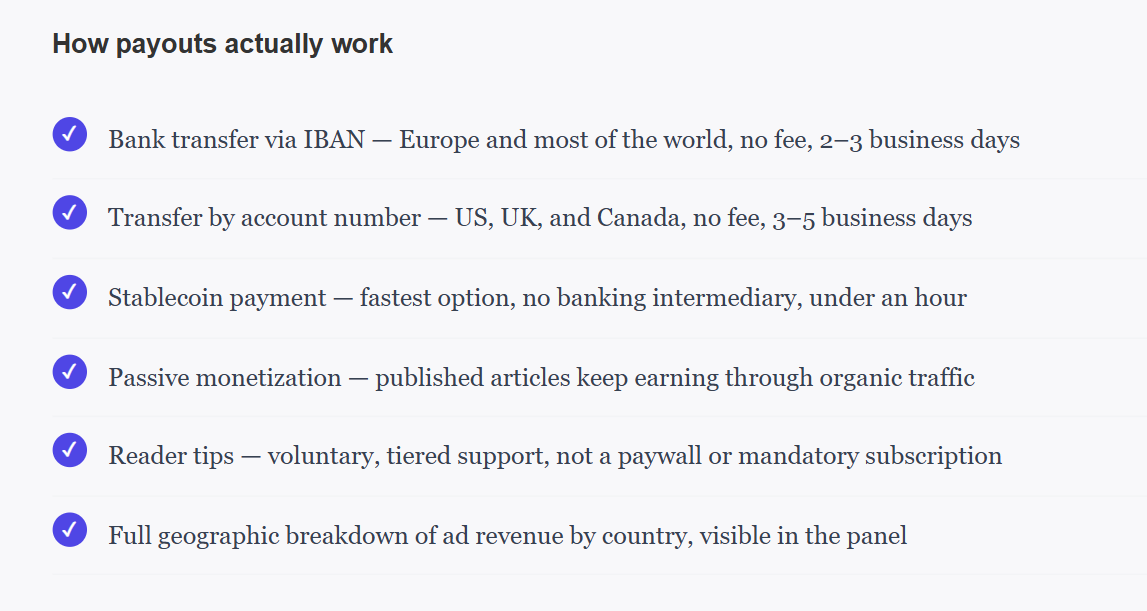
The Earnings section handles the financial side with the kind of directness most platforms avoid: accumulated revenue, ad clicks, and their geographic distribution by country, all visible in the panel rather than buried in a hard-to-parse report. The monetization model is built to be passive by design, once activated, an article keeps earning long after publication, as readers keep finding it through search and organic distribution, meaning a piece written today is still quietly working months later.
A second revenue stream sits alongside advertising: reader tips. Rather than a subscription wall or a mandatory paywall, readers can voluntarily offer a modest amount, in preset tiers of a few dollars, for a specific piece that genuinely impressed them. The panel tracks how many readers contributed, what share of the audience that represents, the average and largest amounts received, and the messages people leave alongside their support. It's a meaningfully different relationship than a classic subscription, the audience isn't charged at the door, they're invited to reward work they've already read and valued.
The Premiere System: Turning an Article Into an Event
This is arguably the platform's most distinctive feature, and one with essentially no equivalent on comparable individual-account services. Premiere lets an important piece be scheduled as a genuine event, complete with a fixed date and time, the way a film or a product launch would be handled. Readers land on a dedicated premiere page with a live countdown, can set a reminder for the exact moment it becomes available, and receive a notification the instant it goes live, simultaneously, to the entire audience at once. Authors can notify subscribers directly and share an invitation link, tracking in real time how many people have actually set a reminder.
The limit of one premiere per day isn't an arbitrary restriction, it's a deliberate design choice meant to keep major pieces feeling like genuine events rather than routine content. Scarcity creates importance, and importance is what actually draws an audience.
A dedicated conversion metric supports the whole mechanism, measuring what proportion of set reminders actually turn into real audience at launch, which lets an author fine-tune timing, subject, and messaging for steadily better results over time. For a journalist, it's the natural home for an exclusive investigation. For a company, it functions like a product launch or press conference, run entirely from its own panel rather than depending on a third-party press outlet.
Challenges, Editorial Guidance, and Badges: Growth Built Into the Workflow
The Challenges section ties visible effort directly to financial outcome. Completing a defined set of objectives, presenting a channel across major social networks, reaching a subscriber threshold on one's own subdomain, publishing a set number of articles, permanently raises the revenue share an account keeps from fifty to fifty-five percent. Each objective comes with a progress indicator, turning growth from a vague aspiration into a measurable, trackable path with a clear next step.
Editorial Guidance functions like a built-in craft manual: practical writing recommendations organized by category, headlines, structure, sources, credibility, each with an estimated reading time and a link to a full guide. The advice is specific rather than generic: write the headline last, once the piece has revealed its actual subject; one idea per paragraph, since most readers are on mobile; name sources explicitly or justify anonymity outright; double-check figures and give them a scale that actually means something; cut any adjective that can't be defended with a fact. For a new creator, it's genuinely a crash course. For a communications team, it's a style guide that's already embedded in the workflow rather than sitting in a forgotten PDF.
Badges then quietly track the recognitions earned along the way. Some unlock quickly, confirming identity, publishing a first piece, writing in two or more languages, holding a high reader-retention rate to the end of an article. Others stay deliberately locked as long-term goals: an extended, error-free review history, priority on a story other newsrooms later pick up, or sustained publishing consistency over a long stretch. Each badge implicitly defines what quality actually looks like on the platform.
Contribute: A Distributed Newsroom Built on Trust
The Contribute section pulls an account into something bigger than its own feed. Members can review pieces recently published by others, checking facts, sources, and images, with the reviewer's name and photo attached to the article as a visible mark of guarantee. Flagged errors go straight to the desk as a private notification. The mechanism does double duty, building individual reputation while creating genuine belonging to a shared editorial process, with clear advancement thresholds, top-contributor status after a set number of accepted reviews, and higher tiers beyond that. It's essentially a distributed newsroom where trust gets built the same way it does at a serious press institution: by verifying each other's work, not just producing your own in isolation.
Rewards That Aren't Just Pixels
This is where AVALW Studio departs most visibly from the usual logic of publishing platforms. Three subscriber thresholds unlock rewards that are physical, not digital, distinctions, with progress toward the first shown in real time as a percentage. At one hundred thousand subscribers, an account receives a printed volume of everything it has published, in chronological order, typeset and hand-bound in linen, the name stamped on the spine, signed by the desk, and numbered as a genuinely unique copy printed nowhere else.
At one million subscribers, the reward becomes a wall piece engraved with the account's most-read article, its cover image, and reader count, made in brushed metal and framed in walnut, ready to display, paired with network-wide promotion and covered travel to the platform's events. At ten million, it's a numbered, limited-edition trophy, a permanent place in the platform's gallery, a lifelong increase to revenue share, a seat in the editorial structure, and an annual award bearing the account's own name, granted each year to a new creator. The underlying principle stays constant throughout: nothing here is purchased or handed out artificially. Every reward is produced from the actual result of the work.
A Few Honest Questions People Are Actually Asking
Is AVALW Studio only for professional journalists? No. The platform is built for three overlapping groups: independent creators just starting out, career journalists, and companies building their own communication channel, with the same full toolset available to all of them from the very first article.
Do I need a large audience before I get access to the real tools? No, and that's the specific point the platform is built around. Analytics, monetization, the weekly report, and the premiere system are all available from day one, not unlocked later as a reward for already being established.
How is the revenue share structured? Accounts start at a baseline share and can permanently raise it to fifty-five percent by completing defined growth objectives, covering social presence, subscriber milestones, and publishing consistency, tracked visibly through the Challenges section.
Who This Is Actually Built For
Taken together, these components form something closer to a complete editorial ecosystem than a simple publishing tool. A user writes, measures their audience with genuinely serious analytics, monetizes through both advertising and direct reader support, launches significant pieces as scheduled events, raises their own revenue share through concrete objectives, takes part in verifying the wider network's editorial work, and advances, step by step, toward tangible, physical recognition. Crucially, none of this waits for the audience to arrive first. The tools show up before the audience does, which means a creator never has to become important before receiving a professional's toolkit, they grow alongside it from the start.
That's the actual proposition underneath AVALW Studio: not a space where permission to publish gets granted, but a complete media desk placed in an account's hands from day one, whether that account belongs to someone publishing their very first article, a journalist deep into an established career, or a company building an independent voice it doesn't have to rent from anyone else. The infrastructure is already built, considered down to the smallest detail. The only thing left is for someone to actually start using it.
A note on this piece
This article describes AVALW Studio's platform features as presented in its own publishing materials as of August 2026. Specific terms, thresholds, and payout details may be updated by the platform over time; check AVALW Studio's official pages for the most current terms before making decisions based on any figure here.