 William BensonVIEW PROFILE →
Two Bets on the Same Future: Why Wall Street Trusts a Four-Year-Old Startup Over Elon Musk's Robot Army
Figure AI has never turned a profit, yet it's worth more than most airlines. Its humanoid robots are clocking real shifts on a real factory floor. Elon Musk's Optimus is still, in his own words, "primarily for learning."
Figure AI has never turned a profit, yet it's worth more than most airlines. Its humanoid robots are clocking real shifts on a real factory floor. Elon Musk's Optimus is still, in his own words, "primarily for learning."
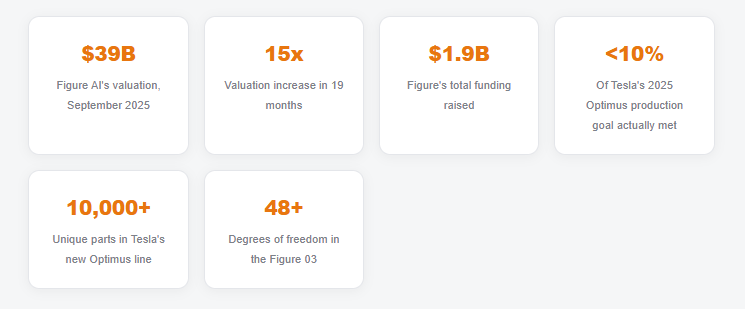
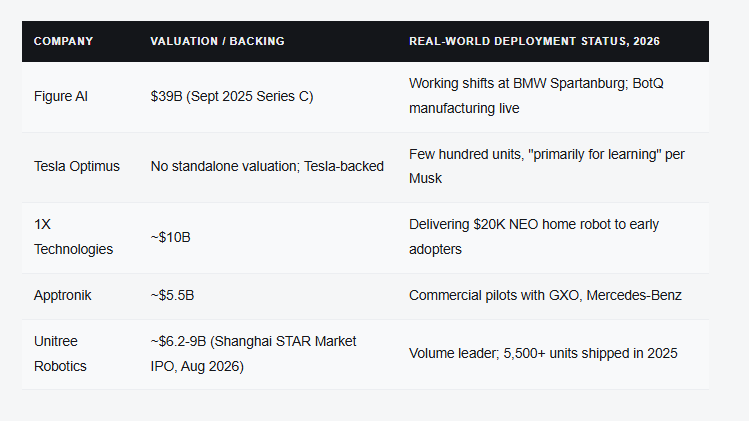
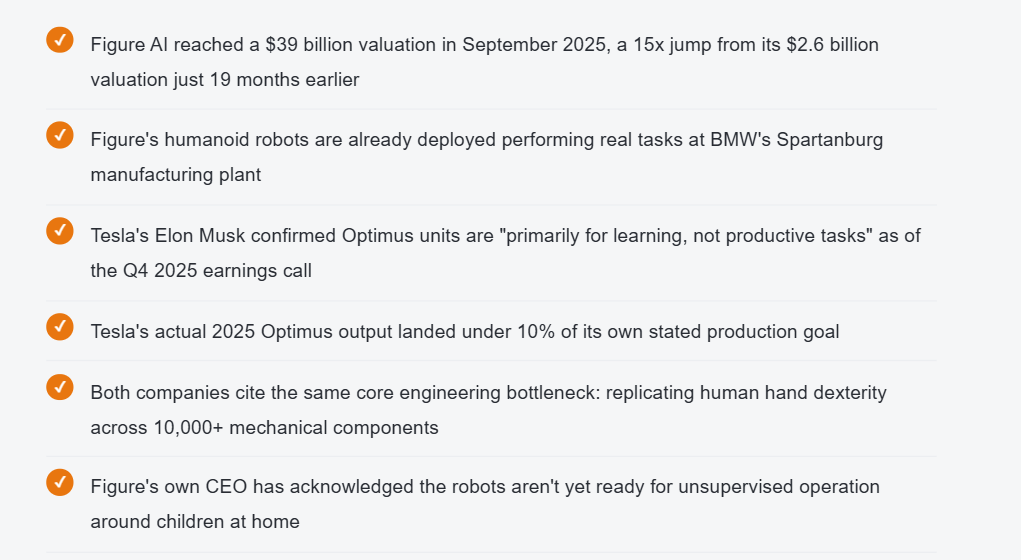
Somewhere on BMW's factory floor in Spartanburg, South Carolina, a humanoid robot with no name recognition outside tech circles is quietly handling real manufacturing tasks, shift after shift. A few thousand miles away, at Tesla's newly retooled Fremont plant, a different kind of humanoid robot, built by a company most of the planet could pick out of a lineup, is still, by its own CEO's admission, mostly just watching and learning. The gap between those two realities is currently worth about $39 billion, and it says more about where humanoid robotics actually stands in 2026 than almost any keynote demo has managed to. A Company That Didn't Exist Four Years Ago Is Now Worth More Than Most Airlines Figure AI's rise has been fast even by Silicon Valley standards. Founded in 2022 by Brett Adcock, an entrepreneur previously known for co-founding the recruiting platform Vettery and the electric aviation company Archer Aviation, Figure assembled a founding team pulled from Boston Dynamics, Tesla, and Apple, three companies with very different but highly relevant expertise in robotics, manufacturing, and consumer hardware. The company raised a modest $70 million Series A in May 2023 at a $500 million valuation, a respectable but unremarkable start for a robotics startup. What happened next wasn't gradual. In February 2024, Figure closed a $675 million Series B round at a $2.6 billion valuation, backed by an unusually high-powered investor list including Microsoft, OpenAI, Nvidia, Amazon, Intel Capital, and Jeff Bezos personally. Eighteen months later, in September 2025, the company closed a Series C round exceeding $1 billion, with new backers including Intel, Qualcomm, T-Mobile, Salesforce, and Brookfield Asset Management, pushing its valuation to $39 billion, a roughly 15-fold jump in just 19 months. That figure makes Figure the single highest-valued humanoid robotics company on the planet, public or private, by a wide margin. Figure's AI models are built entirely in-house. What Figure Is Actually Doing With Robots Right Now The detail that separates Figure's valuation from pure hype is deployment: its Figure 02 and newer Figure 03 robots are already working inside BMW's Spartanburg plant, one of the automaker's largest production facilities, performing real tasks on the floor rather than appearing exclusively in polished demo videos. The company has also opened BotQ, a dedicated mass-manufacturing facility built specifically to scale humanoid robot production beyond hand-built prototypes, a step most competitors in the space have not yet publicly matched. Figure's technical pitch centers on its Figure 03 platform, which industry trackers note features more than 48 degrees of freedom and dexterous, camera-equipped palms designed for fine manipulation tasks, alongside a proprietary AI system called Helix. Notably, CEO Brett Adcock announced in 2025 that Figure had exited its earlier collaboration agreement with OpenAI, stating the company's AI models were now built entirely in-house following an internal breakthrough, a move that signaled real confidence in Figure's own research capabilities rather than continued reliance on an outside partner's foundation models.
Meanwhile, Tesla's Robots Are Mostly Still Watching
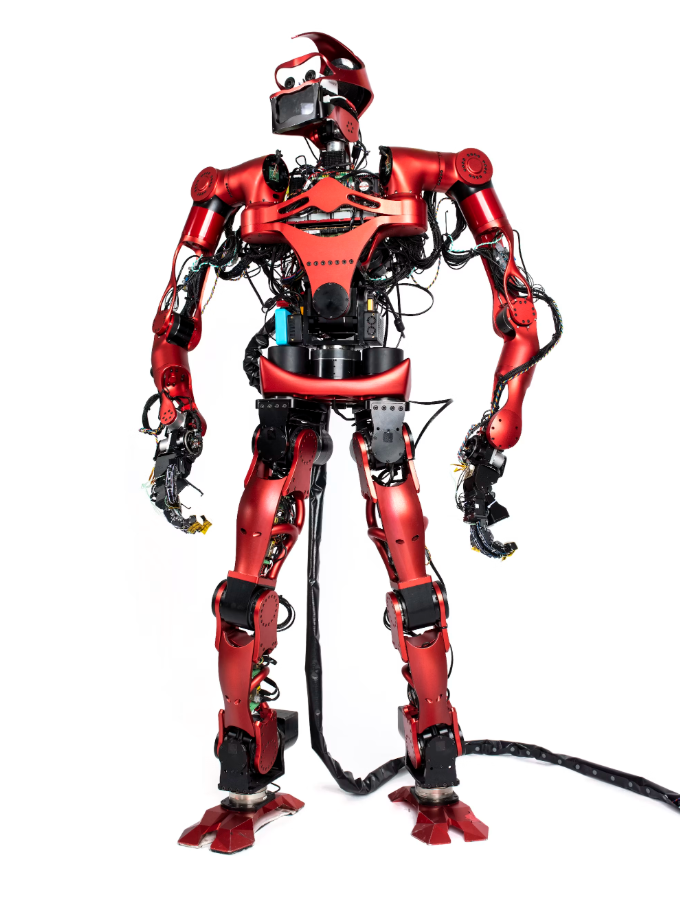
Tesla's Optimus program tells a considerably rockier story in 2026, despite Elon Musk's characteristically bold long-term framing. On Tesla's Q4 2025 earnings call, Musk offered an unusually candid admission: Optimus units deployed inside Tesla's own factories were "not in usage in our factories in a material way," and existing robots were "primarily for learning, not productive tasks, still very much in the R&D phase." That statement stood in sharp contrast to more ambitious public messaging from 2024 and early 2025, when Tesla had floated production targets in the thousands of units.
The reality, according to reporting from The Information, was starker still: actual 2025 output landed at a few hundred units, under 10% of the company's own stated goal. Tesla's Q1 2026 earnings call brought confirmation that Optimus production would begin at the retooled Fremont facility in late July or August, four months after the last Model S and Model X rolled off that same line, but Musk warned output would ramp slowly and called the year's production rate "impossible to predict," citing the roughly 10,000 unique parts involved in the new line. As of mid-July 2026, production had reportedly still not begun, and Tesla's Q2 delivery report contained no Optimus figures at all.
Both companies are stuck on the exact same problem: hands
Musk has been unusually direct about where Optimus's engineering difficulty actually concentrates. "The robot hand and forearm are the most difficult engineering challenges," he acknowledged, pointing to the fact that a human hand contains more than 27 degrees of freedom, and replicating that dexterity mechanically requires precision and durability across a system of more than 10,000 components. Reports have also cited overheating joint motors and battery durability shortfalls contributing to a mid-2026 production pause. Notably, this is the same fundamental bottleneck Figure has built its entire technical pitch around solving first, which may explain why investors have been willing to pay such a steep premium for a company that has actually shipped working dexterous hands to a real factory floor.
Why Investors Are Paying $39 Billion for a Company With Almost No Revenue
Figure's valuation is, by any conventional financial measure, a bet on a decade of future execution rather than current earnings, a genuinely pre-revenue company priced well above several established public robotics and industrial automation firms combined. Analysts justify the premium by pointing to the size of the total addressable market rather than any near-term profit path: Goldman Sachs projects the global humanoid robot market will reach $38 billion by 2035, while Morgan Stanley has floated a considerably more aggressive $5 trillion opportunity by 2050 if general-purpose humanoid labor becomes genuinely viable at scale.
That framing matters because it reveals what's really being priced into Figure's valuation: optionality. If humanoid robots eventually work reliably enough for widespread industrial deployment, and eventually for home use, being the most well-capitalized, most advanced Western pure-play in the category before that inflection point arrives is worth an enormous premium. If the timeline slips by years, as it has repeatedly for Tesla, that premium becomes considerably harder to justify to public markets, a tension that will likely define whatever public offering Figure eventually pursues.
The Home Robot Question Nobody's Fully Answered Yet
Even Figure's own CEO has been careful not to oversell how close general-purpose home robotics actually is. Asked directly on a podcast appearance in late 2025 how close Figure was to safe, unsupervised home autonomy, Adcock gave an unusually candid answer: he "would not let my robot run free for hours and weeks right now" with his own young kids in the house. It's a reasonable, honest assessment from an executive who understands the technology's current limits, but it also sits somewhat awkwardly next to Figure 03 demo footage showing robots folding laundry and loading dishwashers, footage that understandably shapes public perception of how close home deployment really is.
That gap between polished demonstration and safe, unsupervised reality isn't unique to Figure, it's arguably the defining tension across the entire humanoid robotics sector in 2026. Tesla has leaned into a similar dynamic, showcasing Optimus's dexterity and mobility in controlled settings while its own leadership acknowledges the robots aren't yet doing meaningfully productive work even inside Tesla's own factories, let alone in customers' homes.
What this rivalry actually signals about the industry
Stepping back from the individual company scorecards, the Figure-versus-Tesla dynamic reveals a broader split forming across humanoid robotics: Western companies like Figure, 1X, and Apptronik are racing on AI sophistication and precision manufacturing partnerships with premium industrial customers, while Chinese manufacturers like Unitree have taken the opposite approach, prioritizing shipping volume and aggressive price points, undercutting Figure's undisclosed but reportedly six-figure per-unit pricing by a wide margin. Tesla occupies an unusual middle position: enormous manufacturing ambition and capital, paired with a public track record of missed internal deadlines that has started to visibly affect investor patience with the broader Optimus narrative.