 William BensonVIEW PROFILE →
Inside South Africa's Mass Exodus: Why More Than 53,000 Migrants Went Home in a Month
A wave of anti-migrant protests, overcrowded border camps, and a journey home that some didn't survive. Here's the full story behind one of the largest movements of people Southern Africa has seen in years.
A wave of anti-migrant protests, overcrowded border camps, and a journey home that some didn't survive. Here's the full story behind one of the largest movements of people Southern Africa has seen in years.
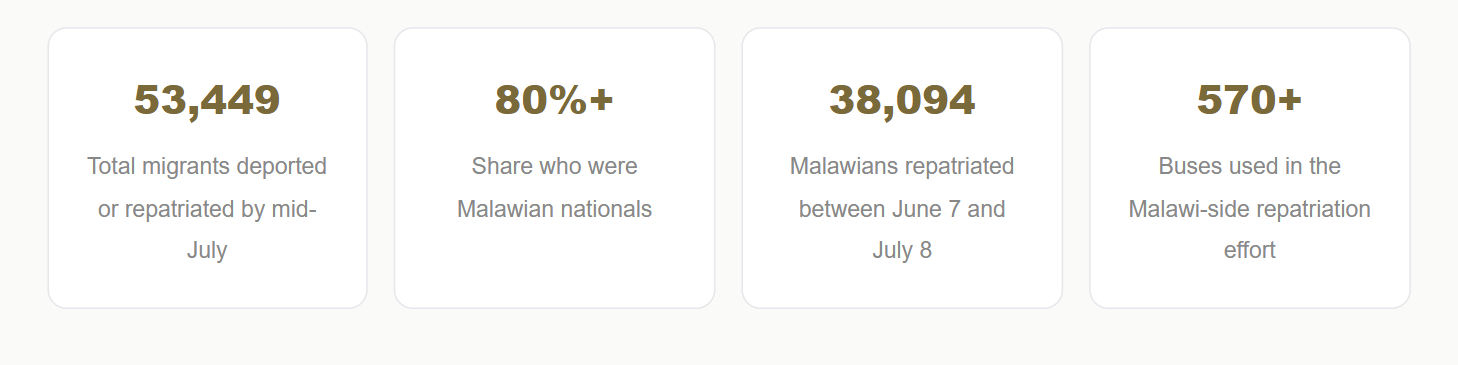
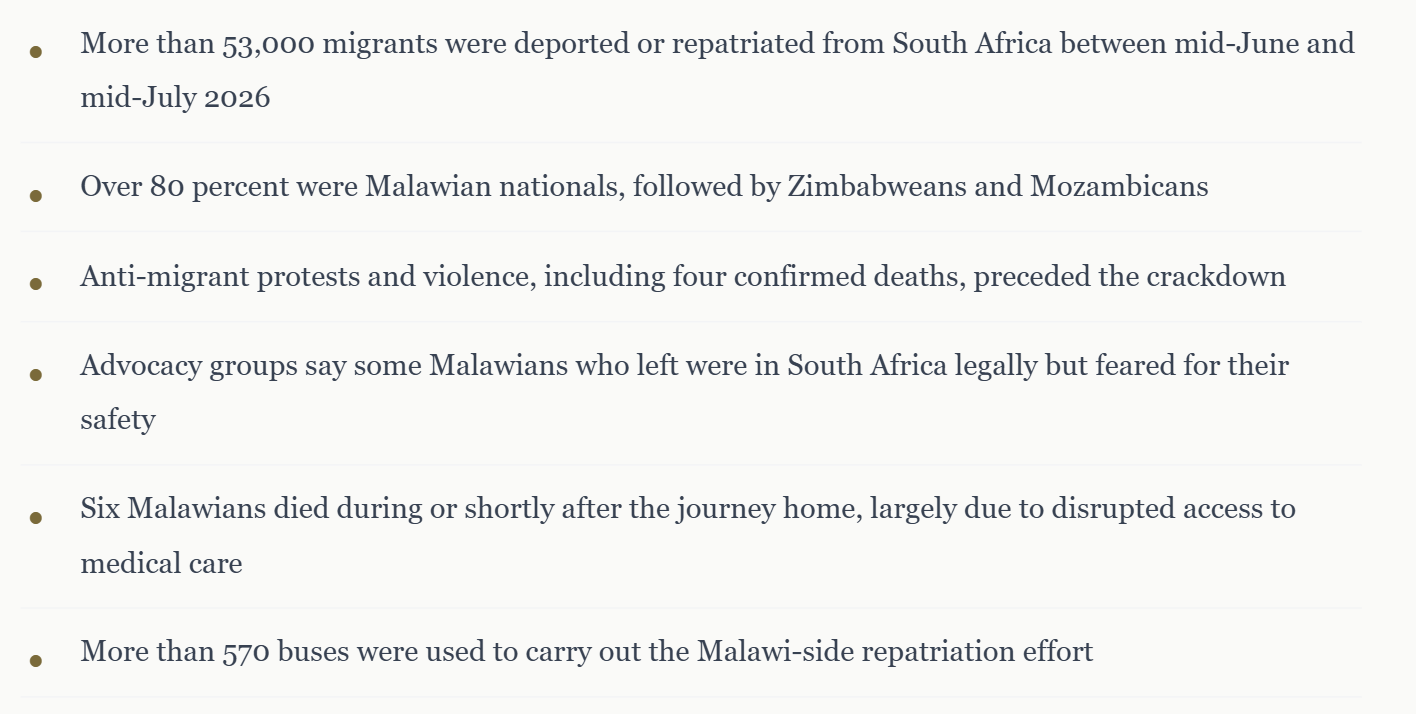
In the space of about a month, more than 53,000 people packed up whatever they could carry and left South Africa, most of them not by choice in any straightforward sense, but because staying had become dangerous, and the machinery of deportation had begun moving faster than anyone expected. The vast majority were Malawian. Many had lived and worked in South Africa for years. Some had done nothing wrong under the country's own immigration rules. A handful never made it home alive. This is the story of what happened at South Africa's border crossings and temporary immigration camps between June and July 2026, why it happened, and what it says about a relationship between two neighboring countries that has always been more complicated than the label "migration crisis" tends to suggest. How the Numbers Grew So Quickly According to South Africa's Justice and Constitutional Development Minister, Mmamoloko Kubayi, who chairs the government's Inter-Ministerial Committee on Migration, more than 53,000 foreign nationals were processed for either deportation or repatriation between mid-June and mid-July 2026 alone. Speaking at a media briefing in Pretoria, Kubayi confirmed that Malawians made up more than 80 percent of that total, with Zimbabweans and Mozambicans accounting for most of the remainder. The pace of the increase was striking even to officials tracking it closely. On June 26, authorities had reported 15,162 Malawian nationals repatriated. Barely two weeks later, that figure had climbed to over 53,000 total departures across all nationalities, an acceleration that outpaced the government's own repatriation infrastructure and left thousands of people stranded in temporary camps while buses and processing capacity struggled to keep up.
What Triggered the Wave
The crackdown didn't emerge in isolation. It followed weeks of anti-immigrant protests across South Africa, organized in part by fringe groups that accused foreign nationals of taking jobs and straining public resources. Those groups set an unofficial deadline of June 30 for undocumented migrants to leave the country voluntarily, a deadline the South African government publicly rejected as having no legal standing, even as it visibly shaped the behavior of thousands of migrants who chose not to wait and find out what enforcement might look like after that date.
The unrest surrounding these protests turned deadly in multiple documented incidents. South African police confirmed that two Mozambican nationals, one Malawian, and one Ethiopian were killed in violence connected to the anti-migrant unrest, a grim reminder that the pressure driving this exodus wasn't purely bureaucratic. For a significant portion of those who left, the calculation wasn't about paperwork, it was about physical safety in neighborhoods where tensions had turned openly hostile.
Photo: Shaun Meintjes / Unsplash — the crisis has tested relations between South Africa and several of its neighbors, with some governments openly criticizing the pace and manner of the repatriations.
A Distinction the Government Insists On
South African officials have been careful throughout the crisis to draw a line between people who were formally deported for lacking valid documentation and those who left through what the government calls voluntary repatriation. Kubayi's briefings did not provide an exact breakdown of how many fell into each category, but officials have consistently maintained that most people processed lacked valid immigration documents.
That framing has been directly challenged by advocacy groups working with migrants on the ground. Sabina Tadera of the Southern Africa Network for Immigrants and Refugees told reporters that a meaningful number of the Malawians who gathered at temporary camps seeking repatriation were, in fact, in South Africa entirely legally, but had chosen to leave anyway out of genuine fear of being targeted by anti-migrant violence regardless of their legal status.
"There is a misconception that all people on the move are undocumented."— Sabina Tadera, Southern Africa Network for Immigrants and Refugees
Life Inside the Temporary Camps
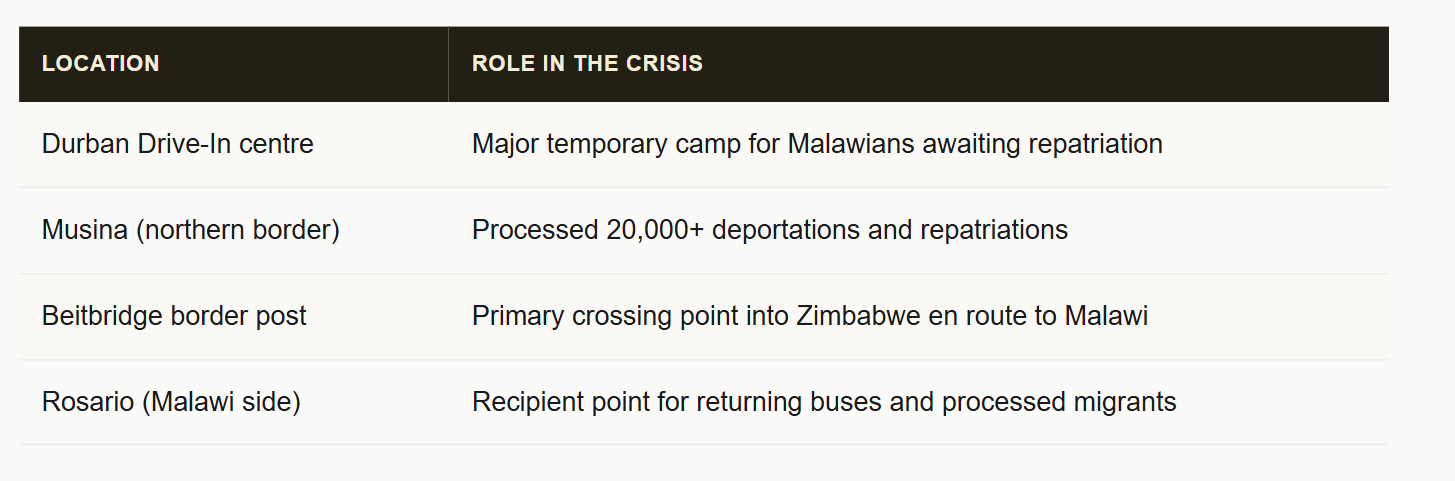
For those waiting to be processed, conditions at the makeshift camps that sprang up across the country, including a large temporary site at the Durban Drive-In and another at the northern border town of Musina, were reportedly difficult. Reporting from the ground described overcrowded camps where food, clean water, and sanitation were in short supply, conditions that grew worse the longer the backlog of people waiting for transport home continued to build.
More than 20,000 migrants were processed through the Musina center alone, according to South African officials, underscoring just how much pressure a single border town's temporary infrastructure was forced to absorb in a matter of weeks. For people who had already been displaced once by fear or circumstance, the camps often represented a second period of hardship rather than a swift resolution.
The Journey Home Cost Lives
Perhaps the most sobering detail to emerge from the crisis came from Malawi's own department of disaster management, which confirmed that six people died during the return journey over the course of a single month. Commissioner Wilson Moleni told reporters that four people died in transit and two more after crossing back into Malawi, and that all six had already been ill before the journey began.
What made those deaths especially difficult to accept, according to Moleni, wasn't simply the underlying illness itself but the circumstances surrounding it. Because those individuals had spent time being displaced from place to place inside South Africa amid the unrest, several had been unable to access the medicines or hospital care they needed, and time spent in the overcrowded camps appeared to have further worsened conditions that might otherwise have been manageable.
Why this detail mattersThese weren't sudden deaths from the physical rigors of travel alone. According to Malawian officials, they were largely the result of chronic conditions going untreated during a period of displacement, made worse by unstable access to medical care while people were being moved between camps and pushed toward the border under time pressure.
Earlier Warning Signs at the Border
This wasn't the first time in recent memory that the manner of South Africa's deportations had drawn criticism. Months before this larger wave began, reports emerged of hundreds of Malawians being deported and left at the Mwanza border post without transport, food, or coordination with local Malawian officials, a pattern advocacy groups described at the time as a violation of basic humanitarian standards for how deportations are supposed to be carried out under international protocols.
Malawian immigration officials at the time were blunt in their criticism, describing deportees as having been effectively abandoned at the border with no way to reach their home districts. That earlier episode, involving smaller numbers but similarly harsh conditions, foreshadowed some of the logistical strain that would resurface at a much larger scale once the June 2026 wave began.
A pattern, not an isolated incidentConcerns about the treatment of Malawian deportees predate this year's mass exodus by many months. Reports from late 2025 already documented similar complaints, undocumented migrants dropped at border posts without support, suggesting the strain seen in mid-2026 built on structural gaps in the repatriation process rather than emerging suddenly.
Malawi's Government Calls It a Historic Crisis
Officials in Malawi have not minced words about the scale of what unfolded. Government spokesperson Chaponda, addressing the situation directly, described it as the most severe crisis to affect Malawians abroad in many years, language that reflects both the sheer number of returnees and the strain placed on Malawi's own disaster response systems to absorb tens of thousands of people arriving home in a compressed period of time.
That strain wasn't just logistical. Many of those returning left South Africa with little more than what they could carry, having built lives, jobs, and in some cases businesses over years of residence. Their sudden return raises longer-term questions for Malawi's own economy and social services, questions that will likely persist long after the border crossings themselves have quieted down.
Where This Leaves Both Countries
South Africa has long been a destination for migrants from across the region, drawn by its relative economic strength compared with many of its neighbors, a dynamic that has produced both genuine opportunity and, at points, sporadic tension for decades. That tension has occasionally turned violent before, including a wave of attacks in 2008 that killed more than 60 people, a grim historical marker that gives this year's unrest an uncomfortable sense of recurrence rather than novelty.
The diplomatic fallout from this latest episode has already begun to surface, with some of the affected countries publicly criticizing South Africa's approach and calling for a more coordinated, humane process going forward. Whether that pressure translates into structural changes to how future repatriations are handled remains an open question, but for the tens of thousands of people who made the journey home this summer, and for the families of those who didn't survive it, the answer will matter far beyond the news cycle that covered it.
This report draws on reporting from Africanews, the Associated Press, PBS NewsHour, Arab News, IOL, and AllAfrica. Figures reflect official statements from South African and Malawian government sources as of mid-July 2026 and may have been updated since publication.