William BensonVIEW PROFILE →
Inside Thailand's Robot-Powered Hospitals: What the AI Healthcare Boom Actually Means for Patients
From flagship university hospitals to public heart surgery wards, Thailand is running one of the most ambitious healthcare robotics experiments in the region.
From flagship university hospitals to public heart surgery wards, Thailand is running one of the most ambitious healthcare robotics experiments in the region.
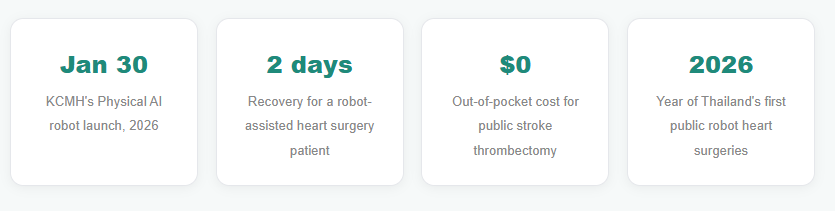
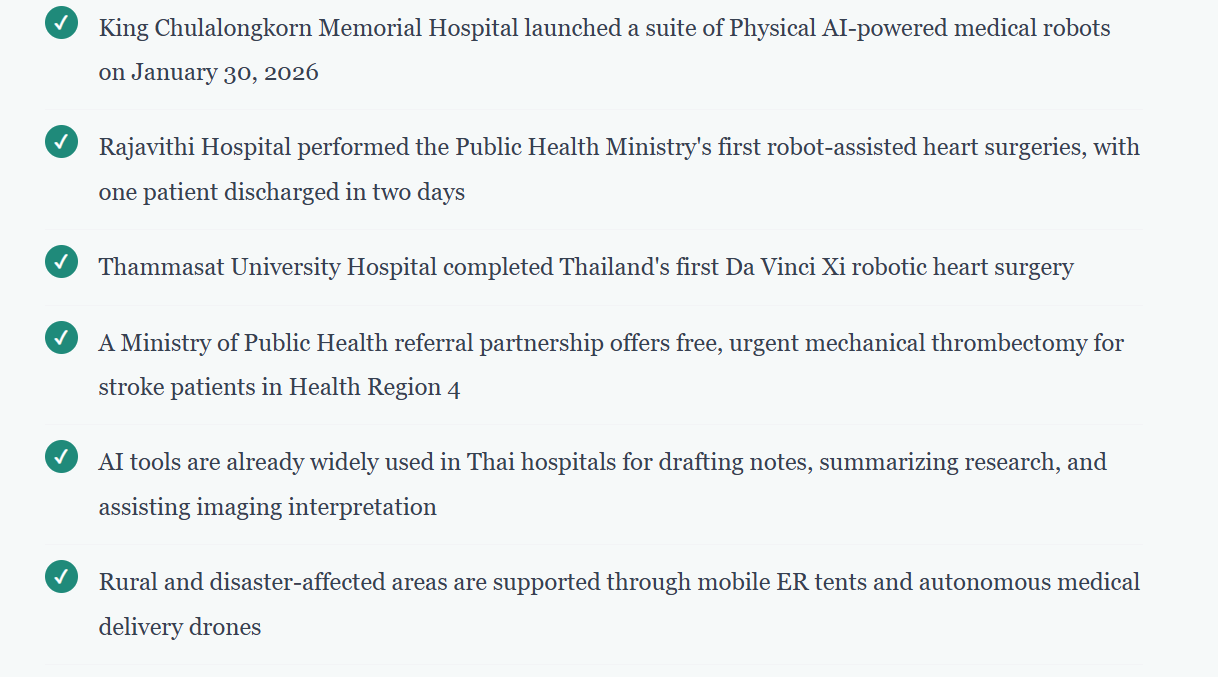
Walk into the right corridor at King Chulalongkorn Memorial Hospital these days, and you might find yourself sharing the hallway with a robot. Not a background prop or a marketing gimmick wheeled out for a press photo, but an actual working piece of the hospital's daily operations, built to interact with patients, assist clinical staff, and quietly shift what a hospital visit in Bangkok looks like in 2026. It's a small, specific image, and it captures something much bigger happening across Thailand's healthcare system right now. Over the past several months, Thailand has moved from talking about AI-assisted healthcare as a future ambition to actually deploying it, in flagship university hospitals, in public regional facilities, and increasingly in the operating rooms where the country has built much of its international medical reputation. The pace and breadth of that rollout is worth understanding in detail, both for what it says about where Thai healthcare is headed and for what it means for the millions of patients, domestic and international, who rely on it. The flagship launch that set the tone The clearest signal of intent came on January 30, when King Chulalongkorn Memorial Hospital, together with the Faculty of Medicine at Chulalongkorn University and telecom giant True Digital, formally launched a suite of Physical AI-powered medical robots designed to assist directly in patient services. The event, held at the hospital's Rattanavithaya Building, wasn't framed as an experimental pilot but as a structural step toward what the partners are calling a genuine Digital Hospital. Central to that vision is a concept the partners describe as a Digital Intelligence Fabric, an underlying infrastructure layer meant to weave together everything from 5G connectivity and broadband to the software platforms and applications running on top of it, creating what Chief Digital Officer Ekaraj Panjavinin of True Corporation described as a seamlessly connected digital health ecosystem built to sustainably support ongoing medical innovation, rather than a single standalone gadget bolted onto existing hospital workflows.
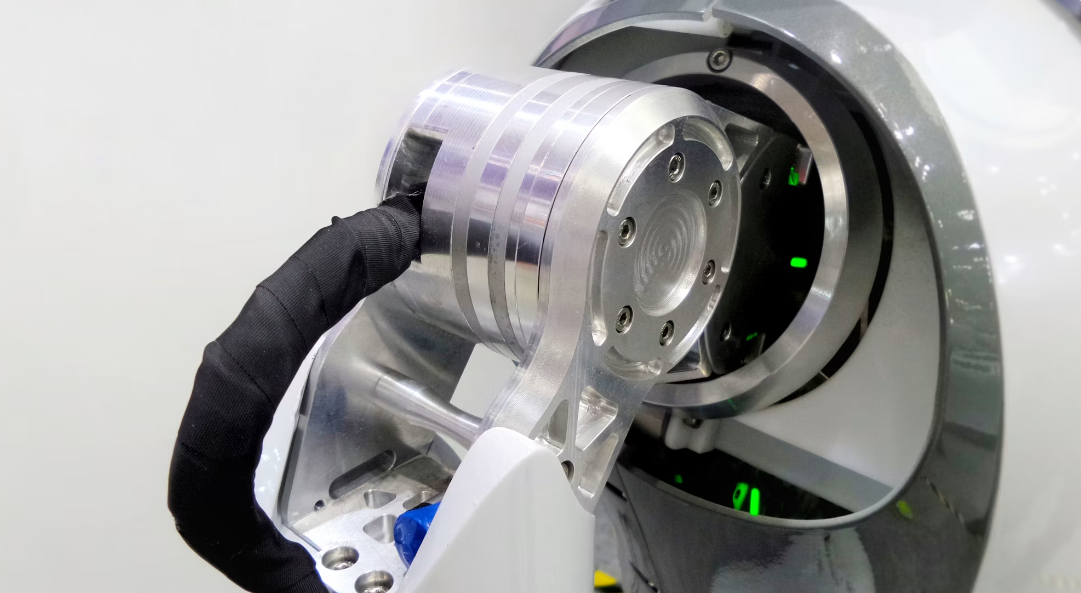
Among the specific tools introduced was a Medical Robot for Treatment and Physical Rehabilitation, purpose-built to support the care of tuberculosis patients, a detail that signals something important about how Thailand is approaching this rollout: not chasing the most headline-grabbing robotic applications first, but targeting specific, well-defined clinical needs where automation and AI assistance can meaningfully reduce risk to both patients and the medical staff treating them.
Robots with names, donated equipment, and everyday clinical work
Not every part of this shift is happening at a flagship university hospital with a formal launch event. At Charoenkrung Pracharak Hospital in Bangkok, two robots named Pro 4 and AI Nose, donated by Sahamitr Pressure Container PCL, have been quietly integrated into outpatient services, a reminder that this trend isn't confined to the most prestigious or well-funded institutions in the country. Corporate donations and public-private partnerships are functioning as a genuine distribution mechanism, helping robotic and AI tools reach hospitals that wouldn't otherwise have the budget to develop this kind of technology internally.
As a February op-ed in the Bangkok Post put it, artificial intelligence in Thai healthcare is no longer a distant innovation confined to technology firms, it's quietly entering hospitals, medical schools, and administrative offices simultaneously. In clinical settings specifically, that means AI systems now routinely draft medical notes, summarize research, help structure differential diagnoses, and assist with interpreting medical imaging, work that used to consume disproportionate amounts of a clinician's time and attention.
"What appears today as a productivity tool may in fact represent a structural shift in how healthcare operates."
— Watcharin Ariyaprakai, Bangkok Post
Where this matters most: rural stroke care and public hospitals
Perhaps the most consequential part of Thailand's healthcare AI push isn't happening in Bangkok's flagship institutions at all, but in how the country is using digital infrastructure to close long-standing gaps in regional care. In Health Region 4, covering provinces including Ayutthaya, Nonthaburi, and Pathum Thani, the Ministry of Public Health has established a partnership connecting local facilities with Thammasat University Hospital and the Prasat Neurological Institute, allowing stroke patients to be referred swiftly for urgent, catheter-based mechanical thrombectomy, a life-saving clot removal procedure, at zero out-of-pocket cost to the patient.
That detail matters enormously for a country where access to specialized, time-critical treatment has historically depended heavily on geography. Stroke care in particular is a race against time, where minutes genuinely determine long-term outcomes, and a digital referral system that gets patients from a regional facility to a specialized stroke hub quickly, regardless of where they happen to live, addresses one of the most persistent inequities in emergency medicine.
The bigger public health goal
Thailand's Ministry of Public Health has been explicit that the aim behind this modernization push is equal access to advanced medical care, regardless of a patient's physical location, not simply showcasing new technology at flagship urban hospitals. The MorPhrom digital platform, expanded as part of this same effort, is designed to make that access tangible for ordinary patients navigating the public healthcare system.
Public hospitals, private-hospital procedures
One of the more striking developments in 2026 has been the entry of robot-assisted cardiac surgery into Thailand's public hospital system, a procedure historically associated almost exclusively with premium private facilities catering to wealthy domestic patients and medical tourists. Rajavithi Hospital, operating under the Department of Medical Services, completed the Public Health Ministry's first two robot-assisted heart surgeries this year, with officials linking the milestone to a broader push for higher treatment standards, improved surgical precision, fewer complications, and wider access to genuinely specialized cardiac care.
One patient who underwent the procedure was discharged after just two days, a recovery timeline that stands in sharp contrast to the longer hospital stays typically associated with traditional open-heart surgery. Separately, Thammasat University Hospital carried out what's being described as Thailand's first Da Vinci Xi robotic heart surgery, a technically demanding procedure that requires a surgical team capable of working with real precision in a confined operative field, alongside an operating system built specifically around that level of coordination.
Why this matters for Thailand's medical tourism industry
For decades, Thailand has built a genuinely significant medical tourism industry around Bangkok, Phuket, and Chiang Mai, drawing millions of international patients seeking world-class care at a fraction of what the same procedures would cost in Western countries. The current wave of AI and robotics investment isn't happening in isolation from that industry, it's reinforcing it, giving Thai hospitals a credible technological edge to point to alongside their existing reputation for skilled clinicians and lower costs.
Robotic surgery specifically has become a meaningful differentiator in that competitive landscape, applied to everything from precise joint replacements and delicate hearing implants to complex cancer treatments, including Hyperthermic Intraperitoneal Chemotherapy for advanced cases and genomic-targeted therapies. By demonstrating that its public healthcare infrastructure can safely regulate and scale these complex treatments, Thailand is reinforcing an international reputation that extends well beyond its private hospital sector.
Reaching beyond the hospital walls
Thailand's healthcare modernization push extends into areas that have little to do with robots in operating rooms at all. For rural regions affected by natural disasters or geographic isolation, the Ministry of Public Health has introduced mobile emergency room tents alongside autonomous delivery drones capable of carrying essential pharmaceuticals across rugged terrain that would otherwise be effectively inaccessible during a crisis. That combination, of advanced hospital-based robotics on one end and practical, rural-focused logistics innovation on the other, illustrates a healthcare strategy aimed at multiple layers of the system simultaneously rather than concentrating investment purely in flagship urban facilities.
Supporting infrastructure is being built out in parallel. Thailand Digital Valley, expected to reach completion by the end of the second quarter of 2026, is designed to support testing, talent development, and partnerships across the country's broader digital health ecosystem, while data infrastructure projects referred to as the Thailand Health Data Space, Health Link, and a Public Health Cloud are quietly building the technical backbone needed to let hospital systems share patient data securely across the country.
What this looks like from the patient's side
It's worth being precise about what all of this actually changes for someone walking into a Thai hospital today, because the reality is less dramatic, and more genuinely useful, than the phrase "AI-powered robots" might suggest. Nobody is being diagnosed or operated on entirely by a machine. What's changing is more incremental and, in most cases, more reassuring: surgeons operating with greater precision through robotic assistance, clinicians spending less time on documentation and more time with patients, stroke victims in provincial areas reaching specialized treatment in a fraction of the time it would have taken through traditional referral pathways, and hospital robots handling routine service and rehabilitation tasks that free up human staff for more complex clinical work.
Guidance circulating among Thai digital health advocates has consistently emphasized that AI features inside patient-facing apps and systems should function as "small helpers," not as a replacement for clinical judgment, alongside a clear expectation that patients understand what data is being collected, why it's being used, and how to opt out where possible. That framing, of AI and robotics as an assistive layer rather than a wholesale replacement for human medical expertise, appears consistently across how Thai hospitals, universities, and public health officials are describing this rollout.