William BensonVIEW PROFILE →
Inside the AI Browser Wars: Why Every Tech Giant Suddenly Wants Your Address Bar
A category that barely existed eighteen months ago has become one of the most volatile fights in tech, complete with a front-runner that rose fast and flamed out even faster.
A category that barely existed eighteen months ago has become one of the most volatile fights in tech, complete with a front-runner that rose fast and flamed out even faster.
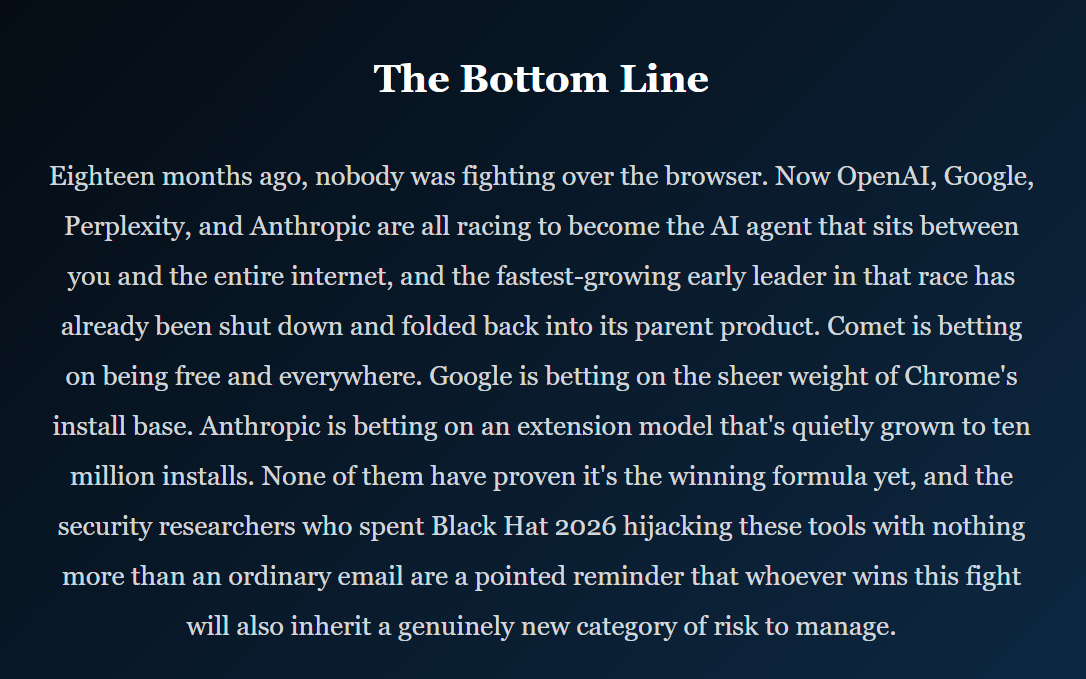
For three decades, the web browser was one of the most stable, unglamorous pieces of software most of us used every day. Open it, click a link, read a page, close it. Nobody wrote breathless headlines about browser innovation. That quiet corner of computing has, somewhat suddenly, turned into one of the most closely watched, fastest-moving battlegrounds in the entire tech industry, and the reason comes down to one deceptively simple idea: what if the browser didn't just show you the web, but actually did things on it for you? That idea now has a name, the agentic browser, and it has pulled OpenAI, Google, Perplexity, and Anthropic into a genuine arms race over the past year. One of the earliest front-runners has already come and gone. The rest are still fighting, and nobody has quite settled on what a winning browser is even supposed to look like. What Actually Makes a Browser "Agentic" Traditional browsers are fundamentally passive. They wait for a click, load a page, and wait again. An agentic browser flips that relationship. Rather than simply displaying a webpage and waiting for instructions, these tools embed an AI assistant capable of reading a page, deciding what to do next, and actually taking action, summarizing a long article or an overflowing email inbox, filling out forms, sending calendar invites, comparing prices across multiple sites, and carrying out multi-step tasks from a single plain-language instruction. In practice, that means telling a browser something like "find me the cheapest flight to Lisbon next weekend and add the best option to my calendar" and having it actually go do that, visiting multiple sites, comparing results, and completing the booking flow largely on its own. It's a genuine shift in what a browser is for, from a window you look through to something closer to an assistant that works on your behalf.
The Meteoric Rise, and Sudden Fall, of Atlas
For a stretch of time, OpenAI's ChatGPT Atlas looked like the browser to beat. Launched in October 2025 as a dedicated, standalone product, Atlas shipped with an Agent Mode capable of executing multi-step tasks with minimal hand-holding, and it captured the imagination of early adopters almost immediately. Within months, it had climbed to somewhere between 10 and 15 million monthly active users, the fastest growth of any entrant in the category, and posted the highest agentic task-completion rate among the AI browsers independently tested, finishing roughly 76 percent of the jobs handed to it.
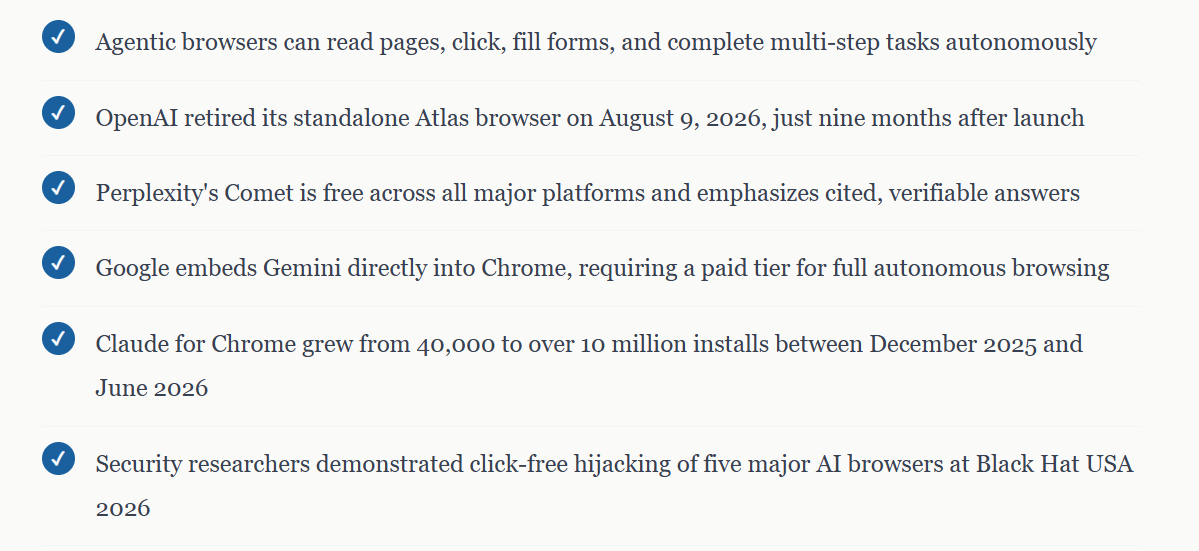
Then, in a twist that says a lot about how unsettled this market still is, OpenAI pulled the plug on its own breakout hit. On July 9, 2026, the company announced it would retire the standalone Atlas browser entirely, with the product ceasing to function on August 9, barely nine months after its high-profile launch. OpenAI's official explanation framed the move less as a failure than a strategic pivot, folding the browser-based agentic capabilities the team had learned building Atlas directly into ChatGPT and Codex instead, alongside a broader new product called ChatGPT Work aimed at competing head-on with Anthropic's own Claude Cowork.
"As chatbot search and task execution capabilities in ChatGPT strengthen, work previously requiring an AI browser can now be done directly within conversations." — OpenAI, on retiring Atlas

Comet's Pitch: Research First, Free Everywhere
While Atlas retreated, Perplexity has kept pressing its own distinct advantage with Comet, a browser positioned around research and citation rather than pure task execution. Comet can summarize emails, browse pages, send calendar invites, and complete multistep tasks, but it does so while consistently citing the sources it pulled information from, a deliberate design choice aimed at users who want to verify what an AI assistant tells them rather than simply trusting it outright.
Two details set Comet apart from its rivals structurally. It's the only one of the major AI browsers available across all four major platforms, Windows, macOS, iOS, and Android, and it has been offered completely free of charge since October 2025. That combination of broad availability and zero cost has made it a natural landing spot for users who might have otherwise gravitated toward the now-defunct Atlas.
Google's Advantage: It Doesn't Need You to Switch
Google's strategy sidesteps the adoption problem entirely by leaning on its single greatest asset, the sheer ubiquity of Chrome itself. Rather than asking users to download and switch to a brand-new browser, Google simply built its Gemini assistant directly into the browser billions of people already have open on their desktop. That distribution advantage is difficult for any standalone competitor to match, no download friction, no behavioral switching cost, just an assistant that's suddenly there the next time Chrome updates.
The pricing structure reflects the computational reality behind these features. Basic Gemini capabilities in Chrome are available on a free tier, but the fully automated browsing experience, the kind capable of completing complex multi-step tasks independently, requires a paid subscription to Google AI Pro or the higher-tier Ultra plan, a tacit acknowledgment of just how much backend computing power genuinely autonomous browsing actually consumes.
Why Anthropic took a different path entirely
Rather than building a standalone browser or embedding directly into an existing one at the operating-system level, Anthropic released Claude for Chrome as an extension, available to paying Claude subscribers. According to Chrome Web Store data, the extension grew from around 40,000 installs in December 2025 to more than 10 million by June 2026, crossing the 1 million mark as early as February, a growth curve that suggests real appetite for agentic capability even in extension form.
The Uncomfortable Question Nobody's Fully Answered
Handing a piece of software the authority to act on your behalf, logging into accounts, filling out forms, potentially moving money or sensitive data, raises security questions that go well beyond anything a traditional browser ever had to answer. An agentic browser isn't just a tool anymore, it's an autonomous actor with meaningful permissions, and that makes it a genuinely new category of target for manipulation.
Those concerns moved from theoretical to demonstrated in August 2026, when security researchers at Zenity Labs showed at the Black Hat USA conference that five of the best-known AI browsers, Claude in Chrome, Gemini in Chrome, Perplexity Comet, ChatGPT Atlas, and Microsoft's Copilot Edge, could all be hijacked using nothing more than ordinary content: an email, a calendar invite, or a link buried under an innocuous social media post. Critically, the demonstrated attacks required no click from the victim at all, the AI agent itself was fooled simply by encountering the malicious content while carrying out its normal browsing tasks.
Why this risk is structurally different from old-school malware
A compromised AI browser doesn't just risk your device the way traditional malware might, it risks anything the agent has been granted access to: logged-in accounts, saved payment methods, calendars, email. Because the agent is designed to read and act on content automatically, the same feature that makes it useful is also what makes it exploitable without requiring a single click from the user.

Separately, a University of Washington study published in July 2026 tested seven agentic browsers, including Atlas, Chrome with Gemini, Claude for Chrome, and Comet, and found that four of them allowed attackers to bypass the same-origin policy, a foundational web security mechanism that has protected browsers since 1995. That a security boundary nearly as old as the modern web itself could be circumvented by newer AI-driven browsing features underscores just how much unresolved risk sits underneath this entire category, even as adoption accelerates.
Why the Numbers Deserve a Little Skepticism
It's worth pausing on where these adoption figures actually come from. Independent market analysis from eMarketer projects that all AI browsers combined will capture only 1 to 3 percent of the global browser market in 2026, describing agentic browsers as facing what it calls a towering barrier to entry despite the surrounding hype. Most of the headline adoption numbers currently circulating, including the user counts reported for both Atlas and Comet, originate from the companies themselves rather than independent, third-party verification.
That gap between company-reported enthusiasm and independently measured market share doesn't mean the technology isn't real or improving quickly, the underlying capability genuinely has advanced fast. It does mean the "browser wars" framing, however dramatic, is still playing out at the margins of how most people actually use the internet day to day, at least for now.
What determines the eventual winner
Three different strategic bets are running in parallel: OpenAI's now-abandoned dedicated app, Google's built-in ubiquity, and Perplexity's free, cross-platform openness. Each approach carries a real trade-off. A dedicated browser demands a genuine behavioral switch from users. An extension or built-in feature rides on existing habits but depends entirely on the health of its host platform. A free, ad-free product needs another way to eventually turn a profit. Nobody has definitively cracked the formula yet, and Atlas's abrupt shutdown is the clearest evidence so far that even a fast-growing early leader isn't guaranteed to survive the shakeout.
Why the Browser Is Worth Fighting Over at All
Stepping back from the individual product bets, the intensity of this competition makes sense once you consider what's actually at stake. The browser remains the primary gateway through which most people experience the internet, and whatever sits at that gateway effectively controls an enormous, continuous stream of attention, personal data, and commerce. An AI positioned between a user and the entire web is about as well-placed as software can be to become the default interface for a person's digital life, a prize substantial enough to justify launching, retreating, and relaunching in pursuit of it, exactly the pattern OpenAI's Atlas experiment just demonstrated in real time.