William BensonVIEW PROFILE →
The Quiet $10 Billion Bet: How Wall Street Decided Prediction Markets Were the Real Deal
The owner of the New York Stock Exchange just spent $2 billion betting that betting on the future is the future.
The owner of the New York Stock Exchange just spent $2 billion betting that betting on the future is the future.
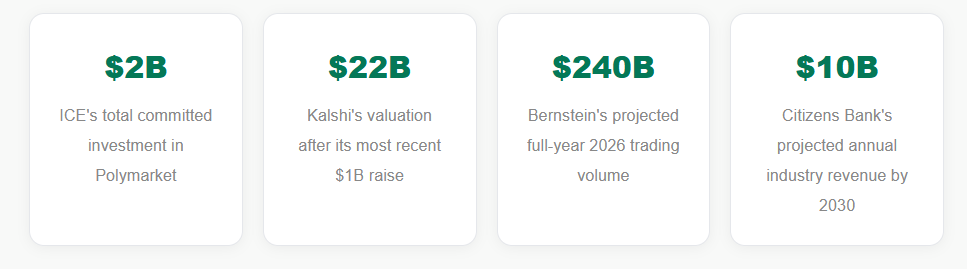
Eighteen months ago, prediction markets were mostly a curiosity, a place internet-savvy traders went to bet on who would win an election, dismissed by most of Wall Street as a gambling site wearing a finance costume. Today, the company that owns the New York Stock Exchange has poured $2 billion into one of them, its biggest rival just raised a billion dollars at a $22 billion valuation, and analysts are casually tossing around the idea that the whole category could be generating $10 billion a year in revenue before the decade is out. Something changed, fast, and it wasn't a fad finding an audience. It was Wall Street deciding this was infrastructure worth owning. The Deal That Changed the Conversation The turning point traces back to October 2025, when Intercontinental Exchange, the parent company of the New York Stock Exchange, announced it would invest up to $2 billion in Polymarket, a decentralized prediction market platform where users trade on the probability of real-world events, everything from elections and interest rate decisions to sports outcomes and cultural moments. The deal valued Polymarket at roughly $8 billion before the investment even landed, a striking figure for a platform that, just a few years earlier, was primarily known for one thing: letting people bet on the 2024 US presidential race. ICE didn't stop there. On March 27, 2026, the company completed an additional $600 million direct cash investment, fulfilling its full $2 billion commitment, and disclosed plans to purchase up to $40 million more in Polymarket shares from existing holders. For a company that runs the world's most recognizable stock exchange alongside futures and clearing operations spanning energy, equity, and credit markets, this wasn't a speculative side bet. It was a deliberate, deepening commitment to a category most of the financial establishment had barely taken seriously two years earlier.
Why ICE Actually Wanted In
Here's the detail that gets lost in most of the excited coverage: ICE's investment thesis was never primarily about prediction markets as a betting product. It was about data. Alongside its investment, ICE became the exclusive global distributor of Polymarket's event-driven data to institutional capital markets, and in February 2026 it launched the Polymarket Signals and Sentiment tool, a normalized data feed delivering crowd-sourced probability assessments as structured signals for institutional and professional traders.
In plain terms, ICE takes the real-time trading activity across thousands of Polymarket contracts, what the collective crowd believes about inflation, elections, central bank decisions, geopolitical flashpoints, and feeds it directly into its existing Consolidated Feed alongside securities pricing and corporate data that institutional traders already rely on daily. It's less "Wall Street embraces betting" and more "Wall Street found a new kind of market intelligence and decided to own the pipe it flows through."

Kalshi vs. Polymarket: Two Very Different Bets on the Same Idea
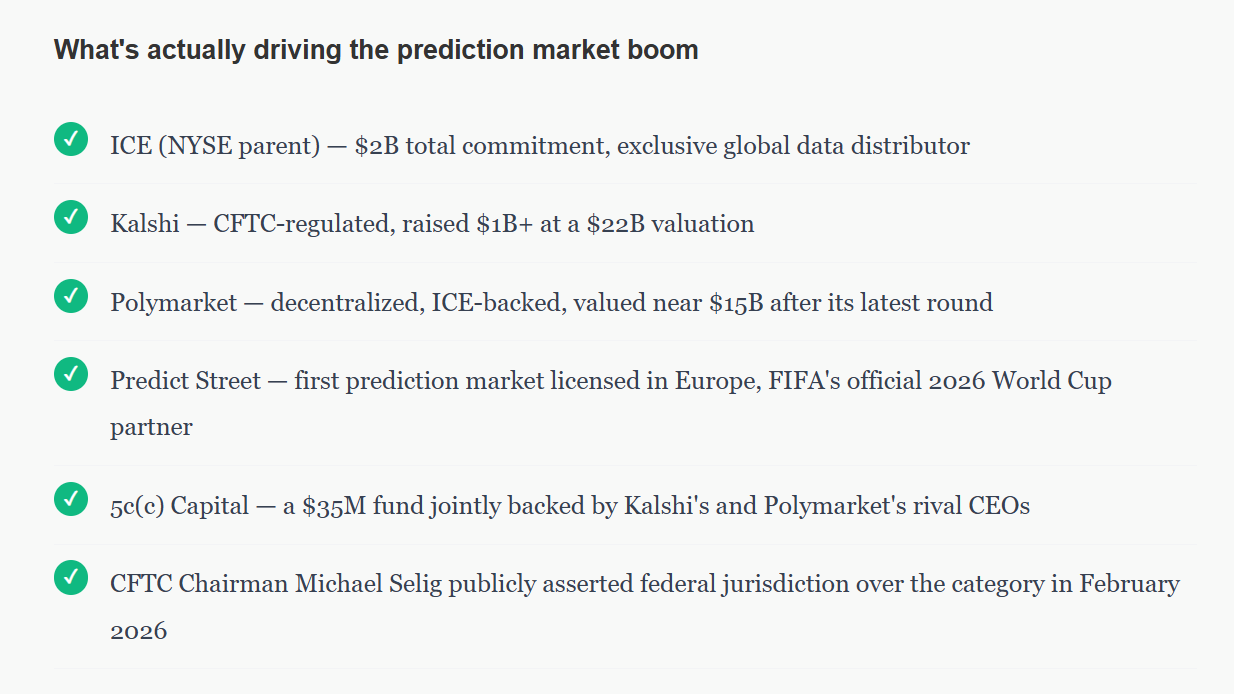
What makes this moment particularly interesting is that Wall Street isn't backing one horse, it's backing two fundamentally different approaches to the same underlying idea. Kalshi operates as a CFTC-regulated exchange, working entirely within the traditional US regulatory framework the way a futures exchange would. Polymarket, by contrast, runs on a more flexible, decentralized model, offering broader international reach, a wider variety of markets with fewer structural constraints, and the kind of rapid expansion that flexibility allows, covering everything from economic indicators to crypto events and cultural moments.
By backing the decentralized version so heavily, ICE made a specific strategic bet: that the future of this category favors scale and global participation over staying tightly inside one country's existing regulatory lines. Kalshi's own trajectory tells a parallel story of legitimacy, its valuation reaching $22 billion on the back of more than $1 billion in fresh funding, with an estimated $1.5 billion in annual revenue, numbers that would have sounded absurd for a "betting site" just two years ago.
Perhaps the clearest signal of how seriously the industry now takes itself: the CEOs of Kalshi and Polymarket, direct competitors fighting for the same market, are jointly backing 5c(c) Capital, a new venture fund aimed specifically at the next wave of prediction market startups.
The Regulatory Green Light Nobody Expected This Fast
None of this institutional rush happened in a regulatory vacuum, and the timing of the federal government's posture mattered enormously. On February 17, 2026, CFTC Chairman Michael Selig published a Wall Street Journal op-ed that effectively planted a federal flag over the entire category. His message to individual states pursuing bans and lawsuits against prediction market platforms was blunt: the CFTC would no longer sit back while state governments, in his framing, undermined the agency's exclusive jurisdiction over these markets.
That single public stance did more to legitimize the space in the eyes of institutional capital than any single funding round could have. Regulatory clarity, or at least a clear federal claim to that clarity, is precisely the kind of signal large, risk-conscious institutions like ICE need before committing billions of dollars, and its arrival lines up almost exactly with the acceleration in institutional investment that followed.

It's Not Just an American Story Anymore
While most of the noise around this boom remains distinctly American, centered on Kalshi and Polymarket, the same institutional logic is starting to take root in Europe. Predict Street, licensed in Gibraltar, became the first prediction market platform formally licensed anywhere in Europe earlier in 2026, and secured a genuinely notable partnership: official prediction market partner status for the 2026 FIFA World Cup. That's not a niche crypto community milestone, it's a mainstream sports institution formally putting its name next to a prediction market platform, the kind of endorsement that would have been unthinkable for the category just a couple of years earlier.
A Few Honest Questions People Are Actually Asking
Is this basically just legalized sports betting with extra steps? Not exactly. While sports outcomes are one popular category, prediction markets cover a much broader range, economic indicators, political outcomes, corporate events, and increasingly, the kind of institutional-grade sentiment data ICE is now distributing to professional traders, a use case that has little to do with recreational betting.
Why would a company like ICE want to be associated with something that still looks like gambling to a lot of people? ICE's public framing has consistently centered on data infrastructure and market signals rather than the trading itself, and its investment is structured around distribution rights to that data, not consumer betting revenue, a distinction the company has been careful to draw.
Could regulators still shut this down? It's a live question. Individual states have pursued bans and legal challenges, and the CFTC's February 2026 assertion of federal jurisdiction, while a strong signal, is not the same as a final, settled legal resolution across every state.
What This Actually Signals About Where Markets Are Headed
Strip away the specific platforms and dollar figures, and the underlying story here is genuinely significant: one of the most established, conservative pillars of traditional finance just spent $2 billion validating an asset class that barely existed in its current form three years ago. That's not the behavior of an industry treating something as a passing trend, it's the behavior of an industry that looked at a new way of pricing collective belief about the future and decided it wanted a stake in owning the infrastructure underneath it.
Whether prediction markets actually reach that $10 billion annual revenue figure analysts are floating for 2030 remains genuinely uncertain, forecasts at this stage of any fast-growing category tend to run optimistic. What's much less uncertain is that the skepticism prediction markets faced even two years ago, dismissed as a niche election-cycle gimmick, has largely evaporated at the institutional level. Wall Street doesn't move $2 billion into something it still considers a fad.
A note on the numbers
Valuation figures, trading volumes, and revenue projections in this piece reflect reporting and industry estimates as of August 2026, drawn from sources including Business Wire, CoinDesk, and Citizens Bank research. Prediction market valuations and volumes remain highly fluid; treat these as a snapshot rather than fixed figures.