William BensonVIEW PROFILE →
Inside the Gulf's $500 Billion Bet to Put Real Estate on the Blockchain
Saudi Arabia and the UAE aren't experimenting with tokenization anymore. They're building it as national financial infrastructure.
Saudi Arabia and the UAE aren't experimenting with tokenization anymore. They're building it as national financial infrastructure.
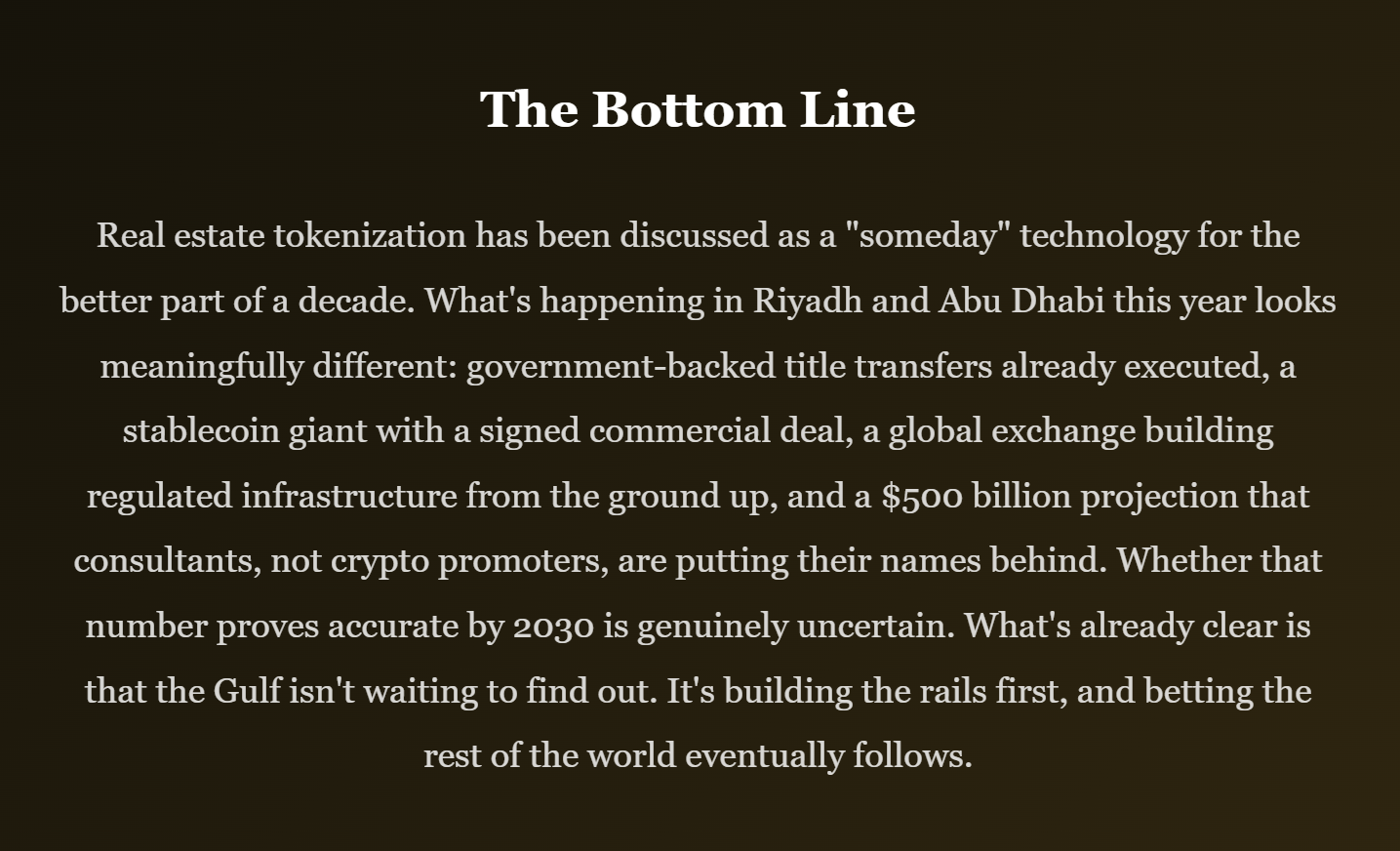
There's a specific moment that tends to separate a genuine financial shift from a passing crypto trend, and it's when the world's largest, most conservative institutions start showing up. That moment arrived for real estate tokenization in the Gulf twice in the space of two weeks this August, first when Tether, the company behind the world's biggest stablecoin, signed on to help digitize Saudi property, and then when Coinbase, one of the most closely regulated exchanges in the industry, chose Abu Dhabi as the home for its entire global tokenization business. Neither of those moves happened in isolation. They're both pieces of a much larger, deliberately coordinated push by two Gulf governments to turn physical wealth, buildings, land, private funds, even bank deposits, into something that can be split into digital tokens, traded instantly, and owned in fractions rather than whole. Consultants now put a number on how big that shift could get: roughly $500 billion in Gulf assets on the blockchain within the next four years. What "tokenizing real estate" actually means Strip away the jargon, and the underlying idea is fairly intuitive. Tokenization takes something real, a commercial tower, a residential complex, a plot of land, and records ownership of it as digital tokens on a blockchain, rather than through the traditional stack of paper deeds, escrow accounts, and title registries. A single building that once required a single wealthy buyer or a consortium of investors can, in principle, be owned in small fractional slices by thousands of people, the same basic logic that lets an ordinary investor buy a single share of a public company instead of needing to buy the whole business outright. The appeal for a market like the Gulf's real estate sector is fairly direct. Institutional-grade property has historically been one of the most illiquid, paperwork-heavy asset classes in finance, transactions measured in weeks or months, ownership records scattered across registries, and access effectively restricted to investors with serious capital and serious patience. Tokenization promises to compress that timeline dramatically while opening the door to a far broader base of investors.
The Tether deal that got the industry's attention
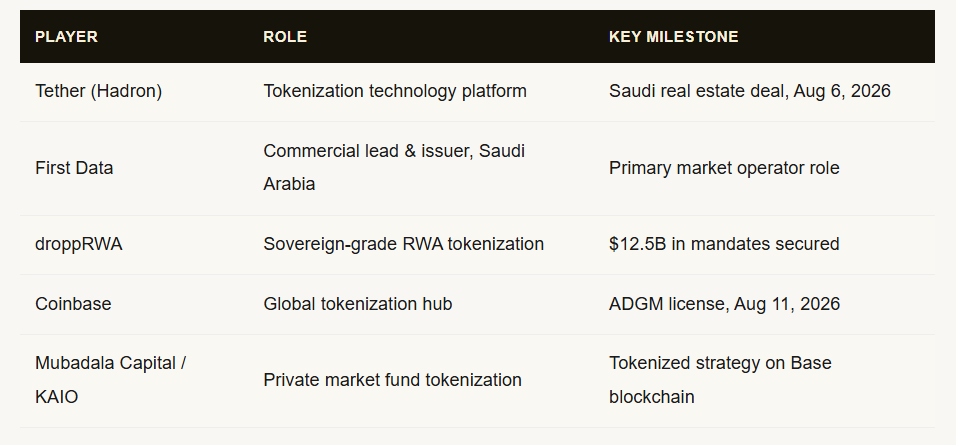
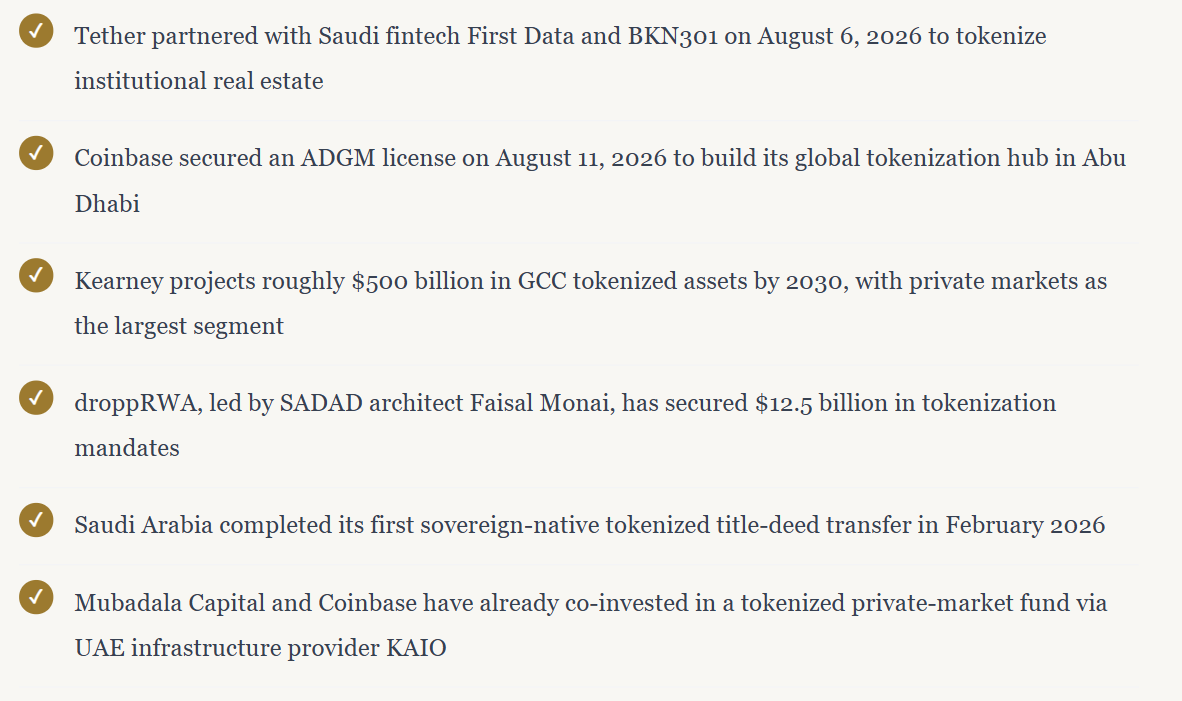
On August 6, Tether announced a three-way partnership with First Advanced Data for Artificial Intelligence, a Saudi fintech known as First Data, and BKN301, a fintech integration specialist, to bring institutional-grade real estate in Saudi Arabia onto the blockchain. The structure divides responsibility cleanly: Hadron by Tether supplies the core technology for issuing and managing the tokens, First Data acts as commercial lead and primary market operator, and BKN301 handles the banking connectivity and regulatory compliance layer that lets the whole system plug into Saudi Arabia's existing financial infrastructure.
What makes this particular deal significant isn't just its scale, it's who's behind it. Tether has spent most of its public identity as the issuer of USDT, the world's most widely used stablecoin. This deal marks a deliberate expansion beyond that identity, positioning the company as infrastructure for real-world assets more broadly, with real estate as the entry point and energy and infrastructure finance explicitly flagged as likely next steps.
"At Tether, we believe real-world asset tokenization will redefine the financial industry, making global assets more liquid, accessible, secure, and scalable."
— Tether, in its official announcement of the Saudi partnership
The man betting $12.5 billion on Saudi Arabia's blockchain future
Behind much of Saudi Arabia's tokenization ambition sits a figure with a track record that predates the entire crypto industry. Faisal Monai, chairman of droppRWA and the architect of SADAD, the Saudi Central Bank's digital payments network launched back in 2004, has secured approximately $12.5 billion in mandates to bring real-world assets onto the blockchain, starting with real estate and expanding toward energy and manufacturing across the broader economy.
Monai's own framing of the opportunity leans heavily on resilience rather than speculation, arguing that tokenization gives Gulf economies a way to insulate wealth from global economic shocks by improving liquidity and transparency across asset classes that have traditionally been slow-moving and opaque. His prediction is specific and ambitious: that by 2030, Saudi Arabia will have demonstrated, while much of the rest of the world is still debating the concept, that sovereign-grade tokenization can function as genuine national financial infrastructure rather than a niche financial product.
Why "sovereign-grade" matters here
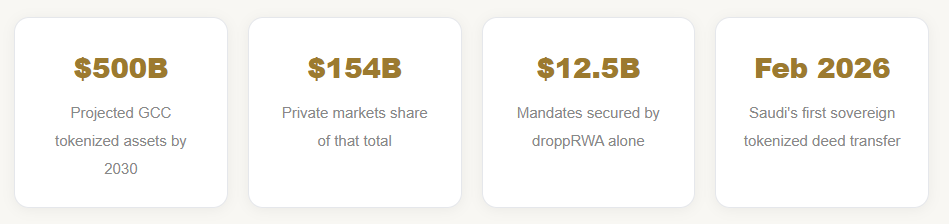
droppRWA's February 2026 tokenized title-deed transfer wasn't a private pilot project, it was executed through Saudi Arabia's own government property registry, cutting a settlement process that traditionally takes days down to seconds. That's a meaningfully different signal than a private company experimenting with blockchain technology on its own; it's a government treating tokenized property records as legitimate legal infrastructure.
Abu Dhabi's parallel bet: Coinbase moves in
While Saudi Arabia builds tokenization into its sovereign financial plumbing, the UAE has taken a different but complementary path, positioning Abu Dhabi as the regulatory home for major global crypto players entering the tokenization space. On August 11, Coinbase announced it had secured authorization from Abu Dhabi Global Market's Financial Services Regulatory Authority to arrange investment transactions and provide custody services for tokenized securities, a license that gives the exchange the legal footing to serve institutional clients who need their digital assets safely held and professionally managed.
Coinbase isn't arriving in an empty market. ADGM introduced one of the world's first dedicated virtual asset regulatory frameworks back in 2018 and now hosts more than 20 licensed virtual asset firms, including Binance alongside Coinbase. Mubadala Capital, the asset management arm of Abu Dhabi's sovereign wealth fund, has already tokenized one of its private-market investment strategies using UAE-based infrastructure provider KAIO, with Coinbase itself taking an exposure to that same fund, a detail that illustrates how tightly interconnected the region's tokenization ecosystem has already become.
Why consultants are putting a $500 billion number on this
The figure driving most of the current coverage comes from global consulting firm Kearney, which estimated in a January 2026 report that close to $500 billion in GCC assets could be represented on blockchain by 2030, spanning private markets, investment funds, bank deposits, public equities, real estate, and commodities. Of that total, Kearney identifies private markets as the single largest opportunity, projecting roughly $154 billion in tokenized private-market value by the same date, with commodities contributing a further $14 billion.
That kind of projection means little without infrastructure and regulatory clarity behind it, which is precisely why the pace of institutional entrants matters as much as the headline number itself. Executives tracking the region point to a specific combination of ingredients driving the pace: national-scale digitization programs, genuinely deep sovereign capital pools, an expanding technical talent base, and regulatory environments in both Riyadh and Abu Dhabi that, in this specific niche, are moving faster than most Western financial jurisdictions.
Tokenized real-world asset figures cited here reflect projections and estimates from Kearney, Ctrl Alt, and company statements as of August 2026. Tokenization remains an early-stage market, and actual asset volumes deployed onchain will depend heavily on regulatory developments and institutional adoption over the coming years.
What this means beyond the Gulf itself
It would be a mistake to read this purely as a regional story. Saudi Arabia and the UAE are, in effect, running a live test case for a question the entire global financial industry has been circling for years: can tokenized real-world assets function as genuine, trusted financial infrastructure, or will they remain a niche product layered awkwardly on top of traditional finance? The answer that emerges from Riyadh and Abu Dhabi over the next several years is likely to shape how seriously other major markets, including the United States, where JPMorgan, BlackRock, and other Wall Street institutions are also racing into tokenization, approach their own regulatory frameworks.
For founders, investors, and financial professionals watching where genuine institutional capital is actually flowing rather than where the loudest social media chatter is happening, the Gulf's tokenization push offers a fairly clear signal: this is no longer an experiment confined to crypto-native firms operating on the margins of traditional finance. It's a coordinated bet, backed by sovereign wealth, central bank alumni, and some of the largest names in digital assets, that the future of how real estate and other real-world assets are owned, traded, and settled looks fundamentally different from how it works today.
The open questions that will decide how far this actually goes
None of this is a guaranteed outcome yet, and it's worth being honest about the parts of this story that remain genuinely unresolved. Regulatory frameworks in both Saudi Arabia and the UAE are still relatively young, even if they're moving quickly by global standards, and questions around investor protection, cross-border legal recognition of tokenized ownership, and genuine secondary-market liquidity will ultimately determine whether tokenized real estate becomes a mainstream asset class or stalls out as a sophisticated but niche product for institutional players.
What's harder to dispute is the sheer concentration of serious capital and serious institutional names now converging on the same bet, within the same few weeks, in the same region. When a stablecoin giant, a major regulated exchange, a sovereign wealth fund's asset management arm, and a government's own property registry are all building toward the same infrastructure simultaneously, that's a considerably stronger signal than any single announcement could provide on its own.