William BensonVIEW PROFILE →
Inside the Most Expensive Hiring Spree in Corporate History, and What Happened When the Money Wasn't Enough
Mark Zuckerberg offered one researcher $1.5 billion. He said no. The ones who said yes walked into a division that's been reorganized four times, frozen its own hiring, and started losing people to the very labs it poached them from.
Mark Zuckerberg offered one researcher $1.5 billion. He said no. The ones who said yes walked into a division that's been reorganized four times, frozen its own hiring, and started losing people to the very labs it poached them from.
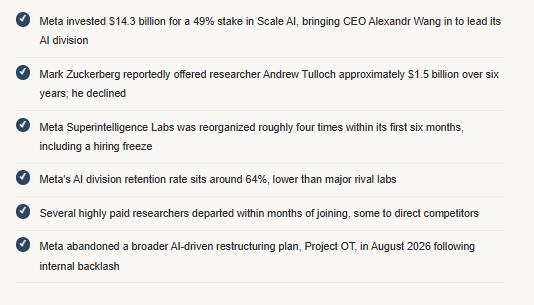
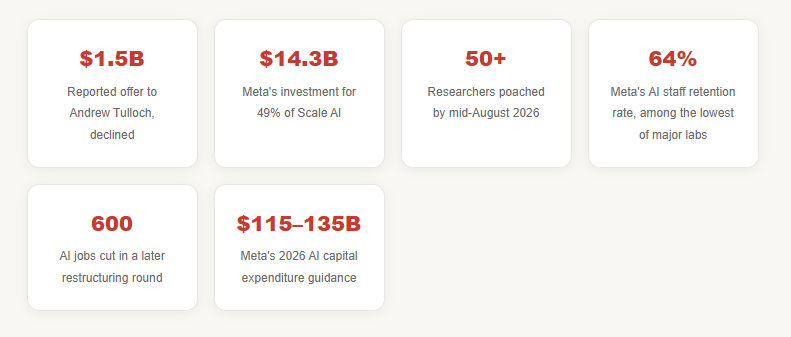
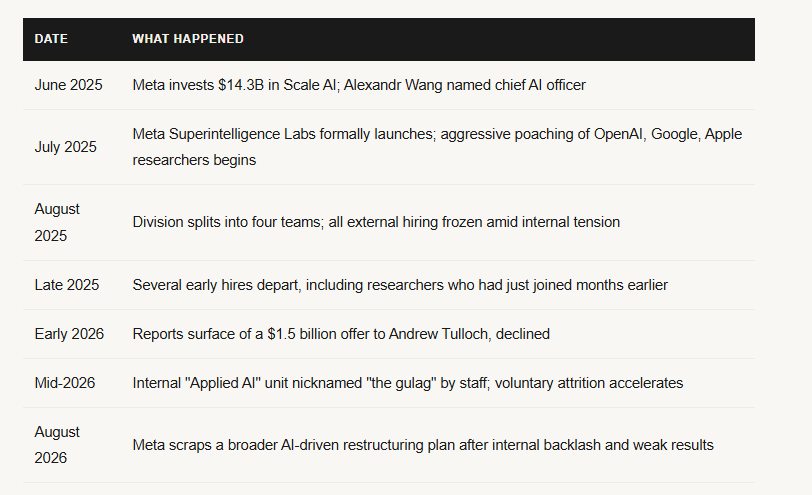
There's a specific moment that captures just how strange the AI talent market became in 2025 and 2026: Mark Zuckerberg personally offering a single researcher roughly $1.5 billion, spread over six years, to leave a startup and join Meta. The researcher, Andrew Tulloch of Thinking Machines Lab, said no. Not to a modest counteroffer, not to a lack of interest, to $1.5 billion. That single rejection tells you almost everything you need to know about how unusual this story is, and about the limits of what money alone can buy in a market this small and this strange. The Bet Behind the Billions Meta's spending spree traces back to a specific moment of self-diagnosis inside the company. By mid-2025, Meta was, by its own leadership's admission, behind. OpenAI had ChatGPT as a cultural phenomenon. Google had Gemini backed by the full weight of its search and cloud businesses. Anthropic had built Claude into a serious enterprise contender. Meta had Llama, a respected but strictly open-weight project that wasn't converting into the kind of product momentum its rivals had. Mark Zuckerberg's answer was to conclude that the scarcest resource in the entire AI industry wasn't compute or data, but the roughly two thousand researchers globally capable of pushing frontier models forward, and that Meta needed to simply outbid everyone for as many of them as it could get. What followed was a hiring campaign unlike anything Silicon Valley had seen. Zuckerberg assembled what insiders reportedly called "the List," a personal roster of target researchers, mostly from OpenAI, and began recruiting many of them directly himself, including invitations to his homes in Palo Alto and Lake Tahoe to discuss offers. Compensation packages reaching $100 million became almost routine for senior hires. Ruoming Pang, previously Apple's head of foundation models, joined with a package reported around $200 million. Shengjia Zhao, a co-creator of ChatGPT, signed for more than $300 million. And for a handful of the very top names, offers reportedly crossed into ten figures, an amount of money that blurs the line between hiring an employee and acquiring a small company. Sam Altman, OpenAI's own CEO, publicly called out the scale of Meta's offers, accusing the company of trying to buy its way into contention rather than earn it. Within Meta, the pitch was framed differently: as an unmatched combination of computing power, talent density, and mission, not just money. The Scale AI Move That Bought a Leader, Not Just a Company The most consequential single deal in the entire campaign wasn't really about hiring an individual researcher at all. In mid-2025, Meta invested roughly $14.3 billion for a 49% stake in Scale AI, a data-labeling company central to how frontier models get trained. Bundled into that investment was Scale's young CEO, Alexandr Wang, who joined Meta as chief AI officer and was installed to co-lead the newly created Meta Superintelligence Labs, alongside former GitHub CEO Nat Friedman. It was a genuinely novel piece of dealmaking: using an investment in a company as the vehicle for acquiring its leadership and its credibility with the research community. Wang has been candid about how he pitches researchers on joining, pointing to Meta's raw computing power, the density of talent already assembled, and the scale of ambition behind the project as the pitch, rather than compensation alone. Under the new structure, every division head across Meta's AI operation, including longtime chief scientist Yann LeCun, was reorganized to report directly to Wang, a significant reshuffling of a research organization Meta had spent over a decade building.

The Reorganizations Started Almost Immediately
What makes this story genuinely unusual isn't just the size of the offers, it's how quickly the division built around them started struggling. Within weeks of Meta Superintelligence Labs officially launching, the Wall Street Journal reported that Meta had split the unit into four separate teams and frozen all external hiring and internal transfers, an extraordinary reversal for an organization that had just spent months in an all-out spending war to build it. By some counts, it was the fourth reorganization of Meta's AI efforts within six months, a pace that even sympathetic industry observers described as chaotic.
The instability wasn't confined to the org chart. Internal reporting later described one of the newer divisions, a roughly 6,500-person Applied AI unit tasked largely with generating training data and coding puzzles for AI agents, as being nicknamed "the gulag" by its own staff, a sign of how far some of the day-to-day work had drifted from the frontier-research mission that justified the original recruiting spend. Engineers reportedly told they could "join or quit" largely chose to quit, with well-funded competitors like Anthropic, OpenAI, and a wave of new AI startups more than happy to absorb the departures.
The retention number that undercuts the whole strategy
According to SignalFire's State of Talent report, Meta's AI division retention rate sat around 64%, notably lower than rival labs. Paying more than anyone else to get researchers in the door turned out to be a very different problem from convincing them to stay, and the gap between those two challenges is arguably the real story behind Meta's AI year.
Money Bought Attention. It Didn't Always Buy Loyalty.
Some of the highest-profile departures came remarkably fast. Researchers who had joined with enormous compensation packages only months earlier were, by late 2025, already announcing their exits, in some cases publicly and pointedly. One departing researcher, Rishabh Agarwal, cited Zuckerberg's own past comments about risk-taking back at him on social media when explaining his decision to leave for a different opportunity after roughly seven and a half years across Google Brain, DeepMind, and Meta. It's a small, almost ironic detail, but it captures something real: for researchers operating at this level, a nine-figure paycheck buys attention, not automatically conviction in a mission or a workplace.

By August 2026, the broader picture had become one of retrenchment rather than expansion. Reuters reported that Meta quietly abandoned a more sweeping AI-driven restructuring plan, internally called Project OT, that would have used AI systems to absorb large portions of the workforce's daily tasks and potentially triggered a second wave of layoffs beyond the 10% workforce reduction already carried out earlier in the year. Employee-sentiment scores had reportedly dropped sharply after staff learned software was tracking their keystrokes and mouse movements as part of the plan, and internal backlash, combined with underwhelming AI results, was enough to shelve it, at least for the remainder of 2026.
What this actually says about the AI talent market
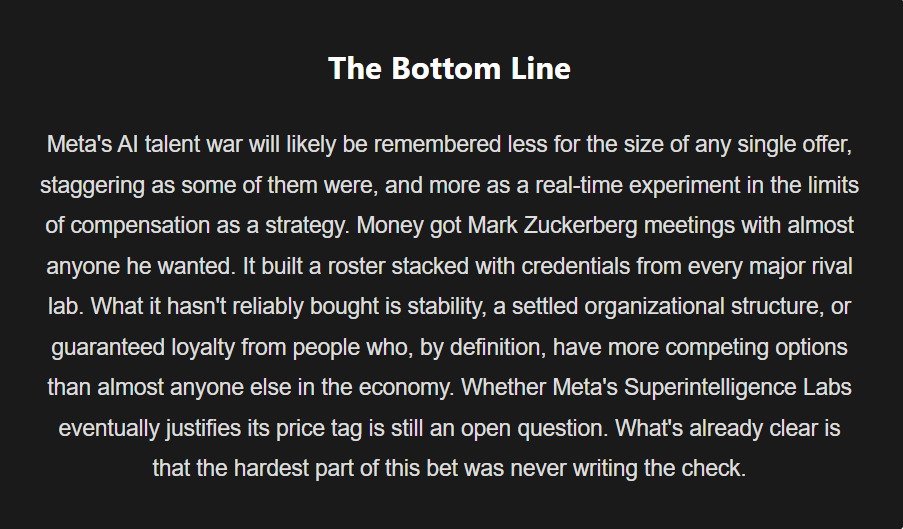
It would be easy to read this as a story about one company's missteps, but the underlying dynamic is bigger than Meta. When a genuinely scarce pool of roughly two thousand people capable of frontier AI research collides with hundreds of billions of dollars in infrastructure investment racing to be deployed, price signals stop behaving normally. Compensation stops functioning as a simple market-clearing mechanism and starts functioning as a bet, sometimes a wildly speculative one, on whether a handful of individuals can meaningfully shift the outcome of a trillion-dollar technology race. Meta's experience suggests that bet is real, but that it doesn't automatically solve the harder, less glamorous problems of organizational stability, clear mission, and day-to-day management that determine whether expensive talent actually stays and delivers.