 William BensonVIEW PROFILE →
Inside the Quiet Comeback That Rebuilt Microsoft Around the Cloud
A decade ago, Microsoft was the tech world's cautionary tale, a company that missed mobile and looked stuck in the past. Today it runs the cloud infrastructure behind the AI boom and owns a stake in OpenAI worth nearly a quarter-trillion dollars.
A decade ago, Microsoft was the tech world's cautionary tale, a company that missed mobile and looked stuck in the past. Today it runs the cloud infrastructure behind the AI boom and owns a stake in OpenAI worth nearly a quarter-trillion dollars.
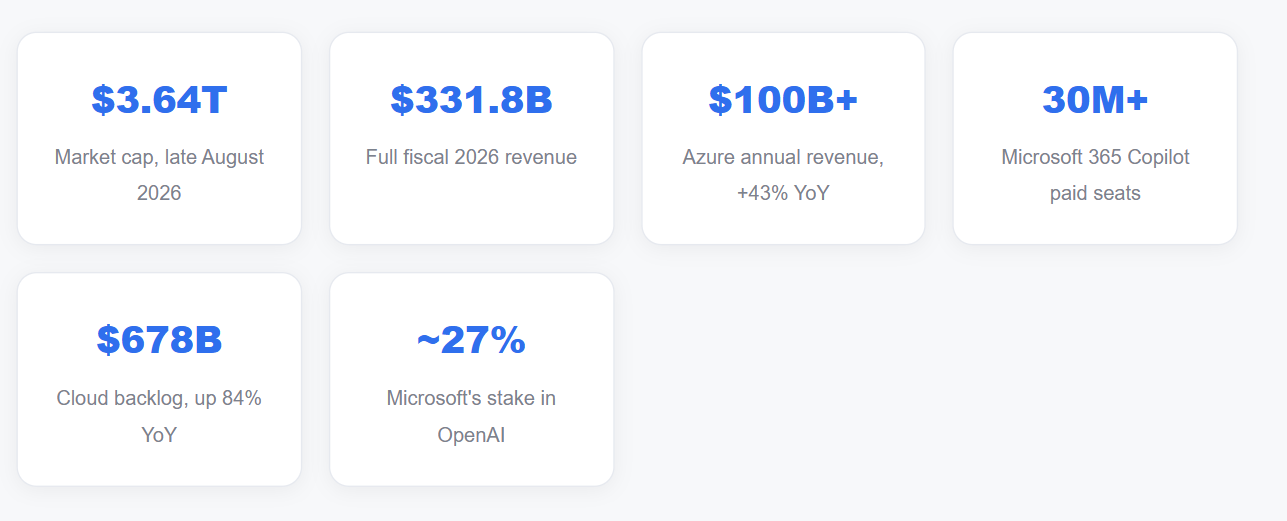
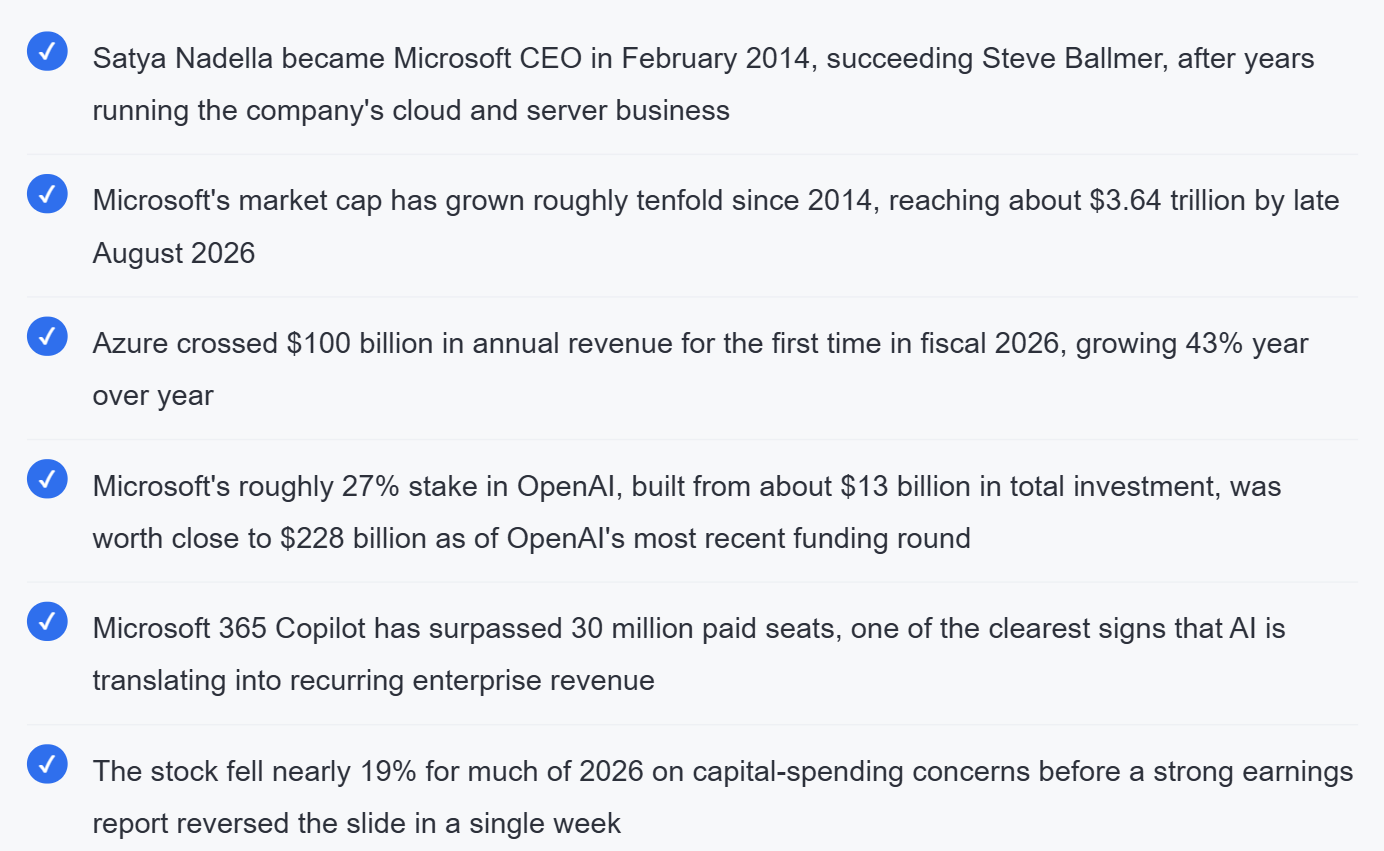
There was a stretch in the early 2010s when writing about Microsoft meant writing about decline. Windows Phone was dying, the Nokia acquisition looked like a mistake before it even closed, and the company that once defined personal computing had become the punchline in every conversation about companies missing the future. Then, in February 2014, the board handed the CEO job to a low-profile cloud executive named Satya Nadella, and over the next twelve years the story quietly flipped. Understanding exactly how that happened, and where the strategy is genuinely being tested right now, says more about the current AI boom than almost any other corporate story in tech. The Company Nadella Actually Walked Into It's easy to forget just how flat Microsoft's stock had been before 2014. For roughly a decade and a half, shares essentially went nowhere while the company's cultural relevance faded alongside them. Windows still generated enormous profit, but the growth story was gone, smartphones had passed Microsoft by entirely, and Google and Amazon were already years into building the cloud infrastructure that would define the next era of computing. Nadella, who had spent years quietly running Microsoft's server and cloud division, wasn't an outsider brought in to shake things up. He was an insider who had already seen, up close, which parts of the company still had room to grow. What followed wasn't a single bold pivot so much as a sustained, almost stubborn redirection of the entire company toward two things: cloud infrastructure and enterprise software subscriptions. Fiscal 2014 revenue, the year Nadella took over, was $86.8 billion, with Windows still effectively defining the business. By fiscal 2026, revenue had grown to $331.8 billion, and operating income was still climbing at a double-digit clip even at that scale. A $10,000 investment in Microsoft stock made on Nadella's first day as CEO would be worth somewhere around $124,000 today on price alone, closer to $150,000 with dividends reinvested, comfortably outpacing the broader market over the same period. Nadella didn't reinvent Microsoft's business. He picked the one part of it, the unglamorous, back-end infrastructure business, that was actually built for the next twenty years, and quietly bet the entire company on it. The Bet That Actually Redefined the Company: Cloud First Azure is the clearest evidence that the strategy worked. In the most recent fiscal year, Azure crossed $100 billion in annual revenue for the first time, growing 43% year over year, a genuinely unusual growth rate for a business already operating at that scale. Microsoft's broader cloud backlog, essentially contracted future revenue the company hasn't recognized yet, ended fiscal 2026 at $678 billion, up 84% from the year before, a figure that gives investors an unusually clear window into demand many quarters out. The most recent quarterly results made the scale of the shift obvious in a single earnings call. Revenue for the quarter came in at $90 billion, up 18% year over year, while net income jumped 31%. Microsoft shares rose roughly 18% in the week following that report, an enormous move for a company already worth well over $3 trillion, and one that flipped the stock from negative to positive for the year almost overnight.
The detail that matters more than it sounds Nadella has pointed to Microsoft's own custom AI silicon as a quiet but important lever going forward, noting that models running on the company's in-house chips deliver up to 40% better performance per watt compared with relying purely on external compute. In an industry where AI margins are increasingly determined by power and hardware efficiency, that's not a minor engineering detail, it's a direct lever on future profitability.

The OpenAI Bet That's Now Worth a Quarter-Trillion Dollars
If Azure is the engine, Microsoft's relationship with OpenAI is the accelerant, and the numbers behind it are almost hard to believe in hindsight. Microsoft's total investment across several rounds, starting with $1 billion in 2019 and eventually including a landmark $10 billion commitment in January 2023, adds up to roughly $13 billion. When OpenAI restructured its for-profit arm into a public benefit corporation in October 2025, Microsoft's stake was formalized at approximately 27% on a fully diluted basis, valued at the time around $135 billion. After OpenAI closed a $122 billion funding round in March 2026 at an $852 billion valuation, that same stake was worth closer to $228 billion, turning Microsoft's original investment into roughly an 18-fold paper gain.
The relationship hasn't stayed static, though. In April 2026, the two companies amended their agreement again, ending Microsoft's exclusive right to supply OpenAI's computing power, a change driven largely by the fact that OpenAI's compute needs had grown far beyond what even Microsoft could provide alone. Microsoft kept its equity stake and its cloud and licensing exclusivity, and has simultaneously worked to diversify its own AI model relationships, including a partnership with Anthropic, so that its Copilot products aren't entirely dependent on a single external lab.

Why the Stock Had Such a Rough Year Before the Rebound
None of this success came without real investor anxiety along the way. For most of 2026, Microsoft was actually the worst performer among the so-called Magnificent Seven, falling roughly 19% from January through midyear and trading nearly 30% below its 52-week high at one point. The core worry was straightforward: Microsoft is spending an enormous amount on data centers and AI infrastructure, reportedly close to $190 billion in capital expenditures this fiscal year alone, and investors weren't convinced that cloud demand would keep pace with that level of spending. It took a genuinely strong quarterly report, with Azure's growth and the Copilot seat numbers front and center, to flip that narrative and send the stock up double digits in a matter of days.
That volatility is a useful reminder that even a company this dominant isn't immune to the market questioning its spending discipline. Some analysts have since gone the other direction entirely, with at least one prediction suggesting Microsoft could be worth $5 trillion by 2029 if cloud and AI growth rates hold, and another floating the idea that Microsoft could overtake Apple as the world's most valuable company within roughly eighteen months. Neither is a certainty, but both reflect how quickly sentiment around the stock has swung in 2026 alone.
What's genuinely still uncertain
The biggest open question isn't whether Microsoft's cloud business is real, it clearly is, but whether the enormous capital spending behind it stays disciplined as AI competition intensifies from Google, Amazon, and a fast-growing list of well-funded rivals. There's also a structural question hanging over the OpenAI relationship: as OpenAI diversifies its compute providers and edges closer to a possible public listing, Microsoft's stake becomes both more valuable on paper and slightly less central to OpenAI's day-to-day operations. Neither risk is severe enough to undercut the last twelve years of results, but both are the kind of thing that could make Nadella's next chapter noticeably harder than his first.