 William BensonVIEW PROFILE →
Inside the Rockfall That Killed 14 Miners, and the Abandoned Shafts That Keep Claiming Lives
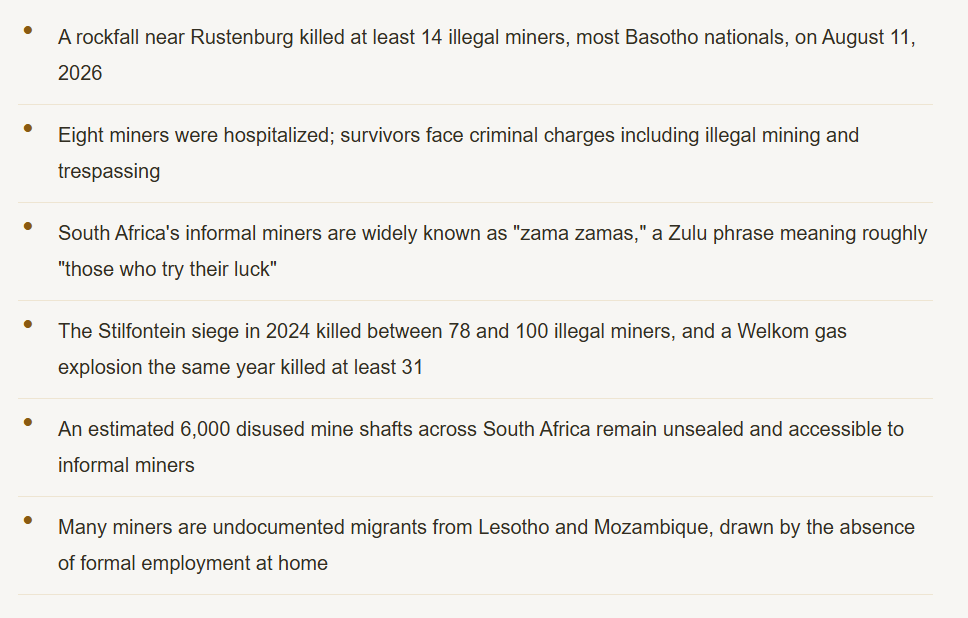
A rockfall at a disused mine near Rustenburg killed 14 illegal miners, most of them from Lesotho, in the third mass-casualty disaster in South Africa's abandoned mines in under two years.
A rockfall at a disused mine near Rustenburg killed 14 illegal miners, most of them from Lesotho, in the third mass-casualty disaster in South Africa's abandoned mines in under two years.
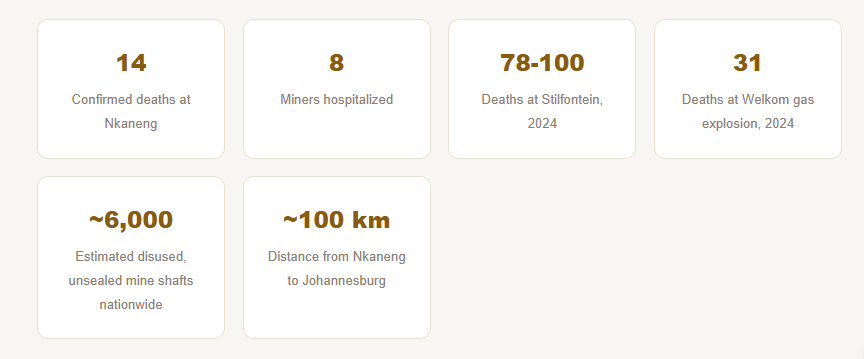
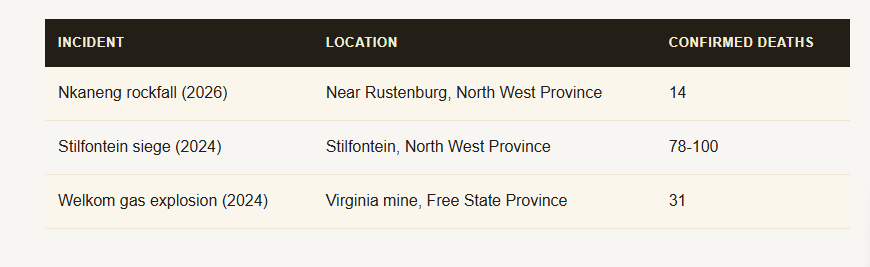
On the morning of August 11, 2026, a section of rock gave way deep inside a disused mine near the small settlement of Nkaneng, close to Rustenburg in South Africa's North West Province. By the time police reached the scene, 14 men were dead, most of them Basotho nationals from neighboring Lesotho, eight more were injured, and an unknown number remained unaccounted for underground. It was, in the words of one police spokesperson, an active scene in an area that has seen this exact kind of tragedy before, and will very likely see it again. What Happened at Nkaneng South African Police Service spokesperson Colonel Adele Myburgh confirmed the deaths in a statement, describing the miners as having been working underground when the rockfall occurred. Eight others were hospitalized, three of whom were later released and immediately arrested on suspicion of illegal mining, while five remained under police guard in hospital. Officials said an unknown number of additional miners may still have been trapped underground as the scene remained active into the following days. The site sits in an area of North West Province surrounded by several currently operating platinum mines, but the shaft where the collapse occurred had long since been abandoned by any formal mining company. Myburgh described the conditions bluntly: the miners had entered old mine shafts that had been abandoned and left in a severely deteriorated state, with no functioning infrastructure or safety systems of any kind protecting the people working inside them. They enter old mine shafts that have been abandoned and are in a severely deteriorated condition, without proper infrastructure or safety measures. Who the Zama Zamas Actually Are The miners involved in incidents like this one are widely known across South Africa as "zama zamas," a Zulu phrase that translates loosely to "those who try their luck," or "chance takers." Tens of thousands of them operate across the country's old gold and platinum mining regions, entering shafts that mining companies sealed off, sometimes decades ago, once a deposit was judged no longer commercially viable to extract through formal means. What counts as unprofitable for a listed mining company can still represent a meaningful income for an individual willing to take on extraordinary risk, and that gap has sustained an entire informal economy for years. Many of the miners working these shafts are undocumented migrants from South Africa's neighbors, particularly Lesotho and Mozambique, countries with far more limited formal employment opportunities. It's a detail that recurs across nearly every major incident of this kind: when the Lesotho government's foreign ministry has had to get involved in identifying casualties, it isn't a coincidence, it reflects how central Basotho labor has become to South Africa's underground informal mining workforce.
A Pattern That Keeps Repeating
The Nkaneng rockfall is not an isolated event, it's the latest in a grim sequence. In late 2024, a months-long standoff between police and illegal miners at a disused gold mine near Stilfontein, roughly 150 kilometers away, ended with somewhere between 78 and 100 confirmed deaths, most from starvation and dehydration after authorities cut off supplies to force miners to surface, a strategy that drew significant domestic and international criticism. Just months before that, at least 31 illegal miners were found to have died in a gas explosion at a shuttered mine near Welkom in the Free State province, a disaster that only came to light weeks later, after families in Lesotho reported relatives missing.
Fatal incidents of this kind are frequently underreported in real time, in part because survivors often avoid contacting authorities out of fear of arrest, a dynamic that can delay both rescue efforts and any accurate public accounting of how many people have actually died. Illegal prospecting remains widespread across South Africa's historic gold-mining regions, where an estimated 6,000 disused shafts, most never properly sealed after formal mining operations ended, offer both opportunity and extraordinary danger to those willing to descend into them.
Rescue, or arrest? A tension without an easy answer
South African law treats zama zama mining as a criminal offense, and police have confirmed that all surviving miners from the Nkaneng collapse will face charges including illegal mining and trespassing. That policy has drawn sustained criticism from labor rights and migrant advocacy groups following the Stilfontein siege, who argue that criminalizing the miners themselves, rather than focusing enforcement on the organized syndicates that control and profit from these operations, discourages injured survivors from seeking help and turns what should be a straightforward rescue operation into a fraught, adversarial standoff.
Why Men Keep Going Underground Despite the Risk
Understanding why this keeps happening requires looking past any single incident and toward the economics underneath it. South Africa's gold mining industry, once the largest in the world, has been in decades-long decline as the easiest, most accessible deposits were exhausted and formal mining companies shifted focus toward other regions and other minerals like platinum. That left behind a vast legacy of old infrastructure and residual ore that, while no longer profitable at industrial scale, remains extractable by hand for anyone willing to accept the risk of unsupported rock, poor ventilation, and zero emergency response infrastructure.
For migrants from Lesotho, where formal employment opportunities remain limited and remittances sent home from South Africa represent a meaningful share of household income for many families, the calculation, however dangerous, often comes down to a stark absence of better alternatives. President Cyril Ramaphosa's government has deployed soldiers as part of a yearlong operation specifically targeting organized crime, with illegal mining identified as a key focus area, but enforcement efforts have consistently focused on removing miners from these shafts rather than the more difficult, expensive work of permanently sealing thousands of abandoned entry points or dismantling the criminal syndicates that supply, extort, and profit from the miners working inside them.
What advocates say would actually reduce the death toll
Migrant rights and mining safety advocates have consistently pushed for a shift in approach following each of these disasters: properly sealing the thousands of abandoned shafts that make this activity possible in the first place, targeting prosecution efforts at the organized crime networks that control access to these mines rather than the individual miners working inside them, and creating a path for injured or trapped miners to seek emergency help without facing automatic arrest. None of those changes have been fully implemented following either the 2024 Stilfontein disaster or the Welkom explosion, a track record that offers little confidence the response to Nkaneng will look meaningfully different, unless something in that underlying policy calculus genuinely shifts.