 William BensonVIEW PROFILE →
Jorge Messi, the Father Who Carried His Son's Dream to Barcelona and Back, Has Died at 68
He was never the one on the field, but for two decades he was the steady hand behind one of the greatest careers football has ever seen.
He was never the one on the field, but for two decades he was the steady hand behind one of the greatest careers football has ever seen.
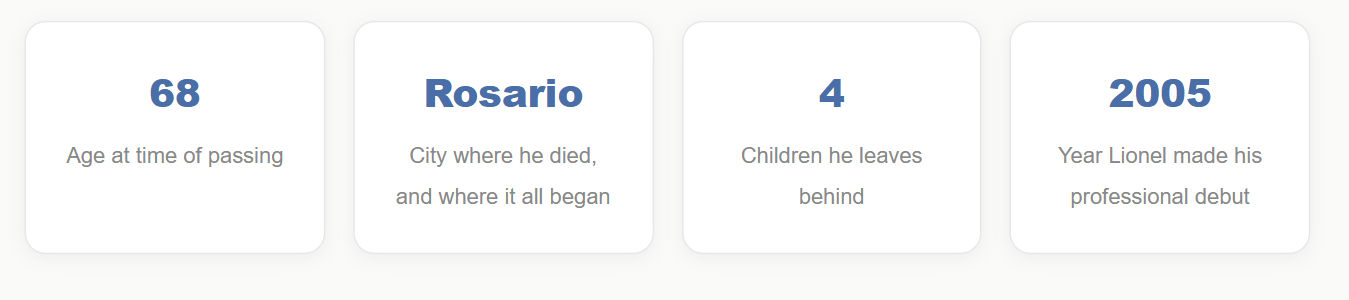
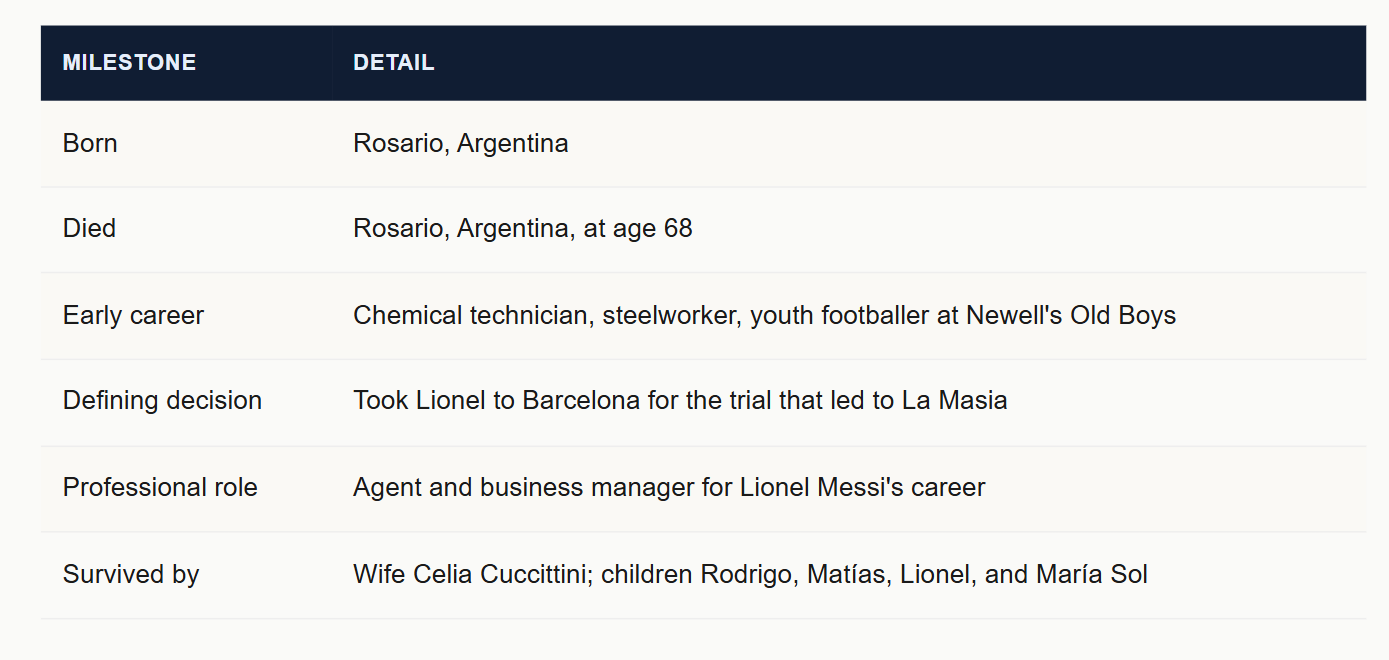
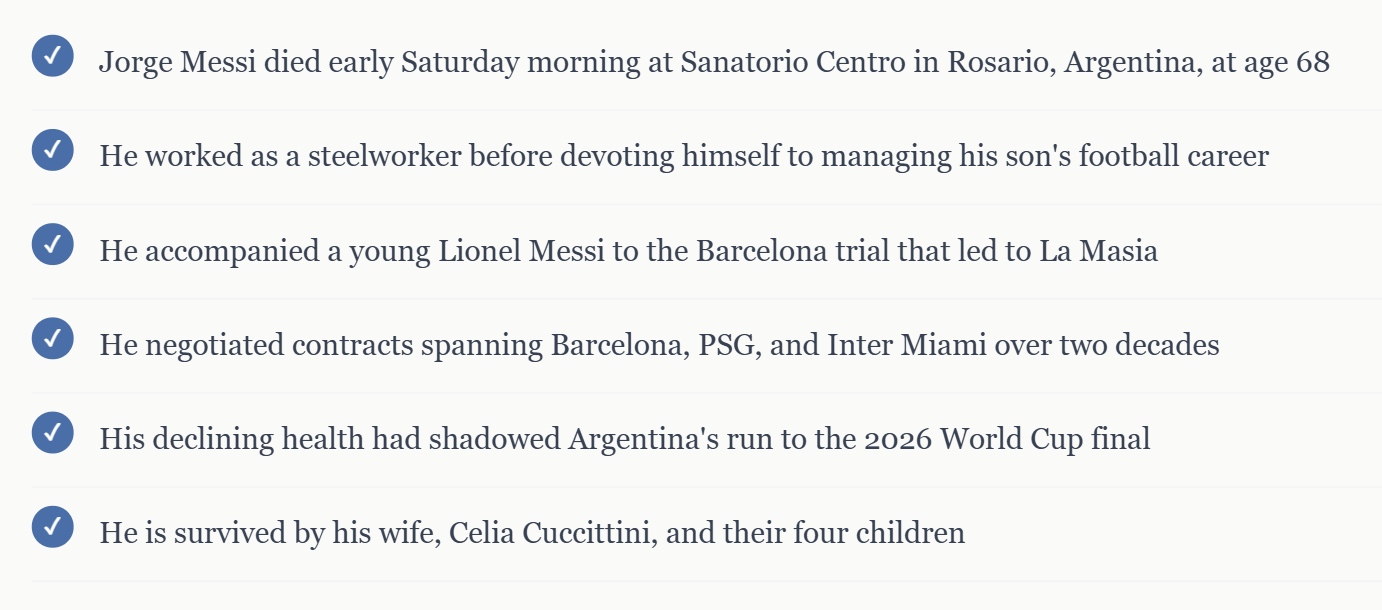
There's a particular kind of grief that arrives when someone who spent their entire life standing just outside the spotlight finally passes, and the world realizes just how much of the light they were actually holding up. That's the shape of the grief settling over Rosario, Argentina this week, following the death of Jorge Messi, the father, agent, and lifelong protector of Lionel Messi, at the age of 68. To most of the football world, he was a familiar figure glimpsed in the stands, a steady presence beside his son through triumphs and heartbreaks alike. To his family, and to the club that shaped him long before it shaped his son, he was something far more foundational: the man who made an impossible dream feel, somehow, entirely reasonable to pursue. A Death Confirmed in the Early Hours of Saturday Jorge Messi died in the early hours of Saturday morning at Sanatorio Centro, a medical center in Rosario, the central Argentine city where both he and his son were born and raised. In a statement, Dr. Carlos Mackey, the hospital's medical director, confirmed the death and offered condolences to the family, while noting that out of respect for the family's privacy, no further details regarding the specific medical circumstances would be released. The Rosario-based club Newell's Old Boys, where a young Lionel Messi first learned the game before his family's move to Spain, confirmed the passing in a tribute posted to social media. The club described Jorge as a devoted leproso, the nickname for Newell's supporters, a respected businessman, and the father who, alongside his wife Celia Cuccittini, underpinned the career of the best player of all time with vision, rigor, and affection.
From Steel Mill to the Stands of the World Cup Final
Jorge Messi's own story began far from the glamour that would later define his son's career. He worked as a chemical technician and later a steelworker, a solidly working-class path that stood in sharp contrast to the extraordinary life his youngest son would eventually lead. As a younger man, he had played soccer himself, reaching the youth ranks at Newell's Old Boys as a midfielder, though he ultimately had to step away from the sport to complete his mandatory military service in Argentina.
That early brush with the game he loved, cut short by circumstance rather than choice, may well explain the intensity with which he later devoted himself to ensuring his own son's path wouldn't be interrupted the same way. When Lionel began showing extraordinary promise as a child, Jorge didn't simply support him from a distance, he restructured much of his own life around giving that talent every possible chance to fully develop.
The Trip to Barcelona That Changed Everything
Perhaps the single most consequential decision of Jorge Messi's life came in the early 2000s, when he made the journey with a young Lionel to Barcelona for a trial that would ultimately open the doors to La Masia, the club's famed youth academy. It was, by any measure, a leap of faith, uprooting a family's life in Argentina on the strength of a talent that, however obvious to those who saw him play, was still just a boy's promise rather than a guaranteed outcome.
That decision would go on to define not just one career but an entire era of football. From La Masia, Lionel Messi rose through Barcelona's ranks, made his professional debut in 2005, and went on to collect eight Ballon d'Or awards, a record that remains unmatched. Jorge negotiated the contracts that made each step of that journey possible, later managing his son's move to Paris Saint-Germain and then to Inter Miami, while also overseeing the use of his son's image rights and a growing portfolio of business investments spanning real estate, hotels, and restaurants.
"My dad was always by my side. Sometimes I would lock myself in my room to cry when we arrived in Barcelona, or my dad would do the same without me seeing him. We pretended we were both OK, but we weren't." — Lionel Messi, in a 2007 interview
Not Without Its Difficulties
The relationship between father and agent was not without genuine complications. In 2013, both Jorge and Lionel were accused by Spanish prosecutors of attempting to conceal earnings related to the player's image rights, a case that ultimately saw Lionel cleared of wrongdoing while his father paid more than 5 million euros to resolve the matter. It's a chapter that doesn't erase the years of devoted support that came before and after it, but it's a part of the full picture of a man whose role in his son's life extended into every corner of a hugely complex career, not just the emotionally uncomplicated parts.
What emerges from that complexity, if anything, is a more human portrait than the simplified narrative of a devoted father alone might suggest, a man who took on the extraordinarily difficult task of being both parent and business manager to one of the most valuable athletes on the planet, and who, like anyone carrying that dual role, didn't navigate every decision perfectly.
A Health Battle That Shadowed the 2026 World Cup
For much of this year, Jorge Messi's declining health had quietly become a subject of concern within football circles, even as details remained largely private. He was unable to attend the 2026 World Cup in North America, a tournament Argentina reached the final of before losing to Spain on July 19. Lionel Messi, now 39, was visibly emotional in Argentina's opening match against Algeria after scoring the first of his three goals in the tournament, and he later attributed some of those early emotional moments to a family situation without elaborating further at the time.
Following the tournament's conclusion, Lionel Messi returned to Rosario to spend time with his father before rejoining Inter Miami for club action, time that, in retrospect, took on considerably more weight than it may have seemed to outside observers in the moment.
Tributes From Around the Football World
Condolences poured in quickly from institutions that had crossed paths with Jorge Messi over the decades. CONMEBOL, South America's football confederation, offered its condolences with what it described as respect and affection for Lionel. UNICEF, the international children's charity for which Lionel Messi serves as a goodwill ambassador, also paid tribute, describing Jorge as a person always committed to the rights of children and a benefactor of the organization's work, a role he took on quietly alongside his more visible responsibilities managing his son's career.
A family, not just a franchise
It's easy to reduce a figure like Jorge Messi to a single function, agent, businessman, gatekeeper. The tributes from Newell's, CONMEBOL, and UNICEF each point instead to a fuller picture: a father whose devotion extended well beyond contract negotiations, into decades of quiet, personal presence in his son's life.
What He Leaves Behind
It would be simple, and not entirely inaccurate, to describe Jorge Messi's legacy purely in terms of the career he helped build: eight Ballon d'Or awards, a World Cup title in 2022, a move to Barcelona that reshaped modern football, and a business empire built around one of the most recognizable names on the planet. But the tributes arriving from Rosario this week point toward something quieter and, in many ways, more difficult to replicate: a father who stayed by his son's side through homesickness, through legal battles, through the disorienting weight of global fame arriving on a teenager's shoulders, and who never fully stepped out of that role even as his son became one of the most famous people alive.
Lionel Messi has not yet issued a public statement in the immediate aftermath of his father's death, and given the family's stated wish for privacy around the circumstances, that silence is entirely understandable. What's already clear, though, from the outpouring of tributes across Argentine football and the wider sport, is that the loss extends well beyond one family. Jorge Messi didn't just manage a career, he helped make possible a chapter of football history that millions of people around the world were fortunate enough to watch unfold.