William BensonVIEW PROFILE →
Why America Is Fighting AI on Two Fronts at Once, and Why They're Really the Same Fight
More than half of Americans are worried AI will cost someone in their household a paycheck. At the same time, folks in over 40 states have started showing up to city council meetings with signs, and it's not the robots they're mad at first, it's their electric bill.
More than half of Americans are worried AI will cost someone in their household a paycheck. At the same time, folks in over 40 states have started showing up to city council meetings with signs, and it's not the robots they're mad at first, it's their electric bill.
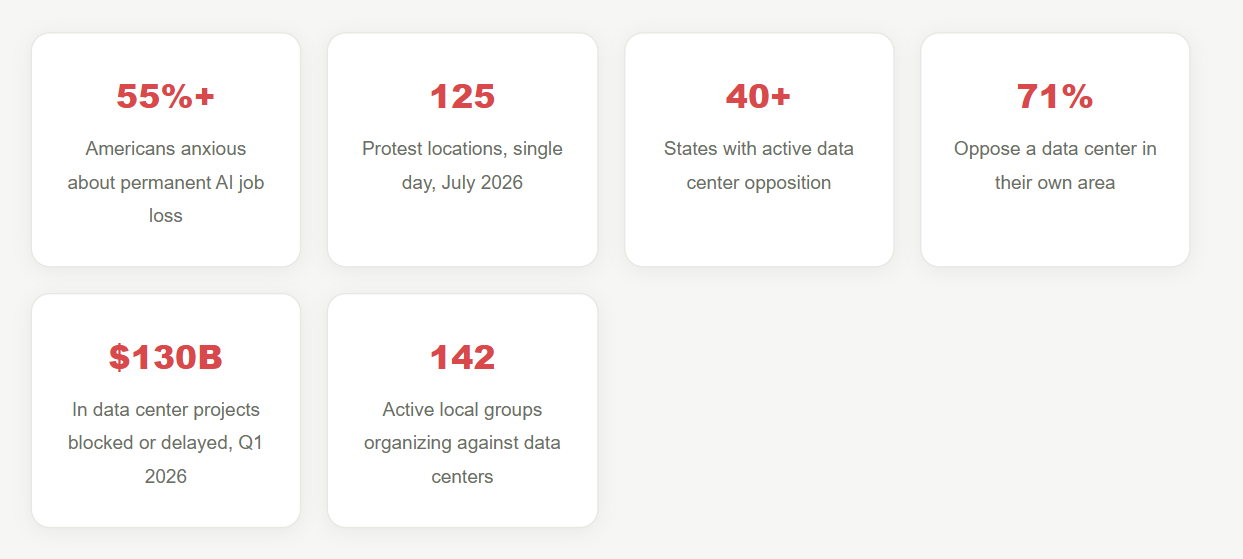
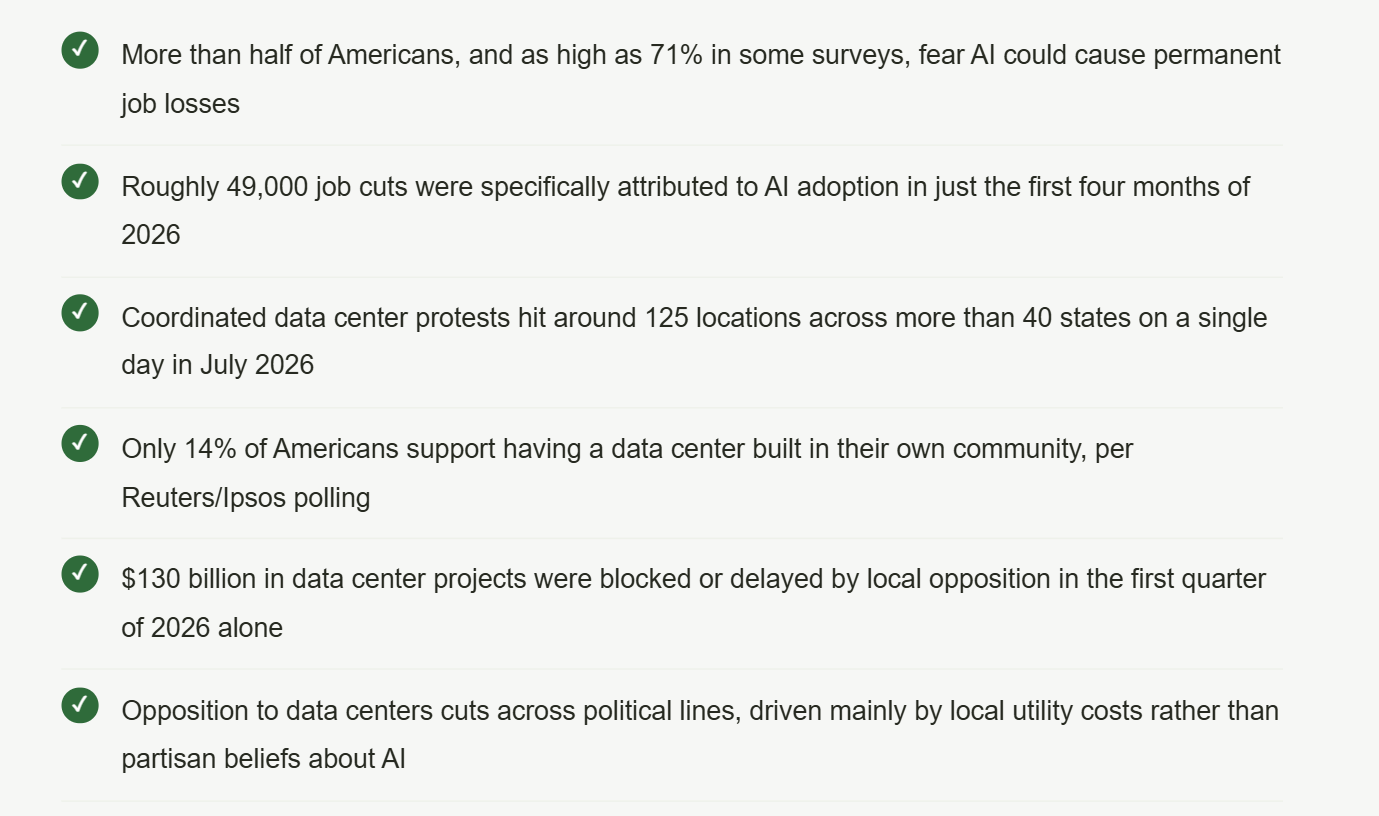
There's a weird split happening in how Americans feel about artificial intelligence right now, and once you notice it, you can't unsee it. Ask people what worries them about AI in the abstract, "will this thing take my job someday," and you get real, deep, widespread anxiety. But ask people what's actually gotten them fired up enough to show up at a town hall meeting or stand outside with a sign, and it's rarely the robots themselves. It's the giant windowless building going up down the street, sucking up the power grid and the water table before anyone in the neighborhood even got a real say in it. Two different fears, same root cause, and this year they finally started colliding in public. Let's Talk About the Job Fear First, Because It's Not Small The numbers on this one keep climbing, and they're honestly a little jarring once you line them up. A Reuters/Ipsos poll from June 2026 found that 53% of Americans are worried AI could put them or someone in their household out of work. Zoom out to the broader question of whether AI will cause permanent, large-scale job losses across the economy, and that number jumps even higher, with a separate Reuters/Ipsos survey putting it at 71%. An Ipsos poll released just this August found that a full two-thirds of American workers, 67%, believe AI is going to make the overall work experience worse by cutting jobs and cranking up productivity pressure on whoever's left. What's notable is how evenly spread this worry is. It's not just factory workers or truck drivers bracing for automation the way people used to picture it. The concern runs across age groups, education levels, and income brackets pretty consistently, though there is a real partisan gap worth mentioning, Democrats have reported higher anxiety than Republicans in multiple surveys, with one poll showing 61% of Democrats worried about household job loss compared to 47% of Republicans. And this isn't just anxiety floating in the air with nothing behind it. A Challenger, Gray & Christmas report tracked roughly 49,000 job cuts specifically attributed to AI adoption in just the first four months of 2026 alone, and companies like Intuit made headlines cutting 17% of their global workforce this year while explicitly pointing to AI as part of the strategic shift. Here's the thing that doesn't always make it into the headlines: this anxiety isn't really about AI as some far-off sci-fi threat anymore. It's about watching real companies make real layoff announcements this year, with AI named specifically as the reason, and realizing your own job might be next on that list. Meanwhile, a Completely Different Fight Is Breaking Out in Backyards Across the Country Here's where it gets interesting. If you'd assume the loudest AI backlash in America right now is about job loss, you'd actually be wrong. The angriest, most organized, most consistently growing protest movement tied to AI in 2026 isn't about robots taking anyone's job directly. It's about data centers, the massive server warehouses that power every AI chatbot response, every image generation, every model training run, showing up in ordinary neighborhoods with almost no warning and even less community input. On July 18, 2026, coordinated demonstrations against AI data center expansion happened at roughly 125 locations across at least 40 states in a single day, according to reporting that tracked the nationwide pushback. That wasn't a fringe event. A June 2026 Reuters/Ipsos poll found that only 14% of Americans actually support having a data center built in their own community, and a Gallup poll from March 2026 found opposition running even deeper: 71% of respondents opposed a data center being built in their area, a higher opposition rate than people reported for a nuclear power plant.

So what are people actually mad about, if it's not jobs?
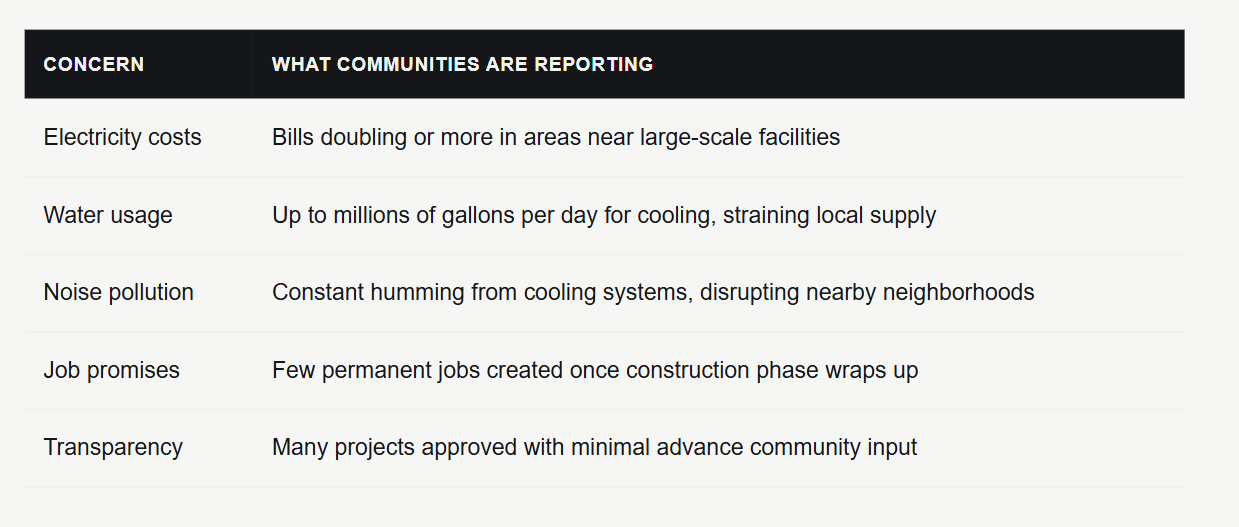
Three things, mostly, and they show up in basically every community fighting these projects regardless of whether the town leans red or blue politically: electricity bills, water usage, and noise. A single large-scale data center can pull as much power as an entire mid-sized city, and in a lot of cases, the added strain on the local grid has translated directly into higher electric bills for regular residents nearby, sometimes doubling what people were paying before. Water is the other big flashpoint, since cooling systems for these facilities can require millions of gallons a day. In El Paso, Texas, residents protested a Meta-backed data center expected to use up to 2.5 million gallons of water daily on its hottest operating days, with local advocates pointing out bluntly that the burden was going to fall on regular people's water and electric bills, not the company's.
The White House Noticed, and Tried to Get Ahead of It
This backlash got big enough that it forced an actual policy response. In March 2026, seven major tech companies signed onto a "Ratepayer Protection Pledge," a White House-brokered agreement meant to keep AI-related data center growth from directly spiking residential electricity bills. States have taken their own swings at the problem too. Oregon passed a law requiring facilities using 20 megawatts or more of power to cover their own share of grid costs, and the state's largest utility responded by hiking data center rates 30% while trimming residential bills slightly in return. Florida rolled out its own measures aimed at shielding everyday ratepayers from AI-driven energy cost increases.
Whether any of that is actually working fast enough is a fair question. Data Center Watch, a group tracking local opposition nationwide, found that $18 billion worth of data center projects were outright blocked and another $46 billion delayed over the past two years, driven almost entirely by community pushback rather than any federal policy shift. In the first quarter of 2026 alone, at least 75 separate projects worth a combined $130 billion were successfully blocked or delayed by local resistance. That's not a fringe movement losing every fight. That's a coast-to-coast pattern of ordinary residents actually winning a lot of these battles at the city council level.
This isn't a red state or blue state thing
One detail that keeps showing up in reporting on this movement is how little it splits along the usual political lines. Conservative small towns and liberal suburbs alike have organized against data center projects, and researchers studying the phenomenon have found that political affiliation and general beliefs about AI have surprisingly little to do with whether someone opposes a data center in their own backyard. What predicts opposition much better is proximity, meaning whether the facility is going up somewhere that directly affects your own utility bill or your kid's bedroom window.
Where the Two Fears Actually Overlap
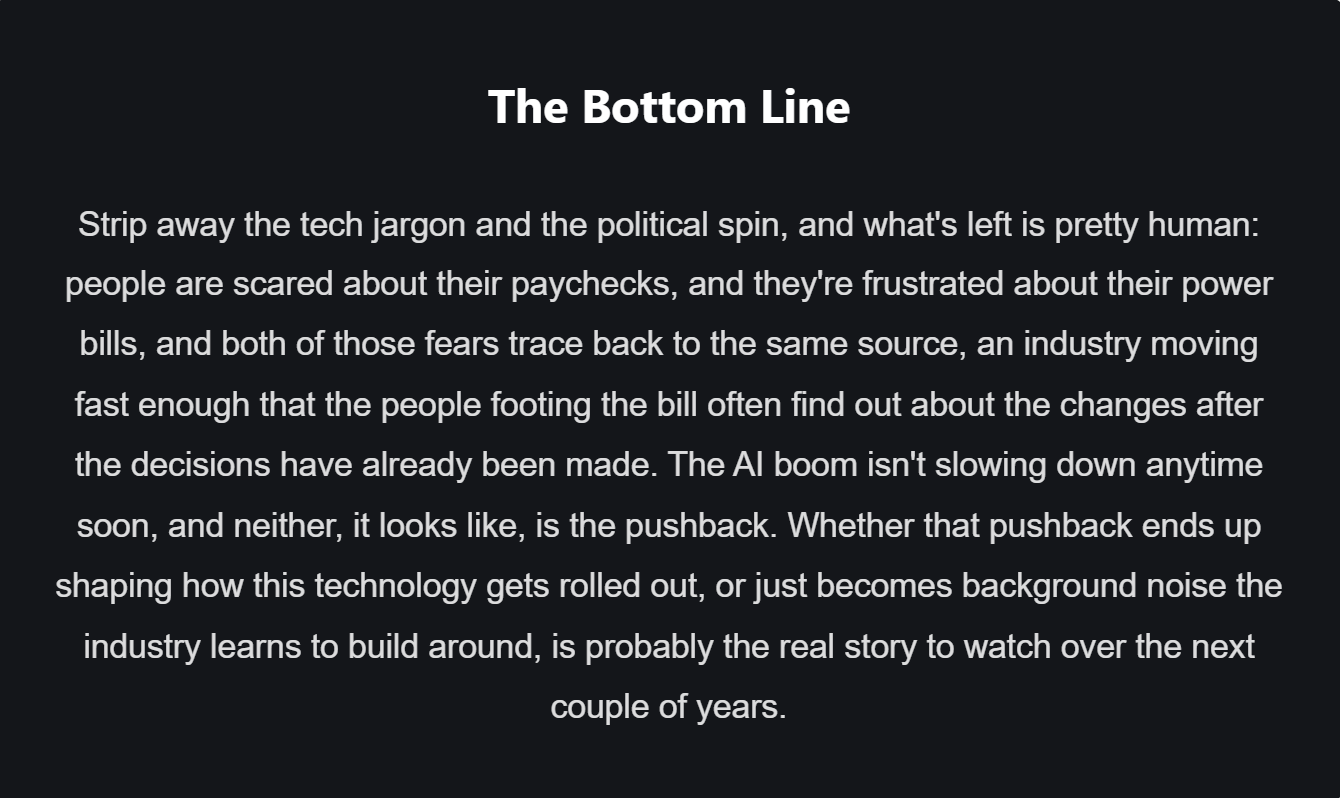
Here's the connection that ties this whole story together. The job anxiety and the data center backlash aren't really two separate stories, they're two symptoms of the same underlying feeling: that the AI boom is happening to people rather than with them. Workers didn't get a vote on whether their employer would automate part of their job away. Homeowners near a proposed data center site frequently didn't get meaningful input before permits were approved and construction crews showed up. In both cases, the people most directly affected feel like the decisions are being made somewhere else, by someone else, with the costs landing squarely on their side of the ledger.

Why Gen Z workers are feeling this especially hard
Young people entering the workforce right now are getting squeezed from a specific angle: a lot of the entry-level, repetitive tasks that used to be how new grads built up experience, drafting basic reports, doing first-pass research, handling routine customer questions, are exactly the kind of work AI tools are already handling reasonably well. That's created a genuinely tricky situation where the traditional ladder into a career has a few rungs missing right at the bottom, and it's a big part of why younger workers, alongside Gen Z specifically, keep showing up as one of the more anxious groups in workforce surveys tracking AI's impact, even though they're also often the demographic most comfortable using AI tools day to day.
What actually happens from here
Neither fight looks close to resolved. Tech companies are still racing to build out data center capacity as fast as physically possible to keep up with AI demand, which means more communities are going to be facing this exact decision, welcome the investment and jobs, or push back over the water and power costs, in the months ahead. On the employment side, companies keep signaling that AI-driven efficiency gains are part of their long-term plans, even as they publicly insist the technology will create new categories of jobs to replace the ones it eliminates. Whether that promise holds up at the scale being promised is genuinely still an open question, and it's exactly why both of these fights, the one over paychecks and the one over power bills, are likely to keep escalating together rather than separately.