 William BensonVIEW PROFILE →
Tariff Checks vs. Tax Credits: What Each Party Is Actually Promising on the Cost of Living
Both sides agree Americans are getting squeezed. Their actual plans to fix it barely resemble each other, and a Supreme Court ruling has already thrown a wrench into one of them.
Both sides agree Americans are getting squeezed. Their actual plans to fix it barely resemble each other, and a Supreme Court ruling has already thrown a wrench into one of them.
Everybody in Washington agrees on one thing right now: people are hurting at the checkout line. That's about where the agreement ends. Republicans are pitching a check in the mail funded by tariff money. Democrats are pitching a stack of legislation aimed at healthcare, housing, and groceries. Neither plan is fully passed. Neither is guaranteed to happen. And a Supreme Court ruling from earlier this year has already thrown a wrench into how one of them is even supposed to get funded. Here's the real, unspun breakdown of what each side is actually offering, and what's realistic before voters head to the polls in November.
01 The Republican Pitch: Cash in Your Pocket, Funded by Tariffs
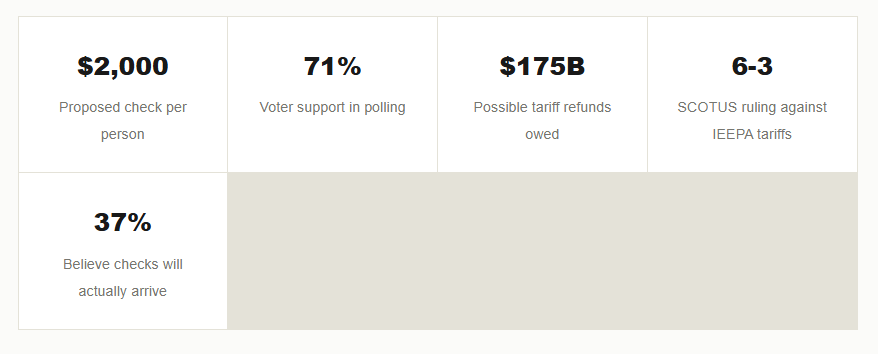
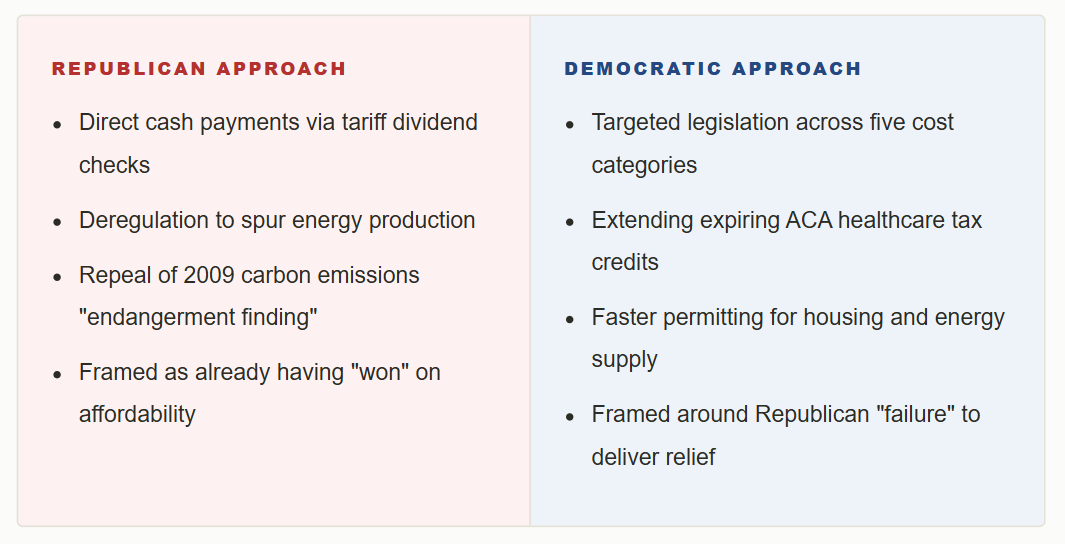
The headline idea from the GOP side is about as simple as political messaging gets: a $2,000 check, sent directly to most Americans, paid for with revenue the government has collected from tariffs on imported goods. President Trump first floated the number on social media, framing it as a "dividend" to middle- and lower-income households while remaining tariff revenue goes toward paying down the national debt. Speaking to reporters aboard Air Force One, he confirmed the plan was still very much alive heading into 2026, telling reporters plainly, "It will be next year," when asked about timing.
The idea is genuinely popular on paper. A Napolitan News Service poll found 71% of registered voters supported the concept of tariff dividend checks, including 88% of Republicans and a surprising 56% of Democrats crossing over to back it. Even higher earners, those making over $150,000 a year, backed the idea at 69%. But popularity and feasibility are two very different things, and this is where the plan runs into real trouble.
The Legal Wrinkle Nobody Saw Coming
Here's the part that's largely gotten buried under the political back-and-forth: the entire funding mechanism behind the original tariff check idea took a direct hit in February 2026. The Supreme Court ruled 6-3 in Learning Resources, Inc. v. Trump that the International Emergency Economic Powers Act, the legal authority Trump had used to impose most of his sweeping tariffs, does not actually give the president the power to set tariffs unilaterally. Chief Justice John Roberts, writing for the majority, held flatly that the power to impose tariffs belongs to Congress alone.
The practical fallout was immediate. Customs and Border Protection stopped collecting IEEPA-based tariffs at midnight on February 24, 2026, and the ruling opened the door to what the Penn Wharton Budget Model estimated could be up to $175 billion in refunds owed to importers who'd already paid those tariffs. Since IEEPA tariffs had been the single largest source of the very revenue Trump wanted to hand back to voters as dividend checks, the ruling didn't kill the idea outright, the administration has pivoted toward other tariff authorities like Section 232 and Section 301, which Treasury Secretary Scott Bessent says can keep total tariff revenue roughly stable, but it did complicate the math considerably and add a genuine layer of legal uncertainty to a plan that was already facing skepticism from fiscal conservatives in Trump's own party.
The Backup Plan in Congress
While the White House's version stays tangled in legal and fiscal uncertainty, Senator Josh Hawley of Missouri has introduced his own legislative version, a $600 tariff rebate per person, including dependent children, which would work out to $2,400 for a family of four. It's a scaled-down number, but it comes with something the president's proposal doesn't currently have: an actual bill sitting in Congress. House Majority Leader Steve Scalise has also floated the idea of a fourth budget reconciliation package built around additional tax cuts, part of a broader, and reportedly not fully unified, Republican effort to show voters some kind of economic win before Election Day.
02 The Democratic Pitch: A Long List of Targeted Fixes
Democrats have taken a structurally different approach, less about a single headline check and more about a bundle of policies aimed at specific cost categories. The Congressional Progressive Caucus released its own New Affordability Agenda in April 2026, targeting healthcare, groceries, utilities, housing, childcare, and gas prices, with an explicit framing around taking on what the caucus called "wealthy special interests and corrupt billionaires."
The New Democrat Coalition, a more centrist bloc within the party, rolled out a parallel version in February 2026, also organized around five core cost categories: healthcare, housing, energy, family care, and household essentials. Multiple individual House members, from Illinois's Nikki Budzinski to Ohio's Emilia Sykes, released near-identical district-level versions of the plan the same week, suggesting a coordinated national messaging push rather than a single unified bill. On healthcare specifically, the party has centered its pitch on extending Affordable Care Act tax credits that are otherwise set to expire, alongside new protections against surprise medical bills and aggressive medical debt collection.
The Housing Angle Both Sides Are Circling
One area where the two parties' plans genuinely overlap, even if they'd never phrase it that way, is housing supply. The Democratic blueprint pushes for lighter permitting rules to get homes built faster and calls for a national strategy on data centers so their electricity costs don't fall disproportionately on nearby residents. Meanwhile, a separate ten-point conservative affordability plan, released by the group Advancing American Freedom and led by former Vice President Mike Pence, also leans heavily on cutting local zoning restrictions, going as far as recommending that roughly $50 billion in annual federal housing assistance be tied directly to zoning reform. Notably, that same conservative plan broke with Trump specifically on tariffs, arguing they contribute to the affordability problem rather than solve it, a rare public crack in Republican messaging on the issue.
An Unusual Bipartisan Wildcard
The Problem Solvers Caucus, an evenly split group of Republicans and Democrats in the House, released its own bipartisan Affordability Agenda in February 2026, opening with a rare admission for a Washington document: "Both parties played a role in creating this crisis, and both parties will need to be part of the solution." It's a framing neither party's leadership has fully embraced on the campaign trail, where blame tends to be a much more useful tool than shared responsibility.
with control of Congress hanging on a razor-thin margin, both parties are treating their affordability messaging as central to the November outcome.
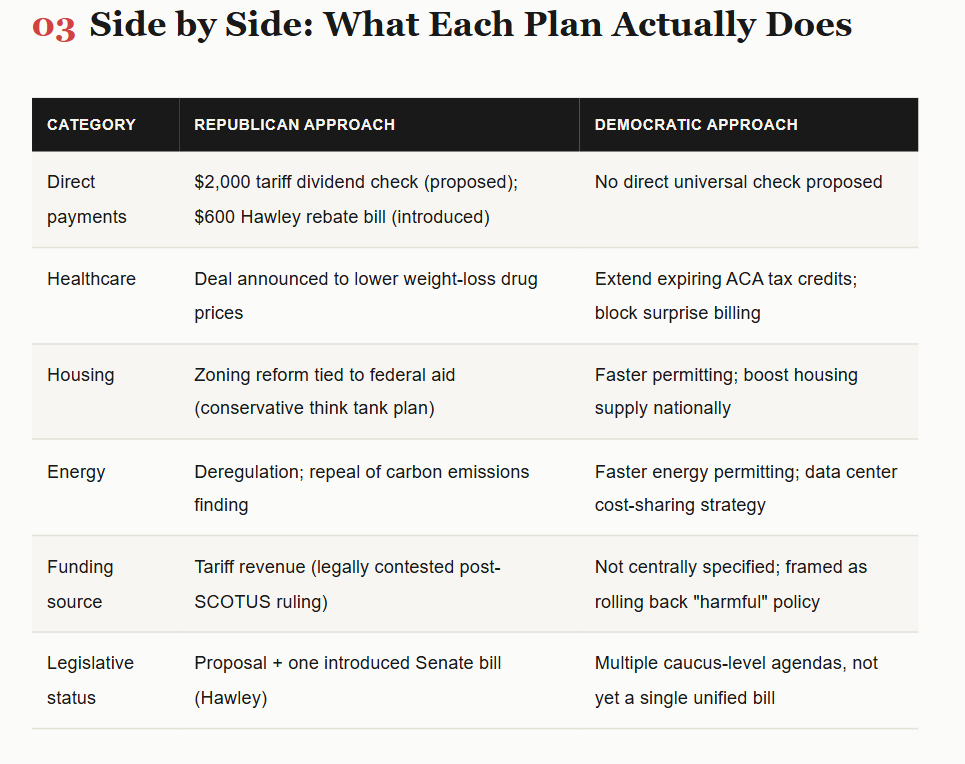
04 Why Neither Plan Is Likely to Land Before November
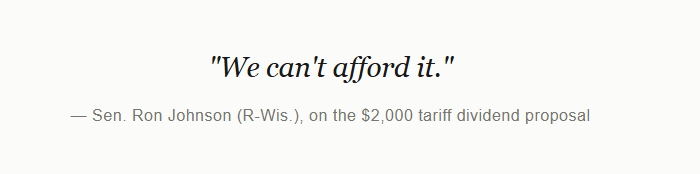
This is the part that tends to get lost in campaign season enthusiasm: realistically, almost none of this becomes a check in your mailbox or a bill's ink on paper before Election Day. The Republican tariff dividend plan still needs Congress to pass authorizing legislation, an uncertain proposition even within the GOP's own ranks given Senator Johnson's public opposition and the broader fiscal hawk resistance to a plan PBS News reported would cost a minimum of $300 billion if structured like the COVID-era stimulus checks. Layer on the post-SCOTUS funding uncertainty, and "next year sometime," Trump's own phrase for the timeline, looks optimistic even by Washingto
n standards.
The Democratic agenda faces a different kind of ceiling. With Republicans holding a narrow but real majority in both chambers, most of the party's affordability legislation has no realistic path to a floor vote, let alone the president's desk, before voters cast ballots. What both parties are really doing right now is less "passing relief" and more "auditioning a message," using their competing plans as evidence for why voters should trust them with a bigger governing majority after November, rather than as policy that's actually going to hit anyone's bank account beforehand.
What Could Realist
ically Move First
If anything shows up before the midterms, it's more likely to be smaller and narrower than either party's headline pitch. The White House's Ratepayer Protection Pledge, where seven major tech companies agreed to shield residential electricity customers from AI-driven cost increases, is already signed and in motion. State-level action, like Oregon's law forcing large power users to cover their own grid costs, is moving faster than anything in Washington simply because state legislatures don't face the same gridlock. And the ACA tax credit extension Democrats are pushing has enough bipartisan sympathy in a handful of swing districts that some version of it, likely scaled back, has a real shot at attracting Republican votes if leadership lets it reach the floor at all.