William BensonVIEW PROFILE →
Man Found Dead in Spanaway Shed, Then a Fire at the Same Property , What Investigators Know Far
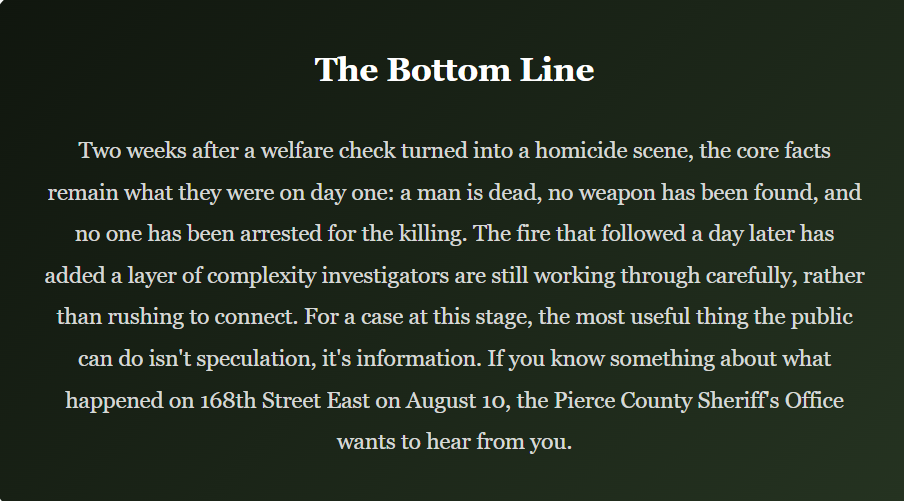
Two weeks later, no arrest has been made in the killing, and detectives are still asking the public for help.
Two weeks later, no arrest has been made in the killing, and detectives are still asking the public for help.
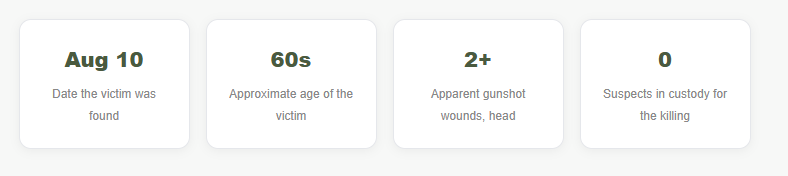
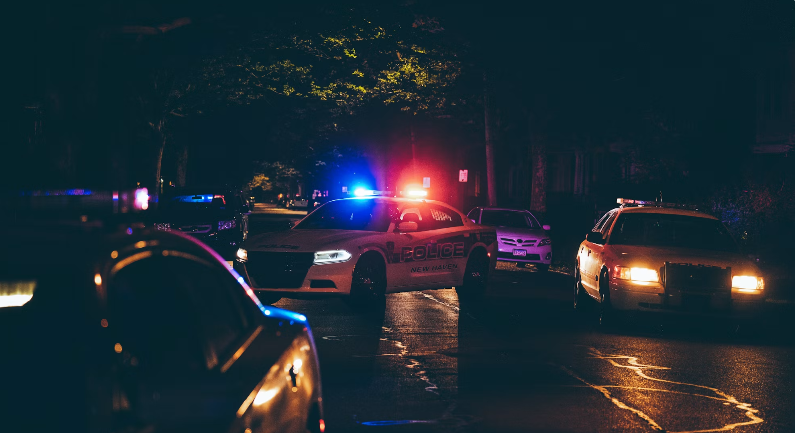
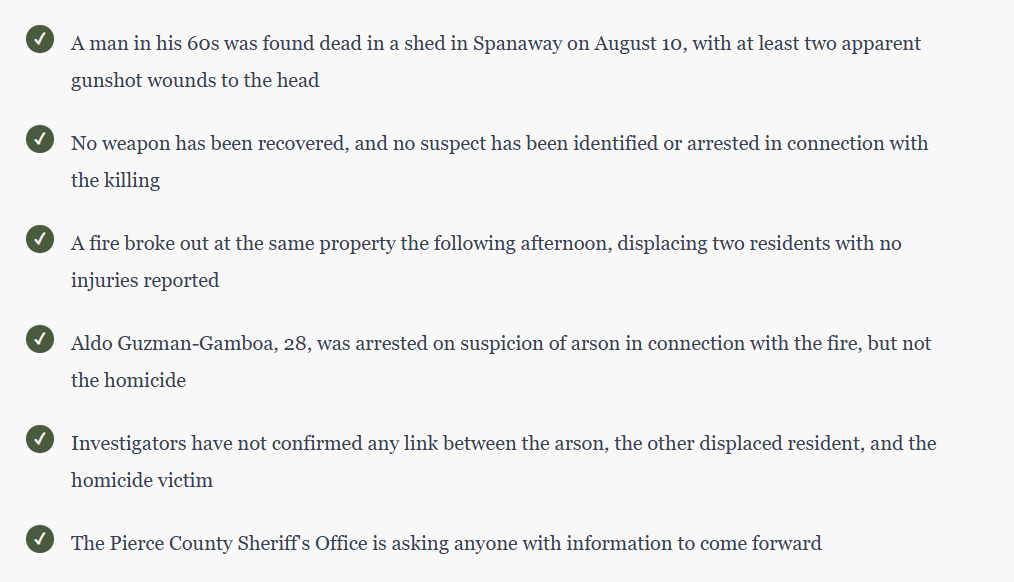
It started, as these calls often do, with a request that sounded routine: a welfare check, the kind of call a dispatcher logs dozens of times a week when someone hasn't heard from a neighbor, a relative, a friend. On the afternoon of Monday, August 10, deputies with the Pierce County Sheriff's Office responded to a home in the 1700 block of 168th Street East in Spanaway, near Spanaway High School, to check on a man who lived in a shed behind the property. What they found instead turned a routine call into a homicide investigation that, two weeks later, still doesn't have a clear resolution. The details that have emerged since are limited, deliberately so, in the way that active homicide investigations tend to stay close to the vest in their early weeks. But what has been confirmed by the sheriff's office paints a picture worth laying out clearly, both for a community trying to make sense of what happened and for anyone who might hold a piece of information investigators haven't found yet. What deputies found According to the Pierce County Sheriff's Office, deputies arrived at the property around 4:30 p.m. and located the victim, a man in his 60s, on the floor of a shed on the property. He had what investigators described as at least two apparent gunshot wounds to the head. No weapon was found at the scene, and as of the most recent public updates, no suspect has been taken into custody.
Detective Josh Mills of the Pierce County Sheriff's Office spoke with reporters in the investigation's early hours, and his comments reflect exactly where a case like this typically stands before any single piece of evidence has pointed decisively in one direction. "We haven't singled anyone out," Mills said. "We haven't ruled anyone out either. We're at the point where we're compiling the information we have and determining how to work from there."
"We haven't singled anyone out. We haven't ruled anyone out either. We're at the point where we're compiling the information we have and determining how to work from there."
— Detective Josh Mills, Pierce County Sheriff's Office
A fire, the very next day
Just over 24 hours after the shed discovery, while the property was still an active investigation site, a second incident unfolded that has since become part of the same case file. Central Pierce Fire & Rescue crews were dispatched around 3 p.m. Tuesday to a reported structure fire at the same address. According to fire officials, two people who lived at the home, though did not own it, were displaced. No injuries were reported, and firefighters were able to extinguish the blaze; notably, the shed where the victim was found does not appear to have sustained damage.
Pierce County deputies, already on scene for the homicide investigation, assisted as the fire was addressed. A 28-year-old man identified as Aldo Guzman-Gamboa, who lived at the home, was arrested around 5:30 p.m. that evening on suspicion of arson, after deputies reported finding two torches, gas cans, and a lighter on the property. According to reporting on the case, the fire broke out just hours after investigators had wrapped up their initial search of the scene for evidence connected to the homicide.
An important distinction
Guzman-Gamboa has been charged with arson, not with the killing. Investigators have not publicly stated whether they believe he is connected to the homicide itself, and as of the most recent reporting, they were still working to determine whether any relationship exists between the arson suspect, the property's other displaced resident, and the man found dead in the shed.
Why investigators are treating the timing carefully
It's natural, when two serious incidents happen at the same address within a day of each other, to assume they must be connected. Investigators, for their part, have been notably measured about drawing that line publicly, and that caution is worth taking seriously rather than reading as evasiveness. A fire that follows a homicide investigation by less than a day could reflect a deliberate attempt to destroy evidence connected to the killing. It could just as easily be an entirely separate incident, coincidental in timing but unrelated in cause, something that happens more often than true-crime narratives tend to suggest.
What can be said with more confidence is the sequence of events: the body was discovered Monday afternoon, detectives and forensic teams processed the shed and surrounding property, and by Tuesday afternoon, hours after that initial search concluded, flames broke out in the house on the same lot. That sequence alone is why the fire has become part of the same investigative file, even without a confirmed causal link.

Living in a shed, and what that detail tells us
One detail in this case that's easy to skip past, but worth sitting with, is that the victim reportedly lived in the shed behind the main house, not inside it. Backyard structures repurposed as informal living spaces have become an increasingly visible feature of housing arrangements across parts of Washington and much of the country, driven by tight rental markets, high housing costs, and, in many cases, informal arrangements between property owners and tenants that fall outside standard leases. It's a detail that speaks less to anything specific about this case and more to a broader, quieter housing reality many communities are navigating, one where victims of violence, when it does occur, aren't always living in circumstances that fit a tidy picture.
What a "no suspect identified" case actually looks like from the inside
For anyone unfamiliar with how homicide investigations actually unfold, the absence of a named suspect two weeks after a killing can read as a lack of progress. In practice, it usually reflects the opposite: a deliberate, methodical process of ruling things out before ruling anything in. Detectives typically spend the early weeks of a case building a full picture of the victim's relationships, recent movements, and any potential conflicts, alongside forensic analysis that, particularly for ballistic and trace evidence, can take considerably longer to process than television procedurals suggest.
Detective Mills' own framing, that investigators are "compiling the information" rather than pursuing a single clear lead, reflects a case still in its evidence-gathering phase rather than one that's stalled. That distinction matters for how the public should understand updates, or the current absence of them, in the weeks ahead.
If you have information
253-798-7530
Pierce County Sheriff's Office — tips can also be submitted anonymously through Crime Stoppers of Puget Sound.
This article reflects information confirmed by the Pierce County Sheriff's Office and Central Pierce Fire & Rescue as of the time of writing. The Sheriff's Office has not publicly released the victim's identity, and the homicide investigation remains open. Details may be updated as the investigation progresses.
What typically happens from here
Cases like this one tend to move forward through a combination of forensic follow-through and public tips, often in roughly equal measure. Ballistic evidence, when a weapon isn't recovered at the scene, can sometimes be matched to a firearm later if one is found in connection with another investigation or a search elsewhere. Digital evidence, including phone records and any surveillance footage from the surrounding area, frequently plays a role in establishing a timeline of who was near the property in the hours before deputies were called.
Public tips remain one of the most consistently valuable tools in cases without an early, obvious suspect, particularly in a community setting like Spanaway, where neighbors, coworkers, or acquaintances of either the victim or others connected to the property may hold details that never make it into an official report unless someone comes forward. The Sheriff's Office's continued public appeal for information, even weeks into the investigation, reflects a genuine and ongoing effort to solve the case rather than a case that has quietly gone cold.