 William BensonVIEW PROFILE →
Mark Zuckerberg's New Innovation Isn't a Headset. It's a Pair of Glasses That Never Stops Listening.
For years, the joke about Mark Zuckerberg was simple: he burned tens of billions of dollars trying to convince the world to strap on a headset and live in a cartoon. That joke doesn't quite land anymore. Meta's latest move away from the metaverse and toward what Zuckerberg calls "personal superintelligence" is smaller, stranger, and — depending on who you ask — either the smartest pivot in Silicon Valley or the same old bet wearing a new pair of frames.
The Announcement That Actually Matters
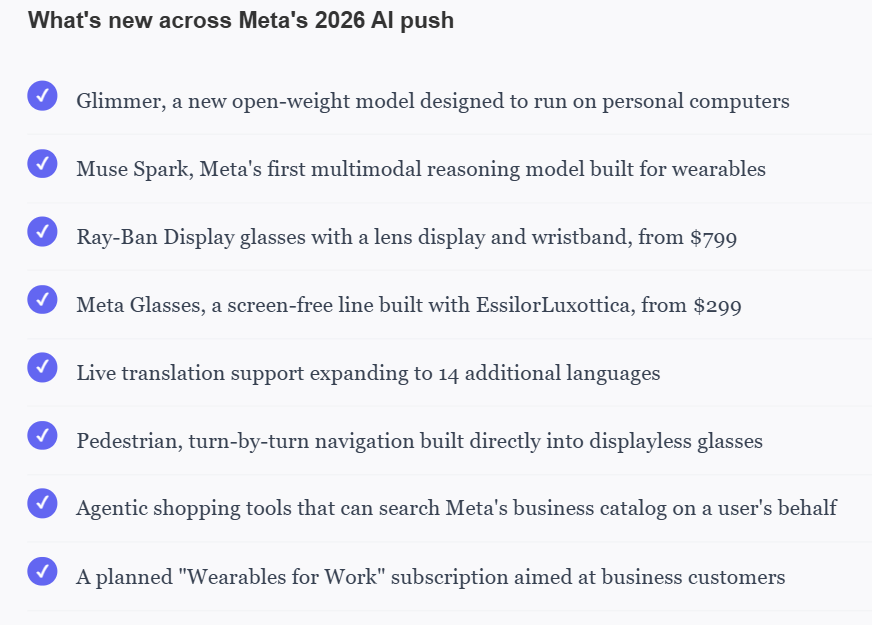
In the second week of August 2026, Zuckerberg published a lengthy open letter laying out how he sees artificial intelligence reshaping daily life, and Meta backed it up with something more concrete than a manifesto: a new open-weight AI model called Glimmer, built to run on personal computers instead of leaning entirely on distant data centers. It's a deliberate contrast with rivals who keep their most capable models locked behind an API, and it says a lot about the argument Zuckerberg is trying to win.
That argument, in plain terms, is this: rather than one enormous AI system serving everyone from a central tower, Zuckerberg wants millions of individually tuned AI agents, each one accountable to the single person who owns it. He frames open access as the safeguard — if everyone has a capable AI in their corner, no single company or government gets to hold all the leverage. It's a philosophy as much as a product plan, and it shapes almost everything else Meta has shipped this year.
Forget the Metaverse — Glasses Are the Real Bet Now
Reality Labs, the division built to chase Zuckerberg's original metaverse dream, is still losing billions of dollars a quarter. But the money is being pointed in a different direction than it was two years ago. Instead of headsets and digital avatars, Meta is now pouring its resources into glasses — plain, wearable, unglamorous glasses that happen to carry a camera, a speaker, and a constantly available AI assistant.
The clearest evidence of that shift arrived with the Ray-Ban Display glasses, priced from $799 and sold with a wristband controller that reads subtle finger movements so a person can answer a text or dismiss a notification without touching a phone. A small display tucked into the right lens handles basic tasks. It's not augmented reality in the flashy, holographic sense Meta once promised with its Orion prototype — it's something far more modest, and arguably far more shippable.
Below that sits a cheaper line simply called Meta Glasses, starting at $299, built in partnership with Ray-Ban's parent company EssilorLuxottica and stripped of any screen at all. They lean entirely on voice and the camera, running on a new in-house multimodal model called Muse Spark. Between the two product lines, Meta is now betting that glasses — not phones — become the place where its AI actually lives.
What "Personal Superintelligence" Actually Means
Strip away the branding and the idea is fairly easy to follow. Most AI labs are racing toward a single, extremely capable system meant to serve everyone — a kind of shared digital brain. Zuckerberg's pitch runs in the opposite direction: instead of one system for the whole world, everyone gets their own model, one that knows their inbox, their calendar, their conversations, and their history well enough to act like a genuinely useful personal aide rather than a generic chatbot.
Meta has an obvious advantage here that OpenAI and Google don't share to the same degree: it already sits inside the daily habits of billions of people through Facebook, Instagram, WhatsApp, and Messenger. Zuckerberg's bet is that this context — years of photos, messages, and social connections — lets Meta's AI feel personal in a way a blank chat window never can.
The pitch Zuckerberg keeps returning to is that widely distributed AI, in the hands of individuals rather than concentrated in one lab, is safer in the long run than a single all-powerful system nobody outside a boardroom can see inside.
Whether that reasoning holds up is genuinely contested. Critics point out that "everyone gets their own AI" still means Meta's models sitting between people and their most private information, built by a company with a long history of monetizing exactly that kind of data. Zuckerberg's answer is that open weights make the system inspectable rather than a black box — though inspectable and trustworthy aren't automatically the same thing, and reasonable people land in different places on this one.
The Silicon and the Billions Behind the Curtain
None of this works without an enormous amount of physical infrastructure, and that's where the real money is going. Meta's 2026 capital budget of roughly $145 billion is overwhelmingly earmarked for data centers, and the company has said it plans to build its own energy infrastructure in the areas where those centers go up, partly to keep local electricity prices from spiking.
That last detail matters more than it might sound. Data center construction has become genuinely controversial in 2026, with one research firm estimating that around $130 billion worth of planned data center projects were blocked or delayed in just the first quarter of the year because of local pushback over water use, noise, and power costs. Meta is trying to get ahead of that resistance rather than get caught in it.

Meta, Apple, Google, and OpenAI Are Fighting Different Wars
It's worth stepping back to see how strange Meta's position actually is. Apple still treats hardware as sacred and is only now rumored to be exploring smart glasses of its own. Google has leaned on its search and Android dominance to push Gemini into phones, including its recently unveiled Pixel lineup. OpenAI, for its part, is chasing the assistant-everywhere model through partnerships and its own hardware ambitions rather than owning a wearable category outright.
Meta is the only one of the four treating glasses as the primary battlefield rather than a side project, and analysts who cover the wearables market have started to take that seriously — even while noting Reality Labs' financial pain hasn't disappeared. One industry analyst summed up the stakes bluntly, framing the glasses push as Meta's attempt to build a hardware platform of its own instead of remaining a guest on Apple's and Google's phones forever.
Whether that framing survives contact with actual sales numbers is the open question. Meta and EssilorLuxottica together already control a large majority of the small but growing smart glasses market, so Meta isn't starting from zero. It's starting from a lead nobody else in the AI race currently has in wearable hardware.
The Money Problem Nobody at Meta Is Pretending Doesn't Exist
Reality Labs posted a loss of roughly $4.5 billion in a single recent quarter, on revenue of only a few hundred million dollars. That gap hasn't closed, and Zuckerberg hasn't claimed it will close quickly. What he has said is that spending on the metaverse-era VR ambitions is being scaled back relative to spending on glasses and wearables, and that this year likely marks the peak of Reality Labs' losses before they start to gradually shrink.
That's a notable change in tone from a company that spent the better part of five years insisting the metaverse was the inevitable next computing platform. It's not an admission of failure exactly, but it's close to one — a quiet redirection of billions of dollars away from an idea that never caught on with ordinary users and toward a device category that already has.
A Few Honest Questions People Are Actually Asking
Do I need a Meta or Facebook account for any of this to work? Largely, yes. The personalization Zuckerberg keeps promoting depends on the AI having access to a person's messages, photos, and social graph. Use the glasses with a bare-bones account and you get a decent camera and a voice assistant — useful, but not the transformative experience Meta is selling.
Is Glimmer actually competitive with the biggest closed models out there? On raw benchmarks, probably not yet. Meta isn't positioning Glimmer as a frontier model that beats everything else — it's positioned as a practical, efficient model that developers and hobbyists can run locally, which is a different kind of competition than topping a leaderboard.
Should I actually buy a pair of these glasses right now? If you're already deep in Meta's apps and curious about hands-free AI, the $299 line is a low-risk way to try the idea. If you're waiting to see whether glasses genuinely replace phones the way Zuckerberg predicts, that's still a multi-year bet, not a this-year certainty.
So, Does Any of This Actually Matter to You?
Here's the honest read. If you already live inside Instagram, WhatsApp, or Messenger for hours a day, Meta's glasses and its personal AI push are genuinely worth watching — the company has more daily attention to build on than almost anyone else attempting this. The features aren't gimmicks on paper; hands-free translation, navigation, and reminders that understand your actual context are useful in ways a generic chatbot isn't.
If you're skeptical of handing a company with Meta's data history even more intimate access to your daily life, that skepticism is reasonable and won't be resolved by a keynote. Zuckerberg is betting that usefulness eventually wins out over hesitation. Whether that bet pays off the way the smartphone did, or fades the way the metaverse push did, is genuinely still unwritten.
Before you take any of this as final Some of the roadmap above — the "Wearables for Work" subscription, the pace of the Glimmer rollout, additional glasses models — is still based on reporting, internal memos, and public comments rather than a single confirmed keynote. Meta has a habit of adjusting timelines, so treat anything not yet shipped as a direction of travel rather than a locked promise.
The Bottom Line
Mark Zuckerberg's newest innovation isn't a single flashy device — it's a wager that the next computing platform sits on someone's face rather than in their pocket, powered by AI that's personal rather than universal. The metaverse taught Meta an expensive lesson about building something the world wasn't asking for. Glasses, Muse Spark, and the open-weight Glimmer model are Zuckerberg's answer to that lesson: smaller promises, cheaper entry points, and a product people already understand how to wear. Whether "personal superintelligence" becomes as ordinary as a smartphone or joins the metaverse as an expensive detour is a question only the next year or two of actual sales — not another keynote — will answer.